
Quartz vs Glass Cuvette: Complete Comparison for Spectroscopists
This post is also available in:
The quartz-vs-glass cuvette decision is primarily a wavelength question: quartz transmits 185–3,500 nm and is mandatory for any measurement below 320 nm (the UV cutoff of optical glass); optical glass transmits 350–2,000 nm and is cheaper for visible-only work. A secondary factor is chemical compatibility — quartz handles concentrated acids and 1,000 °C+ thermal shock while glass is limited to neutral aqueous and ≤ 500 °C. For most UV-Vis labs, quartz is the default and glass is reserved for visible-spectrum cost optimization.
Quartz vs Glass Cuvette: Complete Comparison for Spectroscopists
On this page
MachinedQuartz · Comparison Guide
Quartz vs Glass Cuvette: The Complete Comparison for Spectroscopists
UV transmission, fluorescence, chemical resistance, cost, and lifetime value — every factor you need to choose the right cuvette before you order.
13 sections
6 comparison tables
5-step decision guide
6 FAQ answers
Table of Contents
- Quick answer: which should you choose?
- Key differences at a glance
- Wavelength range and UV transmission
- Quartz grades: JGS1, JGS2, and JGS3
- Fluorescence spectroscopy considerations
- Chemical compatibility
- Cost and lifetime value
- How to tell quartz from glass
- Decision guide by application
- Cleaning and maintenance
- Spectroscopy applications guide
- Custom quartz cuvettes
- Frequently asked questions
Section 1
Quick Answer: Which Should You Choose?
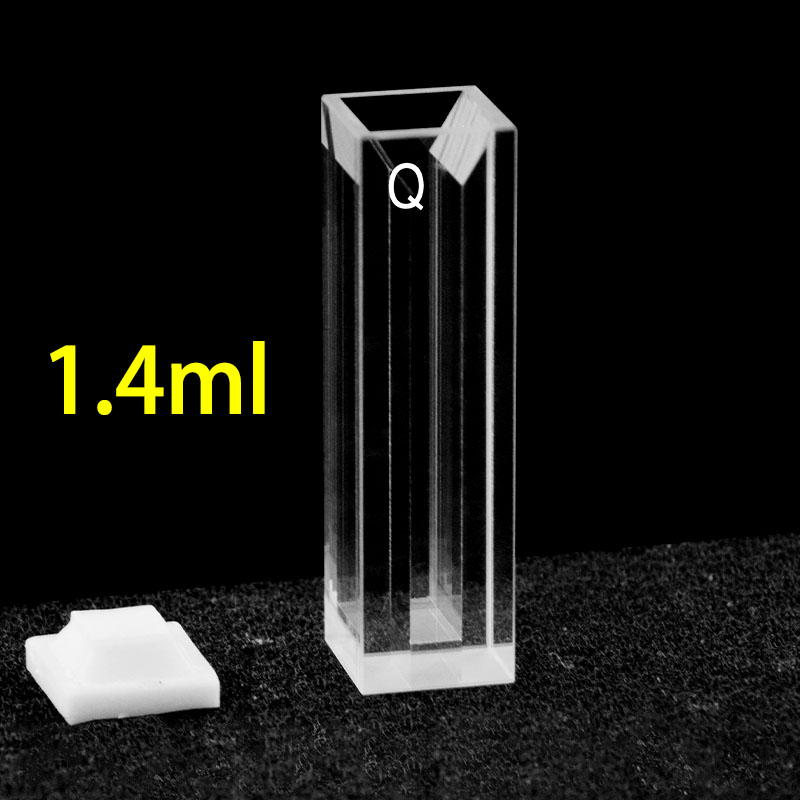
Standard quartz · 10 mm · UV-Vis
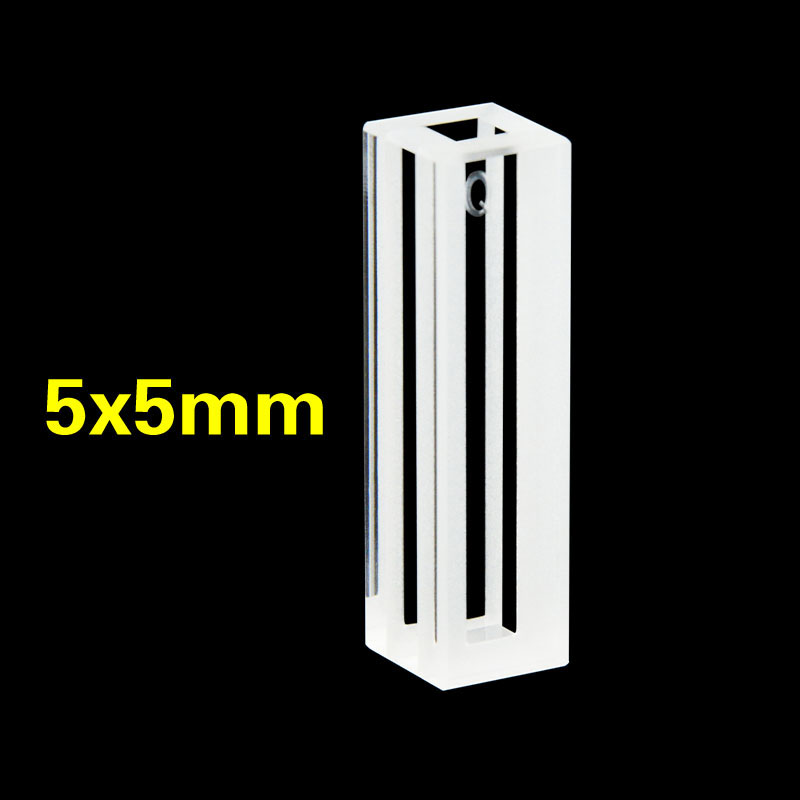
4-window quartz · fluorescence · JGS1
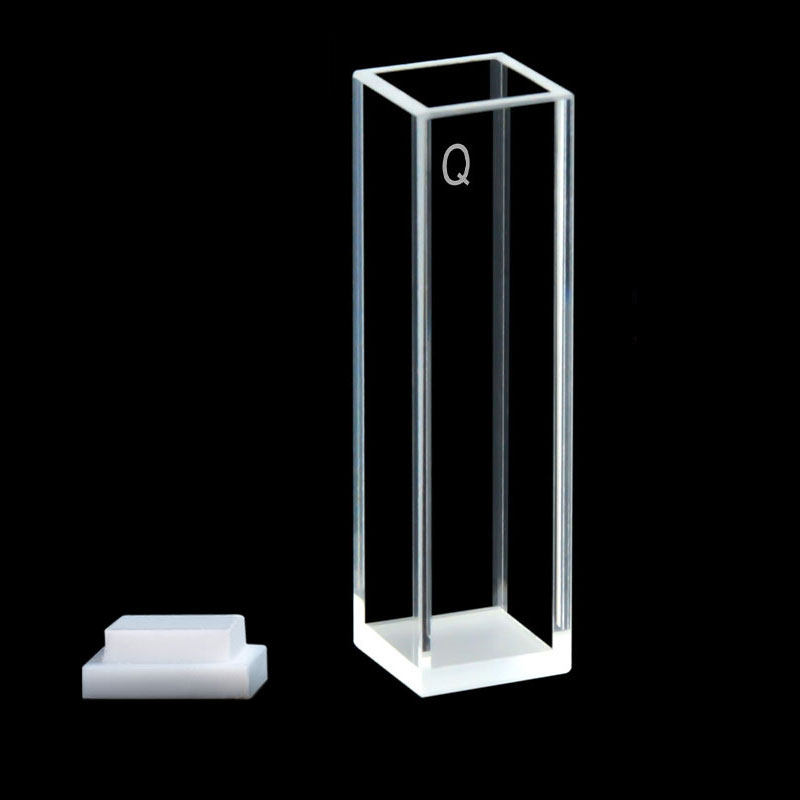
Quartz with stopper · UV-Vis · sealed
A quartz cuvette is a precision optical cell made from high-purity fused silica (SiO₂), transmitting light from 185 nm to 3500 nm depending on grade. A glass cuvette is made from borosilicate glass, limited to wavelengths above approximately 320–340 nm. The core difference is UV transmission: quartz passes UV light that glass absorbs completely.
The short answer: Choose quartz if your measurement goes below 340 nm, if you need fluorescence with minimal background (see the fluorescence cuvette guide for autofluorescence numbers), or if you are working with aggressive solvents. Choose glass if you are doing routine visible-range colorimetry (400–900 nm) and want to keep costs down. For everything else, quartz is worth the premium — it lasts longer, tolerates more, and never limits your measurement range.
The right answer depends on your specific wavelengths, samples, and cleaning protocols. The sections below walk through each factor in detail.
Section 2
Key Differences at a Glance
Quartz and glass cuvettes differ most significantly in UV transmission range and optical quality — two factors that directly determine which material is appropriate for your measurement wavelength and application sensitivity.
| Property | Quartz (Fused Silica) | Optical Glass | Winner |
|---|---|---|---|
| UV transmission | From 185 nm (JGS1) or 220 nm (JGS2) | Cutoff at ~320–340 nm | Quartz |
| Visible transmission | Full 400–700 nm range | Full 400–700 nm range | Tie |
| NIR transmission | Up to ~2500–4500 nm | Up to ~2000–2500 nm | Quartz |
| Autofluorescence | Very low — ideal for sensitive fluorescence | Moderate — can mask weak signals | Quartz |
| Chemical resistance | Excellent (except HF) | Moderate — degrades with strong acids/bases | Quartz |
| Thermal tolerance | Up to ~1650°C; very low CTE | Softens at ~600–700°C | Quartz |
| Scratch hardness | Mohs ~7; harder surface | Mohs ~5–6; scratches more easily | Quartz |
| Optical quality | Face flatness ±0.01–0.05 mm standard | Less consistent in mass production | Quartz |
| Refractive index | ~1.46 at 589 nm | ~1.52 at 589 nm (varies) | Application-dependent |
| Unit cost | $30–$150+ per standard cuvette | $5–$30 per standard cuvette | Glass |
| Lifespan (with care) | 5–10+ years | 1–3 years | Quartz |
| Best for | UV-Vis, fluorescence, high-precision, harsh solvents | Routine visible colorimetry, teaching labs | — |
Section 3
Wavelength Range and UV Transmission
The single most important difference between quartz and glass cuvettes is where they transmit light. According to ASTM E275 (Standard Practice for UV-Vis Spectrophotometry), cuvette material must be transparent at the measurement wavelength — a standard requirement in regulated laboratory environments. Glass absorbs UV below ~320–340 nm; quartz transmits from 185 nm.
This matters for several common assays:
- DNA/RNA quantification at 260 nm — requires UV-grade quartz. Glass renders the measurement meaningless.
- Protein absorbance at 280 nm — glass absorbs significantly even at 280 nm.
- HPLC fraction analysis at 210–220 nm — deep UV; only JGS1 quartz works reliably.
- Visible colorimetry (450–700 nm) — both materials perform equally well. Glass is a cost-effective choice here.
Optical quality note: Beyond UV cutoff, the polished face flatness and parallelism tolerances of quartz cuvettes (typically ±0.01–0.05 mm) provide more consistent optical quality than mass-produced glass cells, affecting photometric accuracy in precision work.
Practical rule: If your wavelength of interest is 340 nm or higher, glass is acceptable. Below 340 nm, you need quartz. Below 220 nm, you need deep-UV grade quartz (JGS1) specifically.
Section 4
Quartz Grades: JGS1, JGS2, and JGS3
Not all quartz is the same — and this is something competing articles rarely explain. “Quartz cuvette” covers three distinct grades of fused silica, each with a different UV cutoff, purity level, and cost. Choosing the wrong grade is as problematic as using glass when you need quartz.
JGS1
Transmission: 185–2500 nm
- Highest purity synthetic fused silica
- Deep UV down to ~185 nm
- Best for nucleic acids, far-UV protein, vacuum UV
- Equivalent to Hellma QS / Suprasil® grade
- Most expensive grade
JGS2
Transmission: 220–2500 nm
- Standard UV-grade quartz
- Covers most lab UV applications
- Protein A280, DNA A260, standard UV-Vis
- Best balance of performance and cost
- Most commonly sold as “UV quartz cuvette”
JGS3
Transmission: 260–3500+ nm
- IR-grade fused silica (low-OH)
- Superior near and mid-infrared transmission
- Used for NIR spectroscopy applications
- UV cutoff ~260 nm — not for DNA work
- Mid-range cost
Key insight: If you see a cuvette labelled “IR quartz,” it is JGS3 — excellent for NIR spectroscopy but with a UV cutoff around 260 nm, too high for reliable DNA quantification. Always confirm the grade before ordering for UV-sensitive applications.
Section 5
Fluorescence Spectroscopy Considerations
Fluorescence measurements are far more sensitive to cuvette material than simple absorbance. In fluorescence spectroscopy, the detector picks up emitted photons — any material that itself fluoresces under excitation contributes background signal that masks weak sample fluorescence.
Quartz (JGS1/JGS2)
Very low intrinsic fluorescence. Preferred for FRET assays, tryptophan fluorescence, single-molecule experiments, and any work requiring signal-to-noise below 1 nM concentrations.
Optical Glass
Moderate autofluorescence, particularly when excited in the UV range (270–400 nm). Can completely obscure low-concentration fluorophores or cellular assays. Acceptable for high-concentration samples only.
4-Window Cuvettes
For fluorescence work, use a 4-window quartz cuvette with all four faces polished. This allows both excitation and emission access from any angle — essential for standard fluorometer geometry.
Use cases requiring quartz for fluorescence: FRET assays, fluorescence polarisation and anisotropy, tryptophan fluorescence studies (~280 nm excitation), qPCR fluorescence standards, and environmental trace analysis at low concentrations.
Section 6
Chemical Compatibility
Fused silica is chemically inert against most laboratory reagents. Its Si–O–Si network resists acid attack, organic solvents, and moderate bases. The one critical exception is hydrofluoric acid (HF), which etches quartz rapidly. Glass cuvettes additionally risk ionic leaching — borosilicate glass can release boron, sodium, and trace metal ions into aqueous solutions, interfering with ICP-MS or sensitive electrochemical measurements.
| Reagent class | Quartz compatibility | Glass compatibility |
|---|---|---|
| Aqueous buffers (pH 3–10) | Excellent | Excellent |
| Strong acids (H₂SO₄, HCl, HNO₃) | Excellent | Moderate — degrades over time |
| Strong bases (NaOH >1 M) | Moderate — slow etch | Poor — significant leaching |
| Hydrofluoric acid (HF) | Incompatible | Incompatible |
| Organic solvents (acetone, DMSO, ethanol) | Excellent | Good |
| Aromatic solvents (toluene, xylene) | Excellent | Moderate |
| Chlorinated solvents (DCM, chloroform) | Excellent | Moderate |
| Concentrated phosphoric acid | Excellent | Poor |
Section 7
Cost and Lifetime Value
Quartz cuvettes cost significantly more than glass — typically 3 to 10 times more per unit. However, when evaluated on a cost-per-measurement basis over the cuvette’s lifetime, quartz often proves more economical for active laboratories.
Optical Glass Cuvette
$5 – $30
Standard 10 mm path, 3.5 mL. Low upfront cost, but lifespan typically 1–3 years with regular use. More susceptible to chipping, scratching, and chemical degradation.
Quartz (Fused Silica) Cuvette
$40 – $180
Standard 10 mm path, JGS1 grade. Higher upfront cost, but properly maintained quartz cuvettes last 5–10+ years. Better scratch resistance, chemical tolerance, and optical quality.
Looking for a specific brand alternative? See our Hellma cuvette alternative guide for a detailed cross-reference, spec comparison, and pricing vs. JGS1 quartz alternatives.
For high-volume routine visible-range work (e.g., OD600 cell density in a teaching lab), glass is perfectly reasonable. For research applications where UV range, fluorescence sensitivity, or chemical compatibility matter, quartz’s longevity makes it more cost-efficient over a multi-year horizon.
Section 8
How to Tell Quartz from Glass Without a Label
Quartz and glass cuvettes look nearly identical. If you inherit unlabelled cuvettes or receive a box without markings, here are three reliable identification methods.
Method 1: Spectrophotometer scan (most accurate)
Fill the cuvette with distilled water and run a blank scan from 190–400 nm. Read where transmission starts:
| Transmission starts at | Material |
|---|---|
| ~185 nm | JGS1 deep UV quartz |
| ~220 nm | JGS2 UV quartz |
| ~260 nm | JGS3 IR quartz |
| ~320–340 nm | Optical glass |
| >400 nm | Plastic (disposable) |
Method 2: Manufacturer markings
Quality manufacturers etch or acid-mark their cuvettes on a non-optical face. Common codes: “Q” or “UV” for quartz, “G” or “VIS” for glass, “I” or “IR” for IR quartz. MachinedQuartz etches all cuvettes with material grade on the black (non-optical) side.
Method 3: UV lamp fluorescence test
Glass fluoresces blue-white under a 254 nm shortwave UV lamp. Quartz cuvettes remain visually dark — they transmit UV rather than absorb and re-emit it. This is a quick field test but less reliable than the spectrophotometer method.
Section 9
Decision Guide: Quartz vs Glass by Application
Step-by-step selector
1
What is your measurement wavelength?
Below 340 nm — you need quartz. 340–700 nm — either material works. Above 700 nm (NIR) — quartz (JGS3 preferred).
Below 340 nm — you need quartz. 340–700 nm — either material works. Above 700 nm (NIR) — quartz (JGS3 preferred).
2
Is fluorescence sensitivity critical?
Yes — quartz only. Background fluorescence from glass will corrupt sensitive measurements. No — continue to step 3.
Yes — quartz only. Background fluorescence from glass will corrupt sensitive measurements. No — continue to step 3.
3
What solvents or reagents will you use?
Organic solvents, strong acids, or harsh buffers — quartz strongly preferred. Aqueous buffers only — glass is acceptable.
Organic solvents, strong acids, or harsh buffers — quartz strongly preferred. Aqueous buffers only — glass is acceptable.
4
How frequently will you use the cuvette?
Daily research use — quartz pays for itself over time. Occasional visible-range screening — glass is cost-effective.
Daily research use — quartz pays for itself over time. Occasional visible-range screening — glass is cost-effective.
5
Do you need a custom geometry or tight tolerance?
Yes — quartz machines to tighter tolerances more reliably than glass.
Yes — quartz machines to tighter tolerances more reliably than glass.
| Application | Recommended material | Grade / notes |
|---|---|---|
| DNA / RNA quantification (A260) | Quartz | JGS1 or JGS2; UV range essential |
| Protein quantification (A280) | Quartz | JGS2 sufficient |
| Enzyme kinetics (340–500 nm) | Quartz | Both work; quartz preferred for longevity |
| Visible colorimetry / OD600 | Glass or quartz | Glass acceptable; saves cost |
| Fluorescence spectroscopy | Quartz (4-window) | Low-fluorescence JGS1/JGS2; all 4 faces polished |
| HPLC UV fraction analysis (210 nm) | Quartz | JGS1 required for deep UV |
| NIR spectroscopy (1000–2500 nm) | Quartz | JGS3 (IR quartz) preferred |
| Organic solvent measurements | Quartz | Chemical resistance critical |
| Teaching labs / OD screening | Glass | Cost-effective for visible-range only |
| Single-use / high-throughput | Plastic disposable | See cuvette selection guide |
Section 10
Cleaning and Maintenance: Quartz vs Glass
Proper cleaning is essential to preserve optical quality and extend lifespan — especially for quartz, where a scratch on an optical face can render a $100+ cuvette unusable. The protocol differs slightly between quartz and glass due to different chemical tolerances.
1
Immediate rinse after use — fill and empty with the same solvent or distilled water three times. Never let samples dry inside; dried protein or dye residues are significantly harder to remove.
2
Routine cleaning — soak in dilute HNO₃ (5–10%) for 10–15 minutes, then rinse thoroughly with distilled water. Removes ionic contaminants and most organic residues without attacking the quartz surface.
3
Persistent organic contamination — 30-minute soak in piranha solution (H₂O₂:H₂SO₄, 1:3) removes carbonaceous residues. Use in a fume hood with appropriate PPE. Alternatively, use Hellmanex III or Decon 90 at manufacturer’s dilution.
4
Drying — blot (do not wipe) optical faces dry with lint-free optical tissue. Air-dry inverted on clean tissue. Never use paper towels — these contain abrasive particles.
5
Storage — store in a protective case away from dust. Keep quartz and glass cuvettes separated to avoid accidental use of the wrong material.
Never use HF on quartz or glass cuvettes — it etches both materials irreversibly. Avoid ultrasonic cleaners unless specifically rated for optical cells.
Glass difference: Avoid prolonged exposure to strong bases (NaOH >0.1 M). Borosilicate glass leaches under alkaline conditions, compromising both the cuvette surface and your sample via introduced boron or sodium ions.
| Cleaning agent | Quartz | Glass | Notes |
|---|---|---|---|
| Distilled water rinse | ✓ | ✓ | Always first step |
| Dilute HNO₃ (5–10%) | ✓ | ✓ | Standard routine cleaning |
| Piranha solution | ✓ | Use briefly | Fume hood required |
| NaOH >0.1 M | Short contact only | Avoid | Leaches glass; slow etch on quartz |
| HF (any concentration) | Never | Never | Etches both irreversibly |
| Hellmanex III / Decon 90 | ✓ | ✓ | Commercial cuvette cleaners |
| Acetone / IPA | ✓ | ✓ | Organic contamination |
| Abrasive wipes | Never | Never | Scratches optical faces |
Section 11
Spectroscopy Applications: Which Cuvette for Which Technique?
Different spectroscopy techniques impose different requirements on cuvette material, geometry, and optical quality. The table below maps the most common laboratory spectroscopy methods to the appropriate cuvette type.
| Spectroscopy technique | Wavelength range | Cuvette material | Special requirements |
|---|---|---|---|
| UV-Vis absorbance (DNA, protein) | 220–340 nm | Quartz JGS1/JGS2 | 2-window standard; UV grade essential |
| Visible colorimetry (Bradford, BCA, OD600) | 400–750 nm | Glass or quartz | Glass acceptable; lower cost |
| Fluorescence (EEM, emission scan) | 250–800 nm ex/em | Quartz 4-window | All 4 faces polished; low autofluorescence |
| Circular dichroism (CD) | 190–260 nm | Quartz JGS1 | Short path 0.1–1 mm; very thin walls |
| NIR spectroscopy | 700–2500 nm | Quartz JGS3 | IR-grade low-OH; standard 2-window |
| Raman spectroscopy | Visible laser + Stokes shift | Quartz | Low fluorescence background critical |
| Atomic absorption (AAS) | 190–900 nm | Quartz flow cell | Flow-through design; chemical resistance |
| HPLC UV detection | 200–400 nm | Quartz flow cell | Matched path length; solvent compatibility |
For most UV spectroscopy applications — including nucleic acid quantification (A260), protein absorbance (A280), and aromatic compound analysis — a standard JGS1 quartz cuvette with a 10 mm path length is the default choice. JGS1 is required only when measurements extend below 220 nm, as in far-UV circular dichroism or vacuum UV spectroscopy. Glass cuvettes are entirely acceptable for routine visible-range work like Bradford protein assays, cell density monitoring at 600 nm, or ELISA plate reader validation at 450–650 nm.
Section 12
When to Consider Custom Quartz Cuvettes
Standard 10 mm path length quartz cuvettes cover the majority of laboratory needs. But several scenarios call for non-standard configurations — and this is where quartz’s machinability advantage over glass becomes significant.
Non-standard path length
You need precise volume control — sub-microliter micro cuvettes (0.1–1 mm path), or long 50–100 mm path cells for trace concentration analysis.
Tight optical tolerances
Research requiring path length accuracy better than ±0.05 mm. Quartz can be fabricated to ±0.01 mm tolerance reliably — glass is harder to achieve at this precision.
Special geometry
Flow-through cells, demountable designs, or cuvettes with specific Z-dimensions for instrument compatibility. See the Z dimension guide for details.
MachinedQuartz fabricates custom quartz cuvettes using three processes — Standard 80, Sintered 80, and Sintered 83 — each suited to different tolerance and geometry requirements. See the custom cuvette fabrication page or the fabrication method guide for details.
Need a quartz cuvette for your application?
Browse standard JGS1 quartz cuvettes or get a custom fabrication quote for non-standard paths, geometries, and tight tolerances.
Browse cuvette catalog Custom quartz cuvettes Request a quoteSection 13
Frequently Asked Questions
Can I use a glass cuvette for UV-Vis spectroscopy?
Only for the visible part. Glass cuvettes transmit from approximately 320–340 nm and above, so they work for visible-range measurements (400–700 nm). For any measurement below 320 nm — including DNA at 260 nm and protein at 280 nm — glass absorbs too strongly to give reliable results. You need quartz.
Is quartz cuvette the same as fused silica cuvette?
Functionally yes. In the cuvette industry, “quartz cuvette” and “fused silica cuvette” are used interchangeably. Both refer to high-purity SiO₂ material. Technically, natural crystalline quartz and synthetic fused silica have slightly different properties, but laboratory cuvettes are made from synthetic fused silica regardless of the label used.
What is the difference between UV quartz and IR quartz cuvettes?
UV quartz (JGS1/JGS2) is high-OH fused silica optimised for UV transmission down to 185–220 nm. IR quartz (JGS3) is low-OH fused silica optimised for near-infrared transmission up to 3500+ nm. Using an IR quartz cuvette for DNA quantification at 260 nm will give inaccurate results because its UV cutoff is around 260 nm. Always confirm the grade before ordering.
How do I clean a quartz cuvette?
Rinse immediately after use with distilled water or the same solvent as your sample. For stubborn residues, soak in dilute HNO₃ (5–10%) or a commercial cuvette cleaning solution (Hellmanex III, Decon 90). Never use HF or abrasive cloths. Dry with lint-free optical tissue using a gentle blotting motion — never wipe optical faces. The same protocol applies to glass cuvettes, but avoid prolonged exposure to strong bases.
Why are quartz cuvettes so expensive compared to glass?
Fused silica requires extremely high-purity raw material (synthetic SiO₂) and must be manufactured at temperatures above 1600°C. The optical faces are ground and polished to flatness tolerances of a few micrometres — a labour-intensive precision process. Glass can be produced at lower temperatures with simpler formulations. The result is a 3–10× price difference, justified by quartz’s longer lifespan and superior optical and chemical performance.
Can quartz cuvettes be autoclaved?
Quartz cuvettes can withstand autoclave temperatures (121°C), but thermal shock is a risk if the cuvette goes from cold to high heat rapidly. Standard autoclaving with gradual warm-up is generally safe. However, neither quartz nor glass cuvettes should be autoclaved with caps or stoppers that may create pressure inside the cell.
Why You Can Trust This Page
AuthorMachinedQuartz Technical Team
Reviewed byBryan Wright (Founder, 13+ yrs at MQ)
Production base1,300+ catalog SKUs · 40+ countries shipped
Last updatedApril 27, 2026 · Next review Oct 2026
Background: Transmission curves, refractive-index data, and chemical-resistance comparisons in this guide come from MQ's QC characterization of both quartz and borosilicate sample cells. Where third-party standards apply, we cite ASTM E275, NIST glass refractive standards, and the IUPAC Gold Book directly.


Recent Comments