
Standard 80, Sintered 80/83, Molded 83/0.01 — Cuvette Fabrication Glossary
This post is also available in:
MachinedQuartz · Glossary & Buyer’s Guide
Standard 80, Sintered 80/83, Molded 83/0.01 — Explained
Five fabrication grades, one decision in 1 minute. Each name tells you two things: how the cuvette is built (Standard / Sintered / Molded) and what UV transmission it delivers (80 vs 83). Find the right grade for your sample, then jump to solvent compatibility, custom geometry, or our 1,352-SKU size chart.
🔧 Need a cell that disassembles? See the Demountable Cuvette Guide — detachable quartz cells, plus how to build mid-IR cells with CaF₂ or sapphire windows.
📡 Working in NIR or IR? See the Quartz IR Cuvette Guide — 190–2500 nm range, water-band path length tips, and fabrication choice.
🔬 Working with tiny samples? The Micro Cuvette Guide covers semi-micro, sub-micro and ultra-micro classes (5–200 µL), aperture geometry, Z dimension, and pipetting accuracy.
🧼 Need to clean these cells? See the Cuvette Cleaning Protocol — 10 cleaning agents, 6 analyte cases, daily & deep cleaning steps.
5 fabrication grades
Naming explained
Decision flowchart
Solvent compatibility linked
Section 1
TL;DR — One Sentence Per Grade
Quick Verdict — Which One Fits You?
- Standard 80 — Lowest-cost cuvette built with optical glue. Use it for: teaching labs, basic UV-Vis with water-based dyes or buffers. Don’t use with: any organic solvent (acetone, methanol, DMSO) — the glue dissolves.
- Sintered 80 — Glue-free all-quartz cell. Use it for: general chemistry, HPLC sample prep, environmental water analysis with diverse solvents at room temperature.
- Sintered 83 — Same as Sintered 80, but with higher UV transmission (≥83% @ 200 nm). Use it for: pharma QC, protein A280 readings, anything that scans below 220 nm.
- Molded 83 — Single-piece quartz, no joints. Use it for: heated organic solvents, autoclaved samples, OEM instruments needing extreme robustness.
- Molded 0.01 — Custom Molded with certified ±0.01 mm path. Use it for: reference standards, instrument validation, FDA/EMA regulatory submissions.
If you only remember one thing: “Standard” = glued, “Sintered” = no-glue all-quartz, “Molded” = single-piece monolithic. The number after the build method is just the % UV transmission at 200 nm.
⚡ Skip the technical details — Find your grade by use case
| Your situation | Recommended grade |
|---|---|
| Teaching lab · routine UV-Vis with water-based samples | Standard 80 |
| Protein quantification at 280 nm · DNA at 260 nm · enzyme kinetics | Sintered 80 |
| HPLC sample analysis · GC-MS prep · using acetonitrile, methanol, DMSO | Sintered 80 |
| Pharma QC · USP <857> method validation · scans below 220 nm | Sintered 83 |
| Heating samples (autoclave, hot solvents, high-temp process monitoring) | Molded 83 |
| OEM instrument integration · extreme thermal cycling · process spectrometers | Molded 83 |
| Reference standard cells · instrument calibration · need ±0.01 mm certified | Molded 0.01 |
| 21 CFR Part 11 audit trails · regulatory submission · per-unit traceability | Molded 0.01 |
If your situation isn’t listed, scroll down to the decision flowchart in Section 6, or email us with your method.
Section 2
What Do “Standard 80”, “Sintered 83” Mean?
The names look cryptic but they’re a 2-word shorthand. Each MachinedQuartz fabrication name is built from two parts: a build method (left) and a UV transmission grade (right).
Why these names matter: they’re shorthand we use across our product catalog. When you see “C102CM-Sintered 83” in a SKU, that’s a 10mm cuvette built by powder-fusion (no adhesive) with high-purity quartz delivering >83% T at 200 nm — making it pharma-QC compliant. The naming convention is consistent across all 1,352 SKUs in our catalog.
These are MachinedQuartz internal names, not industry-wide standards. Hellma uses their own (Suprasil® / Quartz Glass), Starna uses theirs (Spectrosil®). The chemistry and performance are equivalent or better; only the labels differ.
Section 3
The Five Fabrications at a Glance
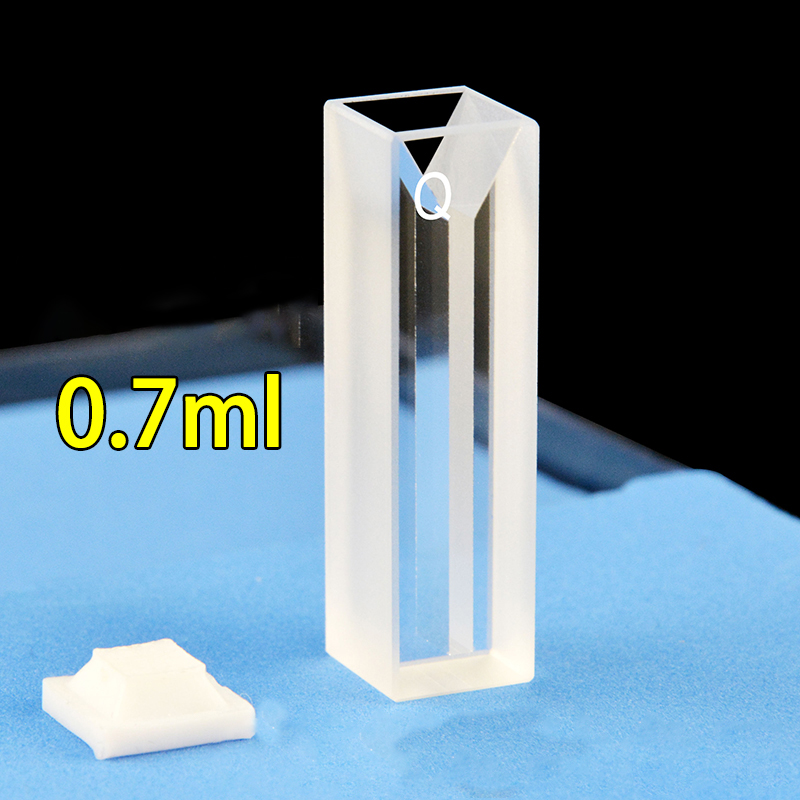
Tier 1 · Budget
Standard 80
UV-cure adhesive bonds polished quartz panels. Lowest cost. Aqueous samples only, <100°C. Cement dissolves in organic solvents (acetone, DMSO, DCM).
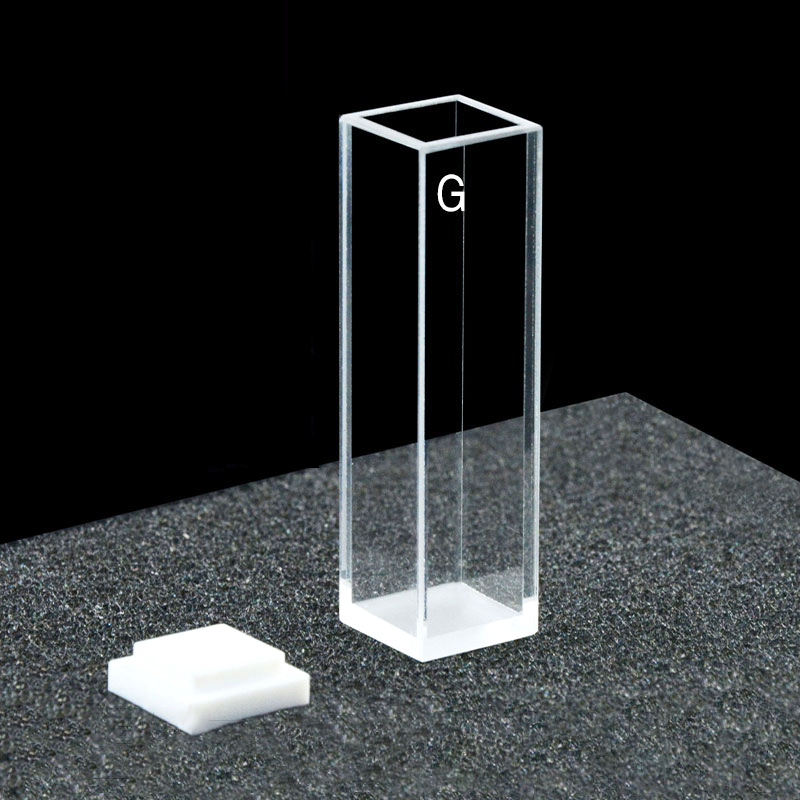
Tier 2 · Workhorse
Sintered 80
Powder-fused, no adhesive; ~600°C service limit. All chemistry compatible (organic solvents, acids, bases — except HF). ~80% T at 200 nm. The default for chemistry labs.
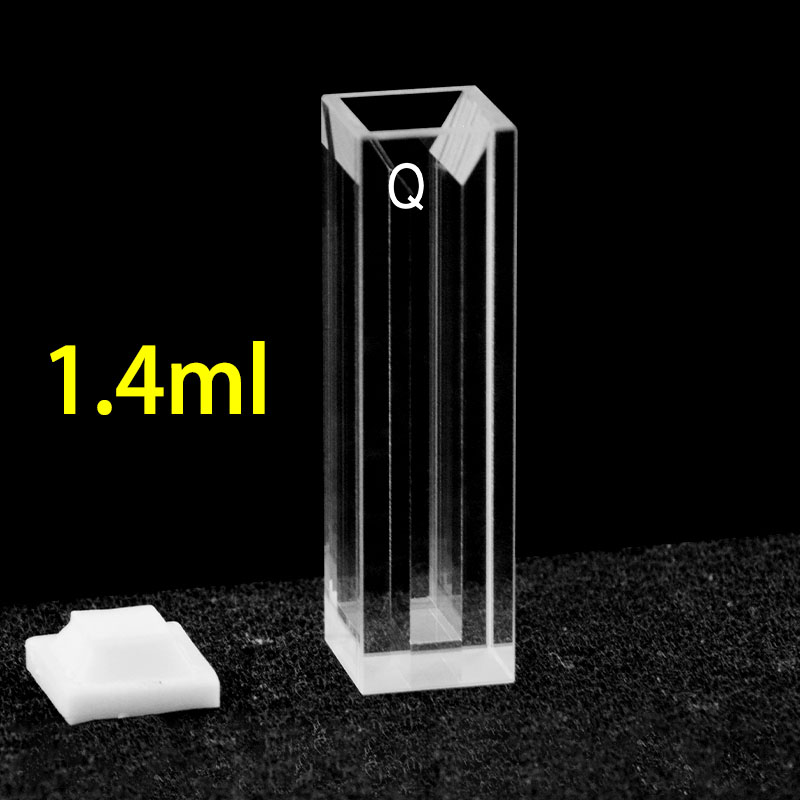
Tier 3 · Pharma QC
Sintered 83
Same build as Sintered 80 but with high-purity synthetic quartz. >83% T at 200 nm — meets USP <857> and Ph. Eur. 2.2.25 photometric requirements.
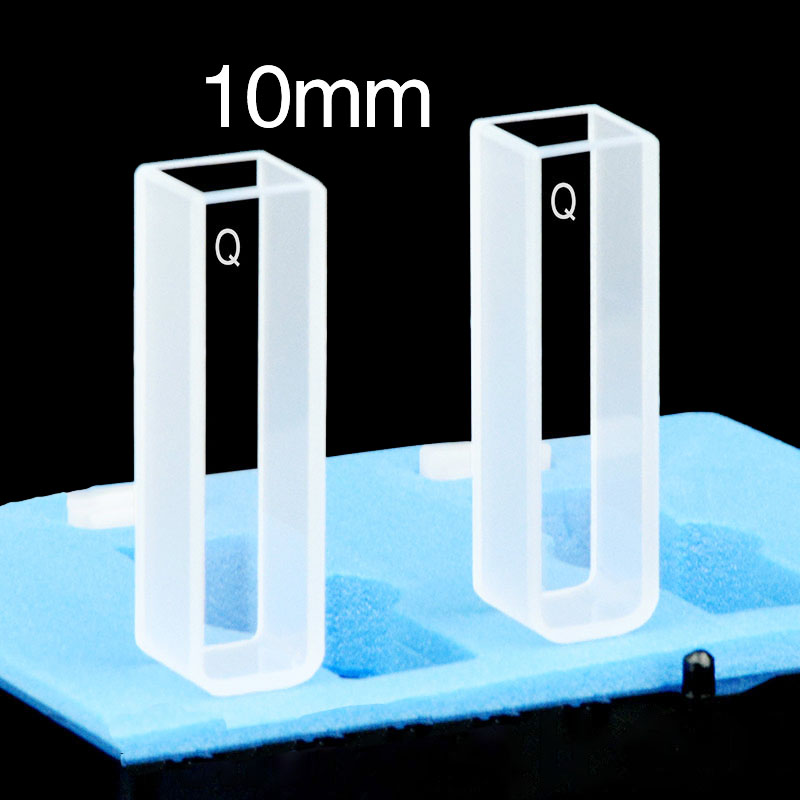
Tier 4 · OEM-rugged
Molded 83
Single-piece quartz formed under heat — no joints, no adhesive. Tolerates thermal cycling. Top tier for heating organic/corrosive samples (matches Hellma/Starna premium).
Tier 5 · Custom flagship
Molded 0.01 (custom precision variant)
Same build as Molded 83 but with ±0.01 mm path tolerance + per-cell dimensional QC certificate. Made-to-order (5-8 day lead time). For reference-standard work, instrument validation, and 21 CFR Part 11 audit trails.
Section 4
Detailed Comparison
Tier 1 · Budget
Standard 80 — Adhesive-Bonded Quartz
Polished quartz windows are bonded to structural sides with a UV-cure optical adhesive (similar to Norland NOA 61). The cement is solid and clear at room temperature, but it’s an organic polymer — and like all organic polymers, it dissolves or swells in organic solvents.
Build method: UV-cure adhesive bonded
UV transmission @ 200 nm: ~80%
Wavelength range: 200–2500 nm
Max temperature: ~100°C (cement softens above)
Solvent compatibility: Aqueous samples only
Path tolerance: ±0.05 mm
Best for: teaching labs, routine UV-Vis with water-based samples
Tier 2 · Workhorse
Sintered 80 — Fused Quartz, No Adhesive
Quartz pieces are fused together by high-temperature powder-sintering, with no organic adhesive at the joints. The ~600°C figure is the sintered joint’s service limit, not the fusion temperature. Chemically inert against virtually every common lab solvent (HF and hot KOH excepted).
Build method: Powder-fused (high-temperature sintering)
UV transmission @ 200 nm: ~80%
Wavelength range: 190–2500 nm
Max temperature: 600°C (cell itself)
Solvent compatibility: All organic solvents, acids, bases (no HF)
Path tolerance: ±0.02 mm
Best for: chemistry labs, HPLC sample analysis, QA work with diverse solvent panels
Tier 3 · Pharma QC
Sintered 83 — High-Transmission Synthetic Quartz
Same powder-fusion build as Sintered 80, but upgraded to high-purity synthetic quartz that delivers >83% transmittance at 200 nm. This is the threshold USP <857> and Ph. Eur. 2.2.25 photometric methods specify for absorbance accuracy in the deep UV.
Build method: Powder-fused, synthetic quartz
UV transmission @ 200 nm: >83%
Wavelength range: 190–2500 nm
Max temperature: 600°C (cell itself)
Solvent compatibility: Same as Sintered 80 (all chemistry, no HF)
Path tolerance: ±0.02 mm
Best for: pharma QC, biopharm protein assays, regulated environmental methods, deep-UV scans below 220 nm
Tier 4 · OEM-rugged
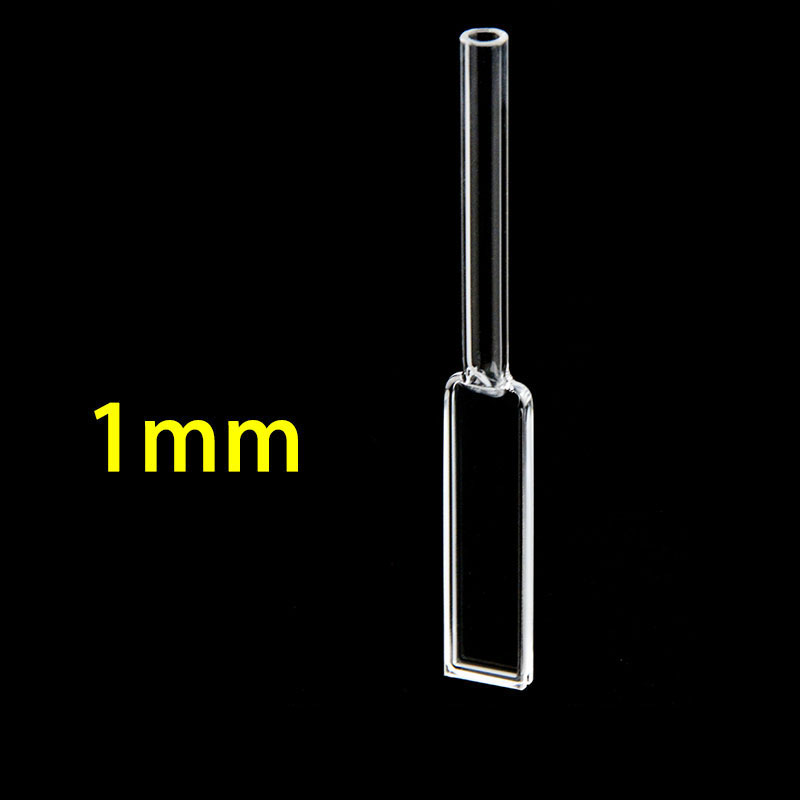
Molded 83 — Single-Piece Monolithic Quartz
Shaped from a single piece of quartz under heat. No joints, no adhesive, no internal stress concentrations. Same chemistry compatibility as Sintered 83 but mechanically tougher, and the only grade we recommend for heating organic or corrosive samples — matching Hellma and Starna premium cells in this regard.
Build method: Single-piece molded under heat
UV transmission @ 200 nm: >83%
Wavelength range: 190–2500 nm
Max temperature: 1200°C (cell itself)
Solvent compatibility: All chemistry, heatable (no HF)
Path tolerance: ±0.02 mm
Best for: OEM instruments, process spectrometers, autoclave-safe applications, heated organic chemistry
Tier 5 · Custom flagship
Molded 0.01 — Custom Precision Variant
Same one-piece monolithic build as Molded 83, but each cell’s path length is individually measured and certified to ±0.01 mm. For methods where the cuvette itself contributes to measurement uncertainty — reference standards, regulatory submissions, instrument validation, 21 CFR Part 11 audit trails — that traceability is required.
Build method: One-piece molded + individual QC
UV transmission @ 200 nm: >85%
Wavelength range: 180–3500 nm (premium grade)
Max temperature: –60 to 1200°C
Path tolerance: ±0.01 mm (certified per unit)
QC documentation: Per-unit dimensional + transmission certificate
Best for: reference standards, instrument validation, audit-ready QC labs
Section 5
Full Specification Comparison
| Property | Standard 80 | Sintered 80 | Sintered 83 | Molded 83 | Molded 0.01 |
|---|---|---|---|---|---|
| Build method | Adhesive bonded | Powder-fused | Powder-fused | One-piece molded | One-piece molded + per-unit cert. |
| Quartz grade | Standard UV | Standard fused | High-purity synthetic | High-purity synthetic | Premium synthetic |
| Wavelength range | 200–2500 nm | 190–2500 nm | 190–2500 nm | 190–2500 nm | 180–3500 nm |
| T @ 200 nm | ~80% | ~80% | >83% | >83% | >85% |
| Solvent compatibility | Aqueous only | All (no HF) | All (no HF) | All (no HF) | All (no HF) |
| Max temperature | 100°C | 600°C | 600°C | 1200°C | 1200°C |
| Heatable with organic? | No | Limited (RT only) | Limited (RT only) | Yes | Yes |
| Autoclavable | No | Yes | Yes | Yes | Yes |
| Path tolerance | ±0.05 mm | ±0.02 mm | ±0.02 mm | ±0.02 mm | ±0.01 mm cert. |
| USP <857> / Ph. Eur. 2.2.25 | Not compliant | Not compliant | Compliant | Compliant | Compliant |
| QC certificate | — | Batch | Batch | Batch | Per unit |
| Lead time | In stock | In stock | In stock | In stock | 5–8 days (custom) |
| Relative cost | $ | $$ | $$$ | $$$$ | $$$$$ |
Section 6
Quick Selection Flowchart
Section 7
★ Which Solvents Can Each Grade Handle?
Picking the right fabrication grade is half the decision. The other half is matching that grade to your specific solvent panel — every reagent has its own concentration limits, temperature ceilings, and cleaning protocols.
📊 Cuvette Solvent Compatibility — 38 Solvents × 3 Fabrications
We rate every common lab solvent (38 acids, bases, organic solvents, oxidizers) against Standard 80, Sintered 80/83, and Molded 83/0.01 — verified against Heraeus, Translume, FireflySci, and Norland. Includes Bryan’s Rule for organic-solvent-in-Sintered protocols and Hellma/FireflySci comparison.
View Solvent Compatibility Chart →
Quick examples of when this matters:
- Running HPLC with acetonitrile? → Standard 80 fails in hours · Sintered 80 is the workhorse
- Cleaning with concentrated H₂SO₄? → Even Sintered grades have 20-min limits · Molded preferred
- Sample contains HF? → No quartz works · Switch to PTFE/PFA cells
- Heating DMSO above room temp? → Only Molded tolerates heated organic solvents
Section 9
Frequently Asked Questions
Can I use Standard 80 if I’m careful with organic solvents?
Brief contact (under 30 seconds) with alcohols (methanol, ethanol, IPA) for cleaning is generally OK. But anything stronger — acetone, DMSO, DMF, DCM, THF, ACN — will dissolve the UV-cure cement over hours to days, even if it appears fine initially. For any HPLC, GC-MS, or organic chemistry workflow, switch to Sintered 80.
What’s the price difference between grades?
Roughly: Standard 80 is the baseline ($). Sintered 80 is ~30% more (cost of glue-free fabrication). Sintered 83 adds another ~50% (high-purity quartz). Molded 83 is ~2-3× the Sintered 83 price. Molded 0.01 is ~3-4× Molded 83 (per-unit measurement + certification). For specific quotes, see our size chart or request a quote.
How long does each grade last?
A well-cared-for quartz cuvette can last 5–10 years of regular lab use. Sintered and Molded grades have no joints to fatigue — they typically outlast the surrounding equipment. Standard 80 lifetime depends heavily on solvent exposure and cleaning protocol; expect 1–3 years if used within spec, or potentially failure within months if exposed to organic solvents.
Is there really no quartz cuvette that handles HF?
Correct — HF (hydrofluoric acid) is the one chemical that destroys all quartz at any concentration. SiO₂ + 6HF → H₂SiF₆ + 2H₂O. For HF-containing samples, switch to PTFE or PFA cuvettes (sold by Hamilton, Starna PTFE line, or other lab suppliers). We don’t sell PTFE cells — if you call about an HF application, we’ll redirect you to a Teflon supplier rather than sell a doomed product.