
Cuvette Material Selection Guide for UV-Vis: JGS1, JGS2, JGS3 Quartz, Glass, Plastic, Sapphire & CaF₂
This post is also available in:
Choosing a UV-Vis cuvette material is primarily a decision between three quartz grades — JGS1 (185–2,500 nm, deep-UV optimized), JGS2 (220–2,500 nm, the standard UV-Vis grade), and JGS3 (260–3,500 nm, NIR optimized) — plus optical glass (350–2,000 nm) and disposable plastic (visible only, single-use). Match the lower wavelength of your measurement to the material’s UV cutoff: below 220 nm requires JGS1; 220–350 nm needs JGS1 or JGS2; above 350 nm allows any of the four.
Cuvette Material Selection Guide for UV-Vis: JGS1 & JGS3 Quartz, Glass, Plastic, Sapphire & CaF₂
On this page
MachinedQuartz · Working Reference
Cuvette Material Selection Guide for UV-Vis: JGS1 & JGS3 Quartz, Glass, Plastic, Sapphire
A working guide to choosing cuvette material by wavelength range, sample chemistry, temperature, and budget — with the three-level decision tree (wavelength → material → MQ SKU) the rest of the internet doesn’t have. Six diagrams, a solvent matrix, and the JGS1 vs JGS3 distinction in cuvette buyer language.
7 materials covered
130 – 8,000 nm range
JGS1 + JGS3 grades
Solvent compatibility matrix
Section 1
The 30-Second Cuvette Material Decision
Most cuvette material decisions come down to one number: the lowest wavelength you need to measure. Everything else — sample chemistry, temperature, budget — is a refinement of that primary cutoff.
Quick answer: Need below 220 nm? → JGS1 deep-UV grade (185 nm cutoff). 220–340 nm? → JGS1 (UV quartz, the MQ default). Above 340 nm only? → optical glass. Disposable visible-only? → polystyrene. High temperature, pressure, or aggressive chemistry? → sapphire. Deep UV below 175 nm? → CaF₂.
Three of those decisions are non-obvious and most SERP results get them wrong: why MachinedQuartz uses JGS1 instead of the cheaper JGS2 grade most catalogs default to, when sapphire is actually worth the cost, and when CaF₂ replaces quartz. The rest of this guide walks each material in working detail — transmission ranges, sample-chemistry compatibility, fabrication pairings, and the typical MachinedQuartz SKU for each use case.
Section 2
The Seven Cuvette Materials at a Glance
The full table of practical cuvette materials, their useful wavelength windows, what each is built for, and the typical cost relative to the JGS2 baseline.
| Material | Transmission range | Best for | Avoid | Cost |
|---|---|---|---|---|
| JGS1 quartz (MQ default) | 185 – 2,500 nm | The MachinedQuartz UV-grade workhorse — covers standard UV-Vis AND deep UV in one cell | Routine visible-only work where glass is sufficient | $$$ (MQ stock) |
| JGS3 quartz | 260 – 3,500 nm | NIR / IR; dye laser; kinetics with heat | Anything below 260 nm | $$$ |
| Optical glass (BK7) | 340 – 2,500 nm | Visible-only routine; teaching labs | Any UV below 340 nm | $ |
| Polystyrene / PMMA | ~380 – 800 nm | Disposable visible; ELISA; OD600 | UV, organic solvents, >60 °C | $ (per-use) |
| Sapphire | 150 – 5,500 nm | High T/P; aggressive chemistry; abrasion | Routine cost-sensitive work | $$$$$ |
| Calcium fluoride (CaF₂) | 130 – 8,000 nm | Deep-UV (< 175 nm); FTIR-coupled | Aqueous (slow water solubility) | $$$$ |
Three real product photos from our standard catalog — the workhorse 10 mm JGS1 cell, a JGS1 cell with PTFE stopper for sealed samples, and the full JGS1 product family in macro / semi-micro / micro sizes:
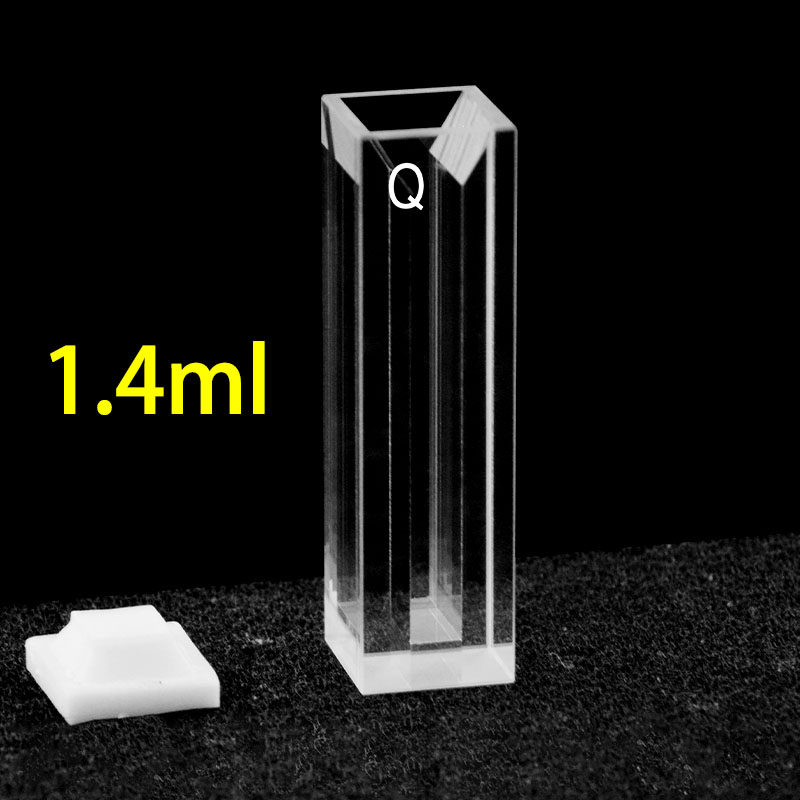
JGS1 standard 10 mm
185 nm UV cutoff · the MQ default
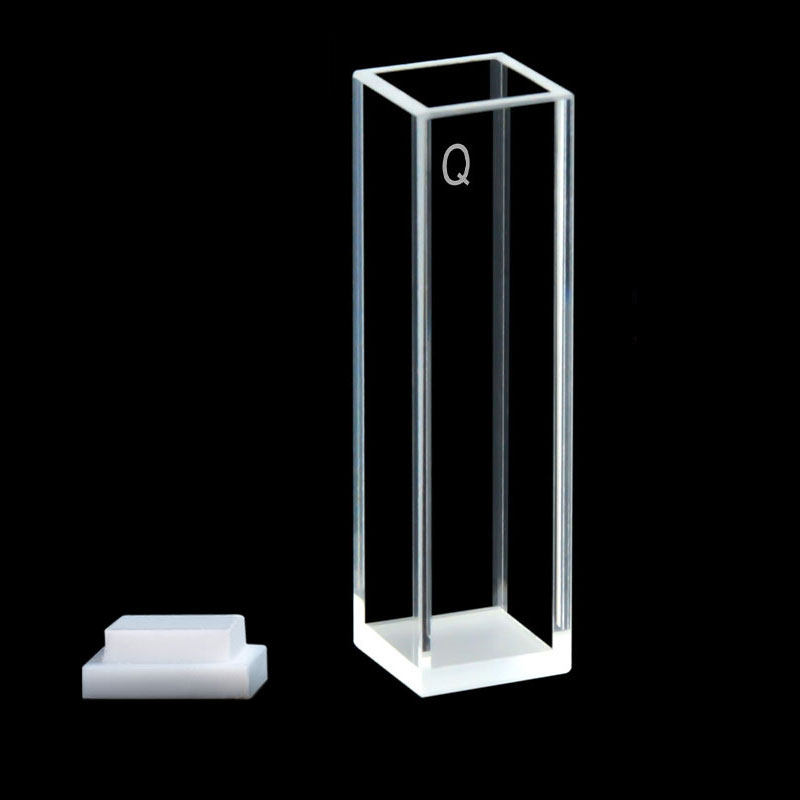
JGS1 with PTFE stopper
sealed sample variant
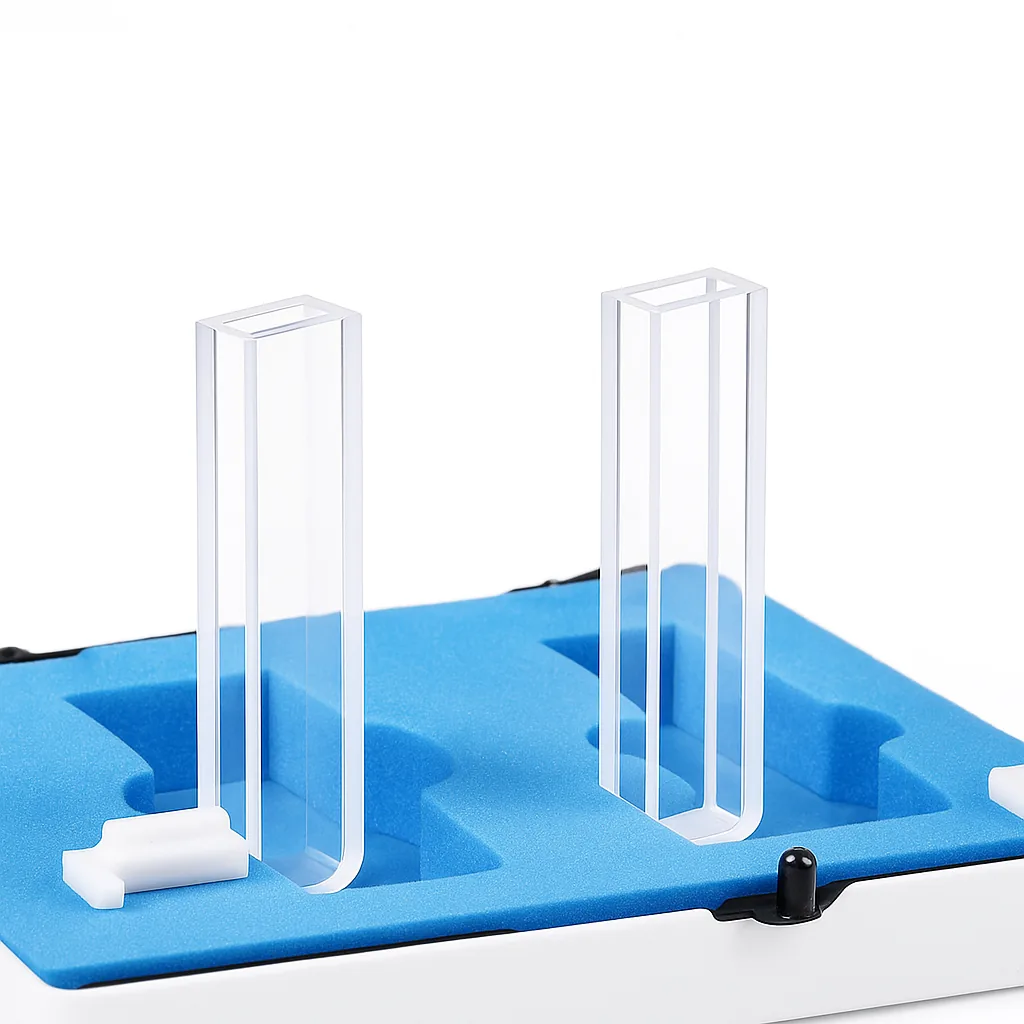
JGS1 standard family
macro · semi-micro · micro
Section 3
Quartz Grades: Why MachinedQuartz Uses JGS1 and JGS3
Most cuvette buyers see “quartz” and assume one material. The Chinese national standard (GB/T series) actually defines three commercial grades — JGS1, JGS2, and JGS3 — each with a different transmission cutoff and manufacturing process. MachinedQuartz fabricates JGS1 and JGS3. We deliberately do not make JGS2. The reason is a working insight, not a constraint: JGS1’s 185 nm transmission window fully contains JGS2’s 220 nm window. Buying JGS1 means you get every JGS2 application plus the deep-UV range below 220 nm — one cell covers two markets at a single price tier.
3.1 The Three GB/T Quartz Grades
JGS1, JGS2, and JGS3 are the Chinese national-standard designations (GB/T national standard) for optical-grade fused silica. The numbers track hydroxyl (OH) content, metallic impurities, and manufacturing route — each of which shifts the transmission window. Below, we cover the two grades MachinedQuartz fabricates (JGS1 and JGS3), then explain in §3.4 why we skip JGS2.
3.2 JGS1 — Synthetic Deep-UV Quartz (the MachinedQuartz default)
Cutoff
185 nm
OH content
~1,000 ppm
Process
Synthetic (CVD/flame)
JGS1 is synthetic deep-UV quartz, made from silicon tetrachloride decomposed in a flame or chemical vapor process. The synthetic route gives extremely low metallic impurity content and exceptionally high transmission down to 185 nm. The hydroxyl groups in synthetic quartz absorb in the NIR around 2.7 µm — JGS1 is excellent for UV through visible but not the right choice for clean IR work past 2.5 µm.
Why JGS1 is the MachinedQuartz default: the 185 nm cutoff covers every analytical UV-Vis wavelength you will ever need, including the deep-UV range (below 220 nm) that JGS2 cannot reach. Nucleic acid quantitation at 260 nm — JGS1. Protein at 280 nm — JGS1. Sunscreen at 290–320 nm — JGS1. Pharmaceutical methods calling for “synthetic quartz” or “<200 nm cutoff” — JGS1. UV-C validation at 254 nm — JGS1. There is no analytical UV-Vis application where JGS1 fails. JGS2’s only advantage is price, and at our manufacturing scale that gap closes enough that we ship JGS1 at the price band most catalogs charge for JGS2.
Our standard catalog defaults to JGS1 in Standard 80 fabrication — the optimal performance combination for routine work.
3.3 JGS3 — IR-Optimized Quartz
Cutoff
260 nm
OH content
< 5 ppm
Process
Dry-fused vacuum
JGS3 is made by vacuum-fusing refined quartz with deliberate exclusion of hydroxyl groups. The dry process pushes the IR transmission cutoff out to 3,500 nm (vs JGS2’s strong OH absorption around 2,700 nm), at the cost of UV transmission down to 260 nm.
When you need JGS3: dye laser cells; NIR spectroscopy of organic chromophores past 2.5 µm; FTIR-coupled measurements where the cell needs to pass through both visible and mid-IR; high-power UV applications where the OH groups in JGS1/JGS2 would cause solarization. Our JGS3 NIR cuvette line covers these cases.
The UV trade-off: anything below 260 nm absorbs hard in JGS3 — do not order JGS3 for any work that hits the deep UV.
3.4 Where JGS2 Fits — and Why MachinedQuartz Doesn’t Make It
Cutoff
220 nm
OH content
~200 ppm
Process
Electric-melted natural
JGS2 is electric-melted from natural quartz crystal — the cheap, mass-market UV grade you find in most online cuvette catalogs. The trace aluminum and iron impurities from the natural feedstock limit deep-UV transmission to 220 nm and above. For routine UV-Vis work where the lowest measured wavelength is above 220 nm — pharmaceutical QC at 254 nm dissolution, DNA/RNA at 260/280 nm, vitamin assays at 290 nm — JGS2 works.
Why MachinedQuartz skips JGS2: JGS1’s 185 nm cutoff fully contains JGS2’s 220 nm range. Every method JGS2 can run, JGS1 also runs. The price gap that historically separated them has narrowed at our manufacturing scale to the point where shipping one premium grade beats running two product lines. The customer wins twice — one cell now works for both routine UV-Vis and any future deep-UV requirement, no inventory split, no risk of grabbing the wrong grade for a 200 nm method.
If you currently order JGS2 from another supplier and want to switch, the spec equivalence is direct: MQ JGS1 covers every JGS2 use case and gives you the 185–220 nm headroom for free.
Section 4
Optical Glass (BK7) — When Visible-Only Is Enough
Borosilicate optical glass — most commonly Schott BK7 or Pyrex equivalents — covers 340 to 2,500 nm. The 340 nm UV cutoff is set by the silicate band gap; below that wavelength, glass absorbs as strongly as the sample you’re measuring, which means useless data.
The 80% rule of production labs: 80% of routine analytical wavelengths sit above 340 nm. Colorimetric methods (most metal complexes, indicator dyes, food and beverage color), enzyme kinetics in the visible range, OD600 cell density, and almost all teaching-lab work fit inside the glass window. Glass cuvettes cost a third of quartz at the same path length, which is why they dominate teaching and routine QC budgets.
Where glass falls down: any aromatic compound below 280 nm. Most pharmaceutical APIs. Nucleic acid quantitation. Sunscreen UV-A/B work. Any organic solvent above 80 °C (the cement on glued glass cells fails). Use our quartz-vs-glass reference for the decision framework when the wavelength sits right at the boundary.
Section 5
Polystyrene and PMMA — Disposable Plastic Cuvettes
Disposable plastic cuvettes — usually polystyrene (PS) or polymethyl methacrylate (PMMA, “acrylic”) — are the volume play. They cost cents per measurement, ship preassembled in bulk, and eliminate the cleaning cycle. They are perfect when you have many samples, modest wavelength requirements, and clean aqueous chemistry.
The two limits matter:
- Wavelength. Standard polystyrene cuts off near 380 nm; PMMA slightly better at 350 nm. Some vendors sell “UV plastic” claiming transmission to 220 nm, but lot-to-lot variation is poor and we do not recommend them for any quantitative UV work.
- Solvent. Polystyrene dissolves in chloroform, methylene chloride, acetone, toluene, and most aromatic solvents — fast. PMMA is slightly tougher but still fails in DMSO, acetonitrile (long exposure), and any strong oxidizer. Our solvent compatibility chart covers the full matrix.
The right uses: OD600 bacterial cultures in saline buffer; ELISA absorbance at 405 / 450 / 595 nm; routine spectrophotometric assays in aqueous reagent kits; teaching laboratory work where breakage cost matters more than precision.
The wrong uses: any UV measurement below 350 nm; any organic solvent contact more than a few minutes; any kinetics longer than the cuvette’s chemical resistance window; any work where the plastic’s autofluorescence interferes with your fluorescence detector.
Section 6
Sapphire — The Hard Choice
Sapphire (single-crystal aluminum oxide, Al₂O₃) is the hardest, most chemically resistant optical material in routine spectroscopy use. Transmission window: 150 nm to 5,500 nm. Mohs hardness: 9 (only diamond is harder). Compressive strength: ~2 GPa. Operating temperature: above 1,500 °C in air.
Transmission
150 – 5,500 nm
Hardness
9 Mohs
Max temp
~1,500 °C
The transmission range overlaps everything quartz does, with the bonus of mid-IR extension. So if sapphire matched quartz on price, every lab would default to sapphire. Cost is the constraint: sapphire cuvettes run 5–10× the price of an equivalent quartz cell, and the manufacturing route (single-crystal growth, then optical polishing on extremely hard material) is fundamentally slower.
When sapphire earns its premium:
- High pressure work — supercritical CO₂ extraction cells, high-pressure reactor windows. Quartz fractures; sapphire holds.
- High temperature — anything above 600 °C continuous operation. Sintered quartz can reach 1,200 °C but loses optical quality past 800 °C; sapphire stays clear.
- Aggressive chemistry — concentrated H₂SO₄, hot HF, aqua regia, concentrated NaOH. Sapphire survives. Quartz etches over time.
- Abrasive samples — slurries with mineral particles, polishing-cycle measurement, anything that physically scrapes the cell window.
- Long service life — when the labor cost of recurring cell replacement exceeds the upfront sapphire premium.
A practical mid-tier: sapphire windows installed on a quartz body. Get sapphire’s chemical and thermal resistance on the optical face while saving the cost of a full sapphire build. We fabricate this configuration for high-T flow cells regularly.
Section 7
Calcium Fluoride (CaF₂) — Deep-UV and Beyond
Calcium fluoride is the workhorse of the <175 nm deep-UV community and the bridge into mid-IR FTIR work. Transmission window: 130 nm to 8,000 nm — the widest of any practical cell material in this guide.
Two applications make CaF₂ irreplaceable:
- VUV (vacuum ultraviolet) — measurements below 175 nm. Even synthetic JGS1 quartz cuts off at 185 nm. For semiconductor lithography wavelengths (157 nm F₂ laser, 193 nm ArF), CaF₂ is the only optical material that transmits cleanly.
- FTIR with UV/Vis coupling — when a single cell needs to pass through the full FTIR mid-IR range (2.5–8 µm) AND the visible/UV for cross-technique correlation. Sapphire stops at 5.5 µm; quartz at 3.5 µm. CaF₂ keeps going.
The constraint with CaF₂: it is slightly water-soluble (~16 mg/L at 20 °C). For continuous aqueous use over weeks, the cell windows fog and need re-polishing. Most CaF₂ cuvette applications use organic solvents, anhydrous samples, or short-contact aqueous exposure. Our CaF₂ window guide covers the FTIR pairing.
Not sure which material fits your method?
Send us your wavelength range, sample chemistry, and operating temperature — we’ll recommend the exact MQ SKU and pricing in under 24 hours. Custom materials and mixed-window assemblies (sapphire face + quartz body, JGS1 windows + sintered seal) ship in 1–2 weeks.
Section 8
Solvent Compatibility Matrix
The material’s transmission range is only half the decision. The other half is whether the cell survives contact with your sample chemistry. Below is the working compatibility matrix for the twelve solvents that show up most often in spectroscopy labs, against the six cell materials.
| Solvent | Quartz (JGS1/2/3) | Optical glass | Polystyrene | PMMA | Sapphire | CaF₂ |
|---|---|---|---|---|---|---|
| Water | ✓ | ✓ | ✓ | ✓ | ✓ | ⚠ slow dissolution |
| Methanol / Ethanol | ✓ | ✓ | ⚠ short OK | ⚠ short OK | ✓ | ✓ |
| Acetonitrile | ✓ | ✓ | ✗ cracks | ⚠ short OK | ✓ | ✓ |
| DMSO | ✓ | ✓ | ✗ dissolves | ✗ dissolves | ✓ | ✓ |
| Chloroform | ✓ | ⚠ joint cement | ✗ dissolves fast | ✗ dissolves fast | ✓ | ✓ |
| Acetone | ✓ | ⚠ joint cement | ✗ dissolves | ✗ dissolves | ✓ | ✓ |
| Hexane / Heptane | ✓ | ✓ | ⚠ swells | ✓ | ✓ | ✓ |
| Toluene | ✓ | ✓ | ✗ dissolves | ⚠ short OK | ✓ | ✓ |
| HF (dilute) | ✗ etches | ✗ etches | ⚠ short OK | ⚠ short OK | ✓ | ✗ reacts |
| Conc. H₂SO₄ | ⚠ slow | ✗ attacks | ✗ chars | ✗ chars | ✓ | ⚠ slow |
| NaOH (1 M, hot) | ⚠ etches | ✗ etches | ✗ dissolves | ✗ dissolves | ✓ | ✗ reacts |
| Aqua regia | ✓ | ⚠ slow | ✗ | ✗ | ✓ | ✗ reacts |
Exposure time matters. “⚠ short OK” means a brief measurement (minutes) is fine, but multi-hour kinetics or overnight storage will degrade the cell. When in doubt, run a 24-hour soak test on a single cell before committing to a method.
For a deeper 38-solvent matrix including specific dissolution times and the joint cement compatibility (which matters for Standard 80 glued cells), see our full cuvette solvent compatibility chart.
Section 9
The Three-Level Decision Tree (Wavelength → Material → Fabrication → SKU)
Walking the full decision from “I have a UV-Vis method” to “I order this specific MachinedQuartz part number” takes three levels of branching. The diagram below maps the full tree.
How to use this tree
1
Wavelength branch. Pick the bin your lowest measured wavelength falls into. This decides material family — JGS1, JGS2, JGS3, glass, plastic, sapphire, or CaF₂.
2
Chemistry branch. Within that material, choose the fabrication method based on sample chemistry and temperature. Standard 80 works for aqueous; Sintered 80/83 for solvents and acids; Molded 83 for sealed high-temperature work.
3
Geometry branch. Decide path length, sample volume, window count (2 for absorbance, 4 for fluorescence), and Z-dimension to match your instrument. Cross-reference with our spectrophotometer compatibility guide.
4
SKU output. Look up the matching stock item in our size chart, or — when the three branches give you a non-catalog combination — request custom fabrication.
Section 10
Fabrication × Material Pairing
Material is half the cuvette decision; fabrication method is the other half. Pairing the right material with the right joining technique is what determines whether the cell survives your method or quietly leaks, etches, or thermally fractures over time.
| Material + Fabrication | Best for | Max temp | Avoid |
|---|---|---|---|
| JGS1 + Standard 80 (glued) | Aqueous routine; ELISA; OD600; cost-sensitive UV-Vis | ~80 °C | Organic solvents, acids, hot work |
| JGS1 + Sintered 80 | Most organic solvents; mild acid wash | ~200 °C | Concentrated bases at temperature |
| JGS1 + Sintered 80 (deep-UV grade) | Deep UV (<220 nm) with solvents | ~200 °C | Routine non-deep-UV work where standard JGS1 Sintered 80 covers it |
| JGS1 + Sintered 83 (pharma) | Pharmaceutical UV with high cleaning cycles | ~250 °C | Routine non-regulated work (overkill) |
| JGS1 + Molded 83 | Sealed cells; volatile / air-sensitive; high-T kinetics | ~1,200 °C | Cost-sensitive routine |
| JGS3 + Molded 83 | NIR / IR work; dye laser; clean IR transmission | ~1,200 °C | Any UV below 260 nm |
| Sapphire windows + quartz body | High-T flow cells; aggressive process monitoring | ~600 °C | Cost-only-driven decisions |
The takeaway: if you only specify “JGS1 quartz” when ordering, you have made half a decision. Specify the fabrication method too — the difference between Standard 80 and Sintered 80 is the difference between a cell that survives your method for years and one that fails in a month. See our fabrication glossary for the joining-method deep dive.
Section 11
Frequently Asked Questions
What’s the difference between JGS1, JGS2, and JGS3 quartz?
JGS1, JGS2, and JGS3 are the three Chinese national-standard quartz grades. JGS1 is synthetic deep-UV quartz with a 185 nm cutoff — the MachinedQuartz default for all standard UV-Vis cuvettes because it covers every analytical wavelength. JGS2 is electric-melted with a 220 nm cutoff, cheaper but limited; MachinedQuartz does not stock it because JGS1 fully covers its range. JGS3 is dry-fused with a 260 nm UV cutoff but extended IR transmission to 3,500 nm — used for NIR and IR work where the OH content of JGS1 would interfere.
Why is quartz used in UV-Vis cuvettes instead of glass?
Glass absorbs strongly below 340 nm because of the silicate band gap and trace iron impurities. Any UV measurement of nucleic acids (260 nm), proteins (280 nm), aromatic compounds, sunscreens, or pharmaceutical APIs below 340 nm requires quartz transparency. Above 340 nm, glass works fine — that’s why teaching labs and routine visible-range QC use glass for the cost savings.
Can I use plastic cuvettes for UV measurements?
Standard polystyrene cuvettes cut off near 380 nm, so they cannot be used for true UV work. Some vendors sell “UV plastic” claiming transmission down to 220 nm, but lot-to-lot variation is poor and the readings are noisy. For any quantitative UV measurement, a quartz cell is the correct choice. Plastic cuvettes work well in their proper range — visible-only work above 380 nm where breakage cost beats precision.
Are sapphire cuvettes worth the extra cost?
For routine UV-Vis work, no. Quartz covers the same wavelength range at 5–10× lower cost. Sapphire earns its premium in three cases: high-pressure work (supercritical CO₂, pressure vessels), high-temperature work above 600 °C continuous, and aggressive chemistry (concentrated H₂SO₄, hot NaOH, HF, aqua regia). A practical mid-tier is sapphire windows installed on a quartz body — keeps the optical resistance where it matters without paying for a full sapphire build.
What cuvette material is best for organic solvents?
Quartz handles all common organic solvents — methanol, ethanol, acetonitrile, DMSO, chloroform, acetone, hexane, toluene — without etching or dissolving. The constraint is the joint cement in Standard 80 glued cells, which can dissolve in chloroform and acetone after prolonged contact. For sustained organic solvent work, use Sintered 80 or Molded 83 fabrication on quartz — no joint cement at all.
Why do my plastic cuvettes give noisy readings below 350 nm?
The plastic itself is absorbing UV at those wavelengths. Polystyrene’s aromatic ring chromophore absorbs hard between 200 and 280 nm; PMMA’s absorption rises below 350 nm. Even “UV plastic” cuvettes have variable transmission lot to lot in the UV. For any measurement below 350 nm, switch to a quartz cell — the noise comes from the cell material, not the sample or the instrument.
What’s the lowest wavelength a quartz cuvette can measure?
MachinedQuartz JGS1 reaches 185 nm — the practical limit for all analytical UV-Vis work. The cheaper JGS2 grade reaches only 220 nm. For wavelengths below 175 nm (the vacuum-UV region used in semiconductor lithography), even JGS1 won’t transmit — you need CaF₂ or LiF windows and a nitrogen-purged optical path.
Can I use the same cuvette for absorbance and fluorescence?
Only if it’s a four-window cuvette — all four side faces optically polished. Standard two-window absorbance cells have only the front and back faces polished, which means the 90-degree fluorescence emission path is blocked. A four-window quartz cell in JGS1 or JGS2 lets you run both measurements on the same sample, which is standard practice in nanoparticle and dye chemistry work.
Related resources from the cuvette knowledge base


Recent Comments