
Fused Quartz Labware: When to Upgrade from Borosilicate (17-Family Selection Guide)
This post is also available in:
Fused quartz labware is a family of 17 product types (beakers, flasks, crucibles, vials, tubes, mortars, boats, dishes, and more) used when borosilicate glass cannot meet the requirements of trace analysis, high-temperature work above 500 °C, deep-UV transparency, or high chemical purity. Quartz tolerates thermal shock to 1,200 °C (vs borosilicate 400 °C), resists hydrofluoric and concentrated acid attack except for HF, and contributes < 5 ppm of metal impurities to stored or processed samples.
Fused Quartz Labware Hub
Fused Quartz Labware: When to Upgrade from Borosilicate
17 product families. 133 stock SKUs. Continuous use to 1100 °C, full chemical resistance except HF and hot strong base, and trace-metal purity that borosilicate cannot match. This guide maps the catalog by function and shows where the upgrade is worth it — and where it is not.
1100 °C
Continuous use
17 families
Crucibles → mortars
133 SKUs
In stock, no MOQ
2 pcs
Custom MOQ
What this guide is — and isn’t: a working selection guide written by the team that machines this catalog every day at MachinedQuartz. It is opinionated about when fused quartz is the right material and when it is overkill or wrong (HF and boiling KOH). What you will not see: hype about “premium quartz” without spec, certifications we don’t actually issue, or recommendations to upgrade for applications where Pyrex is fine. Last reviewed May 2026.
1. When to upgrade from borosilicate
Borosilicate (Pyrex / Duran / Schott 8330) handles the vast majority of bench work. Most labs do not need quartz, and we will tell you so. The four scenarios where the upgrade pays back are:
- Continuous use above 500 °C. Borosilicate softens around 820 °C but begins creeping at 500 °C. Quartz holds geometry to 1100 °C continuous, with short excursions to 1200 °C.
- Trace-metal sensitivity. Borosilicate leaches Na, K, B, Al at the ppm level after extended acid contact. Type 3 synthetic quartz keeps total trace metals under 1 ppm — critical for ICP-MS sample prep, semiconductor work, and reference-standard preparation.
- UV transparency. Pyrex cuts off around 290 nm. Fused quartz transmits cleanly from 180 nm (UVC) through visible. Required for photochemistry, UV-cured polymers, deep-UV fluorescence, and any reaction monitored by UV spectroscopy through the wall.
- Thermal-shock resistance. Borosilicate fails on a 100–150 °C ΔT quench. Quartz tolerates 800 °C ΔT in plate form and 200–300 °C ΔT in thin-wall labware — meaning a glowing red crucible can be plunged into water without cracking (we do not recommend this, but it survives the demo).
If your protocol does not stress any of those four axes, you are paying a 4–8× premium for spec margin you will never use. Stay with borosilicate.
2. Material fundamentals: Type 1, 2, 3
“Fused quartz” and “fused silica” are used interchangeably in catalogs, but the four ASTM Type designations differ in how the material is made — which controls trace metals, OH content, and UV transmission. For labware, only Types 1, 2, and 3 are relevant.
| Grade | How made | OH content | Trace metals | Used for |
|---|---|---|---|---|
| Type 1 (electric-fused) | Electrically fused natural crystal in vacuum | < 5 ppm | 20–30 ppm Al, 1–4 ppm Na+K | Combustion boats, low-cost crucibles, refractory inserts |
| Type 2 (flame-fused) | Flame-fused natural crystal in H2/O2 flame | 150–400 ppm | 20–30 ppm Al, 1–4 ppm Na+K | Most stock labware: beakers, flasks, dishes, vials |
| Type 3 (synthetic) | SiCl4 hydrolysis in H2/O2 flame (CVD) | 500–1000 ppm | < 1 ppm total metals | ICP-MS sample prep, semi-grade vials, photochemistry |
| Type 4 (synthetic, dry) | SiCl4 plasma deposition | < 5 ppm | < 1 ppm | Deep-UV optics — not standard for labware |
Practical takeaway: Type 2 is the default for our beakers, flasks, and crucibles — it gives 90 % of the spec at a fraction of the cost. Specify Type 3 if your sample sees ppb-level trace-metal analysis after contact, or if your photochemistry runs deep into the UV. Boats and inserts are usually Type 1 because they live in furnaces, not in solution.
OH content matters when you go above 1000 °C. Type 2’s high OH means more H2O outgassing and faster devitrification under reducing flames. For long furnace runs at > 1100 °C, Type 1 (low-OH) extends service life by 2–3×.
3. Thermal limits and shock tolerance
The single biggest reason to specify quartz is operating temperature. The chart below sets common laboratory glass on the same axis: continuous-use temperature on the bottom of each bar, peak short-term tolerance on top.
Three numbers are worth memorising:
- 1100 °C — continuous-use limit for fused quartz labware. Above this, devitrification (cristobalite formation on the surface) accelerates rapidly. The vessel still holds, but the surface frosts and weakens with thermal cycling.
- 1200 °C — viscous-sag onset. Above this, the wall slowly deforms under its own weight; the formal softening point is ~1680 °C.
- 200–300 °C — typical thermal-shock ΔT for thin-wall labware (beakers, flasks, dishes). Plate-form quartz tolerates much more (~800 °C ΔT) because the shape is simpler. Do not read the plate spec and apply it to thin-wall labware.
Devitrification is one-way. Once a crucible has been red-hot for hours and shows surface frosting, it will keep degrading on every subsequent run. For long furnace campaigns above 1100 °C, plan for crucibles as consumables and budget for replacement after 30–50 cycles.
4. Chemical compatibility (and the HF rule)
Fused quartz is the most chemically inert oxide glass — except for two combinations. The matrix below shows compatibility against common reagents. Borosilicate is included for comparison; sapphire and PFA/PTFE are added so you know what to switch to when quartz is wrong.
The HF rule: hydrofluoric acid dissolves silica at any concentration, even dilute. There is no quartz vessel that resists HF. The only material that does is fluoropolymer (PFA, PTFE, FEP). If your protocol uses HF — even as a trace cleaner — you need PFA, not quartz.
Hot strong base is the second exception. NaOH and KOH at the boil etch fused silica (and borosilicate) by attacking the Si–O–Si network. For sodium fusion or KOH fusion analyses, use a nickel or zirconium crucible instead.
Outside those two cases, quartz handles every common laboratory reagent: all mineral acids cold or hot (including aqua regia), every standard organic solvent, and most molten salts below 1000 °C.
5. The 17 product families at a glance
The catalog spans 17 sub-categories and 133 in-stock SKUs. The map below groups them by what you do with them — containment, reaction, distillation, or sample prep. Each group corresponds to one section below.
6. Group 1 — Containment & holding
Containers that hold liquid or solid sample at room or moderately elevated temperature. No flame contact. The most common upgrade reason here is UV transmission, not temperature — most labs reach for quartz beakers because they need to monitor a photoreaction through the wall, or because the sample is too contamination-sensitive for borosilicate’s leached sodium.
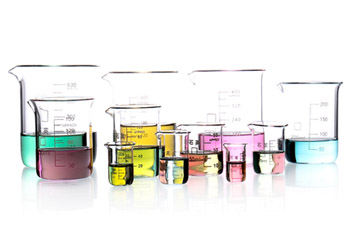 Beakers
Clear quartz beakers, 5 mL – 500 mL
16 SKUs. Type 2, low-form Berzelius profile. Pour spout polished smooth. Free-blown bottom for thermal cycling.
Browse beakers → Cylinders
Graduated cylinders, 5 mL – 250 mL
7 SKUs. Hex base for stability. Volumes etched, not painted — survive HCl wash. Tolerance ±5 % of marked volume.
Browse cylinders → Reagent bottles
Reagent bottles with ground stopper
7 SKUs, 50 mL – 1 L. Ground-glass stopper (no PTFE, no rubber — fully autoclave-safe and contamination-free). For UV-grade water, photoresist, ICP standards.
Browse bottles → Sample vials
Screw-cap sample vials, 1.5 mL – 30 mL
13 SKUs. PP screw caps with PTFE-faced silicone septa. For trace-metal storage where borosilicate’s leached sodium would skew your blank.
Browse vials → Petri dishes
Petri dishes, 35 mm – 100 mm
6 SKUs total. UV-transparent base for inverted microscopy with deep-UV illumination. Autoclave-safe to 1100 °C dry-heat sterilisation.
Browse Petri →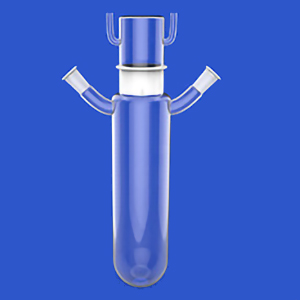 Test tubes
Test tubes, 5 mL – 50 mL
10 SKUs (clear + frosted variants). For furnace pyrolysis, UV-monitored kinetics, low-temperature flash chemistry. Standard 13×100 mm and 16×150 mm formats.
Browse test tubes →Volume tolerance, honestly. Our graduations are accurate to ±5 % of marked volume — sufficient for the rough measurement role of a beaker or cylinder. We do not certify our cylinders to Class A volumetric tolerance (±0.1 %). For volumetric standards work, use Class A volumetric flasks (borosilicate is fine; the contact time is too short for sodium leaching to matter).
7. Group 2 — Reaction & high-temperature
Vessels that go into a furnace, muffle, or open flame. This is the group where the upgrade from borosilicate is non-negotiable — Pyrex sags above 500 °C, fused quartz holds shape to 1100 °C continuous.
 Boats — 34 SKU
Combustion boats, 0.5 mL – 25 mL
34 SKUs across single-handle, two-handle, and chamfered profiles. The largest family in our labware catalog. Used for TGA, LECO ash analysis, sulfur-by-combustion, semiconductor process boats.
Browse boats → Crucibles
Crucibles, 5 mL – 300 mL
10 stock SKUs. Tall-form (height > diameter) for ash retention. The 300 mL MQM329 is a workhorse for sample digestion and metallurgical sample prep.
Browse crucibles → Evap. dishes
Evaporating dishes, 50 mL – 250 mL
3 stock SKUs. Wide-shallow geometry maximises surface area for solvent removal. Pour spout standard. Compatible with hot-plate and IR lamp drying.
Browse evap dishes →Pick the right reaction vessel
| If you need… | Reach for | Why |
|---|---|---|
| Solid sample in a furnace, recovered intact | Combustion boat | Open-top, easy to load and weigh. Single-handle for tube furnaces, two-handle for muffle. |
| Sample to be ashed and weighed | Crucible | Tall-form retains ash. Lid available for reducing atmosphere. Tare-and-reweigh workflow. |
| Solvent removal from solution | Evaporating dish | Wide shallow profile. Hot plate or IR lamp. |
| UV-transparent culture surface | Petri dish | Only quartz transmits below 290 nm. For deep-UV fluorescence imaging of live cells. |
| Material insert (refractory pad / disc) | Material insert | Custom-machined to your furnace geometry. 4 stock SKUs, custom > 90 % of orders. |
What we do not stock: high-form (height < diameter) crucibles, perforated crucibles for Gooch-style filtration, or crucibles with ground-on lids. The 10 SKUs we list are the proven sizes — if your furnace fixture demands a non-standard form, send us a sketch and we will quote a custom run with 2-piece MOQ.
8. Group 3 — Distillation & flow
Round-bottom flasks, distillation flasks with side-arms, ground-joint assemblies, and filtering flasks. This is where customers most often combine quartz vessels with non-quartz fittings (PFA tubing, PTFE stopcocks, ground-glass adapters in borosilicate). The flask is quartz because the contents are hot or UV-sensitive; the rest of the train can be standard.
Round-bottomClear quartz flasks, 50 mL – 150 mL
4 SKUs. Plain round-bottom, no joint. For UV-monitored reflux through the wall. Pair with a quartz cold finger or borosilicate condenser via slip-fit silicone bushing.
Browse flasks → Distilling
Distilling flasks with side-arm, 50 mL – 500 mL
7 SKUs. Side-arm angled at 75°, ground 14/23 or 24/40 male joints. For acid distillation (HCl, HNO3 sub-boiling) and Type-1-water polishing. The standard reagent-grade distillation train uses a quartz pot and quartz side-arm to keep boron and sodium out of the distillate.
Browse distilling →Joint flasksJoint flasks, 14/23 to 29/32
4 SKUs. Single-neck round-bottom with standard ground female joint. Compatible with any borosilicate adapter, condenser, or addition funnel — quartz only where the flask itself sees heat.
Browse joint flasks →Filtering flasks (Buchner-style, vacuum)
3 SKUs (250 mL, 500 mL, 1 L). Sidearm-vacuum geometry compatible with #5 and #6 rubber stoppers. Vacuum rating is the same as borosilicate — we do not claim higher pressure differential. Quartz is chosen here for the same reason as the round-bottom group: UV transparency or trace-metal cleanliness, not vacuum performance.
Mixing quartz and borosilicate in one assembly is fine. A common, cost-effective build: quartz flask + standard borosilicate condenser + PTFE adapter. The flask sees the heat and the sample; the condenser does not. You buy quartz once, where it matters.
9. Group 4 — Sample preparation
Tools for turning a solid sample into something you can analyse — primarily mortars and pestles, plus stand-alone material inserts.
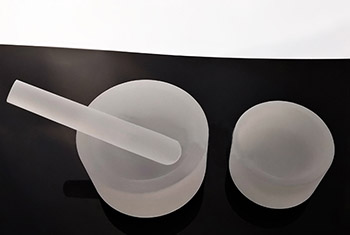 Mortars
Mortars & pestles, 50 × 60 × 20 mm to 100 × 120 × 35 mm
5 stock sizes. Heavy-walled bowl with matching pestle. Used when borosilicate or agate would contaminate the sample with B, Na, or trace iron — typical applications: ICP-MS prep, geological sample digestion, semiconductor reagent grinding.
Browse mortars →InsertsMaterial inserts (refractory plugs, discs, custom)
4 stock SKUs, 90 % custom. Stand-alone discs, plugs, or shaped pieces dropped into furnace fixtures or process boats. Send us a sketch and we machine the geometry from blank.
Browse inserts →Pestle pairingStandard pestle profiles
Each mortar ships with a matching pestle in the same lot. Replacement pestles available — order by mortar SKU and we match the curve. Custom pestle lengths quoted on request.
Mortar catalog →Mortars are an investment. Stock prices run $400–$525 per set — that is the cost of machining a thick-wall hemispherical bowl from a block of fused quartz. If you need contamination-free grinding but can tolerate iron pickup, an agate mortar is 5–10× cheaper. Choose quartz only when iron, boron, or sodium pickup would skew your analysis.
Need a custom geometry?
Send a sketch or DXF. 2-piece MOQ on custom labware, standard lead time 2–4 weeks. ISO-9001 documentation on request.
10. Selection decision tree
If sections 6–9 covered the families, this tree covers the workflow — start with the task, navigate to a vessel in 3–4 steps.
11. Common application scenarios
Six recurring workflows where customers buy our labware. Use these as templates — most lab protocols are variations on one of them.
TGA / ASH
Thermogravimetric analysis & loss-on-ignition
Combustion boat (1–5 mL) + crucible (10–50 mL) for higher loadings. Type 1 quartz preferred above 1100 °C. Boats are consumables; budget 50–100 per year for a busy TGA bench.
ICP-MS PREP
Trace-metal sample preparation for ICP-MS
Quartz reagent bottle (acid storage), Type 3 vials (sample storage), quartz crucible (acid digestion on hot plate). Mortar & pestle for solid prep. Total kit: ~$800 for a complete trace-metal-clean digestion bench.
UV PHOTOCHEM
UV-monitored photochemistry
Clear quartz flask + UV lamp (254 nm or 365 nm). Reaction monitored through the flask wall by UV-Vis fibre probe. Joint flask if you need to add reagent during the run.
ACID DISTILL
Sub-boiling acid distillation (HCl, HNO3)
Quartz distilling flask + quartz side-arm + PFA collection bottle. Produces ppb-pure mineral acid for ICP-MS, semiconductor cleaning, isotope-ratio mass spec. The borosilicate alternative leaches B and Na directly into your distillate.
SEMI
Semiconductor wafer cleaning
Quartz beaker (large) + PFA tweezers + Type 3 deionised water. Quartz wins because it does not shed sodium into the wafer surface during the rinse. We do not stock cassettes or wafer carriers — we make the beakers.
DEEP-UV BIO
Deep-UV imaging of live cells
Quartz Petri dish (35 mm) + inverted microscope with UV objective. Required for autofluorescence imaging of NADH/FAD (340/450 nm) or label-free protein imaging at 280 nm. Cells stay viable on the quartz surface.
12. Custom geometry & sizes
Roughly half of our labware orders include at least one non-stock dimension. Our shop is built for short-run custom work — 2 pieces is the minimum, no tooling fee.
What we routinely customise without a tooling charge
- Beaker / cylinder volume — any size from 5 mL to 5 L
- Wall thickness — heavier wall for thermal cycling, thinner for fast UV transmission
- Pour spout angle and shape
- Stopper-joint size (14/23, 19/22, 24/40, 29/32)
- Side-arm angle and length on distilling flasks
- Boat profile — single-handle, two-handle, chamfered, with grooves for thermocouple
- Crucible aspect ratio — tall-form, low-form, or wide-shallow
- Mortar bowl curvature and pestle length
Custom work that requires upfront discussion
- Ground-glass joints on quartz (we make them, but they are slow — 4-week lead time)
- Frosted or sandblasted exterior for measurement marks
- Quartz-to-quartz fused assemblies (multi-piece welds)
- Embedded thermocouples or sample-port flanges
- Vessels > 2 L volume — custom blowing tooling required
What we do not manufacture (and do not partner-source): heating mantles, ground-glass adapters in non-quartz materials, GL-screw cap closures, rotovap glassware sets, fritted Buchner filter discs, opaque or fluorescent quartz. If your protocol needs those, you are buying from a different supplier.
13. Catalog quick-link grid
All 17 sub-categories with stock counts and direct links. Use the master Fused Quartz Labware catalog page to filter by SKU, dimension, or price.
14. FAQ
When is fused quartz overkill versus borosilicate?
If your protocol does not exceed 500 °C, does not require UV transmission below 290 nm, and does not run at the trace-metal level (sub-ppm), borosilicate is the right answer at 1/4 to 1/8 the price. The four scenarios that justify quartz are: continuous use above 500 °C, deep-UV transparency, ppb-level trace-metal cleanliness, and large-ΔT thermal shock. If none of those apply, save the money.
Can fused quartz handle hydrofluoric acid (HF)?
No. HF dissolves silica at any concentration, including dilute solutions. There is no quartz vessel that resists HF — and there is no surface treatment that changes this. The only laboratory material that reliably resists HF is fluoropolymer (PFA, PTFE, FEP). If your protocol uses HF, even as a trace cleaner, switch to PFA bottles, beakers, and digestion vessels. We do not manufacture fluoropolymer ware and will not pretend our quartz is suitable.
What is the maximum continuous-use temperature?
1100 °C for standard Type 2 fused quartz labware, with short excursions tolerated to 1200 °C. Above 1100 °C, surface devitrification (cristobalite formation) accelerates and the vessel weakens with each thermal cycle. For long campaigns at 1100–1200 °C, Type 1 (low-OH) quartz extends life by 2–3× because the lower water content slows devitrification.
How much thermal shock can quartz labware take?
200–300 °C ΔT for thin-wall labware (beakers, flasks, dishes). Plate-form quartz tolerates much larger shocks (~800 °C ΔT) because the geometry is simple — but you cannot read the plate spec and apply it to thin-wall items. A red-hot crucible plunged into water survives the demo, but we do not recommend the practice; thermal cycling shortens service life regardless of whether the vessel cracks immediately.
What does Type 1 / Type 2 / Type 3 quartz mean, and which do I need?
Type 1 is electric-fused natural crystal — low water (< 5 ppm OH) but moderate trace metals. Best for furnace work above 1000 °C. Type 2 is flame-fused natural crystal — higher OH (150–400 ppm) but mature, low-cost. The default for our beakers, flasks, and dishes. Type 3 is synthetic CVD quartz — < 1 ppm total trace metals, used when your sample sees ppb-level analysis (ICP-MS) or photochemistry below 200 nm. Order Type 2 unless you have a documented reason to upgrade.
Can you provide NIST-traceable volume calibration on cylinders or volumetric flasks?
Our cylinders carry ±5 % volume tolerance — sufficient for transfer and dispense, not sufficient for analytical volumetric work. We do not stock or certify Class A volumetric flasks or cylinders. If you need ±0.1 % volumetric accuracy, use Class A borosilicate (the contact time during a one-shot transfer is too short for sodium leaching to matter). For a custom calibrated quartz cylinder, expect a multi-week lead time and individual certification cost — we will quote it but it is rarely the right answer.
What is the lead time for custom sizes?
Stock SKUs ship within 1–2 weeks via FedEx DAP. Custom geometry on the standard families (a non-stock beaker volume, a different boat length, a modified joint angle) typically runs 2–4 weeks. Items that require new tooling — multi-piece welded assemblies, embedded thermocouples, > 2 L flasks — run 4–6 weeks. The 2-piece MOQ applies to all custom work.
Do you supply opaque or sandblasted quartz?
We can sandblast a measurement scale or a frosted band onto stock labware (custom job, 2-piece MOQ). What we do not stock or manufacture is bulk opaque (translucent fused-silica) quartz — the kind made by sintering rather than fusing crystal. Opaque quartz is its own product category, used for diffuse light scattering and high-temperature insulation. It is not the same material as our clear labware and we do not partner-source it.
Can I autoclave quartz labware?
Yes, with no upper-temperature concerns up to 1100 °C dry heat. Quartz tolerates standard wet autoclaving (134 °C, 30 min) indefinitely. Mixed materials (PP cap on a quartz vial) are limited by the cap, not the quartz — for autoclaving, remove plastic caps first or order with a ground-glass stopper instead.
What do you not make?
We do not manufacture or supply: heating mantles, hot plates, magnetic stirrers, GL-screw caps, rotovap glassware sets (condensers, evaporator flasks for rotary), fritted Buchner discs (sintered glass filters), PTFE/PFA-jointed assemblies, fluorescent quartz, opaque (translucent fused-silica) quartz, NIST-traceable Class A volumetric flasks, ground-on Schlenk-line stopcocks. If you need any of these, we will tell you and point you at a supplier who does.
15. Notes & honest limits
What this guide explicitly does not claim
• HF resistance. Fused quartz dissolves in HF at any concentration. Use PFA or PTFE for any HF-containing protocol.
• Boiling-base resistance. NaOH and KOH at the boil etch fused silica. For sodium-fusion or KOH-fusion analyses, use nickel or zirconium crucibles.
• Volumetric Class A accuracy. Our cylinders and beakers carry ±5 % volume tolerance. We are not a calibrated volumetric standards manufacturer.
• Indefinite life above 1100 °C. Devitrification accelerates above 1100 °C and the vessel will weaken with thermal cycling. Plan for crucibles and boats as consumables in long furnace campaigns.
• Substitute for sapphire above 1500 °C. If your continuous-use temperature exceeds 1100 °C with thermal cycling, fused quartz is not the right material; switch to sapphire or alumina.
Pyrex and Duran are registered trademarks of Corning and DWK Life Sciences respectively. Schott 8330 is a registered trademark of Schott AG. PFA, PTFE, and FEP are generic chemical names; trademarked product names (Teflon, Tefzel, etc.) belong to their respective owners. References to ASTM Type 1 / 2 / 3 / 4 follow the convention in ASTM C162 and the Corning Glass Works classification of fused silica grades.
Last reviewed May 2026 by the MachinedQuartz technical team. Specifications and stock availability change over time — confirm current SKU availability and pricing on the catalog page or by emailing [email protected] before specifying a final BOM.
Ready to spec your quartz labware?
133 stock SKUs across 17 families. Custom dimensions ship in 2–4 weeks. 2-piece MOQ on custom orders, no tooling fee on standard variations.
Browse the catalog →Request a custom quote →

Recent Comments