
Cuvette vs NanoDrop Pedestal: When to Use Each
This post is also available in:
The cuvette-vs-NanoDrop decision is primarily about sample volume, repeat measurement, and accuracy requirements. NanoDrop pedestal spectrophotometers measure 1–2 µL drops at 0.05–1.0 mm pseudo-path-lengths and excel at fast nucleic-acid quantification (A260/280), but show 2–5% variability between drops. Cuvettes need 50–3,500 µL but deliver ±0.5% reproducibility, support kinetics and thermostatting, and are the only choice for USP / GMP-compliant pharma QC.
Honest Comparison · Method Selection
Cuvette vs NanoDrop Pedestal: When to Use Each
Microvolume pedestal spectrophotometers and traditional cuvettes both measure UV-Vis absorbance, but they make different tradeoffs on sample volume, accuracy, throughput, cleanliness, audit trail, and price. This guide tells you, application by application, when each is the right tool — and when a 0.1 mm sub-micro cuvette beats a $5,000 pedestal.
1 µL vs 50 µL
Volume Compared
$5K–$10K
Pedestal Price
$30–$200
Sub-Micro Cuvette
Both
Have Their Place
The Thermo NanoDrop and its category clones (Implen NanoPhotometer, DeNovix DS-11, BioTek Take3, Eppendorf BioSpectrometer) replaced traditional cuvettes for one specific use case in the early 2000s: measuring tiny volumes of nucleic-acid samples (1–2 µL of plasmid or PCR product) without burning the precious sample on a 50 µL cuvette fill. Two decades later, microvolume pedestals are the default first instrument in many molecular-biology labs — and a generation of analysts has grown up assuming “spectrophotometer” means “pedestal”.
That assumption costs them. Cuvettes — specifically sub-micro cuvettes with 0.1–1.0 mm path lengths — remain the better choice for several common applications: routine measurements where volume is not the constraint, kinetic monitoring, GMP-validated assays, low-concentration samples, and price-sensitive teaching labs. This guide compares the two honestly, application by application. Where pedestals win, we say so. Where a sub-micro cuvette beats a $5,000 pedestal — which is more often than the marketing suggests — we say that too.
Why MachinedQuartz wrote this comparison. We make sub-micro cuvettes (0.1, 0.2, 0.5, 1.0 mm paths in 100–200 µL volumes). We have a commercial interest in the answer being “use a cuvette”. But we also use NanoDrop-class pedestals in our own QC lab and the honest answer for many applications is “use the pedestal”. This page lays out both sides so you can decide.
1. How each method works
Microvolume pedestal (NanoDrop and clones)
You pipette 1–2 µL of sample onto the lower pedestal. The instrument lowers the upper pedestal until surface tension forms a column of liquid between the two pedestal faces. A UV beam passes through the column. The path length is set by the gap between pedestals, typically 1 mm at first measurement and 0.2–0.5 mm at a second auto-shortened measurement (NanoDrop One uses this approach for high-concentration samples). After measurement, you wipe both pedestals with a Kimwipe and load the next sample. No cuvette to clean, no cuvette to break, no glassware to track.
Traditional cuvette spectrophotometer
You pipette 50–3,500 µL of sample (depending on cell choice) into a quartz cuvette of certified path length, place the cuvette in the spectrophotometer cell holder, close the lid, and read. The cuvette is reusable: rinse, dry, refill. Path length is whatever you ordered (0.01 mm to 200 mm) and is traceable to a manufacturer’s certificate of analysis. Sample can be recovered from the cuvette for downstream work.
2. Honest side-by-side comparison
The dimensions that actually drive method choice in lab practice.
| Dimension | NanoDrop pedestal | Sub-micro cuvette |
|---|---|---|
| Sample volume | 1–2 µL (huge win) | 50–200 µL |
| Sample recovery | Sample evaporates / wipes off | Recoverable for downstream use |
| Path length traceability | Auto-set, instrument-calibrated | Certified per cuvette, NIST-traceable |
| Path length range | 0.2–1 mm fixed by design | 0.01 mm to 200 mm |
| Throughput (samples/hour) | 60–120 | 30–60 (manual cuvette) |
| Concentration linear range | 2–3,700 ng/µL dsDNA (auto-switching) | Continuous via path length choice |
| Capital cost | $5,000–$15,000 instrument | $30–$200 cuvette + any UV-Vis |
| Per-sample consumable | ~$0.05 (Kimwipe + tip) | ~$0.05 (rinse + tip) |
| GMP / pharmacopoeial use | Limited (not all pharmacopoeial methods accept) | Fully accepted (USP <851> etc.) |
| Kinetic / time-course | Single point only | Continuous in cell holder |
| Temperature control | Limited (some models heated) | Full Peltier / water-jacket |
| Sample carryover risk | Low if Kimwipe technique is good | Very low (rinse cycle) |
| Volatile / toxic sample handling | Open pedestal — not ideal | Closed cuvette with cap |
| Audit trail (compliance) | Instrument software log | Cuvette CoA + spectrometer log |
| Best for | Plasmid/PCR/qPCR template QC, microvolume DNA, fast walk-up | Method validation, kinetics, regulated work, low concentration, recovered sample |
The pattern: NanoDrop wins on volume, throughput, and walk-up convenience. Sub-micro cuvettes win on traceability, range, kinetics, regulated environments, and total cost of ownership when you do not need the volume advantage.
3. When the NanoDrop pedestal wins outright
Several use cases are unambiguously NanoDrop territory. If you are doing these things primarily, the pedestal is the right instrument.
Plasmid prep and PCR product QC
Microliters of precious miniprep eluate or PCR cleanup. The 1 µL sample is what makes pedestals exist. A 0.5 mm sub-micro cuvette can do the measurement at 50 µL, but in a workflow where you are preparing 100 plasmid preps a day, the throughput and walk-up convenience of the pedestal wins.
Sequencing library QC
Pre-flight QC of NGS libraries before pooling needs DNA concentration to 1 ng/µL precision and ratio QC (A260/A280, A260/A230). Pedestals do this in 30 seconds per sample. Cuvettes can match the precision but lose on throughput.
Walk-up shared instrument in academic core facilities
The “user calibrates and brings their tip” workflow that pedestals were built for. No cuvette to lose, break, or contaminate; minimal training; user error is bounded by Kimwipe technique.
RNA quality assessment (A260/A280 ratio)
Same argument as plasmid prep. Microvolume + ratio measurement is the canonical pedestal application.
If the workflow is “prep the sample, measure the sample, run the sample”: the NanoDrop fits naturally because the measurement is a step in a high-throughput pipeline. The capital cost amortises over thousands of measurements.
4. When a sub-micro cuvette wins outright
The flip side. Several common workflows are clearly cuvette territory.
Method validation / GMP / IVD work
Pharmacopoeial methods (USP, EP, JP) and most regulated environments (GMP, GLP, IVD device development) specify cuvette path length and require traceable path-length verification. Pedestal path length is auto-set by the instrument and is not directly traceable in the way a certified cuvette is. For regulated work, the pedestal is at best a screening tool; the cuvette is the validated measurement.
Kinetic and time-course measurements
Enzyme kinetics (NADH consumption at 340 nm), DNA melting curves, thermal denaturation, ligand-binding kinetics — all require continuous monitoring of one sample over time at controlled temperature. Pedestals are single-point instruments by design; cuvettes in a thermostatted cell holder are the only way to do continuous-monitoring work.
Low-concentration samples
Below about 5 ng/µL of dsDNA, pedestal measurements become unreliable (1 µL of 5 ng/µL is 5 nanograms total, near the noise floor of the optical system). A 1 mm sub-micro cuvette with 100 µL of the same sample contains 500 nanograms in the beam path — 100x more material to measure. Cuvettes give better precision at low concentration.
Sample recovery for downstream work
If the sample is precious and you need to use it after measuring (re-load on a sequencer, transfer to a binding assay, fraction-collect from chromatography), the cuvette returns the sample to you. The pedestal wipes the sample onto a Kimwipe.
Volatile, toxic, or hygroscopic samples
Methanolic samples, organic-solvent dyes, hygroscopic salts — an open pedestal is the wrong containment. A capped cuvette (or screw-top cuvette for anaerobic / volatile work) is the right containment.
You already own a UV-Vis spectrophotometer
Most labs do. A sub-micro cuvette uses the spectrophotometer you already paid for; the pedestal asks you to buy a new $5,000+ instrument for one specific use case. The break-even point depends on how many DNA QC measurements you do versus how many other UV-Vis measurements (proteins, OD600, kinetics, dyes) you also do.
The cost-effective stack: a UV-Vis benchtop with a Peltier cell holder, plus 0.5 mm and 1 mm sub-micro quartz cuvettes (~$50–100 each), plus standard 10 mm cells, covers everything a NanoDrop does plus everything a NanoDrop cannot do. Budget: $15,000–25,000 for the spectrometer plus $200 in cuvettes vs $10,000+ for the pedestal alone.
 50 µL volume
C104CD15 — Ultra-micro 50 µL
10 mm path · four-way light · the smallest sample volume in a fixed quartz cell
View ultra-micro range →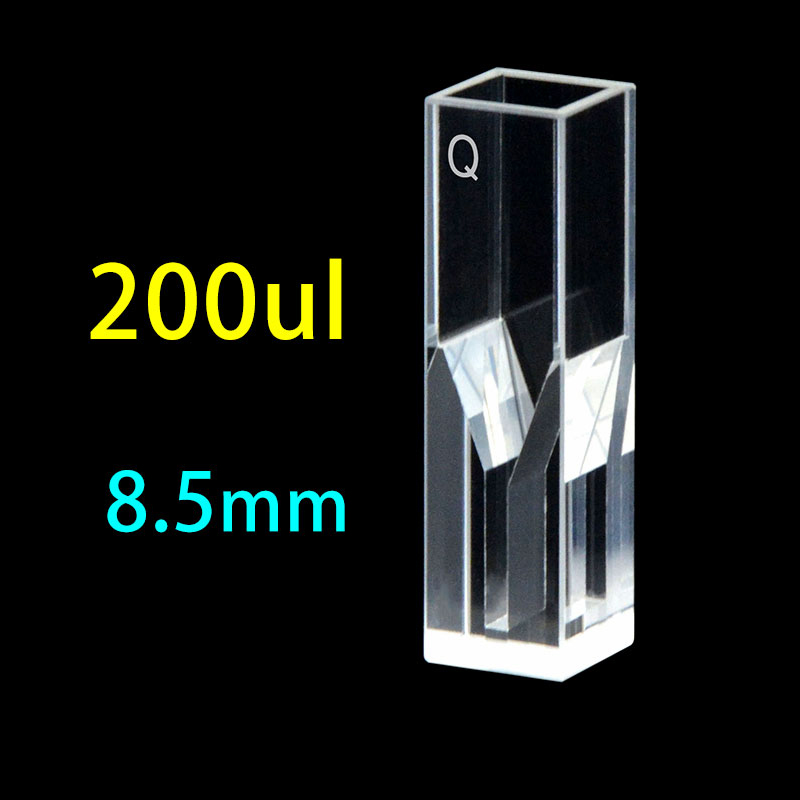 200 µL routine
C104CS99 — Sub-micro 200 µL
10 mm path · the workhorse alternative to a NanoDrop pedestal for 50 ng/µL+ samples
View sub-micro → 0.5 mm concentrated
C054TE — 0.5 mm screw-cap
175 µL · screw cap · for concentrated DNA & antibody where 1 mm saturates
Sub-mm guide →5. The decision tree
Three questions resolve most cases.
Question 1: Is sample volume < 5 µL the binding constraint?
If YES — you have only a few microliters of plasmid eluate, PCR cleanup, or precious microvolume sample — the NanoDrop is the right tool, with two exceptions: (a) the work is GMP-validated or pharmacopoeial (use the cuvette method), or (b) the concentration is below the pedestal noise floor (~ 5 ng/µL for dsDNA; use a cuvette).
Question 2: Do you need kinetics or temperature control?
If YES — enzyme kinetics, DNA melting curves, ligand binding, time-course measurements — only a cuvette in a thermostatted cell holder will do the job. Pedestals are single-point instruments by design.
Question 3: Is the work GMP, GLP, IVD-validated, or pharmacopoeial?
If YES — use a cuvette with a certified path length traceable to the cuvette manufacturer’s CoA. Pharmacopoeial methods specify cuvette path length and require path-length verification.
For everything else, both methods will give you the answer; the choice comes down to throughput, cost, and operator preference.
6. Workflow examples
Workflow A: Molecular biology core facility — pedestal wins
Daily traffic: 50–200 plasmid preps, miniprep eluates at 100–500 ng/µL, sample volumes of 30–50 µL. Users want fast walk-up. The NanoDrop One throughput (60+ samples/hour) and 1 µL volume make this clearly pedestal territory. Cuvettes would slow workflow and consume sample.
Workflow B: Pharma stability assay — cuvette wins
Active pharmaceutical ingredient at the assay design point, validated against a USP or in-house method. Path length must be traceable; method requires 1 cm cell. The pedestal cannot do this work in a regulated environment because path length is not USP-traceable.
Workflow C: Enzyme kinetics — cuvette wins
Lactate dehydrogenase activity, NADH consumption at 340 nm, 25 °C, 5-minute kinetic run. Requires cuvette in thermostatted cell holder. Pedestal cannot run this method.
Workflow D: Concentrated protein A280 — either, depending on sample volume
Recombinant antibody at 5–15 mg/mL. NanoDrop One auto-shorts to 0.2 mm path and reads in the linear window. A 0.5 mm sub-micro cuvette does the same job in 30 seconds with the additional benefit of recovering the sample. If you have only 2 µL, use the pedestal. If you have 50 µL, the cuvette is equally fast and you keep the sample.
Workflow E: Trace dye in environmental sample — cuvette wins
Sub-mg/L dye in wastewater. Concentration is below the pedestal noise floor (its 0.5–1 mm effective path length cannot achieve the absorbance needed). A 50 mm long-path cuvette is the right tool (see long-path cuvettes for trace UV-Vis).
7. Total cost of ownership
Three-year amortised cost for a typical mid-size lab doing 5,000 measurements per year (30% DNA QC, 20% protein, 20% OD600, 30% other).
| Cost item | NanoDrop-only | UV-Vis + sub-micro cuvettes |
|---|---|---|
| Capital instrument | $8,500 (NanoDrop One) | $18,000 (mid-tier UV-Vis benchtop with Peltier) |
| Cuvettes (3 yr) | $0 | $400 (mix of 0.1, 0.5, 1, 5, 10 mm) |
| Service contract (3 yr) | $2,400 | $3,600 |
| Consumables (Kimwipes / pipette tips) | ~$300 | ~$300 |
| Workflow constraint | Cannot do kinetics, regulated work, low concentration | Does everything NanoDrop does + more |
| 3-year total | ~$11,200 | ~$22,300 |
| Per-measurement cost (15K measurements) | $0.75 | $1.49 |
The NanoDrop is cheaper per measurement when DNA QC dominates the workflow. The UV-Vis + cuvette stack is more expensive but covers a wider range of methods. For labs that do anything beyond DNA QC, the UV-Vis stack is usually the better long-term investment. If you already own a UV-Vis spectrophotometer (most labs do), the marginal cost of adding sub-micro cuvettes is essentially $200–500 — vs $8,500 for the pedestal.
8. Audit-trail and compliance considerations
For regulated environments (GMP, GLP, FDA 21 CFR Part 11, EU GMP Annex 11), instrument data must be traceable, auditable, and tied to a validated path-length standard. The two methods differ here.
NanoDrop / pedestal compliance
NanoDrop instruments record measurement data in their software (PC-tethered or self-contained), with timestamps and operator login. Path length is auto-set by the instrument. Path-length verification is done with the manufacturer’s calibration check kit at intervals defined by SOP. For internal tracking and lab QC this is generally sufficient. For pharmacopoeial methods (USP, EP, JP) the pedestal is typically not the validated path — the methods specify a 1 cm cuvette.
Cuvette compliance
Each cuvette ships with a CoA from the manufacturer specifying path length to ±0.005 cm. Path length is verified as part of incoming inspection or via in-house holmium oxide / didymium glass standards (USP <851> protocol). Spectrometer software records measurement data. The audit trail is: instrument log + cuvette CoA + path-length verification record. This is the path that regulatory auditors expect to see for pharmacopoeial methods.
If your work touches FDA submission, GMP release testing, or pharmaceutical quality control: use a cuvette with a traceable path-length CoA. The NanoDrop is excellent for in-process QC (R&D, screening, IPC) but is rarely the validated method for finished-product testing.
9. MachinedQuartz sub-micro cuvettes that match NanoDrop volumes
Three sub-micro cuvette geometries cover the volume range where NanoDrop is typically considered.
| Cuvette | Path length | Sample volume | Best for |
|---|---|---|---|
| 0.1 mm sub-micro | 0.1 mm | ~ 50 µL | Concentrated DNA / protein (1,000–3,000 ng/µL; 10–50 mg/mL) |
| 0.2 mm sub-micro | 0.2 mm | ~ 80 µL | Concentrated samples + path-length lock |
| 0.5 mm sub-micro | 0.5 mm | ~ 100 µL | Standard concentrated DNA (200–1,000 ng/µL) |
| 1 mm sub-micro | 1 mm | ~ 100–200 µL | Routine DNA / protein at 50–500 ng/µL; the workhorse |
| 5 mm sub-micro | 5 mm | ~ 500 µL | Dilute samples |
All sub-micro cuvettes are JGS1 or JGS2 quartz, masked aperture (z-height 8.5 mm or 15 mm depending on cuvette) for compatibility with most spectrophotometers. See our micro cuvette guide for the deeper technical detail and z-dimension page for spectrometer compatibility.
Try a sub-micro cuvette first
2-piece MOQ. Try a 0.5 mm and 1 mm cuvette before committing $8,500 to a pedestal. Free shipping on first orders for qualified evaluators.
Request samples →See bulk programs →Related guides & tools
10. Frequently asked questions
Is a NanoDrop more accurate than a cuvette?
No. They are about equally accurate within their respective working ranges. NanoDrop is more convenient at 1-microlitre sample volumes; cuvettes are more accurate at low concentrations (below 5 ng per microlitre dsDNA) where pedestals approach their noise floor. For pharmacopoeial methods, cuvettes are the validated measurement; pedestals are typically a screening or in-process tool.
Can a sub-micro cuvette replace a NanoDrop for DNA QC?
For routine DNA quantitation at 50 to 1000 ng per microlitre with 50 to 100 microlitres of sample, yes — a 0.5 mm or 1 mm sub-micro cuvette gives equivalent or better accuracy at lower instrument cost. The NanoDrop wins when sample volume is the binding constraint (1 to 5 microlitres) or when throughput exceeds 50 samples per hour.
How much DNA do I need to get a reliable reading on a sub-micro cuvette?
About 50 microlitres of sample at 50 to 1000 ng per microlitre dsDNA gives a clean reading on a 0.5 or 1 mm cell. For lower concentrations, switch to a 5 mm or 10 mm cell with the same 50 to 100 microlitre sample volume. For samples below 10 ng per microlitre, a 10 mm cell is the right choice; below 5 ng per microlitre, consider concentrating the sample.
What is the path length on a NanoDrop pedestal?
The NanoDrop One uses an auto-shortening path of 1 mm at first measurement, automatically shortened to 0.2 mm at second measurement for high-concentration samples. The original NanoDrop ND-1000 used a fixed 1 mm path. Pedestal path length is set by the gap between pedestals, calibrated by the instrument; it is not user-changeable in the same way a cuvette path length is.
Can I do enzyme kinetics on a NanoDrop?
No. NanoDrop measurements are single-point: pipette, measure, wipe. There is no continuous-monitoring mode and no temperature control suitable for enzyme kinetics, DNA melting curves, or other time-course measurements. For kinetics, use a cuvette in a thermostatted cell holder on a UV-Vis benchtop.
Does my pharma method allow NanoDrop instead of cuvette?
Almost never for finished-product testing. USP, EP, and JP spectrophotometric methods specify path length and require path-length verification with holmium oxide standards in cuvette format. NanoDrop pedestals can be used in pharma R&D, in-process control, and screening, but the release-test method is typically the cuvette-based pharmacopoeial method. Check with your QA team for your specific method.
How do I clean a sub-micro cuvette between samples?
Rinse three times with the next sample (or with clean buffer or water) before each measurement. For nucleic acid work, a deionised water rinse plus a methanol or ethanol final rinse is sufficient. For protein work, dilute SDS or Hellmanex III soak followed by water and methanol rinse. Avoid abrasive cleaning: small chambers are more sensitive to scratch damage than 10 mm cells. See the cuvette cleaning protocol guide for the full SOP.
Do sub-micro cuvettes work in any UV-Vis spectrophotometer?
Almost always, with one caveat: sub-micro cuvettes are masked-aperture, meaning the optical window is reduced to about 2 mm by 8.5 or 15 mm to match the small chamber. This requires that the spectrometer beam be approximately centred on the optical axis and not extend past the masked window. Most modern spectrometers (Cary, Lambda, Shimadzu UV, JASCO, etc.) accept sub-micro cells with the standard cell holder. See the z-dimension page for compatibility detail.
Can I recover my sample from a sub-micro cuvette?
Yes. After measurement, withdraw the sample with a pipette tip (gel-loading tip works well for narrow chambers) and transfer back to the source tube. Recovery is typically 80 to 95 percent of the loaded volume, with the remaining 5 to 20 percent left as a film on the chamber walls. For NanoDrop, sample recovery is essentially zero — the sample wipes off onto a Kimwipe.
How long does a sub-micro cuvette last with proper care?
5 to 10 years of daily use is typical. The failure modes are scratching of the inner chamber (avoid with care during cleaning), thermal cracking (avoid sudden temperature changes), and contamination buildup that does not respond to cleaning (replace). At 50 to 200 dollars per cuvette and a 5 to 10 year life, the per-measurement cost is in the cents.
11. Disclaimer & notes
Trademark notice: NanoDrop is a registered trademark of Thermo Fisher Scientific. Implen NanoPhotometer, DeNovix DS-11, BioTek Take3, Eppendorf BioSpectrometer are trademarks of their respective owners. References to these products are for comparison and method-selection context only.
Comparison data reflects publicly available specifications and our own laboratory experience with both methods. Specifications change over time; verify with the manufacturer’s current product literature for binding figures.
Application examples in Section 6 are typical workflow patterns and are not exhaustive. Your specific assay, sample matrix, regulatory environment, or instrument-vendor recommendation may shift the choice. When in doubt, run the same sample on both methods and compare against a known reference standard.
Cost calculations in Section 7 use representative US list prices for mid-tier instruments and consumables. Actual costs vary by region, vendor, configuration, and contract terms.
Pharmacopoeial compliance: the path-length validation requirements of USP <851>, EP 2.2.25, and equivalent methods in other pharmacopoeias are subject to the published method version at the time of your submission. Always reference the current version of the method.
Information currency: last reviewed May 2026.


Recent Comments