
Demountable Cuvette Guide: Detachable Quartz Cells & IR Window Assemblies
This post is also available in:
A demountable cuvette is a quartz cell whose two optical windows can be separated and cleaned individually, with the path length set by interchangeable PTFE or stainless-steel spacers (typically 0.01, 0.025, 0.05, 0.1, or 0.5 mm). Demountable cells are essential for highly viscous samples that cannot be loaded into a sealed cell, IR work where the inter-window gap must be set with micrometer precision, and applications requiring thorough chemical cleaning between samples.
On This Page
Demountable Cells · Detachable Cuvettes
Demountable Cuvette Guide: Detachable Quartz Cells & IR Window Assemblies
🔧 Seeing weird spectra? Bubbles, interference fringes, baseline drift, sloping baselines, noise — diagnose 8 common UV-Vis symptoms in our UV-Vis Troubleshooting Guide with a 3-step rotate-the-cuvette triage that isolates cell vs. instrument problems in 30 seconds.
Disassemble for cleaning, swap path length, or build your own mid-IR cell with replaceable windows. Two product paths covered: MachinedQuartz quartz detachable cells for UV-Vis-NIR, and DIY assemblies using CaF₂ or sapphire windows for FTIR mid-IR work.
0.5 / 1 / 2 mm
Quartz path lengths
150–600 µL
Sample volume
2–25 µm
CaF₂/sapphire IR range
Sintered / Molded 83
Glue-free quartz
Reviewed by the MachinedQuartz Technical Team. We have manufactured detachable quartz cuvettes for short-path UV-Vis spectroscopy since 2026, with 0.5 mm, 1 mm, and 2 mm path lengths in continuous production. We also supply CaF₂ and sapphire windows used by customers as the optical interfaces in third-party demountable cell holders for FTIR mid-IR work. This guide covers both paths — what MQ sells assembled, and what we sell as raw material for DIY cell building.
What is a demountable cuvette?
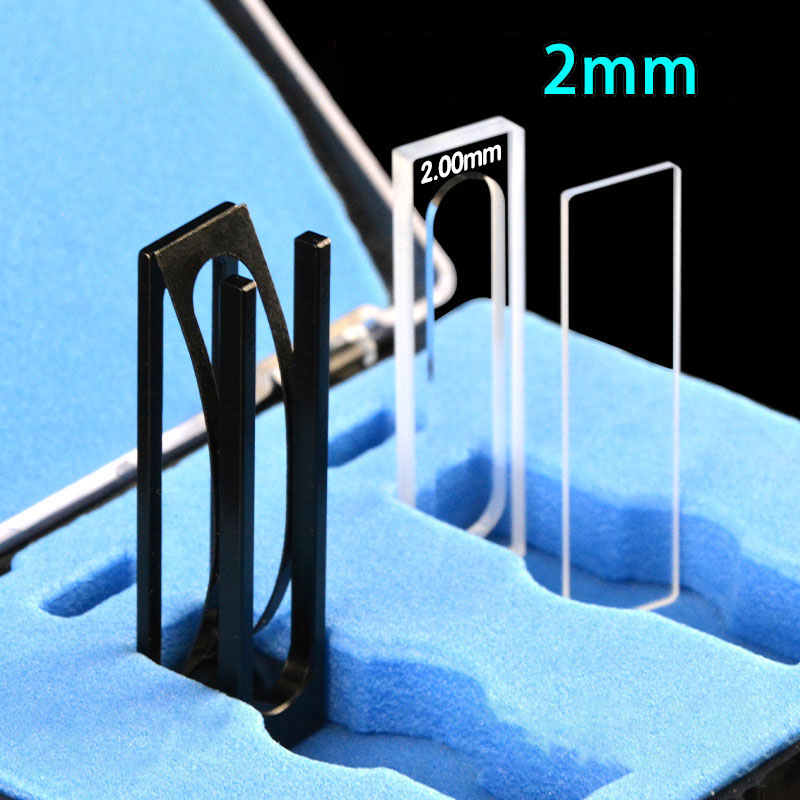
A “demountable” or “detachable” cuvette is a cell that disassembles into separate parts — typically front window, spacer, back window, and clamping body — instead of being a single sealed quartz body. Each part is independently swappable. The cell can be taken apart for cleaning, the spacer can be changed to alter path length, and damaged windows can be replaced without buying a whole new cell.
Demountable cells solve four common problems that sealed cuvettes can’t:
- Viscous or paste-like samples that won’t rinse out of a sealed cell — pharmaceutical creams, polymer melts, paint formulations, lipid pastes
- Permanently-staining samples — heavy dyes, melanin-rich biological extracts, polymerizing monomers that cure inside the cell before you can clean
- Variable path-length experiments — measuring a concentration series or kinetic study where you want to change the path length without buying multiple cells
- Mid-IR spectroscopy (FTIR) — where quartz can’t transmit and you need optical-grade alkali halide or fluoride windows that aren’t available as sealed cuvettes
The trade-off versus sealed cells: demountable cells require disassembly between samples (slower throughput), reproducibility depends on consistent reassembly torque (path-length variability ~5%), and the sample isn’t sealed against air ingress (oxygen-sensitive samples can be problematic). Sealed cells win for routine high-throughput work; demountable cells win for everything that doesn’t fit a sealed cell’s constraints.
Two product classes — assembled vs DIY
Demountable cells split into two distinct product classes with very different supply chains:
Path 1 — Assembled quartz cuvettes (UV-Vis-NIR)
MachinedQuartz manufactures complete detachable quartz cuvettes for UV-Vis and NIR transmission spectroscopy. The cell ships as a working unit: quartz body, quartz cover, integrated spacer at the specified path length, and a card-holder-compatible variant for thermometric and high-throughput rigs. Path lengths of 0.5, 1, and 2 mm cover the typical 150–600 µL sample volume range. Both Sintered 83 and Molded 83 fabrications are stocked; Standard 80 is not offered in this category because the adhesive seam is incompatible with the sample-clamping geometry.
Buy this when your wavelength is below 2500 nm and you want a complete cell ready to use.
Path 2 — DIY mid-IR assembly (FTIR work)
For wavelengths above 2500 nm, quartz can’t transmit and you need a different optical window material — CaF₂ to 8 µm, BaF₂ to 12 µm, sapphire to 5.5 µm, or alkali halides (KBr, NaCl) for the full mid-IR range. MachinedQuartz does not sell complete mid-IR demountable cells but does supply the optical windows: CaF₂ windows in standard round sizes from φ6 mm to φ50 mm, and sapphire discs and sheets in similar size ranges.
The complete cell is built by combining MQ windows with a clamping body from a third-party supplier — Specac OmniCell, Pike VeeMAX, Crystran kits — plus your choice of spacer (PTFE, amalgam, Mylar). DIY assembly takes 5 minutes and lets you replace any part independently when it gets contaminated or damaged. For specialty mid-IR work this is the standard approach in pharmaceutical R&D and academic FTIR labs.
MachinedQuartz quartz detachable cuvettes — the assembled product
MQ’s detachable cuvette line covers three path lengths, two volume ranges, and two fabrication grades — about 16 base SKUs plus card-holder-compatible variants:
| Path | Volume | Fabrication options | Best use |
|---|---|---|---|
| 0.5 mm | 150 µL | Sintered 83 · Molded 83 | High-concentration UV-Vis (drug formulations, concentrated antibodies) |
| 1 mm | 300 µL | Sintered 83 · Molded 83 | NIR water-band measurements, viscous biological samples |
| 2 mm | 600 µL | Sintered 83 · Molded 83 | Routine demountable work, kinetic studies with variable analyte |
Two engineering details that distinguish MQ’s detachable cells from generic quartz cuvettes:
Quartz cover, not flexible window
Many demountable cell designs use a thin quartz or glass plate as the front window, held in place by spring tension. MQ’s design uses a precision-ground quartz cover that mates flush with the cell body — no flexing, no gradient in path length across the optical aperture. Reproducibility cell-to-cell is < 0.5% path-length variation, vs 3–5% for spring-loaded designs.
Card-holder compatibility
Half of MQ’s detachable cuvette line is “card holder compatible” — meaning the cell fits into a 12.5 × 12.5 × 45 mm sample card holder used in high-throughput UV-Vis spectrophotometers (Cary 60 with rapid-changer, Lambda 25 with 8-cell turret). This is important for kinetic studies and process monitoring — the card holder swaps cells in seconds without manual reinstallation.
For card-holder use, specify “Card Holders Compatible” in the product name when ordering from the detachable cuvettes catalog.
DIY mid-IR cells using MachinedQuartz windows
For FTIR mid-IR work above 2500 nm, the standard approach is a demountable transmission cell built from optical windows + spacer + clamp body. The components come from different suppliers; the assembly is a 5-minute lab procedure.
Window selection — match wavelength to material
Pick the window material based on your wavelength range and sample chemistry:
- CaF₂ (φ6 mm – φ50 mm) — covers 200 nm to 8 µm continuously. Insoluble in water, low-cost, easy to clean. The default for aqueous and most organic mid-IR work. MQ CaF₂ windows in 11 standard sizes.
- BaF₂ — covers 200 nm to 12 µm. Wider IR range than CaF₂, still water-resistant. More fragile (tendency to cleave). MQ stocks select sizes; custom by request.
- Sapphire (φ1.5 mm – φ50 mm) — covers 200 nm to 5.5 µm. Mechanical strength + chemical inertness make it ideal for high-pressure or aggressive-chemistry samples. MQ sapphire discs and sheets.
- NaCl, KBr — alkali halide windows for 2.5–17 µm or 2.5–25 µm respectively. Cheap but water-soluble; we don’t stock these — buy from Crystran or KBr Industries.
- ZnSe — for 500 nm to 20 µm. Tough, water-insensitive, ATR-compatible. Toxic dust hazard. We don’t stock; buy from Edmund Optics or Crystran.
Spacer + clamp body
Once you have the windows, you need a spacer to set path length and a clamping body to hold everything together. Both come from third-party suppliers:
- Specac OmniCell — the lab standard. Stainless body, accepts most window materials, takes amalgam or PTFE spacers from 0.025 to 1.0 mm. Sold as kit ($300–$600) or accessory.
- Pike VeeMAX III — for ATR variant. Smaller form factor, integrated heated stage option.
- Crystran demountable kits — budget option with NaCl/KBr windows pre-included; you can replace with MQ CaF₂ or sapphire as needed.
For the optical specs of MQ windows used in these assemblies — transmission curves, surface flatness, parallelism — see the spec sheets on each individual product page.
Spacer thickness — the only variable that changes the path length
In a demountable cell, the spacer between the two windows determines the optical path length completely. Window thickness doesn’t matter; only the gap between them — set by the shim — defines how much sample sits in the optical path.
Five common thicknesses cover almost all applications:
- 0.025 mm (25 µm) — for FTIR thin-film and very strong absorbers. Holds about 3 µL of liquid in a φ12.5 mm aperture. Used for concentrated proteins, neat solvents, and any IR sample where you need to keep absorbance below 1.0 OD with strong bands.
- 0.1 mm (100 µm) — FTIR liquid samples. About 12 µL volume. The default for routine mid-IR liquid work where the sample is dilute enough that 100 µm gives a usable signal.
- 0.5 mm — UV-Vis-NIR aqueous samples (concentrated proteins, drug formulations). 150 µL volume. The MQ 0.5 mm Detachable Cuvette ships with a built-in spacer at this thickness.
- 1.0 mm — General-purpose UV-Vis-NIR. 300 µL volume. The most-ordered MQ detachable cuvette path length.
- 2.0 mm — Organic solvents and clear samples that need a longer path. 600 µL volume.
Spacer materials matter beyond thickness:
- PTFE (Teflon) — solvent-resistant, chemically inert, reusable. The default for routine UV-Vis-NIR. MQ ships PTFE shims with detachable cuvette orders.
- Lead amalgam — soft metal that conforms to the windows under clamping pressure, sealing tight. The classic FTIR mid-IR spacer for liquids that would leak past PTFE.
- Aluminum or copper — single-use cheap spacers for expendable measurements. Not for routine work.
- Mylar — UV-clear flexible spacer. Used when you want to read absorbance through the spacer (rare but useful in dichroic measurements).
- Stainless or brass — for high-temperature work above 200 °C where PTFE would soften.
Tip: For variable-path-length experiments, buy a complete spacer kit from Specac or Pike — usually 5 or 7 thicknesses in PTFE, ranging from 0.025 to 1.0 mm. Mixing and matching saves the cost of buying separate shims for each path length. The kit also includes installation tools and torque guidelines for consistent reassembly.
Filling viscous samples — the demountable advantage
The whole reason demountable cells exist is to handle samples that won’t fill a sealed cuvette. Three sample classes that demountable cells specifically solve:
Pastes, gels, and creams
Cosmetic creams, pharmaceutical ointments, polymer gels, and paint formulations are too viscous to pipette into a 1 mm sealed cuvette. The standard procedure is:
- Disassemble the cell — remove the front window
- Apply a small amount of paste directly to the back window’s optical face using a small spatula or a syringe with a wide-bore tip
- Replace the front window — the spacer determines how thick the layer becomes; excess paste squeezes out the sides
- Wipe excess off the outer optical face before measurement
For consistency across samples, weigh the paste portion before assembly so each measurement uses the same amount.
Polymer melts and viscous solutions
Polymer solutions in viscous solvents (high-MW polystyrene in toluene, polysaccharides in glycerol, gelatin) flow too slowly to pipette into a sealed cell. Apply directly to the back window with a glass rod or large-bore syringe; clamp closed; let viscosity equilibrate for 1–2 minutes before scanning.
Solid films and thin sheets
Plastic films, cellulose membranes, hard-coated optical windows. These can’t be pipetted at all — they’re solid samples that need to sit in the optical path. Place the film between the windows in lieu of a spacer; clamp closed; the film thickness becomes the effective optical path. For films thinner than 25 µm add a PTFE shim to set total path; for thicker films the film alone provides path length.
Note: For samples that contain abrasive particles (metal pigments, sand, mineral fines), check the sample for hard particles before clamping — pressing a hard particle between two quartz windows under torque cracks the windows. Filter abrasive samples through a 0.5 mm mesh before loading.
Cleaning demountable cells — disassemble, clean parts separately
The cleaning protocol for demountable cells differs from sealed cuvettes in one key way: disassemble the cell completely, clean each component separately, then reassemble for the next sample. This is what makes demountable cells faster to clean than sealed cells when the sample is anything other than a routine aqueous solution.
Standard cleaning sequence:
- Open the clamp body while holding the cell over a waste container — sample drips out through the gap as soon as pressure releases
- Remove the front window with optical tweezers — never with bare fingers (skin oils stain quartz)
- Wipe the spacer with lens paper soaked in an appropriate solvent — water for aqueous samples, ethanol or acetone for organics
- Rinse each window separately with the sample’s compatible solvent, then DI water + 1% Hellmanex bath for 5 minutes, then 5× DI rinse
- Air-dry rim-up overnight on lens paper at room temperature — never blot
- Reassemble when fully dry — windows back into clamp body, fresh spacer, careful alignment
For deep cleaning of dyed or polymerized samples, the deeper protocol from the cuvette cleaning protocol guide applies — Hellmanex 50 °C overnight, sonicate while submerged, chromic acid only on Sintered/Molded 83 quartz windows (never on alkali halides — they’ll dissolve).
Don’t: mix cleaning chemistry between window materials. CaF₂ tolerates mild acid but cleaves in strong base; sapphire tolerates anything except HF; quartz handles most chemistry but etches in HF or NaOH > 1 M. If you have CaF₂ and quartz windows in the same demountable cell, clean each separately with the appropriate chemistry rather than soaking the whole cell.
DIY vs buy assembled — when each makes sense
For UV-Vis-NIR work where MachinedQuartz sells a complete detachable cell, buying assembled is almost always the right answer. The cost and time are minimal, the geometry is precision-machined, and there’s no DIY assembly variability to manage. Skip to the products section.
For mid-IR work where MQ doesn’t sell a complete cell, the DIY question becomes real. Decision matrix:
| Factor | Buy assembled (Specac/Pike) | DIY with MQ windows |
|---|---|---|
| Initial cost | $1,200–$3,500 | $500–$1,500 (clamp $300–600 + windows $40–120 each) |
| Time to first measurement | Out of the box | ~10 minutes assembly |
| Window replacement | OEM windows only · expensive | Replaceable from any supplier · cheaper |
| Path-length flexibility | Spacers only | Spacers + window swap (CaF₂ vs sapphire vs BaF₂) |
| Reproducibility | Better (factory-aligned) | Slightly worse (manual reassembly) |
| Special features (heated, ATR, flow) | Available with cost premium | Hard to retrofit · buy assembled |
The general rule: buy assembled if your work is routine and high-throughput; build DIY if you need flexibility, replacement window economy, or non-standard window materials. Many labs do both — a Specac OmniCell as the workhorse plus a DIY kit for unusual experiments where a sapphire window is needed instead of the OEM CaF₂.
Recommended MachinedQuartz detachable cuvettes & windows
The MachinedQuartz catalog covers both product paths discussed above. Below are the most-ordered configurations for each:
For UV-Vis-NIR work — assembled quartz detachable cuvettes
2 mm Detachable
600 µL · most popular path length
View options →
1 mm Detachable ★
300 µL · default for NIR water-band
View options →
0.5 mm Detachable
150 µL · high concentration samples
View options →
For mid-IR DIY — optical windows
| Material | Range | Common sizes | Cost per window |
|---|---|---|---|
| CaF₂ windows | 200 nm – 8 µm | φ6 / φ10 / φ12 / φ12.7 / φ25.4 / φ50 mm | $40–$120 |
| Sapphire discs | 200 nm – 5.5 µm | φ1.5 / φ10 / φ25 / φ50 mm | $60–$180 |
| BaF₂ windows (custom) | 200 nm – 12 µm | φ12 / φ25 mm | quote |
| Custom (any material, any size) | — | quote | 4-week lead |
For card-holder-compatible variants, the full SKU range, or custom diameters and path lengths, see the detachable cuvettes catalog. For path-length math before ordering, use the Beer-Lambert path length calculator.
Frequently asked questions
What is a demountable cuvette?
A cuvette that disassembles into separate parts — typically front window, spacer, back window, and a clamping body that holds them together. Unlike sealed cuvettes (single-piece quartz body), demountable cells let you take the cell apart for cleaning, swap the spacer to change path length, or replace damaged windows. The trade-off is slightly worse reproducibility (manual reassembly) and slower throughput than sealed cells.
When should I use a demountable cuvette instead of a sealed one?
Four cases: (1) viscous or paste samples that won’t rinse out — pharmaceutical creams, polymer gels, paint formulations. (2) Permanently-staining samples like heavy dyes or polymerizing monomers. (3) Variable path-length experiments where you change path between samples. (4) Mid-IR (FTIR) spectroscopy where quartz can’t transmit and you need CaF₂, BaF₂, or sapphire windows that aren’t available in sealed cuvette format.
What’s the difference between a detachable and a demountable cuvette?
Same thing, different terminology. “Detachable” is more common in pharmaceutical and biotech labs (often used in MachinedQuartz product names); “demountable” is more common in academic and industrial spectroscopy (used by Specac, Pike, Crystran). Both refer to cells that disassemble for cleaning or path-length adjustment.
What is the smallest path length available in a demountable cell?
About 0.025 mm (25 µm) using a Mylar or amalgam spacer. This is the standard for FTIR thin-film work where you want to measure neat liquids or strong absorbers without saturating the detector. Below 25 µm becomes hard to seal reliably; for sub-micron path lengths, ATR (attenuated total reflectance) is the better technique.
Can I make my own demountable cell from MachinedQuartz windows?
Yes — that’s how mid-IR demountable cells are typically built. Buy CaF₂ or sapphire windows from MachinedQuartz, plus a clamping body from Specac OmniCell, Pike VeeMAX, or Crystran kits, plus PTFE or amalgam spacers. Total assembly takes ~10 minutes and you can replace any individual part. For UV-Vis-NIR, just buy MQ’s complete detachable quartz cuvette — DIY assembly isn’t necessary.
How do I clean a demountable cuvette?
Disassemble completely, clean each part separately. Open the clamp, remove front window with optical tweezers, wipe the spacer, rinse each window with the sample-compatible solvent, then 1% Hellmanex bath for 5 minutes, 5× DI rinse, ethanol displacement, air-dry rim-up overnight. Reassemble when fully dry. For deep cleaning of dyed or polymerized samples, see the cuvette cleaning protocol guide.
Why does my demountable cell have inconsistent absorbance between samples?
Three usual causes: (1) inconsistent reassembly torque — use the manufacturer’s recommended torque or a consistent finger-tight feel. (2) Worn spacer — PTFE compresses with use; replace after 50–100 reassemblies. (3) Window contamination from previous samples — clean each window separately rather than soaking the whole assembly. For pharmaceutical QC where reproducibility matters at the 1% level, sealed cuvettes give better repeatability than demountable cells.
Can I use a demountable cell for fluorescence?
Most demountable cells are 2-window (transmission only) — designed for absorbance measurements. For fluorescence you need 4-window light geometry which most demountable designs don’t support. Some specialty 4-way demountable cells exist for niche photophysics work but are not stocked by MQ; contact us for custom quotes if needed. For routine fluorescence, see the fluorescence cuvette guide.
What is the temperature limit of a demountable cell?
Depends on the spacer and clamp body materials. PTFE spacers soften above 200 °C — use stainless or brass for higher temperatures. The quartz windows themselves tolerate up to 1200 °C in Molded 83 fabrication. The clamp body (Specac OmniCell stainless) tolerates up to 250 °C with thermal jacket option. For in-situ heated DRS or IR above 250 °C, custom cells with all-metal clamp bodies and high-temperature spacers are available — contact MachinedQuartz for quotes.
How do I pick path length for a demountable cell?
Match path length to your sample’s expected absorbance — Beer-Lambert linear range is roughly 0.1 to 1.0 OD. For aqueous proteins at 280 nm, 1 mg/mL needs 1 mm path; 10 mg/mL needs 0.1 mm. For NIR water-band measurements above 1300 nm, always use 1 mm or shorter. For FTIR thin-film of strong organic absorbers, 0.025 to 0.1 mm. Use the Beer-Lambert path length calculator to estimate from your target absorbance.
About this guide. MachinedQuartz manufactures detachable quartz cuvettes for UV-Vis-NIR transmission spectroscopy and supplies CaF₂ and sapphire optical windows used by customers in third-party demountable cell holders for FTIR mid-IR work. Spec values, application recommendations, and DIY assembly notes in this guide come from internal QC measurements and customer reference setups across pharmaceutical, polymer, and academic R&D labs.
Next step: pick a path
For UV-Vis-NIR transmission work, MachinedQuartz’s complete detachable quartz cuvettes (0.5 / 1 / 2 mm path) ship in 1–3 days from US stock. For mid-IR FTIR work, MQ supplies CaF₂ and sapphire windows in standard sizes that you combine with a third-party clamp body for a complete demountable cell. Both options serve different markets — pick by wavelength range, sample type, and assembly preference.


Recent Comments