
Quartz Capillary Tubes & Rods: Selection Guide
This post is also available in:
Quartz capillary tubes and rods are precision-drawn fused-silica tubes (hollow) and rods (solid) with outer diameters from 0.5 mm to 50 mm, used in X-ray diffraction, gas chromatography injectors, capillary electrophoresis, microfluidics, fiber-optic preforms, and high-temperature furnace tubes. Selection depends on three parameters: profile (round, square, rectangular, or D-shape), grade (JGS1/JGS2/JGS3 by wavelength), and finish (fire-polished, ground, or precision-bore).
Microfluidics · CE · GC · Photonics
Quartz Capillary Tubes & Rods: Selection Guide
Cross-section selection, dimensional tolerances, and application matrix for 11 cross-section types of fused-quartz capillary tubes and solid rods. From 0.3 mm round CE capillaries to multi-hole gas-delivery tubes to D-shape and triangular specialty geometries — the entire MachinedQuartz capillary range mapped to the application that needs it.
11
Cross-Section Types
513+
Stock SKUs
0.3–30 mm
OD Range
JGS1/2/3
Material Grades
A capillary tube is the simplest precision optical and fluidic component imaginable: a hollow tube with a very small inner diameter, drawn from molten silica or machined from solid quartz blanks. The simplicity disguises how many distinct applications depend on getting the geometry exactly right. A 50 µm inner-diameter quartz capillary is the heart of every capillary-electrophoresis instrument; a 100 µm square-bore capillary is the substrate for half the microfluidic chips published in Lab on a Chip; a 5-hole multi-bore capillary delivers carrier gas to GC injectors; an eccentric-bore capillary positions an optical fibre in a quantum-optics atom trap.
This guide covers all 11 cross-section types we manufacture — round tubes, round solid rods, square tubes, square solid rods, multi-hole circular, outer-square inner-round, outer-circular inner-square, rectangular, D-shape, eccentric, and triangular — and maps each to the application that needs it. The decision matrix in section 10 covers eight major application classes; the catalog section links directly to the 513-SKU inventory.
Who needs this guide. Capillary-electrophoresis instrument OEMs, microfluidic chip designers, GC column manufacturers, semiconductor diffusion-tube buyers, optical-fibre preform R&D groups, photonic-crystal-fibre researchers, quantum-optics labs building atom or ion traps, precision-dosing equipment makers, and the procurement teams sourcing the capillaries for any of these. If you have ever spent a week trying to source a 0.3×0.5 mm rectangular capillary, this guide is for you.
1. Why fused quartz capillaries
Capillaries can be drawn from several materials — borosilicate (BK7-class) glass, soda-lime glass, fused quartz, and several specialty polymer formulations. For demanding analytical and scientific work, fused quartz dominates for five reasons:
- Deep-UV transparency. Fused quartz transmits from 185 nm with appropriate JGS1 grade. CE work at 200–220 nm (peptide bond absorbance), GC detection at 254 nm, and many fluorescence excitations are below the cutoff of borosilicate glass (310 nm).
- Chemical inertness. Fused quartz is essentially inert to acids (except HF), bases, organic solvents, and process gases. Capillary inner walls do not contribute leachables to the analyte stream.
- Low thermal expansion. Coefficient 0.55 × 10⁻⁶ /K — about 5× lower than borosilicate. Important for capillary-based instruments where temperature varies during operation.
- High temperature tolerance. Operational up to 1100 °C continuous. Critical for GC inlets at 250–400 °C, semiconductor diffusion tubes at 800–1200 °C.
- Mechanical strength. Drawn quartz has high tensile strength (up to 7 GPa for fresh-drawn fibre); machined-end products survive routine handling.
What quartz capillaries are NOT for
- HPLC capillaries: the standard is fused-silica (synonymous with quartz here) but with specific surface treatment (PEEK or polyimide coating) for pressure tolerance up to 1000 bar. We supply blank uncoated quartz capillaries; coated HPLC capillaries are a downstream specialty.
- Biocompatible / single-use medical: regulated medical use requires a separate biocompatibility certification chain that we do not currently offer.
- Cost-sensitive disposable applications where polymer (PMMA, COC, COP) is acceptable: quartz is overkill.
Existing on-site reference: see also our micro quartz capillary tubes & rods page for the full catalog with extensive product photos. This guide is the selection-and-application companion.
2. The 11 cross-section types — overview
The 513-SKU MachinedQuartz capillary catalog is organised by cross-section. Round tubes dominate by SKU count because they cover the largest market (CE, GC, microfluidics), but seven of the eleven types serve specialty applications that round tubes cannot fill.
| Type | SKUs | Typical OD range | Typical ID / bore | Primary application |
|---|---|---|---|---|
| Round hollow tube | 324 | 0.3–30 mm | 0.05–25 mm | CE, GC, microfluidics, sample handling |
| Round solid rod | 81 | 0.34–25 mm | n/a (solid) | Optical positioning, fibre fiducials, mounting pins |
| Square hollow tube | 24 | 0.5–10 mm | 0.2–9 mm | Microfluidics, square-bore CE, optical positioning |
| Square solid rod | 18 | 0.5–15 mm | n/a (solid) | Photonic crystal fibre preforms, alignment fixtures |
| Multi-hole circular | 12 | 1–6 mm | 5×0.15 mm typical | GC inlet liners, gas distribution, photonic crystal fibres |
| Outer round, inner square | 12 | 1–5 mm | 0.2–3 mm sq | Specialty microfluidics, fibre alignment |
| Outer square, inner round | 24 | 1–5 mm sq | 0.2–4 mm rd | Easy-mount round-bore for square-aperture instruments |
| Rectangular | 9 | up to 5×3 mm | variable | Slot-shape sample chambers, beam shaping |
| D-shape | 3 | ~2.5×2.3 mm | ~1.6 mm | Lateral-flat-side mounting, specialty optical positioning |
| Eccentric bore | 3 | specialty | off-centre bore | Atom traps, ion traps, off-axis fibre alignment |
| Triangular | 3 | specialty | triangular bore | Optical fibre positioning, specialty waveguides |
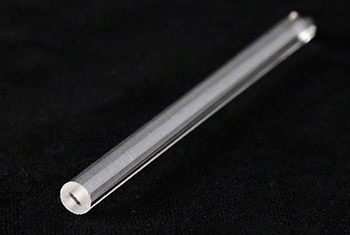 Round · 324 SKU
Round hollow tubes
OD 0.3 – 30 mm · ID from 50 µm · the universal default
View round tubes → Square · 24 SKU
Square hollow tubes
OD 0.5 – 10 mm · square bore · for chip microfluidics & flat optical access
View square tubes → Multi-hole · 12 SKU
Multi-hole circular
1 – 6 mm OD · 5x parallel bores · for GC inlets & PCF preforms
View multi-hole →3. Round hollow tubes & solid rods
The largest single category in the catalog. Round-hollow tubes cover capillary electrophoresis, GC capillary columns, microfluidic interconnects, semiconductor diffusion tubes, and almost every general-purpose precision-bore application. Round solid rods serve a distinct purpose: optical positioning, fibre fiducials, alignment pins, and ion-trap or atom-trap support structures.
Round hollow tube dimensional ranges
- OD range: 0.3 to 30 mm in catalog; custom from 0.15 mm to 100+ mm
- ID range: 50 µm to 25 mm; the wall thickness sets the upper bound on ID for a given OD
- Typical wall thickness: 0.05–0.5 mm for sub-mm OD; 0.2–1 mm for 1–5 mm OD; thicker for larger OD
- Length: standard cuts 25, 50, 100, 200, 500 mm; custom up to 1500 mm; longer requires multi-piece fusion or custom drawing
Capillary electrophoresis (CE) capillaries
The CE workhorse is a 50–75 µm ID round-bore tube, 50–75 cm length, with a polyimide outer coating that reinforces the bare quartz. We supply uncoated quartz blanks; the polyimide coating is applied downstream by Chrom Tech, Polymicro Technologies, or the customer. Detection-window options: a UV-transparent window can be opened by burning off the polyimide coating in a 1 cm region near the cathode end.
GC capillary columns
GC capillary columns use a 250–530 µm ID round-bore tube, 15–60 m length, with a stationary-phase coating applied to the inside wall. We supply the bare quartz capillary substrate; the stationary-phase chemistry is applied by Restek, Agilent, Phenomenex, or the customer. GC capillaries are the highest-volume capillary use case globally, and the dominant industrial application.
Round solid rods
The 81-SKU round-rod range covers diameters from 0.34 mm to 25 mm. Common uses: optical positioning fiducials in microscopy and lithography, mounting pins for ion-trap electrodes, support structures in atom-trap experiments, and alignment dowels in high-temperature furnace assemblies. The bare-quartz surface is essentially atomically smooth at µm scale, allowing precise mechanical positioning.
 Round rod
Solid rod 81 SKU
OD 0.34 – 25 mm · solid
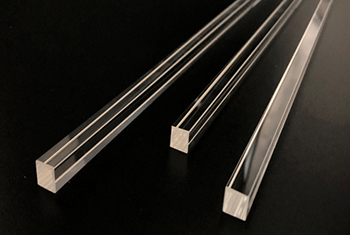 Square rod
Square solid 18 SKU
OD 0.5 – 15 mm · solid
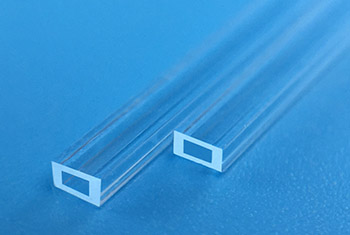 Rectangular
Rectangular tubes 9 SKU
up to 5 x 3 mm
 Square/round
Outer sq inner rd 24 SKU
flat mounting + round bore
4. Square & rectangular hollow tubes
Square cross-section tubes serve applications where a flat optical face matters: light enters or exits perpendicular to a flat surface, eliminating the cylindrical-lens distortion that round tubes introduce. The 24 SKUs in the square-hollow range cover OD 0.5–10 mm with corresponding inner-square dimensions. Wall thickness is typically 0.1–0.5 mm.
Square-bore microfluidics
Many microfluidic chip designs use square-bore capillaries as flow channels because the square cross-section is easier to model (rectangular Hagen–Poiseuille has clean closed-form solutions) and the flat walls integrate cleanly with optical detection (Raman scattering, fluorescence imaging, refractive-index sensing). Common geometry: 100–500 µm inner square bore in a 0.5–1 mm OD tube.
Square-bore CE
Less common than round-bore CE but used for flow-injection and isotachophoresis where the bore-shape uniformity is more important than electroosmotic flow profile. The flat walls also allow direct optical-fibre coupling for laser-induced fluorescence detection without introducing the lensing artifact that round-bore detection windows show.
Outer-square, inner-round (24 SKUs)
A specialty geometry: square outer profile (easy to mount in machined fixtures via flat-face contact) with a round inner bore (preferred for fluid flow). Used in instrument designs where the capillary must fit a square aperture but the analyte stream wants a round bore for laminar flow.
Outer-round, inner-square (12 SKUs)
The complementary geometry: round outer profile (fits standard ferrules and round-bore fittings) with a square inner bore (flat optical access for through-wall detection). Less common but useful where the application needs both standard fluidic interconnects and flat optical detection.
Rectangular tubes (9 SKUs)
Where the bore needs different X and Y dimensions: slot-shape sample chambers (microspectroscopy of thin films), beam-shaping waveguides (rectangular mode profile), and asymmetric microfluidic flow channels. Standard sizes up to 5 × 3 mm; custom proportions available.
5. Multi-hole capillaries (12 SKUs)
A multi-hole capillary is a single quartz tube with multiple parallel internal bores. The most common configuration in the catalog is a 5-hole circular pattern: four bores arranged at the corners of a square plus one central bore, all running parallel through the length of the tube. Typical dimensions: 1 mm OD, 5 × 0.15 mm bores.
GC capillary inlet liners
Modern GC inlets use a multi-hole liner inside the standard 4 mm OD glass inlet liner to control sample evaporation and prevent backflash. The 5-hole geometry distributes the flash-vaporised sample across multiple parallel paths, reducing peak distortion at the column head.
Photonic crystal fibre (PCF) preforms
PCFs guide light through a periodic array of parallel air-holes in the silica matrix — effectively a complex multi-hole capillary. Research-grade PCF preforms can be assembled by stacking and fusing single-hole capillaries (the “stack and draw” method). Multi-hole capillaries are used as starting blanks for the central core or as preform building blocks.
Gas distribution & sample injection
Multi-hole capillaries serve as miniature gas-distribution manifolds: parallel injection of multiple reagents into a microfluidic chip, multi-stream blending in microreactor chemistry, or multi-bore detector windows for parallel optical interrogation of N samples in a single capillary.
6. D-shape, eccentric, triangular — the specialty geometries
Three small-volume catalog families serve very specific applications where round, square, or multi-hole capillaries cannot work.
D-shape (3 SKUs)
A round outer profile with one flat face cut along the length — cross-section looks like a capital D. The flat face provides:
- A defined mounting surface for kinematic positioning (the flat references against a flat mount)
- A flat optical entrance for through-wall imaging without cylindrical-lens distortion
- A reference flat for milling additional features (channels, holes) into the capillary wall
Standard catalog: 2.5×2.3 mm OD with 1.62 mm round bore. Custom dimensions on request.
Eccentric bore (3 SKUs)
A round outer profile with the inner bore offset from the geometric centre by a controlled distance. Critical for:
- Atom traps: the offset bore positions the trapped atoms slightly off the optical axis, eliminating direct stray-light coupling into the detector
- Ion traps: similar geometry for ion-trap quantum-computing experiments where electrode geometry depends on bore position
- Off-axis fibre alignment: precision optical-fibre positioning where the fibre needs to be eccentrically mounted relative to the outer mounting reference
Triangular (3 SKUs)
Equilateral-triangle outer profile with triangular bore. Used for:
- Optical fibre positioning where three fibres need to be packed into a single bore at equal mutual spacing
- Specialty optical waveguides (triangular-mode propagation)
- Mechanical fitments where a triangular bore is needed to constrain a triangular insert
 D-shape
D-shape · 3 SKU
flat face for mount
 Eccentric
Eccentric · 3 SKU
off-centre bore
 Custom
Custom geometry
2-piece MOQ
 In-stock
Stock range
513 SKUs catalog
7. Material grades — JGS1 / JGS2 / JGS3
Three fused-quartz grades cover the full UV-NIR transmission range. Grade choice depends on the wavelength of any optical detection or excitation involved in the application.
| Grade | Transmission | OH content | Use case |
|---|---|---|---|
| JGS1 (Type 1, synthetic) | 185–2500 nm | ~ 1,000 ppm | Deep-UV CE detection, UV laser optics, deep-UV LIF; default for analytical work |
| JGS2 (Type 2, standard) | 220–2500 nm | ~ 100 ppm | Visible-only detection, GC capillaries, microfluidic chips at visible wavelengths |
| JGS3 (Type 3, low-OH IR) | 260–3500 nm | < 5 ppm | NIR work, laser-welding optics, NIR-extending applications |
Capillary-specific grade selection
- CE at 200–220 nm (peptide-bond detection): JGS1 mandatory; JGS2 cuts off below 220 nm
- GC capillaries (no UV detection): JGS2 standard; cost-effective
- Microfluidic chips with fluorescence detection (300–700 nm): JGS2 sufficient
- NIR microfluidics (1300–1600 nm telecom-grade detection): JGS3 preferred for low OH absorption
- Semiconductor diffusion (high temperature, no optical use): any grade; JGS2 standard for cost
For deeper grade discussion, see our UV cutoff guide — the same JGS-grade definitions apply across our cuvette, plate, and capillary product lines.
8. Dimensional tolerances and surface quality
Capillary precision is set by three dimensions: outer diameter, inner diameter (or bore profile), and concentricity. For specialty applications (CE, microfluidics, ion-trap geometry) tolerances tighter than the routine catalog values are available on request.
| Dimension | Catalog tolerance | Tightened on request |
|---|---|---|
| OD on round tubes ≤ 5 mm | ± 0.05 mm | ± 0.01 mm |
| OD on round tubes > 5 mm | ± 0.10 mm | ± 0.03 mm |
| ID on round tubes | ± 0.02 mm or 5% | ± 0.005 mm |
| Concentricity (OD-to-ID) | < 5% wall variation | < 2% wall variation |
| Square inner dimensions | ± 0.05 mm | ± 0.01 mm |
| Length cut | ± 0.5 mm | ± 0.1 mm |
| End-cut perpendicularity | < 1° | < 0.1° |
| Surface roughness Ra (drawn) | < 50 nm | < 20 nm |
Surface quality on the inner bore
The inner bore of a drawn capillary is essentially fire-polished as a side-effect of the drawing process — the molten silica reflows under surface tension during the draw, producing a surface roughness in the 10–50 nm range. This is critical for CE work (rough walls produce electroosmotic-flow nonuniformity) and for low-loss optical waveguide applications. For machined-end products (cut from preform-machined blanks rather than drawn), the inner surface is the as-machined finish unless specifically polished post-machining.
Tolerance vs. cost. Routine catalog tolerances are economical because they match the natural variability of the drawing process. Tightening to half the routine tolerance roughly doubles the price; tightening to one-fifth the routine tolerance can increase price 5–10x because of yield loss during inspection. Specify the tolerance you actually need; over-specifying inflates the quote without delivering benefit.
9. Drawing vs machining — how each capillary is made
Quartz capillaries are produced by two distinct manufacturing routes. The right method depends on the geometry, the volume, and the dimensional tolerances required.
Drawing from preform (volume production)
The dominant method for round, square, multi-hole, and standard cross-sections at small dimensions (OD < 10 mm). Process: a precision-machined preform with the desired cross-section geometry (10× to 100× the final dimensions) is heated in a graphite-element furnace at ~2000 °C; controlled tension pulls the softened preform through a neck-down zone where it reduces in cross-section while preserving the geometric proportions. The drawn capillary emerges from the bottom of the furnace and is wound on a take-up spool; downstream operations cut to length, inspect dimensions, and pack.
Drawing produces hundreds of metres of capillary per preform with consistent dimensions; surface quality is excellent because the molten silica reflows under surface tension. Round and square geometries scale to very small dimensions (50 µm ID is routine; 5 µm ID is achievable). Multi-hole geometries are also drawn this way using multi-hole preforms.
Machining from solid blank (specialty geometries)
For specialty cross-sections (D-shape, eccentric, complex multi-bore, large OD), a solid quartz blank is machined directly to the final geometry using diamond-tooled grinding and ultrasonic machining. Process: a quartz cylinder of slightly larger OD than the target is rough-machined to approximate shape; finer grinding stages refine the inner bore and outer profile; a final polish step achieves the surface specification.
Machining is slower than drawing (hours per piece vs metres per minute) and tolerated dimensions are larger (typically 0.1 mm rather than 0.01 mm), but it allows arbitrary cross-sections that cannot be drawn. Machining is also the production method for short-length specialty pieces where setting up a draw is not economical.
Hybrid: machined preform + drawn capillary
For specialty cross-sections where a long capillary is needed (e.g., a 5-hole drawn from a machined preform), the preform is machined first to the complex cross-section, then drawn to reduce the dimensions while preserving the geometry. This is how most multi-hole and complex-geometry capillaries are produced at length.
10. Application matrix — mapping needs to types
The decision matrix below maps eight common application classes to capillary type recommendations. Use it as a starting point; specific dimensions and grade depend on your detailed application.
| Application | Recommended type | OD / ID range | Grade |
|---|---|---|---|
| Capillary electrophoresis (CE) | Round hollow tube | OD 0.36 mm; ID 50–75 µm | JGS1 (UV detection) |
| GC capillary columns | Round hollow tube | OD 0.4–0.7 mm; ID 250–530 µm | JGS2 (visible only) |
| GC inlet liners | Multi-hole circular | OD ~ 4 mm; 5×0.15 mm bores | JGS2 |
| Microfluidic chips | Square or round tube | OD 0.5–1 mm; bore 100–500 µm | JGS2 or JGS1 if UV detection |
| Semiconductor diffusion / ion implant | Round hollow tube | OD 5–30 mm; large ID | JGS2 (no optical) |
| Optical-fibre preform & PCF | Multi-hole or specialty | variable | JGS1/JGS3 by application |
| Atom / ion traps | Eccentric bore | specialty | JGS1 (UV trap lasers) |
| Optical positioning / fiducials | Round solid rod | OD 0.5–5 mm | JGS2 |
Sourcing notes
- For CE: we supply uncoated bare quartz blanks. Polyimide outer coating and detection windows are added by Polymicro Technologies, Chrom Tech, or the customer.
- For GC: we supply bare uncoated capillary substrate. Stationary phase coating is applied by Restek, Agilent, Phenomenex, or the customer.
- For HPLC: we supply blank uncoated quartz; PEEK or polyimide jacket and high-pressure end fittings are downstream.
- For semiconductor: we supply the bare quartz tube; fixturing for specific furnace models is the customer’s responsibility.
11. Catalog & ordering
The MachinedQuartz capillary catalog has 513 SKUs across 11 cross-section types and a wide range of dimensions. Custom geometry and dimensions outside the catalog are available with no tooling fee on most variations — the same OEM and bulk programs that apply to our cuvette range apply to capillaries.
Need a custom capillary?
Send the cross-section type, OD, ID (or bore dimensions), length, JGS grade, and quantity. Custom dimensions within standard drawing envelope ship without tooling fee. We respond within one business day.
Request quote →Browse catalog →Browse the catalog
Related guides
12. Frequently asked questions
Do you supply CE capillaries with the polyimide coating?
We supply uncoated bare quartz capillary blanks. The polyimide outer coating and any detection-window opening are added downstream by Polymicro Technologies, Chrom Tech, the instrument vendor, or the customer’s in-house operation. The bare blank is the limiting input; the coating is a secondary process applied to it.
What is the smallest inner diameter you can make?
Routine drawn product reaches 50 microns inner diameter; specialty drawn capillaries reach 5 microns. Below 5 microns the dimensional tolerance becomes a large fraction of the bore (a 1 micron tolerance on a 5 micron bore is 20 percent), and the bore can collapse during drawing if the wall is too thin. For sub-5-micron applications, consider hollow-core photonic crystal fibers or alternative micro-channel technologies.
What length capillaries can you supply?
Standard catalog cuts are 25, 50, 100, 200, and 500 mm. Custom lengths up to 1500 mm are routine. Above 1500 mm, the capillary is supplied either spooled (continuous run) or as multiple shorter cuts. Drawn capillary on a take-up spool can reach hundreds of metres in a single continuous length; cut to your specified length in our QC step.
Can you make capillaries with a wall thinner than 50 micrometres?
Yes for round hollow tubes; standard catalog includes wall thickness as low as 50 micrometres. Below 50 micrometres the capillary becomes mechanically fragile during routine handling and ID-OD concentricity becomes harder to hold. For ultra-thin-wall applications (below 25 micrometres), specify the working OD and ID, and we’ll quote with appropriate handling and packaging recommendations.
How does the price scale with quantity?
Capillary pricing follows our standard volume tiers from the bulk OEM program: list price at 2 to 4 pieces, 5 to 30 percent volume discount up to 1000 pieces. For drawn capillaries, the per-piece cost drops more sharply with quantity than for machined products because the per-preform setup cost amortises over the entire drawn length. For applications needing tens of thousands of pieces per year, contact us for an annual contract pricing proposal.
Do you offer fused-silica capillary with HPLC pressure ratings?
We supply blank uncoated capillaries; HPLC requires high-pressure end fittings (typically NanoFerrule or Idex Health & Science fittings) and PEEK or polyimide outer coating for pressure tolerance up to 1000 bar. The combination of bare quartz capillary plus pressure fittings is the customer’s downstream assembly. We can quote the bare-quartz capillary; pressure fittings are sourced from your fittings supplier.
Can you make capillaries longer than 1500 mm in one piece?
Yes via spooled continuous draw, or via multi-piece fusion welding for rigid (non-spool) lengths. Spooled product reaches hundreds of metres. Welded multi-piece rigid runs are standard up to 3 metres; longer runs are quoted custom and need careful packaging for transport. The economical break-point between rigid welded and spooled depends on the application; ask at quote time.
Does MachinedQuartz make hollow-core photonic crystal fibres (PCF)?
We supply the multi-hole quartz capillary blanks and preform building blocks used as inputs to PCF drawing facilities; we do not produce finished PCFs at this time. PCF drawing requires specialised optical-fibre drawing towers with active feedback control on hole-area ratio — that is a downstream specialty operation. For finished PCF, refer to specialised photonic-fibre manufacturers; for the input materials, we are a competitive supplier.
How are square-bore capillaries made — drawn or machined?
Both, depending on dimensions. Square-bore capillaries with OD below about 5 millimetres are typically drawn from a square-bore preform that is itself precision machined; the drawing process preserves the square cross-section while reducing dimensions by 10 to 100 times. Above 5 mm OD, square-bore capillaries are typically machined from a solid round blank by ultrasonic or diamond-tooled grinding; this is slower but allows large dimensions and tight wall thickness control.
What surface finish is on the inner bore?
For drawn capillaries, the inner bore is fire-polished by the drawing process itself: the molten silica reflows under surface tension during the draw, producing a surface roughness Ra of 10 to 50 nanometres. This is excellent for CE work where wall roughness affects electroosmotic flow uniformity, and for low-loss optical waveguide applications. For machined-end products, the inner surface is as-machined unless specifically polished post-machining; specify if you need a specific Ra target.
13. Disclaimer & notes
Specifications on this page are typical values for commercial-grade fused-quartz capillary tubes and rods produced by MachinedQuartz. Specific dimensional tolerances, surface roughness, and material grade depend on the manufacturing route (drawn vs machined), the cross-section type, and the production lot. For binding specifications refer to the certificate of analysis supplied with each shipment.
Application recommendations are general guidance based on typical industry practice. Specific applications may have requirements (regulatory compliance, specific tolerances, surface treatments, downstream coatings) that constrain choice further. Verify against your application’s full specification before ordering.
Downstream products. MachinedQuartz supplies bare uncoated quartz capillary blanks. Polyimide CE coatings, GC stationary phases, HPLC pressure jackets, and PCF drawing are downstream specialty operations performed by other vendors or in-house. We are the input-material supplier; we do not perform these downstream operations.
Trademark notice. Polymicro Technologies, Chrom Tech, Restek, Agilent, Phenomenex, NanoFerrule, Idex Health & Science are trademarks of their respective owners. References are for compatibility and supply-chain context only.
Information currency: last reviewed May 2026. Catalog and SKU range subject to change.


Recent Comments