
DLS & Particle Sizing Cuvettes: Vendor Compatibility & Selection
This post is also available in:
A DLS / particle-sizing cuvette is a specialty quartz cell with a flat polished bottom and four optically polished sides, designed for dynamic light scattering instruments (Malvern Zetasizer, Brookhaven NanoBrook, Wyatt DynaPro) that measure 90° or backscatter intensity. Standard DLS cells are 12.5 × 12.5 × 45 mm with 800 µL volume; sub-microliter sizing requires capillary or low-volume variants in JGS1 grade for protein and nanoparticle work below 350 nm.
Dynamic Light Scattering · Nanoparticle Sizing
DLS & Particle Sizing Cuvettes: Vendor Compatibility & Selection
Cuvette selection for dynamic light scattering nanoparticle analysis on Malvern Zetasizer, Wyatt DynaPro, Anton Paar Litesizer, Brookhaven 90Plus and other DLS instruments. Geometry, surface quality, fabrication grade, and the sample-prep discipline that separates good DLS data from noise.
1 nm–10 µm
Particle Size Range
10 mm
Standard DLS Path
4-Way
Polished Geometry
3 grades
Fabrication Options
Dynamic light scattering measures the diffusion of nanoparticles in suspension by tracking the time-fluctuation of laser light scattered at a fixed angle. The hydrodynamic diameter calculated from the autocorrelation function depends on three things being right: the particles must be in solution, the laser path must be clean, and the cuvette must scatter as little spurious light as possible into the detector. The cuvette is part of the optical path and a meaningful contributor to data quality.
This guide covers what DLS demands of a cuvette — geometry, surface quality, sample volume, fabrication discipline — and maps the requirements to the major instrument families: Malvern Zetasizer (the dominant platform), Wyatt DynaPro, Anton Paar Litesizer, Brookhaven 90Plus, and several less common platforms. The decision matrix in section 9 maps experiment type to MQ product, and the catalog section lists the six MachinedQuartz SKUs that ship as DLS-ready cells.
Who needs this guide. Biopharma protein-aggregation labs, gene-therapy AAV/LNP characterisation teams, polymer suspension QC, nanomaterial synthesis groups, drug-delivery formulation labs, and any application where particle size in the 1 nm to 10 µm range is the readout. If you have ever blamed bad DLS data on “the sample” without first checking the cuvette, this guide is for you.
1. How DLS works — and why the cuvette is in the optical path twice
Static light scattering (SLS) measures the average intensity of scattered light to derive molecular weight; dynamic light scattering (DLS) measures the time-fluctuation of that intensity to derive size. As nanoparticles in suspension undergo Brownian motion, they pass in and out of the laser beam waist; the scattered intensity at any fixed detector angle fluctuates on the microsecond-to-millisecond timescale. Smaller particles diffuse faster (faster fluctuation); larger particles diffuse slower. The autocorrelation function g²(τ) captures this timescale and a curve fit (cumulants for narrow distributions, CONTIN or NNLS for multimodal) gives the hydrodynamic diameter distribution.
The cuvette participates in the optical path on both sides:
- The incident laser passes through one cuvette wall on the way in. Wall scattering, surface scratches, or fingerprints on this face seed spurious scatter into the entire measurement.
- The scattered light passes through a different cuvette wall on the way to the detector (90° or 173° depending on the instrument). Wall imperfections on this face reach the detector directly — worse than incident-side imperfections because they are amplified by the geometry.
This is why a 4-clear-side polished cuvette is the standard for DLS work: the same cell can be used on both 90° and 173° instruments, and any cell rotation puts a polished face on both incident and detection paths. A 2-side cell (only opposite faces polished) works only for transmission absorbance and is wrong for DLS.
Why “any 10 mm cuvette” is not the right answer. A standard 2-clear-side absorbance cuvette has rough or matte sides. Light scattered from the suspension reaches those rough faces and produces secondary scattering directly into the detector at 90°. Result: noise floor is 5–10x what it should be, the autocorrelation is poorly conditioned, and the calculated size has a systematic positive bias from the spurious counts. Always use 4-clear-side for DLS.
2. What DLS demands of a cuvette
Five physical properties of the cell determine whether your data is good or noise.
4-clear-side polished geometry
The cuvette must transmit cleanly on both the incident and the detection paths. Two-clear-side absorbance cuvettes have matte or unpolished sides that scatter spuriously into the detector. Use 4-clear-side cells (sometimes called “fluorescence cuvettes”) for DLS even when the application is purely scattering.
Path length 10 mm
The DLS path length convention is 10 mm. The path actually does not affect the result mathematically (DLS measures intensity fluctuation, not absorbance), but instrument geometry and sample volume considerations have standardised 10 mm. Some specialty short-path cells (1 mm) exist for very concentrated samples or high-extinction backgrounds; use only if your instrument vendor explicitly recommends.
Surface quality
Window flatness within λ/4 (about 150 nm) over the optical aperture; surface roughness Ra < 0.05 µm. Visible scratches, water spots, or fingerprints on the optical face directly contribute to the noise floor.
Sample-side wall finish
The interior wall must be clean and dust-free. Quartz cells are inherently smooth; the issue is contamination, not manufacturing. A speck of dust adhering to the inside of the wall scatters as much light as a 100-nm particle in suspension — a single dust mote can ruin a measurement.
Material grade
Standard JGS2 fused quartz is fine for visible-laser DLS (532 nm green, 633 nm red). JGS1 deep-UV grade is not necessary unless your instrument also offers 405 nm or shorter excitation. Optical glass (BK7-class) works for 532/633 nm but not for the small fraction of platforms using 405 nm.
3. Vendor compatibility — major DLS platforms
The standard 10 mm 4-clear-side fused-quartz cuvette (12.5 × 12.5 × 45 mm outer dimensions) is the universal DLS cell — native to every major instrument family. Where vendors differ is in the specialty cells they offer for specific applications: disposable cells for routine screening, capillary cells for zeta potential, folded cells for combined size + zeta measurements.
Malvern Zetasizer (Nano ZS / ZSU / Pro / Ultra)
The dominant DLS platform globally. Native acceptance of standard 10 mm 4-clear-side quartz; Malvern ships their own glass cells (PCS1115) and disposable polystyrene (DTS0012). For zeta potential measurements, the folded capillary cell (DTS1070) is standard and proprietary. The Zetasizer’s 173° backscatter geometry is more tolerant of sample turbidity than 90° instruments — useful for concentrated samples where multi-scattering would otherwise dominate.
Wyatt DynaPro (NanoStar / Plate Reader II)
Single-cuvette NanoStar and 384-well plate reader formats. Standard 10 mm quartz cells in the NanoStar; for plate-reader work the format is the SBS plate, not a cuvette. Wyatt does not ship disposable polystyrene cells in their standard accessory range; quartz is the recommended choice. Wyatt also offers MALS and SLS combined platforms (DAWN, miniDAWN) where the same cuvette discipline applies plus a stricter cleanliness requirement for the SLS angular intensity profile.
Anton Paar Litesizer (100 / 500 / DLS Pro)
Newer-generation 175° backscatter platform with strong focus on automated measurement. Standard 10 mm quartz native; disposable PMMA and polystyrene supported; the Omega capillary cell for zeta potential is vendor-specific. Anton Paar’s “particle quality” feedback algorithm helps identify sample issues during measurement — useful for noisy or inhomogeneous samples.
Brookhaven 90Plus / NanoBrook
90° scattering geometry; standard 10 mm 4-clear-side quartz native; disposable cells supported. Brookhaven offers SLS option on the 90Plus PALS platform. Native goniometer-based platforms (BI-200SM) accept standard cuvettes plus specialty narrow-bore cells for very small samples.
Other platforms
- Postnova / Wyatt FFF + DLS hybrids: standard 10 mm quartz, integrated into a flow path; cleanliness becomes flow-cell-relevant
- Stunner (Unchained Labs): high-throughput plate-based DLS for biopharma; uses a proprietary droplet format, not standard cuvettes
- NanoSight (Malvern NTA): different technique (single-particle tracking, not DLS); uses a flow cell with laser-illuminated viewing volume, not a cuvette
 Mold 83 · premium
C104CE29 — Mold 83 DLS cell
10 mm · 3.5 mL · 4-way light · highest transmission, single-piece fused construction
View C104CE29 →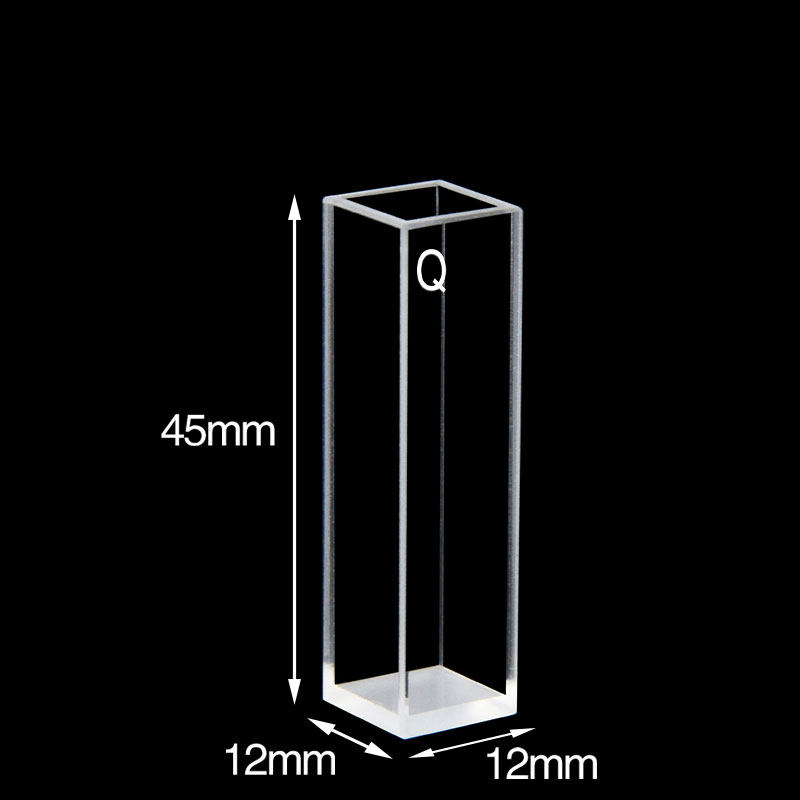 Sint 80 · workhorse
C104CA6 — Sint 80 DLS cell
10 mm · 3.5 mL · 4-way light · solvent-resistant sintered, mid-tier price/performance
View C104CA6 →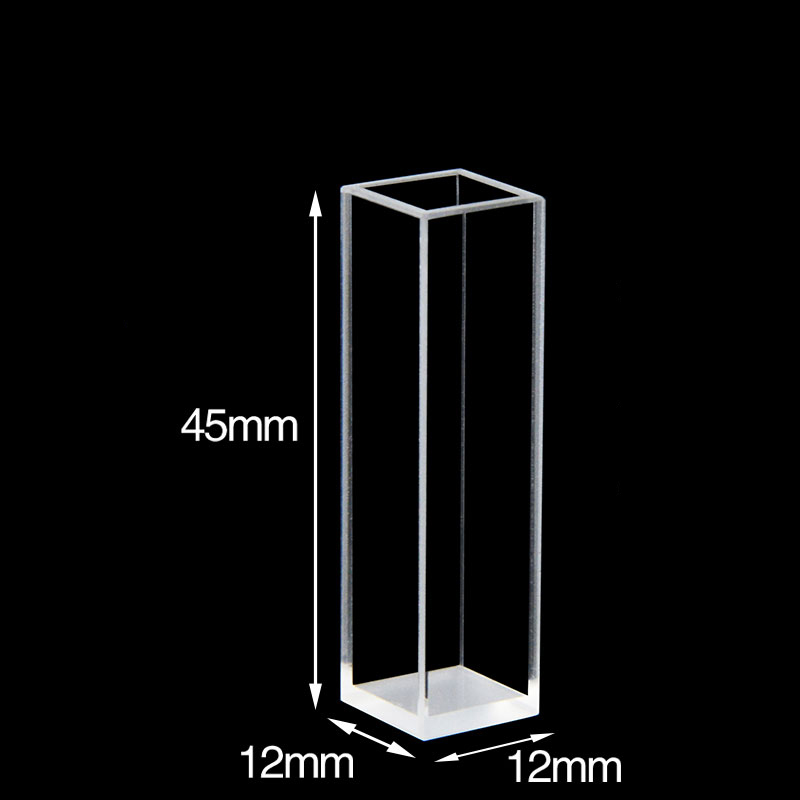 Std 80 · entry
C104CS92 — Std 80 DLS cell
10 mm · 3.5 mL · 4-way light · entry-tier glue-assembled, aqueous samples only
View C104CS92 →4. Sample volume considerations
The standard 10 mm DLS cuvette (3.5 mL nominal volume) needs to be filled to a minimum that puts the sample in the laser path and detection-collection cone. Underfilled cells produce meniscus-edge scattering that contaminates the autocorrelation.
Minimum fill heights
- Standard 10 mm 4-clear-side cell (3.5 mL nominal): minimum fill ~700 µL for 90° instruments; ~1.0–1.5 mL for backscatter (173°) instruments
- Reduced-volume cells (semi-micro 1.4 mL nominal): 200–400 µL; useful for limited samples, but check vendor minimum spec
- Capillary cells (zeta potential): 200–1,000 µL; vendor-proprietary format
The “more sample is better” rule of thumb
Within reasonable limits, filling the cuvette to 80–90 % of nominal capacity (rather than the minimum) gives more stable measurements. Reasons: the laser passes well below the meniscus; thermal convection in the small sample volume is reduced; the cell wall above the sample column does not contribute spurious scatter via near-field illumination.
For sample-limited applications (precious AAV, expensive antibodies, single-cell extracts), a semi-micro 4-clear-side cuvette accepts 200–500 µL. The smaller chamber is more sensitive to dust because the dust-to-sample ratio is higher per volume; centrifuge or filter even more carefully than for standard 3.5 mL work.
5. The cleanliness discipline — what separates good DLS from bad
DLS cuvette and sample cleanliness is qualitatively different from absorbance work. The Mie scattering intensity scales with the sixth power of particle diameter, so a single 1 µm dust speck in a 100 nm nanoparticle sample scatters as much as a million of the target nanoparticles. The autocorrelation function fits this contamination as if it were a “real” sub-micron-sized population, biasing your reported size distribution and inventing peaks that do not exist.
Pre-filter every sample
- 0.45 µm PVDF or PES syringe filter for samples in the 1–200 nm range
- 0.22 µm for samples below 50 nm where higher-confidence dust removal matters
- 0.1 µm for ultra-clean work (extracellular vesicles, virus particles, ultra-fine nanoparticles)
- For samples that cannot be filtered (large particles, gel-prone formulations), centrifuge at 3,000 g for 5 minutes; collect the supernatant for DLS
Cuvette cleaning protocol for DLS
- Rinse 3× with deionised water
- Rinse 3× with HPLC-grade methanol or ethanol
- Soak 10 minutes in 1 % Hellmanex III or equivalent detergent
- Rinse 5× with HPLC-grade water
- Final rinse with HPLC-grade methanol
- Dry inverted on a lint-free wipe, in a dust-free area (laminar-flow hood ideal)
- Inspect by holding cuvette under a strong lamp and rotating — any visible particle, film, or wipe-mark means re-clean
Storage
Store cleaned DLS cuvettes inverted in a foam-cushion box with the optical face protected. Storage in air dust contaminates within hours; storage in nitrogen-purged boxes or sealed containers extends the inter-cleaning interval. Avoid touching the optical face with bare hands at any time — even after cleaning, fingerprint oils transfer in seconds.
Common dust sources we have seen. Pipette tips with bench dust on the outside (always clean tip exterior or use box-fresh tips). Bench wipes that shed lint (use lint-free Kimwipe or laser-cleaning wipes). Sample tubes stored in a drawer with rubber seals (rubber dust). Reagent bottles uncapped longer than necessary (settle dust). The cleanest DLS work happens in laminar-flow hoods with filtered tip boxes.
6. Fabrication grade selection
MachinedQuartz manufactures the 10 mm 4-clear-side DLS cell in three fabrication grades. Each works with every major DLS instrument; the choice depends on solvent compatibility, optical performance, and price tier.
Tier 3 · entry
Standard 80 (glue-assembled)
Lowest cost; aqueous samples only. The bonding glue between window and side wall can dissolve in acetonitrile, DMSO, dichloromethane and other organic solvents. For routine aqueous work and student labs — not for solvent-containing formulations.
Tier 2 · workhorse
Sintered 80 (powder sintered)
Mid-tier; solvent-resistant powder-sintered construction. Stable to all common organic solvents and dilute acids. The default choice for routine DLS QC work in pharma, biotech, and nanomaterial synthesis labs. T > 80 % at 633 nm.
Tier 1 · premium
Molded 83 (one-piece fused)
Highest performance; one-piece integrally fused construction with no bonding interfaces. T > 83 % at 633 nm (highest light throughput of the three grades). Stable to all solvents and to elevated temperatures up to 1200 °C. The choice for SLS work where transmission stability matters most.
Decision rule
- Aqueous samples only, budget tier → Standard 80 (C104CS92 / C104CS93)
- Mixed aqueous + organic, routine QC → Sintered 80 (C104CA6 / C104CA7) — default for most labs
- SLS option, premium DLS, very stringent applications → Molded 83 (C104CE29 / C104CE30)
For details on the underlying fabrication processes, see our fabrication method guide.
7. Quartz vs disposable plastic cuvettes — honest comparison
Most DLS instrument vendors ship disposable polystyrene or PMMA cuvettes (Malvern DTS0012, Anton Paar PMMA cells) at attractive per-unit prices. The argument for disposables is convenience: no cleaning, no carryover, batch-fresh start every measurement. The argument for quartz is data quality.
| Property | Quartz (10 mm 4-side) | Disposable polystyrene / PMMA |
|---|---|---|
| Per-unit cost | $80–200 (reusable for years) | $1–3 (single-use) |
| Cleaning required | Yes (3–5 min protocol) | No |
| Carryover risk | Low if cleaned correctly | Zero (single-use) |
| Solvent compatibility | Aqueous + most organics | PMMA fails in acetone, MeCN, DCM; PS fails in MeCN, DCM, ethyl acetate |
| Background scattering | Very low (clean quartz) | Higher (polymer chains scatter) |
| UV laser (405 nm) compatibility | Yes (with quartz JGS2) | Limited (PS opaque below 280 nm) |
| Temperature limit | Up to 1200 °C (Mold 83) | ~ 60 °C max |
| Optical surface quality | Polished, λ/4 flatness | Molded; subtle wave / mark patterns |
| Best for | Validated methods, low concentration, demanding samples, small particle work below 10 nm | High-throughput screening, dirty samples, biohazardous material, contamination-sensitive workflows |
The pragmatic recommendation
Maintain both. Use disposables for routine high-throughput screening and contaminated samples. Use quartz for: validated method runs, GMP-relevant work, the smallest particle sizes (below 10 nm where polystyrene scattering background dominates), low-concentration samples where signal-to-noise matters, and any organic-solvent formulation where polymer cells fail. The cost trade-off depends on your throughput.
Disposable cells age in storage. Polystyrene cells stored in a humid lab can develop subtle surface haze in 6–12 months. PMMA absorbs trace solvents from labware glue. For consistent QC results, rotate disposable stock and inspect each cell briefly under a lamp before use.
8. Zeta potential, electrophoresis, and combined SLS
Several DLS instruments offer additional measurement modes that need different cuvette formats.
Zeta potential (capillary cell)
Zeta potential measurement applies an electric field across the sample and measures the resulting electrophoretic mobility of the charged nanoparticles. The standard cuvette is a folded capillary cell with two electrodes; the Malvern DTS1070 is the dominant format. These cells are vendor-proprietary; MachinedQuartz does not manufacture this format. For zeta-potential work, source from the instrument vendor.
Static light scattering (SLS) on the same instrument
Some platforms (Malvern Zetasizer Ultra, Wyatt DAWN, Brookhaven 90Plus PALS) offer SLS in addition to DLS, deriving molecular weight (Zimm plot) from absolute scattered intensity at multiple angles. SLS is much more demanding of cuvette transmission and surface quality than DLS because the absolute intensity (not the time fluctuation) is the readout. For SLS work, use the highest-grade cuvette available (Molded 83 in our range) and the most rigorous cleaning protocol.
Multi-angle DLS (MADLS)
Newer Zetasizer models combine 13°, 90°, and 173° measurements into a single experiment for improved size-distribution resolution. The standard 4-clear-side quartz cuvette works for all three angles simultaneously — this is the geometry advantage of 4-side polish.
Nanoparticle Tracking Analysis (NTA / NanoSight)
Different technique entirely — tracks individual nanoparticles in a flow cell via dark-field microscopy. Uses a proprietary flow chamber, not a standard cuvette. Outside the scope of this DLS-cuvette guide.
9. Decision matrix — experiment type to cuvette
The matrix below maps eight common DLS workflow types to MachinedQuartz cuvette recommendations. Use it as a starting point; your specific instrument and sample may shift the choice.
| Experiment | Cuvette format | MQ grade | Notes |
|---|---|---|---|
| Routine protein aggregation QC | 10 mm 4-side, 3.5 mL | Sintered 80 (C104CA6) | The workhorse; ~$100 reusable indefinitely |
| AAV / LNP characterisation (biopharma) | 10 mm 4-side, 3.5 mL | Molded 83 (C104CE29) | Premium grade; method-validation grade |
| Polymer suspension QC (organic solvents) | 10 mm 4-side, 3.5 mL | Sintered 80 or Molded 83 | Avoid Standard 80 (glue dissolves) |
| Aqueous nanomaterial routine | 10 mm 4-side, 3.5 mL | Standard 80 (C104CS92) | Cheapest; aqueous only |
| SLS / molecular weight (Wyatt DAWN) | 10 mm 4-side, 3.5 mL | Molded 83 (C104CE29) | Highest transmission for absolute intensity work |
| Sample-limited (200–1000 µL) | Semi-micro 4-side | Sintered 80 (semi-micro range) | From the broader micro cuvette catalog |
| Zeta potential | Vendor capillary (DTS1070 etc.) | Vendor only | MQ does not make this format |
| High-throughput screening | Disposable PS / PMMA | Vendor disposables | Use disposables; quartz overkill |
10. MachinedQuartz DLS SKU range
Six SKUs cover the three fabrication grades in two packaging formats (single piece + pack of two). All are 10 mm 4-clear-side, 3.5 mL nominal volume, PTFE friction cap, 12.5 × 12.5 × 45 mm outer dimensions.
| SKU | Grade | Pack | Best for |
|---|---|---|---|
| C104CE29 | Molded 83 | 1 pc | Premium DLS / SLS / method validation |
| C104CE30 | Molded 83 | 2 pcs | Method validation with reference + sample pair |
| C104CA6 | Sintered 80 | 1 pc | Routine workhorse for organic + aqueous |
| C104CA7 | Sintered 80 | 2 pcs | Routine pair for back-to-back QC |
| C104CS92 | Standard 80 | 1 pc | Entry tier, aqueous only |
| C104CS93 | Standard 80 | 2 pcs | Entry tier pair |
Custom geometry (different path length, different volume, semi-micro 4-side, larger or smaller outer dimensions) is available with no tooling fee on quantities of 5+ pieces. Send your spec for a quote.
Need DLS cuvettes?
2-piece MOQ, FedEx Express DAP delivery, no documentation surcharge for OEM-tier customers. We respond within one business day with the right grade for your application.
Request quote →Bulk & OEM →Related guides
11. Frequently asked questions
Do I need a 4-clear-side cuvette for DLS or will a standard absorbance cuvette work?
You need 4-clear-side. A standard 2-clear-side absorbance cuvette has matte or unpolished sides that scatter spuriously into the detector at 90 degrees. The result is noise floor 5 to 10 times higher than necessary, badly conditioned autocorrelation, and systematic positive bias on the calculated particle size from spurious counts. The 10 mm 4-clear-side fluorescence-style cuvette is the universal DLS cell.
Will my Malvern Zetasizer cuvettes work on a Wyatt DynaPro?
Standard 10 mm 4-clear-side quartz cuvettes work on every major DLS instrument including Malvern Zetasizer, Wyatt DynaPro, Anton Paar Litesizer, and Brookhaven 90Plus. Where vendors differ is in specialty cells: disposable polystyrene (Malvern DTS0012, Anton Paar PMMA), capillary cells for zeta potential (Malvern DTS1070, Litesizer Omega), and folded cells. The standard quartz cell is the universal common denominator.
How do I clean a DLS cuvette to keep it dust-free?
Three rinses with deionised water; three rinses with HPLC-grade methanol or ethanol; 10-minute soak in 1 percent Hellmanex III detergent; five rinses with HPLC water; final methanol rinse; dry inverted on a lint-free wipe in a dust-free area. After cleaning, inspect under a strong lamp by rotating the cuvette; any visible particle, film, or wipe-mark means re-clean. Store inverted in a foam-cushion box; never touch the optical face with bare hands.
Can I use a 1 mm path length cuvette for DLS?
Generally no, with two exceptions. The standard DLS protocol uses 10 mm path length and instrument vendors calibrate to this geometry. Short-path cells (1 to 5 mm) might be used for very concentrated samples where the standard 10 mm cell would suffer from multi-scattering, or for specialty short-path-length-required configurations. Always check with your instrument vendor before using non-standard path lengths; the autocorrelation analysis assumes the standard geometry.
What sample volume do I need for DLS in a 10 mm cuvette?
Minimum about 700 microlitres for 90-degree-scattering instruments and 1.0 to 1.5 millilitres for backscatter (173-degree) instruments like the Zetasizer Nano. Filling to 80 to 90 percent of the 3.5 mL nominal capacity gives more stable measurements than filling just to the minimum. For sample-limited applications, semi-micro 4-clear-side cells accept 200 to 500 microlitres but require even more careful filtering and cleaning.
Do disposable polystyrene cuvettes give equivalent DLS results to quartz?
For routine protein QC at typical concentrations and particle sizes (50 to 500 nm), disposable PS cells give equivalent quality to quartz. For demanding work — small particles below 10 nm where polymer scattering dominates, low-concentration samples where signal-to-noise matters, organic-solvent formulations where PS dissolves, or GMP-validated methods — quartz is the right choice. Maintain both; use disposables for screening, quartz for validated methods.
Why does scattering scale with the sixth power of particle diameter?
Mie scattering theory shows that for particles smaller than the wavelength of the laser (Rayleigh regime, particles much less than 100 nm), scattered intensity scales with d to the sixth power, where d is the particle diameter. For particles approaching the wavelength (Mie regime), the scaling is more complex but still strongly size-dependent. Practical implication: a 1 micron dust particle scatters about a million times more than a 100 nm nanoparticle — even one dust speck biases the autocorrelation toward larger apparent sizes. Filter every sample.
What fabrication grade should I order for routine DLS work?
Sintered 80 (C104CA6) is the workhorse. It handles all common organic solvents (Standard 80 fails in acetonitrile, DMSO, dichloromethane), gives good optical performance (T greater than 80 percent at 633 nm), and costs less than the premium Molded 83 grade. For premium work — SLS option, GMP method validation, smallest particles — step up to Molded 83 (C104CE29). For aqueous-only routine, Standard 80 (C104CS92) is the budget choice.
Can I use the same cuvette for absorbance and DLS measurements?
Yes if it’s 4-clear-side. A 4-clear-side cuvette works for both absorbance (transmission through two opposite faces) and DLS / fluorescence (90-degree scattering through perpendicular faces). The standard 2-clear-side absorbance cuvette is wrong for DLS but the 4-clear-side fluorescence-style cuvette serves both purposes. This is why most DLS labs standardise on 4-clear-side as their general-purpose cell.
Does MachinedQuartz make zeta potential capillary cells?
No. The Malvern DTS1070 folded capillary cell, Anton Paar Omega cell, and similar zeta-potential cells are vendor-proprietary formats with integrated electrodes and specific geometry. We do not manufacture this format. For zeta-potential work, source the cells from your instrument vendor. Our standard 4-clear-side cuvettes are for DLS size measurement only, not zeta potential.
12. Disclaimer & notes
Cuvette recommendations on this page are general guidance for typical DLS workflows. Specific instrument vendor specifications take precedence; always verify cell dimensions, geometry, and material compatibility against your instrument vendor’s specification sheet before ordering.
Vendor-proprietary cells. MachinedQuartz manufactures the standard 10 mm 4-clear-side fused-quartz DLS cell that fits every major instrument family. We do not manufacture vendor-proprietary capillary cells (Malvern DTS1070 zeta potential, Anton Paar Omega cell), folded cells, or instrument-specific accessories — for those formats, source from the instrument vendor.
Trademark notice. Malvern Zetasizer, Wyatt DynaPro, Anton Paar Litesizer, Brookhaven NanoBrook, Postnova, Stunner, NanoSight are trademarks of their respective owners. References are for compatibility and method context only. Product references (DTS0012, DTS1070, etc.) are vendor part numbers used for compatibility identification.
Sample preparation. Filtering and cleaning protocols on this page are general guidance. Specific assays, biopharma SOPs, and GMP-validated methods may require modifications. Follow your laboratory’s validated SOP for sample preparation and cuvette handling.
Information currency: last reviewed May 2026. Instrument vendor specifications and accessory catalogs are subject to change.


Recent Comments