
Cuvette Z Dimension Guide: Form Factors, Brands & Custom Z
This post is also available in:
The Z-dimension of a cuvette is the distance from the bottom of the cell base to the center of the spectrophotometer’s optical beam — typically 8.5 mm (Beckman DU, Eppendorf, and various clinical/older instruments), 15 mm (the modern standard: Agilent, Shimadzu, Thermo, PerkinElmer Lambda), or 20 mm (Agilent Cary 4000/5000/6000i and some specialty research instruments). A wrong Z-dim means the beam either passes through the empty space below the sample or strikes the cell wall, producing a 1–5% systematic error that cannot be corrected in software.
On this page
MachinedQuartz · Geometry Reference
Cuvette Z dimension: every form factor and every spectrophotometer
The vertical distance from cuvette base to optical-beam center. Get it wrong and your spectrophotometer reads zero. This guide maps Z values across cuvette form factors (macro, semi-micro, sub-micro, ultra-micro, flow), every major instrument brand (Cary, Lambda, Genesys, Shimadzu, Hitachi, Jasco, and the 8.5 mm Beckman/Eppendorf group), and shows how to measure Z yourself when the spec sheet is gone. Pairs with the cuvette selection guide.
Modern: Z = 15 mm
Legacy: Z = 8.5 mm
Custom 6–22 mm
10 brands mapped
5-step measurement
Contents
§1 · Definition
What “Z dimension” actually means
Cuvette manufacturers use the letter Z to describe the vertical distance between the bottom of the cuvette and the center of the optical beam path — i.e., the height at which the spectrophotometer’s beam crosses through your sample. Most modern instruments are built around Z = 15 mm; some legacy lines and a few specialty platforms use Z = 8.5 mm, Z = 12.5 mm, or Z = 20 mm.
The number is small but unforgiving. A 1 mm Z mismatch in a 10 mm aperture cell may still pass beam through the chamber but with reduced signal and asymmetric noise. A 6.5 mm mismatch (Z=8.5 cuvette in Z=15 holder) clips the beam against the cuvette wall entirely — you read absorbance from the glass, not the sample.
Key takeaway: Z is set by the spectrophotometer, not by the experiment. Match the cuvette’s Z to the instrument’s beam height, or the measurement is invalid.
§2 · Cuvette Forms
Z values by cuvette form factor
Different cuvette forms have different “Z assumptions” baked in. The table below lists what Z value each common form factor ships at by default. For all of them, the actual Z is set by the cuvette’s internal chamber geometry (where the optical-grade window face begins above the cuvette base), not by the outer body height — two cuvettes with identical exterior dimensions can have different Z values.
| Form factor | Aperture | Default Z | Volume @ 10 mm | Use case |
|---|---|---|---|---|
| Macro standard | 10 × 10 mm | 15 mm | 3.5 mL | Routine UV-Vis on modern instruments |
| Semi-micro | 4 × 10 mm | 15 mm | 1.4 mL | Sample-limited routine work |
| Sub-micro (Z = 15) | 2–4 × 10 mm | 15 mm | 50–400 µL | Precious sample, modern instrument |
| Sub-micro (Z = 8.5) | 2–4 × 10 mm | 8.5 mm | 50–400 µL | Beckman DU series, Eppendorf photometers |
| Ultra-micro | 1.5 × 10 mm | 15 mm | 5–50 µL | DNA / protein quantitation, Z=15 instruments |
| 4-way / fluorescence | 10 × 10 mm | 15 mm | 3.5 mL | Fluorometers, Cary Eclipse, FluoroMax, FS5 |
| Demountable | 10 × 10 mm | 15 mm | 0.05–0.5 mL | Neat liquids, IR cells with custom spacers |
| Cylindrical reflectance | varies | n/a | varies | Diffuse reflectance UV-Vis, sphere ports |
| Flow cell (rectangular) | 10 × 10 mm | 15 mm | continuous | HPLC detector flow, kinetics |
| Flow cell (capillary) | round bore | varies | continuous | Custom OEM detector geometries |
The dominant pattern: Z = 15 mm everything for instruments built after roughly 2000. Sub-micro and ultra-micro variants with smaller volumes still keep Z = 15 by raising the chamber’s vertical offset inside the cuvette body — this is how a 50 µL ultra-micro cell uses the same instrument as a 4 mL macro cell. Detail on sub-micro internal geometry is on our sub-micro Z dimension page.
§3 · Brand Map
Z by spectrophotometer brand and model
Most current instruments converge on Z = 15 mm; the exceptions are mostly older platforms still in service in QC labs that have been running the same SOP for fifteen years. The chart below maps the major brands.
Quick lookup by brand
Z = 15 mm
Modern lines (90% of installed base)
Agilent Cary 60/100/300/3500; PerkinElmer Lambda 25/35/45/365/465/650/750/850/950/1050; Thermo Genesys 10S/30/40/50/150/180 and Evolution 100/160/220/260; Shimadzu UV-1800/2600/3600/3700; Hitachi U-3900/U-5100; Jasco V-630/650/670/770. Default cuvette stock is Z = 15.
Z = 8.5 mm
Legacy lines still in service
Beckman DU series (DU 40–DU 800), Eppendorf BioPhotometer/BioSpectrometer, and various clinical analyzers and older OEM modules. These need Z = 8.5 cuvettes — a Z = 15 cell will read zero.
Z = 12.5 mm
Niche / European platforms
Some older Jasco V-series; certain Cecil instruments; a few European OEM detectors used in pharma QC. Confirm in the manual or measure (§5).
Z = 20 mm or 22 mm
High-end research / specialty / custom OEM
Agilent Cary 4000/5000/6000i high-end research spectrophotometers use Z = 20 mm; HPLC detectors with extended optical path, some bioprocess monitoring detectors, and custom diode-array readers also fall here. Order Z = 20 mm explicitly, or custom-build for non-standard values.
If you don’t know your Z: the spec sheet, the optics manual, and the cuvette holder block all carry the value. If all three are missing, measure with the protocol in §5 — it takes about three minutes.
§4 · Mismatch Symptoms
What happens when Z is wrong
A Z mismatch presents as one of three symptom patterns. Knowing which pattern you see narrows the diagnosis to a 10-second cuvette swap.
Symptom 1 — Zero signal at all wavelengths
Diagnosis: beam misses the chamber entirely, hitting cuvette wall above or below the sample. Common when putting a Z = 8.5 mm cuvette in a Z = 15 mm holder, or vice versa.
Symptom 2 — Asymmetric / “shoulder” peaks
Diagnosis: partial beam clip — only part of the beam passes through the sample, the rest is absorbed by glass. Off-by-1 mm Z, or a tilted holder. Peaks read low and look distorted.
Symptom 3 — Higher-than-expected baseline + noise
Diagnosis: beam grazing the meniscus or air gap above the liquid in a sub-micro cell. Sample volume too low for the Z value of the cuvette — top of the chamber sits above the liquid.
Symptom 4 — Reads in air, fails when filled
Diagnosis: the cell aligns optically (Z is right) but the sample is below the beam — common with sub-micro cells that need careful pipetting to fill above Z. Add 50–100 µL more sample or use a smaller-volume cell.
The trap that costs the most time: a Z mismatch can read absorbance numbers that “look reasonable” if the beam catches the meniscus at an angle. Always verify against a known reference standard (e.g., NIST 930e) when first commissioning a new cuvette type. A 1 mm Z error reads 5–10% low at all wavelengths; a 2 mm error can read 30–50% low while still appearing internally consistent.
§5 · Measurement
Measuring your spectrophotometer’s Z dimension
If the spec sheet is missing and the cuvette holder is unmarked, this five-step bench protocol determines Z to ±0.5 mm in under five minutes. You need only the cuvette holder (out of the instrument is fine), a strip of receipt-printer paper or thermal paper, and a flashlight or laser pointer.
Five-step Z measurement protocol
1
Pull the cuvette holder out of the spectrophotometer (most are spring-clip removable). Place it on the bench so the beam aperture faces you.
2
Place a piece of thermal paper or white card in the cuvette slot, oriented vertically. Without a cuvette in the way, you can see exactly where the beam aperture sits.
3
Shine a flashlight or laser pointer through the input aperture from the lamp side. The bright spot on the paper marks the beam axis. Mark its position with a pencil.
4
Measure with calipers from the bottom edge of the holder (where a cuvette base would rest) up to the pencil mark. That distance is Z.
5
Cross-check with a known cuvette. If you have a Z = 15 mm cell, drop it in and verify the beam passes through the chamber. If it reads, your instrument is Z = 15 — confirmed. If it reads zero or low, you have a non-Z=15 instrument and your caliper number is correct.
Quick alternative — buy a multi-Z spacer kit. Several vendors (including MQ on request) ship 4-spacer sets at Z = 8.5, 12.5, 15, and 20 mm. Drop each spacer into the holder; the one that aligns with the beam aperture is your instrument’s Z.
§6 · Custom Z
Custom Z fabrication
When the catalog Z values (8.5 / 15 / 20 mm) don’t match an instrument, the cuvette has to be custom-built. Custom Z is the most common reason MQ ships a non-stock SKU — the rest of the cuvette spec is identical to a catalog cell, only the chamber’s vertical offset inside the body changes.
Common custom Z requests
- Z = 6.5 / 7.5 mm: some 1980s–1990s lab spectrophotometers and microplate-spectrometer hybrids
- Z = 11.5 / 12.5 mm: Cecil 9000 series, certain Jasco legacy units, some HPLC detectors
- Z = 17 / 19 / 22 mm: custom OEM detector blocks, bioprocess monitoring, some vertical-beam instruments
- Z = matched pair for two-detector dual-beam systems where each path has slightly different Z
What custom Z costs
Custom Z is a chamber-position change, not a different fabrication process. Standard 80 (glue-assembled), Sintered 83 (powder-fused), and Molded 83 (one-piece fused) all support custom Z at the same per-cell price as their catalog Z = 15 versions, with an 8–14 day lead instead of in-stock shipping. Material grades (JGS1 / JGS2 / JGS3) and aperture (macro / semi-micro / sub-micro / ultra-micro) carry through unchanged. Detail on construction options is on our cuvette fabrication method page.
If you also need a non-standard path length (e.g., 7 mm or 25 mm) or a non-standard aperture, see the path length decision flow and the size chart first — they cover the orthogonal axes that interact with Z choice.
§7 · FAQ
Frequently asked questions
What is the standard Z dimension for cuvettes?
Z = 15 mm is the modern standard, used by every major spectrophotometer brand released after roughly 2000 — Agilent Cary, PerkinElmer Lambda, Thermo Genesys/Evolution, Shimadzu UV-1800/2600/3600, Hitachi U-3900/U-5100, Jasco. If you buy a generic catalog cuvette without specifying Z, you get Z = 15 mm.
What instruments still use Z = 8.5 mm?
Mainly the Beckman DU series, Eppendorf BioPhotometer/BioSpectrometer, and various clinical analyzers. These remain in service in QC and clinical labs with long-validated SOPs. Order Z = 8.5 mm cuvettes specifically for them.
Can I use a Z = 15 mm cuvette in a Z = 8.5 mm instrument?
No. The beam will pass below the cuvette’s chamber, hitting only the lower wall — you’ll read zero or near-zero absorbance regardless of sample. The two Z values are not interchangeable. The same is true in reverse (Z = 8.5 cuvette in a Z = 15 instrument).
How is sub-micro Z = 15 different from macro Z = 15?
Same instrument-side Z; different internal chamber. A macro Z = 15 cuvette has a large chamber filling most of the body. A sub-micro Z = 15 cell has a small chamber (50–400 µL) that is positioned vertically so its center matches the Z = 15 beam height. The sub-micro body extends below to keep the sample column tall enough to bridge the 15 mm offset. See our sub-micro Z dimension page for the geometry detail.
Does Z affect path length or aperture?
No. Z, path length, and aperture are three orthogonal dimensions. Z sets the vertical offset (instrument compatibility); path length sets the horizontal optical distance (Beer-Lambert); aperture sets the sample volume per unit path. Pick each independently against its own constraint. The selection hub covers all three.
What’s the easiest way to confirm an instrument’s Z?
Three options, in order: (1) check the spec sheet — it will say “10 mm cell, Z = 15 mm” somewhere; (2) drop a known Z = 15 cuvette into the holder and run a colored reference standard — if you read absorbance, Z = 15; (3) measure with calipers per the protocol in §5. Any of the three takes under five minutes.
Do flow cells have a Z dimension?
Yes. Rectangular flow cells follow the same Z convention as static cuvettes — Z = 15 mm fits modern instruments, Z = 8.5 mm fits legacy ones. Capillary flow cells, dipping probes, and OEM-specific flow geometries use custom Z values defined by the host detector — always confirm with the detector spec sheet before ordering.
Why do older instruments have a smaller Z?
Earlier optical designs used compact cuvette holders and shorter optical paths to fit the lamp-source-to-detector geometry of single-beam designs. As instruments moved to dual-beam, monochromator, and Czerny-Turner architectures, the holder block grew taller — Z = 15 mm became the default to match. The shift happened gradually through the 1990s.
Can MachinedQuartz fabricate any Z dimension?
Yes — between Z = 6 mm and Z = 22 mm in 0.5 mm increments. We routinely ship Z = 8.5, 11.5, 12.5, 15, 17, 20, and 22 mm. Aperture, path length, and material grade (JGS1 / JGS2 / JGS3) carry through unchanged. Lead time 8–14 days for any non-stock combination.
My cuvette reads in air but not when filled — is that a Z problem?
Likely yes. The cell aligns optically (Z is correct) but the liquid level falls below the beam. This is most common with sub-micro and ultra-micro cells where you may have under-filled. Add more sample or step down to a smaller-volume cell. If adding sample doesn’t fix it, the issue is elsewhere — see the symptom table in §4.
§8 · Recommended Products
Recommended cuvettes by Z dimension
Below are MQ stock SKUs covering the most-asked-for Z configurations. Custom Z (6 to 22 mm) is built to drawing in 8–14 days.
 Z = 15 · 50 µL
Quartz 10 mm Ultra-Micro, Z = 15
Sub-micro chamber raised to standard Z = 15 mm beam height. For DNA / protein quantitation on Cary, Lambda, Genesys, Hitachi U-3900.
 Z = 15 · 700 µL
Glass 10 mm Semi-Micro, Z = 15
Semi-micro 700 µL chamber for sample-limited routine UV-Vis above 340 nm. Modern Z = 15 instruments only.
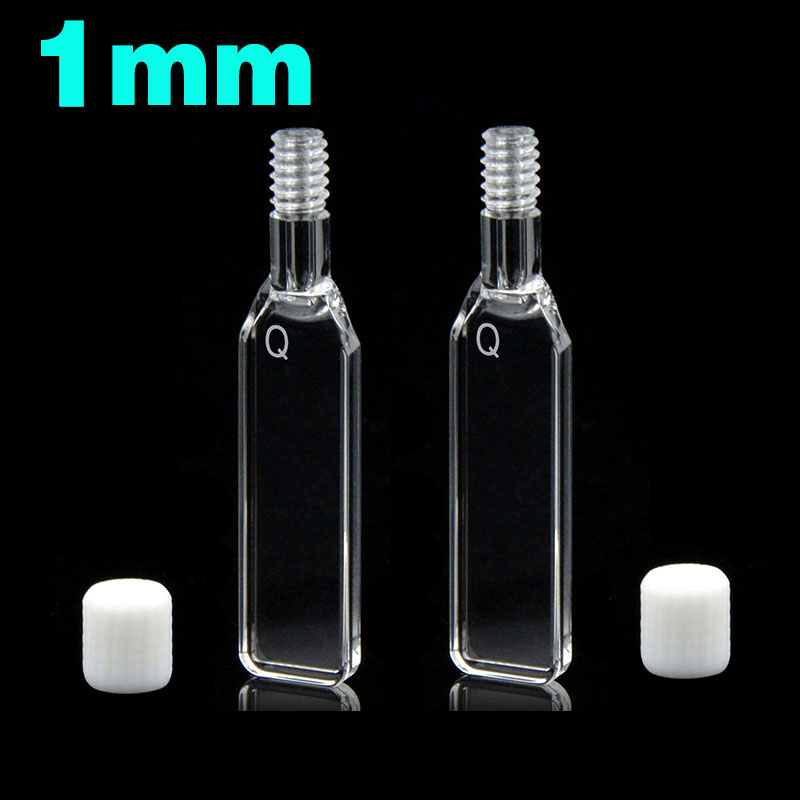 Z = 15 · 1 mm path
Quartz 1 mm Screw-Cap, Z = 15
Sealed 1 mm short-path cell at standard Z. For concentrated DNA / protein where 10 mm saturates absorbance.
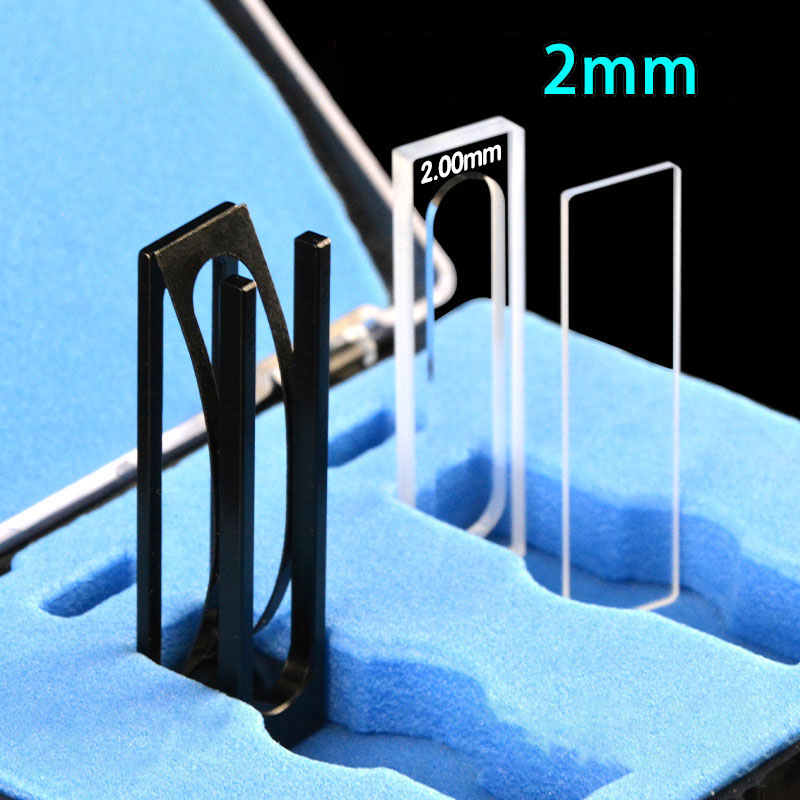 Z = 15 · 2 mm path
Quartz 2 mm Detachable, Z = 15
Demountable 2 mm cell at standard Z. For neat liquids, IR demountable assembly, and high-concentration kinetics.
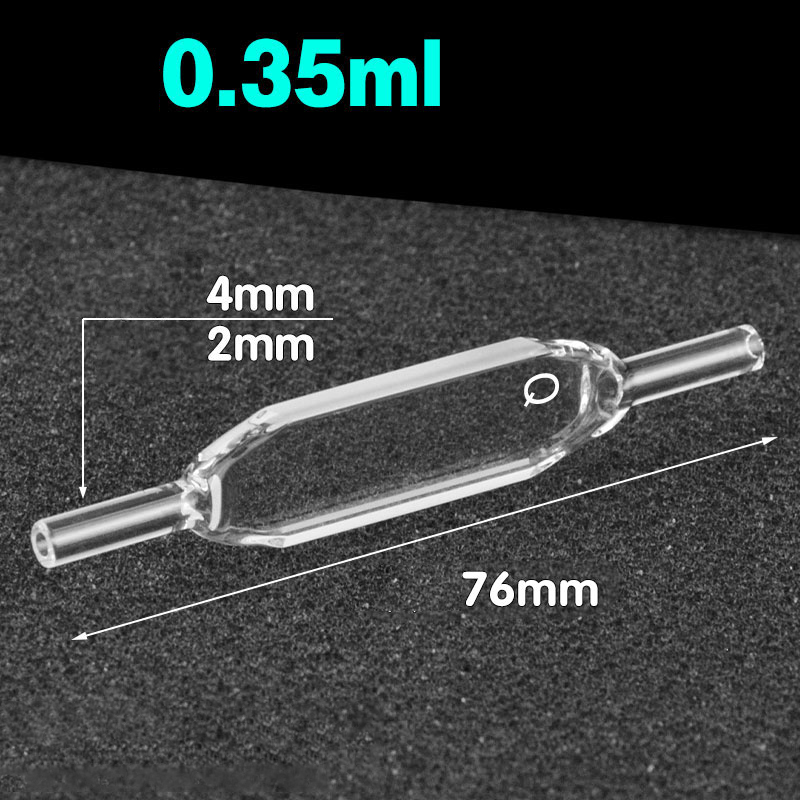 FLOW · 1 mm
Quartz 1 mm Flow Cell
HPLC / kinetics flow cell, 1 mm path. Default Z = 15 mm; Z customizable for OEM detector geometries.
CUSTOM Z
Z = 8.5, 12.5, 17, 22 mm
Legacy and OEM Z values built to drawing. JGS1 / JGS2 / JGS3, Standard 80 / Sintered 83 / Molded 83. 8–14 day lead.
Need a cuvette for a non-Z=15 instrument?
Send us the spectrophotometer make and model — or just the measured Z dimension — and we will quote the matching cuvette in your preferred grade and path length. Lead time 8–14 days.
Request a quote → Browse size chartWhy You Can Trust This Page
AuthorMachinedQuartz Technical Team
Reviewed byBryan Wright (Founder, 13+ yrs in cuvette manufacturing)
Production baseZ = 6 to 22 mm fabricated in-house · 1,300+ catalog SKUs
Last updatedMay 6, 2026 · Next review November 2026
Methodology: Z values cited per brand are taken from manufacturer instrument manuals (Agilent Cary, PerkinElmer Lambda, Thermo Genesys/Evolution, Shimadzu UV/Hitachi U-series, Jasco V-series, Beckman DU) and verified against the cuvette holder geometry of each platform we ship cells for. Mismatch symptom diagnosis follows our internal QC failure-mode catalog accumulated over 13+ years of OEM cuvette validation.
References
- Agilent — Cary UV-Vis spectrophotometer specifications
- PerkinElmer — Lambda spectrophotometer family
- Shimadzu — UV-Vis spectrophotometer documentation
- Hitachi High-Tech — U-series UV-Vis spectrophotometer manuals
- ISO 9001:2015 — Quality management systems requirements (cuvette geometry tolerances)


Recent Comments