
Large Window Cuvettes for Wide-Beam Spectrophotometers
This post is also available in:
Large Window Cuvettes
Large Window Cuvettes for Wide-Beam Spectrophotometers
When standard 12.5 × 12.5 mm cuvettes clip the light beam or starve photon throughput, large-window quartz cells solve the problem at the source. Available in 5–100 mm path lengths with bodies up to 100 mm tall.
5–100 mm
Path Length Range
Up to 35 mL
Sample Capacity
JGS1 / JGS3
UV-Vis-NIR Quartz
A large window cuvette is a quartz spectroscopy cell with an enlarged optical aperture (typically 15 mm to 100 mm wide, versus the 10 × 10 mm standard) that prevents beam-clipping in wide-beam UV-Vis spectrophotometers, integrating-sphere couplings, and tall-body kinetics work, while preserving the same path-length precision (±0.005 mm) as standard cuvettes.
TL;DR — When you need a large window cuvette:
You’re using a wide-beam spectrophotometer (older Cary, Agilent 8453 diode-array), an integrating sphere, a long-arc lamp, or any setup where the standard 10 × 10 mm aperture cuts off part of the beam. Large-window cells offer the same path-length precision as standard cuvettes but with apertures up to 20 × 50 mm or larger, eliminating throughput loss and stray-light artifacts caused by beam clipping.
Definition
What is a large window cuvette?
A large window cuvette is a quartz spectroscopy cell where the optical aperture (the polished window face) is significantly larger than the standard 10 × 10 mm format. The path length — the distance the light travels through the sample — can stay at 1, 5, 10 or 50 mm, but the window itself is enlarged so the entire beam passes through unobstructed.
Three configurations are common:
- Wide-aperture cells: standard footprint but with an enlarged polished window (e.g. a 10 mm path-length cell with a 12.5 × 30 mm window).
- Tall-body cells: standard 12.5 mm width but a body 50–100 mm tall, so the beam can pass through any vertical position (used with sample stirring or settling).
- Oversized footprint cells: full enlargement on both axes (e.g. 50 × 50 mm exterior, 17 mL volume), used in long-arc-lamp UV-Vis or large-aperture FT-IR instruments.
All three share the same fabrication discipline: optical-grade JGS1 quartz, parallelism within ±0.005 mm across the window, and full polish on light-pass faces. See Standard 80, Sintered, and Molded fabrication methods for how the window-to-body bond affects max temperature and chemical compatibility.
Why It Matters
Why standard cuvettes fail for wide-beam optics
The 12.5 × 12.5 mm “Hellma 100-QS” footprint became the de facto ISO-compatible standard in the 1960s, designed around narrow-beam single-monochromator spectrophotometers. Modern instruments often have wider beam profiles:
| Instrument Type | Typical Beam Width | Standard 10 mm Cell? |
|---|---|---|
| Single-beam UV-Vis (Genesys, NanoDrop OneC) | ~3–6 mm | Fine |
| Diode-array (Agilent 8453, HP 8452) | ~10–12 mm | Beam edges may clip |
| Older double-beam (Cary 14, Beckman DU) | 10–18 mm | Severe clipping |
| FT-IR with long-arc source | 15–25 mm | Need oversized window |
| Integrating-sphere coupled UV-Vis | 20–50 mm | Need oversized window |
| Process / inline analyzers | 5–15 mm | Path-length-driven choice |
- Photon loss at the window edges — measured intensity drops, baseline noise rises, and detection limits worsen.
- Stray-light artifacts — light grazing the polished edges scatters off the cell walls and reaches the detector unmodulated, distorting absorbance readings (most noticeable above OD 2.0).
- Spatial inhomogeneity bias — if the sample isn’t perfectly homogeneous (settling particles, gradient cuvettes, kinetic mixtures), a clipped beam samples only the central column, missing edge effects.
A large-window cell removes all three at once.
Applications
Five typical use cases
1. Long-arc lamp UV-Vis
Older mercury-xenon arc systems and some custom UV reactors emit a beam 15–25 mm wide. Standard cuvettes clip 30–50 % of the photon flux. A 20 × 50 mm window cell recovers it.
2. Integrating-sphere coupling
Diffuse-reflectance and total-transmittance measurements through an integrating sphere need the sample to fill a much larger entrance port (commonly Ø 25 mm). Large-aperture quartz cells avoid the donut-shaped sampling profile of small cells.
3. Sample throughput / production QC
When a 17 mL or 35 mL aliquot is the natural sample size (process water, beverage QC, ferment broth), a 50 mm or 100 mm tall cuvette holds the full volume in one pour — no aliquoting, no contamination risk.
4. Custom OEM instrument integration
OEM integrators specifying their own optics often need cells that match a non-standard cell holder (e.g. 20 × 20 mm body with a 10 mm path). MQ ships these directly from drawing/CAD with 4–6 week lead times.
5. Settling / stirred kinetics
For reactions where particles settle or where you need a stir bar, a tall-body 50 mm cuvette lets you place the beam high enough to avoid the settled layer or the stir-bar vortex.
6. Gradient & layered samples
Density-gradient experiments, biofilm growth at fluid interfaces, or layered emulsion studies all need the beam to traverse a tall sample column. A 100 mm tall window cell makes it possible to scan the column at multiple heights with one cuvette.
Sample products from MQ catalog
See the range — large window cuvettes in stock

C202CE1
Quartz 10mm Path / 20mm Body Large

C502CE4
Quartz 10mm Path / 50mm Body Large
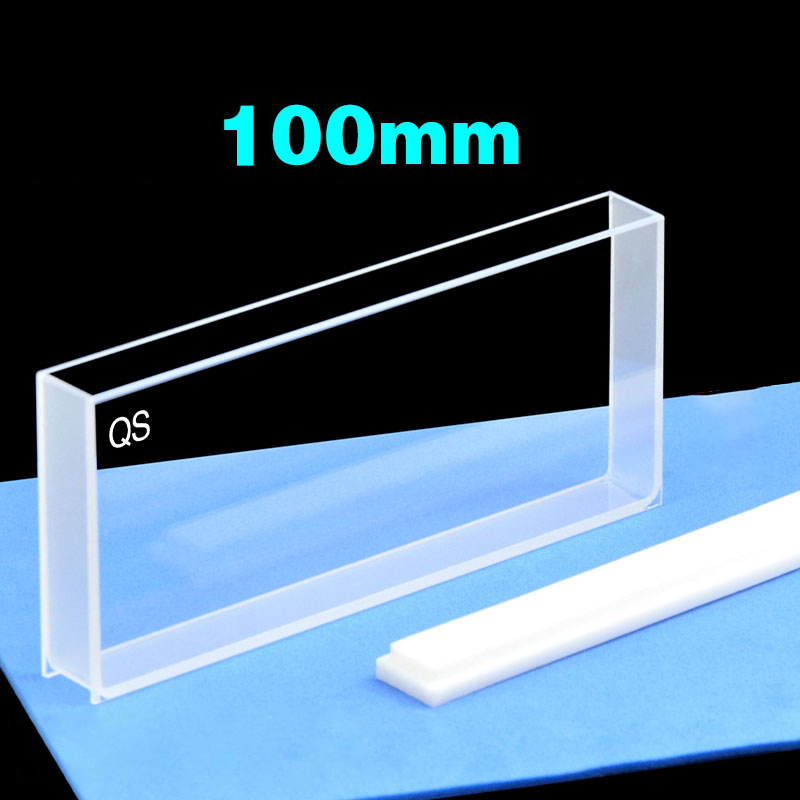
C1002CR
Quartz 100mm Standard Cuvette
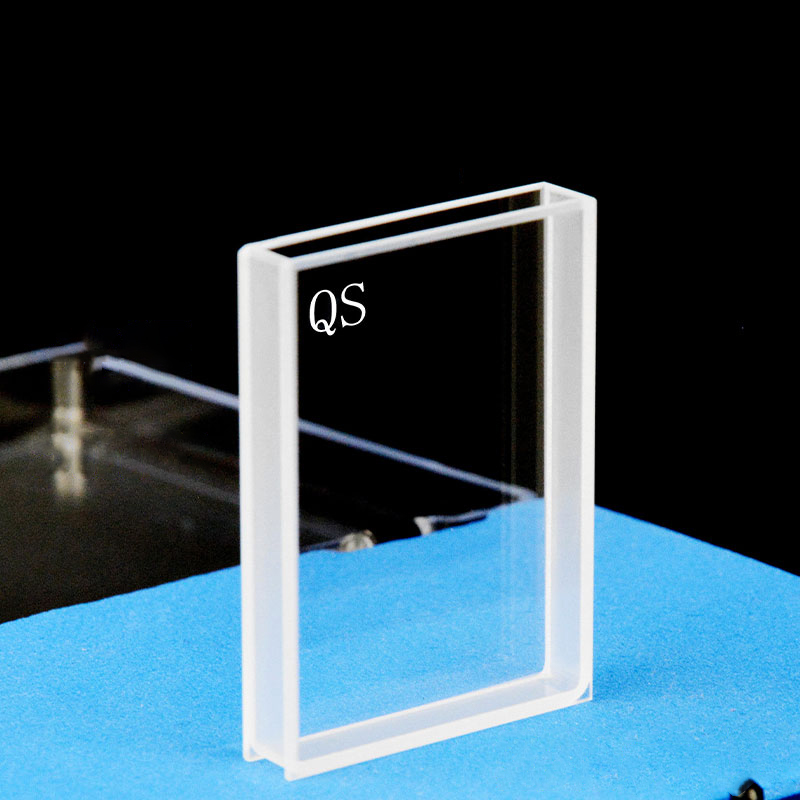
C052CS7
Quartz 5mm Large Surface Light-Tran
Path-length variants from 5 mm to 100 mm, with bodies up to 100 mm tall. Click any to view spec sheet.
Product Range
MachinedQuartz large window cuvette catalog
MachinedQuartz holds 20+ large-window SKUs in stock, with custom geometries available from drawing in 4–6 weeks. Selected stock SKUs:
| SKU | Path × Body | Volume | Fabrication | Notes |
|---|---|---|---|---|
| C202CE1 | 10 mm path / 20 mm body | 7 mL | Molded 83 | Wide window, low-stray-light |
| C202CR6 | 10 mm path / 20 mm body | 7 mL | Sintered 83 | Solvent-resistant |
| C202CA3 | 10 mm path / 20 mm body | 7 mL | Sintered 80 | Mid-range, aqueous + alcohol |
| C502CE4 | 10 mm path / 50 mm body | 17.5 mL | Molded 83 | Tall-body, large volume |
| C502CR5 | 10 mm path / 50 mm body | 17.5 mL | Sintered 83 | Pharma QC grade |
| C502CA5 | 50 mm path | 17.5 mL | Sintered 80 | Long-path, large window |
| C1002CR | 100 mm path | 35 mL | Sintered 83 | Trace UV-Vis, high transmission |
| C1002CS5 | 10 mm path / 100 mm body | 35 mL | Standard 80 | Tall column, kinetics & gradient |
| C052CS7 | 5 mm path, large surface | 5 mL | Standard 80 | Short-path, oversized window |
| C032WS3 | 3 mm path, large surface | 3 mL | Standard 80 | High-OD samples, wide beam |
Full catalog and stock status: browse all Large Window Cuvettes →
Selection Guide
How to pick the right large-window cell
Step 1 — Measure your instrument’s beam width
If you don’t know it, place a piece of phosphor card or burn paper at the cuvette position and run the lamp at low intensity. The illuminated area = beam profile. If it’s wider than 10 × 10 mm, you need a large window.
Step 2 — Match window dimensions to beam, not path length
Path length is set by your concentration (Beer-Lambert) — see our path-length-by-analyte selection matrix. The window dimensions are a separate decision driven by beam profile and sample volume. Order them independently.
Step 3 — Choose fabrication for solvent + temperature
Aqueous-only at room temperature: Standard 80 (lowest cost). Mixed organic solvents or temperatures up to 600 °C: Sintered 80 or Sintered 83. Temperatures above 600 °C, harsh chemicals, or pharma-grade QC requiring T > 83 %: Molded 83 (one-piece fused).
Step 4 — Confirm Z-dimension matches your cell holder
Standard cell holders have a specific beam height (Z). MQ standard Z = 15 mm (the modern default); legacy holders (Beckman DU, Eppendorf) use Z = 8.5 mm, and some specialty holders need 20 mm. For sub-micro and large-window cells we publish a Z-dimension reference guide; for any custom Z, send us your instrument model and we’ll machine to spec.
Spec Comparison
Standard vs large-window cuvette: side-by-side
| Spec | Standard 10 mm cell | Large window 10 mm cell |
|---|---|---|
| Window aperture | 10 × 10 mm | up to 20 × 50 mm or 50 × 50 mm |
| Path length | 10 mm | 10 mm (same) |
| Sample volume | 3.5 mL | 7 mL → 35 mL depending on body |
| Beam-clipping risk | High for wide-beam optics | None |
| Stray-light contribution | Up to 0.3–0.5 % at edges | < 0.05 % |
| Compatible with sphere coupling | No (small port mismatch) | Yes |
| Holds stir bar / settling | No | Yes (tall-body variants) |
| Cost (typical) | 1× | 1.5–2.5× |
| Lead time (in stock) | Same day | Same day for stock SKUs |
| Custom geometry lead time | 2–4 weeks | 4–6 weeks |
Need a non-standard window dimension?
MachinedQuartz fabricates custom large-window cells from your drawing in 4–6 weeks, MOQ 1.
Request Custom Quote Browse Stock SKUsFAQ
Frequently asked questions
Is a large window cuvette the same as a wide-aperture cuvette?
Yes — the terms are used interchangeably. “Large window” emphasizes the polished face dimensions, “wide aperture” emphasizes the optical opening seen by the beam. Both refer to a quartz cell with an enlarged polished face beyond the standard 10 × 10 mm.
Will a large-window cell fit my standard cuvette holder?
If the body footprint is 12.5 × 12.5 mm (just with a taller body), yes — it fits any standard 1 cm spectrophotometer holder. If the footprint is enlarged (e.g. 20 × 20 mm or 50 × 50 mm), you’ll need a custom or oversized cell holder. Always check your instrument’s published cell-holder dimensions, or send us your model and we’ll confirm fit.
Does a larger window degrade path-length accuracy?
No. Path-length tolerance (±0.005 mm in MQ Sintered 83 / Molded 83 grades) is set by the parallelism of the two optical faces, not by their area. A 50 × 50 mm window can be polished to the same parallelism spec as a 10 × 10 mm window, provided the manufacturer has the right grinding fixture — MQ’s molded process maintains tolerance across the full 100 mm path.
Do I need quartz, or will optical glass work?
For UV-Vis below 350 nm, quartz is required (optical glass cuts off around 320 nm). For visible-only work above 350 nm, optical glass is cheaper and works fine. NIR work above 2500 nm needs JGS3 quartz. See our quartz vs glass cuvette comparison for the full breakdown.
Can I get a large window cuvette in IR-grade quartz (JGS3)?
Yes. All MQ large-window SKUs are available in JGS1 (deep UV) and JGS3 (NIR) on a custom-order basis. Stock SKUs are JGS1; JGS3 is made-to-order with a 4–6 week lead time.
What’s the maximum window size you can fabricate?
For a 10 mm path length: up to 100 × 100 mm window (special-order). For a 100 mm path length: up to 50 × 50 mm window. Beyond that we recommend a flat plate + custom holder design — contact us with your geometry and we’ll quote.
How does a large window affect cleaning protocol?
The same protocol as standard cuvettes — Alconox or Hellmanex III soak, ultrasonic clean, methanol rinse. The larger surface area means more wiping discipline (always lint-free lens tissue, never paper towel) and a higher chance of fingerprint contamination on the larger window — handle by the body only. See our cuvette cleaning protocol for the full step-by-step.
What’s the lead time for a custom large-window cell?
Stock SKUs ship same day from our US warehouse (5–8 days to lab). Custom geometries from drawing/CAD are 4–6 weeks for path lengths up to 50 mm, 6–8 weeks for 100 mm path or oversized window (> 50 × 50 mm). MOQ 1 for custom — no minimum order quantity.
Get a quote in 24 hours
Send us your spectrophotometer model and beam profile — we’ll recommend the right window dimensions and confirm holder fit before you order.
Request Quote Read Selection Guide

Recent Comments