
Quartz Flow Cells for HPLC and Continuous Flow Analysis
This post is also available in:
Quartz Flow Cells
Quartz Flow Cells for HPLC and Continuous Flow Analysis
Path-length-defined optical cells with inline plumbing — for HPLC detectors, FIA/CFA, process monitoring, and stopped-flow kinetics. 0.5–10 mm path lengths, two-way and four-way light, fluorescence-grade JGS1.
0.5–10 mm
Path Lengths
2-Way / 4-Way
Light Geometry
140 µL+
Min Volume
JGS1 / JGS2
Quartz Grades
A quartz flow cell is a sealed quartz spectroscopy cell with inlet and outlet plumbing ports, designed to measure UV-Vis absorbance, fluorescence emission, or scattering on a flowing sample stream — most commonly as the detector cell in HPLC and UPLC, in flow injection analysis (FIA), continuous flow analysis (CFA), and inline process monitors. Path lengths range from 0.5 mm (UPLC) to 100 mm (process / trace analysis), with two-way light geometry for absorbance and four-way light geometry for fluorescence.
TL;DR — When to use a quartz flow cell:
You need to measure UV-Vis absorbance, fluorescence emission, or scattering on a flowing sample — HPLC eluent, autosampler stream, process water, kinetic reaction mixture. A flow cell replaces a static cuvette with a sealed quartz body that has inlet/outlet tubing, so the sample passes through the optical path continuously. Choose 2-way light for absorbance/HPLC detection, 4-way light for fluorescence (90° emission collection).
Definition
What is a quartz flow cell?
A quartz flow cell — also called a flow-through cuvette or flow-through cell — is a precision-machined optical chamber with two ports for fluid plumbing. Sample enters through the inlet, fills the optical path, exits through the outlet, and the spectrophotometer or fluorometer reads continuously as the fluid moves through.
The construction is identical to a static quartz cuvette in every other respect: JGS1 quartz for full UV transmission down to 185 nm, parallelism within ±0.005 mm on Sintered 83 / Molded 83 grades, and the same Z-dimension matching as standard cells. The only differences:
- Sealed body — no removable cap; the optical chamber is permanently closed.
- Inlet / outlet tubes — typically 1/16″ or 1/8″ OD quartz nipples that accept PTFE or PEEK tubing via flangeless fittings.
- Defined internal volume — selected to balance HPLC peak resolution (smaller is better) against detection limit (larger path × larger volume = more signal).
The cell is mounted in the same cell holder as a static cuvette; the only added complexity is connecting the inlet and outlet to your fluidics — typically the column outlet (HPLC) or a peristaltic pump (FIA/CFA).
Light Geometry
Two-way vs four-way light flow cells
The single biggest decision when ordering a flow cell is whether you need two-way (transmission only) or four-way (transmission + 90° emission) optical access.
| Two-Way Light | Four-Way Light | |
|---|---|---|
| Polished faces | 2 (entrance + exit) | 4 (entrance + exit + 2 side faces) |
| UV-Vis absorbance | ✅ Optimal | ✅ Yes (slightly more cost) |
| Fluorescence (90°) | ❌ No | ✅ Required |
| Right-angle scattering | ❌ No | ✅ Yes |
| Best for HPLC UV detector | ✅ | Overkill |
| Best for FLD detector | ❌ | ✅ Required |
| Best for stopped-flow kinetics + emission | ❌ | ✅ |
| Cost | 1× | 1.4–1.8× |
Decision rule: If you’ll only ever measure absorbance, choose 2-way. If there’s any chance of needing fluorescence (current or future detector swap), choose 4-way — the cost premium is small and you avoid re-buying the cell later.
Path Length Selection
Choosing the right path length for flow analysis
Path length sets sensitivity. The Beer-Lambert relationship (A = ε·c·L) means doubling the path length doubles the signal at fixed concentration. But in flow systems there’s a trade-off: longer path = larger internal volume = wider HPLC peak.
| Path Length | Typical Volume | HPLC Peak Impact | Best Use Case |
|---|---|---|---|
| 0.5 mm | ~140 µL | Negligible | UPLC, fast kinetics, high-OD samples |
| 1 mm | ~350 µL | Negligible–small | Standard HPLC UV detector (most common) |
| 2 mm | ~0.7 mL | Small (Δ<5 % for 1-min peaks) | Trace-level HPLC, low-conc analytes |
| 3 mm | ~1.05 mL | Noticeable on narrow peaks | Preparative HPLC, FIA |
| 10 mm | ~3.5 mL | Major peak broadening on analytical HPLC | Process monitoring, CFA, stopped-flow |
For analytical HPLC most users choose 1 mm path. UPLC users often go to 0.5 mm. For process monitoring or FIA where peak resolution doesn’t matter, 10 mm gives 10× the absorbance signal of a 1 mm cell.
For a deeper treatment of the absorbance–concentration trade-off, see our path-length-by-analyte selection matrix and the complete path length guide.
Applications
Where quartz flow cells are used
HPLC
HPLC UV / FLD detection
Inline detector cell for analytical HPLC. 1 mm path × 350 µL volume is the standard. 4-way required for fluorescence detectors (Agilent 1260 FLD, Waters 2475).
UPLC
UPLC narrow-bore
Sub-1 µL peaks need 0.5 mm path × ~140 µL cells to avoid peak distortion. JGS1 grade for < 200 nm analytes (peptides, low-MW pharma).
FIA / CFA
Flow injection / continuous flow
Long-path cells (10 mm or larger) maximize sensitivity in autoanalyzers (Skalar, Lachat QuikChem). Peak shape concerns relaxed; path-length sensitivity dominates.
Process
Inline process monitoring
Bioreactor sampling, UV-T254 water-quality monitors, brewery beverage QC. Sintered 83 fabrication for steam sterilization and CIP compatibility.
Kinetics
Stopped-flow kinetics
Fast mixing + quench + readout. 2-way for absorbance kinetics, 4-way when fluorescent probe is the readout. Sub-millisecond dead-volume cells available on custom basis.
DLS
DLS / Particle sizing flow
Inline particle-size monitoring downstream of formulation processes. 4-way light for backscatter or 90° detection — see also DLS cuvette guide.
Spectroelectro
Spectroelectrochemistry
Working-electrode cell with optical access. Custom path lengths from 0.1 mm (thin-layer) for in-situ UV-Vis of redox intermediates.
Gas
Gas-phase optical absorption
Sealed flow cells for headspace gas analysis (NO₂, SO₂, ozone monitoring). 100 mm path-length variants give ppb-level sensitivity in atmospheric chemistry instruments.
Fittings & Plumbing
Inlet / outlet fittings and tubing compatibility
MachinedQuartz flow cells ship with quartz nipples in 4 mm, 5 mm, 7 mm, and 10 mm OD configurations (specified in the SKU as “4 mm OD” etc). These accept standard:
- 1/16″ OD PEEK tubing via flangeless fittings (10–32 thread, IDEX P-200 series) — most common for HPLC integration.
- 1/16″ OD stainless tubing via Valco or Swagelok fittings — for high-pressure or solvent-resistant runs.
- 3 mm or 1/8″ OD silicone or Tygon tubing via clamp connection — for low-pressure FIA, CFA, peristaltic-pumped analyzers.
- PTFE compression sleeves for quartz-to-quartz inline coupling on multi-cell stacks.
For UHPLC pressures (> 600 bar), the quartz body itself can withstand up to 200 bar reliably; pressure beyond that requires a custom flow cell with reinforced collar. Specify your max operating pressure when requesting a quote.
Flow cell catalog
Stock flow cells across path lengths and light geometries
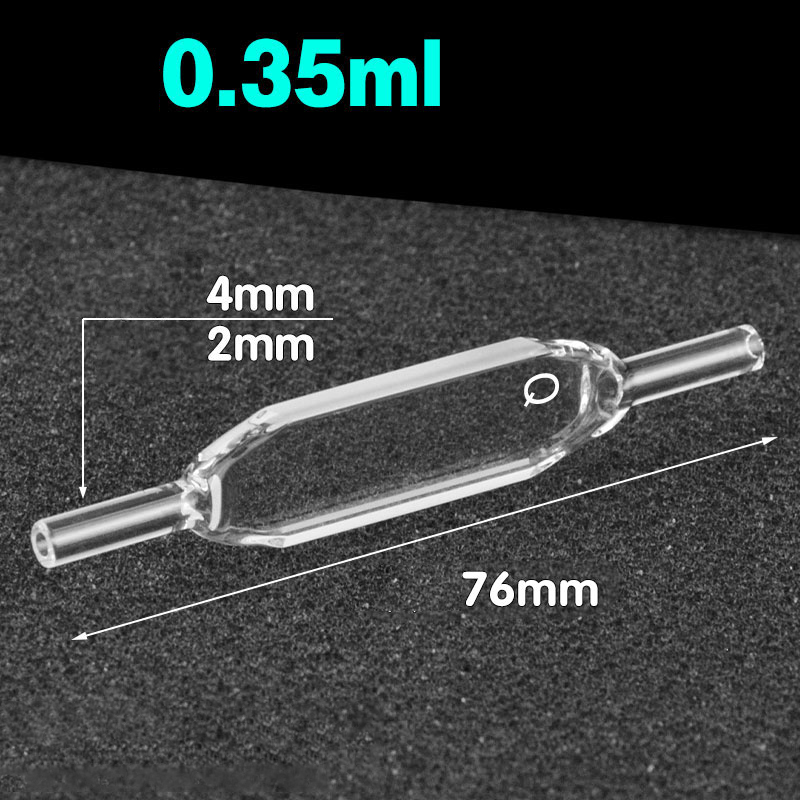
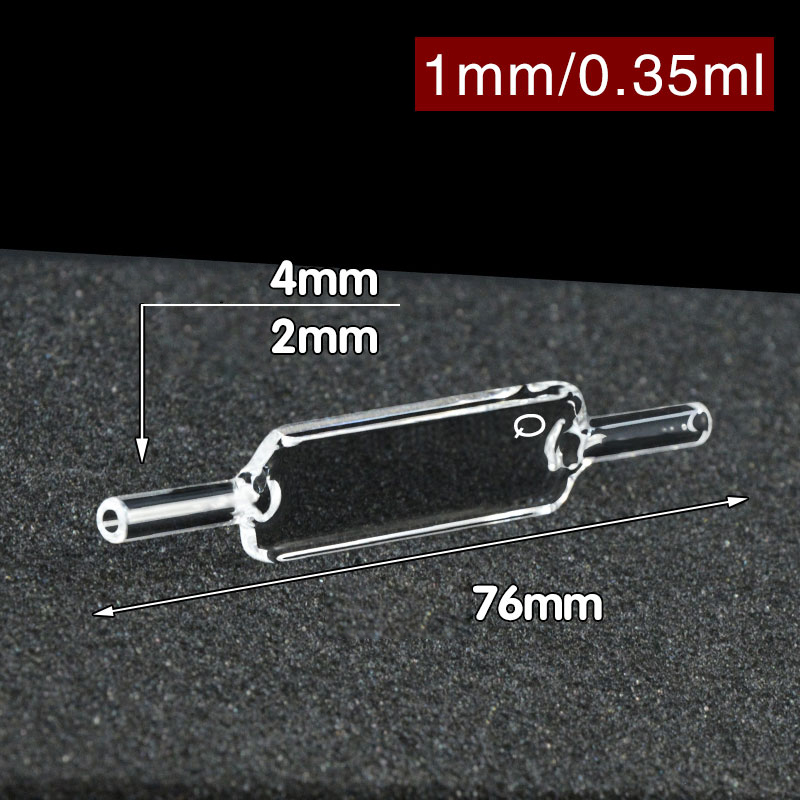
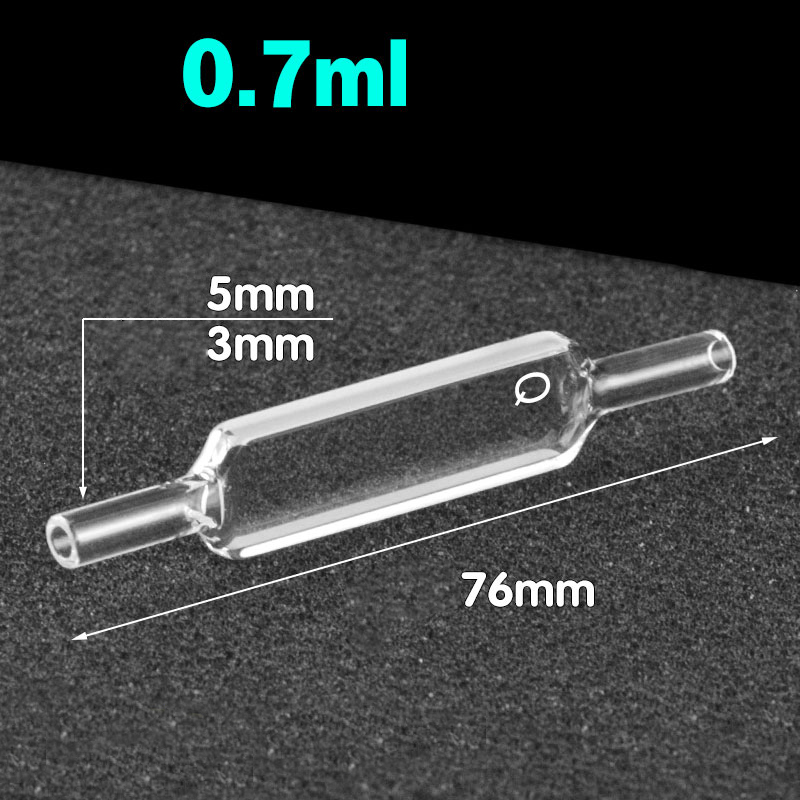
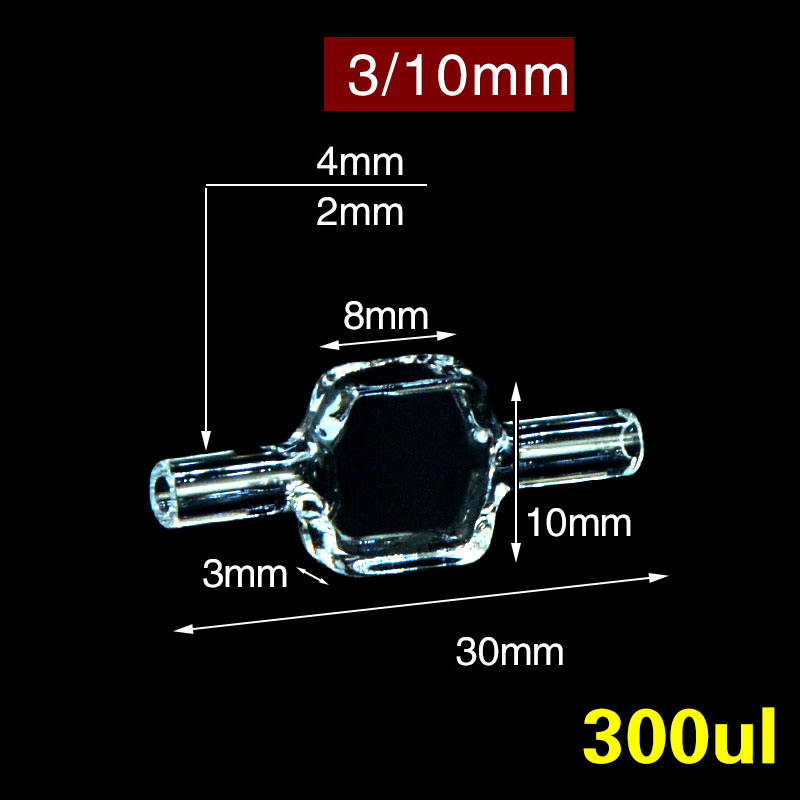
0.5 mm to 10 mm path, 2-way and 4-way light, 4–10 mm OD plumbing. Each ships from US warehouse same day.
Product Range
MachinedQuartz flow cell catalog
Selected stock SKUs from our 50+ flow cell range:
| SKU | Path | Light | OD | Volume | Fab | Best For |
|---|---|---|---|---|---|---|
| C0.54WS | 0.5 mm | 4-way | 4 mm | 140 µL | Molded 83 | UPLC FLD |
| C012WS4 | 1 mm | 2-way | 4 mm | 350 µL | Molded 83 | HPLC UV |
| C014WS3 | 1 mm | 4-way | 4 mm | 350 µL | Molded 83 | HPLC FLD |
| C022WS7 | 2 mm | 2-way | 5 mm | 0.7 mL | Molded 83 | Trace HPLC UV |
| C024WS3 | 2 mm | 4-way | 4 mm | 0.7 mL | Molded 83 | Trace HPLC FLD |
| C024WS4 | 2 mm | 4-way | 5 mm | 0.7 mL | Molded 83 | Trace HPLC FLD (5mm OD plumbing) |
| C034WS | 3 mm | 4-way | 4 mm | 300 µL | Molded 83 | Fluorescence flow + low volume |
| C2.52CS1 | 2.5 mm | 2-way | — | Sample | Standard 80 | Sample-flow / FIA |
| C102WS15 | 10 mm | 2-way | 10 mm | 3.5 mL | Molded 83 | Process / CFA UV |
| C102WS16 | 10 mm | 2-way | 4 mm | 3.5 mL | Molded 83 | Long-path HPLC peak-OK |
| C104WS9 | 10 mm | 4-way | 4 mm | 3.5 mL | Molded 83 | Process fluorescence |
| C104WS10 | 10 mm | 4-way | 4 mm | 3.5 mL | Molded 83 | Process fluorescence (alt) |
| C012WS6 | 10 mm | 4-way | — | 3.5 mL | Molded 83 | Customizable, OEM |
→ Browse all quartz flow cells · See the complete cuvettes & cells size chart
Maintenance
Cleaning and avoiding carryover
Carryover is the #1 reason flow cells get replaced before end-of-life. The protocol matters:
Routine flush (between runs)
- 10 column volumes of mobile phase at flow rate.
- If switching solvent classes (organic ↔ aqueous), 20 column volumes at intermediate composition first.
- Dry purge with N₂ if storing dry overnight.
Deep clean (weekly or after sample with strong matrix effect)
- Flush with 5 % HNO₃ (for biological residues) or 5 % NaOH (for organic acids), 30 min static contact, then water rinse.
- If absorbance baseline drift > 0.005 AU after flushing, sonicate the cell ex-situ in Hellmanex III or Alconox solution for 10 min.
- Final rinse: HPLC-grade water, then methanol, then storage solvent.
Never do
- HF or BOE — etches quartz, causes irreversible window damage.
- Wire brushes or scouring pads — scratches the polished faces (any scratch > 1 µm degrades baseline noise).
- Sudden temperature shock — moving from −20 °C to 80 °C in seconds can crack a sealed cell. Equilibrate at 5 °C/min max.
Full protocol: cuvette cleaning protocol with 10 solvent recipes.
Need a custom path length, OD, or fitting?
MachinedQuartz fabricates flow cells from drawing in 4–6 weeks, MOQ 1. Send your HPLC model and detector and we’ll spec the cell for you.
Request Quote Browse Stock SKUsFAQ
Frequently asked questions
What’s the difference between a flow cell and a flow cuvette?
The terms are used interchangeably. “Flow cell” is more common in HPLC and process analyzer contexts; “flow cuvette” is more common in research and bench spectroscopy. Both refer to the same device — a sealed quartz optical chamber with inlet/outlet plumbing.
Can I use my standard cuvette holder with a flow cell?
Usually yes. MachinedQuartz flow cells with 12.5 × 12.5 mm body footprint fit any standard 1 cm spectrophotometer holder. The plumbing tubes exit the top, so the holder lid must be open or modified. For HPLC detector cells the holder is built into the detector module — confirm cell dimensions match your specific detector model (Agilent G7117A, Waters 2998, Shimadzu SPD-M40, etc).
What’s the maximum back-pressure a quartz flow cell can take?
Standard MQ flow cells are rated to 200 bar (2,900 psi) continuous. UHPLC applications above 400 bar require a reinforced-collar custom cell — specify your max system pressure when ordering. The quartz itself fails by collar leak before catastrophic body fracture, so you’ll see a slow drip well before any safety event.
How do I match the flow cell volume to my HPLC peak width?
Rule of thumb: cell volume should be ≤ 10 % of the peak volume. For analytical HPLC with 30-second peaks at 1 mL/min flow rate, peak volume = 500 µL, so the cell volume should be ≤ 50 µL. That’s why most analytical HPLC detectors use a 1 mm × 350 µL cell — slightly larger than ideal but accepted as a practical compromise. UPLC peaks (5-second wide) need 140 µL or smaller.
Do I need quartz, or will an optical-glass flow cell work?
For UV detectors (190–350 nm) you need quartz (per USP <851> spectrophotometry guidance) — optical glass cuts off around 320 nm. For visible-only detectors (350–800 nm) optical glass works and is cheaper. NIR detectors (above 1100 nm) need JGS3 grade quartz to maintain transmission. See quartz vs glass cuvette for the full breakdown.
Can a flow cell be used as a static cuvette?
Yes — fill it with sample via the inlet, cap both ports, and use it like any sealed cuvette. The optical performance is identical. The only minor disadvantage is the slightly larger overall body (due to the inlet/outlet nipples) which can complicate cell-holder fit on some compact instruments.
How long does a quartz flow cell last in production HPLC?
With proper cleaning and no aggressive solvents, 5+ years of daily use is typical. The two main failure modes are window scratching from particulate-laden samples (always use a 0.45 µm filter upstream) and collar leak from over-tightened fittings (finger-tight + 1/4 turn is the spec for flangeless PEEK). Quartz itself doesn’t degrade.
What’s the lead time for a custom flow cell?
Stock SKUs ship same day from our US warehouse (5–8 days to lab). Custom geometries: 4–6 weeks for path lengths up to 10 mm with standard fittings, 6–8 weeks for non-standard ODs, reinforced collars, or oversized bodies. MOQ 1 — no minimum order quantity for custom designs.
Help us spec the right cell for your detector
Send us your HPLC/FLD model number and we’ll cross-reference fitments — typical reply within 24 hours.
Email Sales Read Selection Guide

Recent Comments