
Cuvette Path Length Guide: How to Choose the Right Path Length for UV-Vis Spectroscopy
This post is also available in:
Cuvette path length is the distance light travels through the sample inside a spectrophotometer cell — the L variable in the Beer-Lambert law A = ε · c · L. Standard cells are 10 mm; available path lengths range from 0.01 mm (sub-microliter ultra-thin cells) to 200 mm (long-path trace analysis). Doubling path length doubles absorbance at fixed concentration, so path-length choice is the bench-side lever for keeping readings in the linear 0.1–1.0 AU range without diluting the sample.
Cuvette Path Length Guide: How to Choose the Right Path Length for UV-Vis Spectroscopy
On this page
MachinedQuartz · Spectroscopy Guide
Cuvette Path Length Guide: How to Choose the Right Path Length
Path length is the single most important dimension of a cuvette — it determines how much light interacts with your sample, directly controls absorbance sensitivity, and sets the working concentration range for your assay. This guide explains the physics, lists every standard path length with its primary use case, and gives you a practical framework for choosing.
Beer-Lambert Law
0.1 mm – 200 mm range
Application lookup table
Interactive calculator
Table of Contents
Quick Path Length Picker
Pick the row that matches your sample, jump to the right product:
| Path Length | Best For | Typical Concentration Range | MQ Product |
|---|---|---|---|
| 1 mm | Highly concentrated samples, protein A280, undiluted DNA/RNA | 1–10 mg/mL protein, >100 ng/µL nucleic acid | Standard 80 / Sintered 83 |
| 5 mm | Moderate concentration, semi-micro samples | 0.5–5 mg/mL protein, dye stock solutions | Standard 80 |
| 10 mm | Standard reference, most UV-Vis assays, kinetics | Most routine work, A = 0.1–1.0 in target range | Standard 80 / Molded 83 |
| 20 mm | Dilute samples, environmental water, low-absorbance | Trace organics, dilute biomolecules | Standard 80 |
| 50 mm | Very dilute samples, water quality, residual analysis | µg/L pollutants, sub-µM analytes | Custom — request quote |
| 100 mm | Ultra-trace analysis, gas absorption cells | ng/L analytes, low-pressure gas | Custom — request quote |
Path Length × Sample Volume Matrix
Different cuvette geometries trade path length against sample volume. Use this matrix to find the right combination for your sample size:
| Sample Volume | 1 mm | 2 mm | 5 mm | 10 mm | 20 mm | 50 mm | 100 mm |
|---|---|---|---|---|---|---|---|
| < 50 µL (ultra-micro) | Best | OK | OK | OK* | — | — | — |
| 50 – 500 µL (sub-micro) | OK | OK | Best | Best | OK | — | — |
| 500 µL – 1.4 mL (semi-micro) | OK | OK | OK | Best | Best | OK | — |
| 1.4 – 3.5 mL (standard) | — | — | OK | Best | Best | Best | OK |
| 3.5 – 10 mL (macro) | — | — | — | OK | Best | Best | Best |
| > 10 mL (flow / large) | — | — | — | — | OK | Best | Best |
Best — geometry-matched, no waste, optimal beam fill
OK — works but suboptimal (excess volume or beam clipping)
— Not recommended (wrong geometry)
Bottom line: Match path length to your sample volume first, then verify your absorbance falls in the 0.2–1.0 sweet spot. *Sub-50 µL samples in a 10 mm path require a sub-micro cuvette with reduced internal width — see our Z-Dimension Guide for compatibility with your spectrophotometer.
Section 1
What Is Cuvette Path Length?
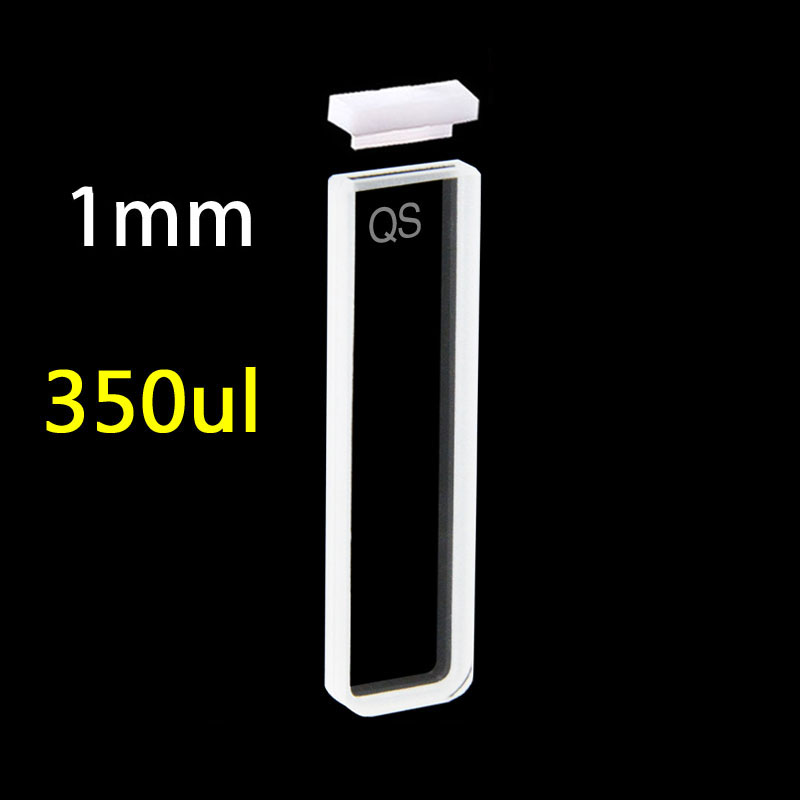
1 mm · concentrated samples · high absorbance
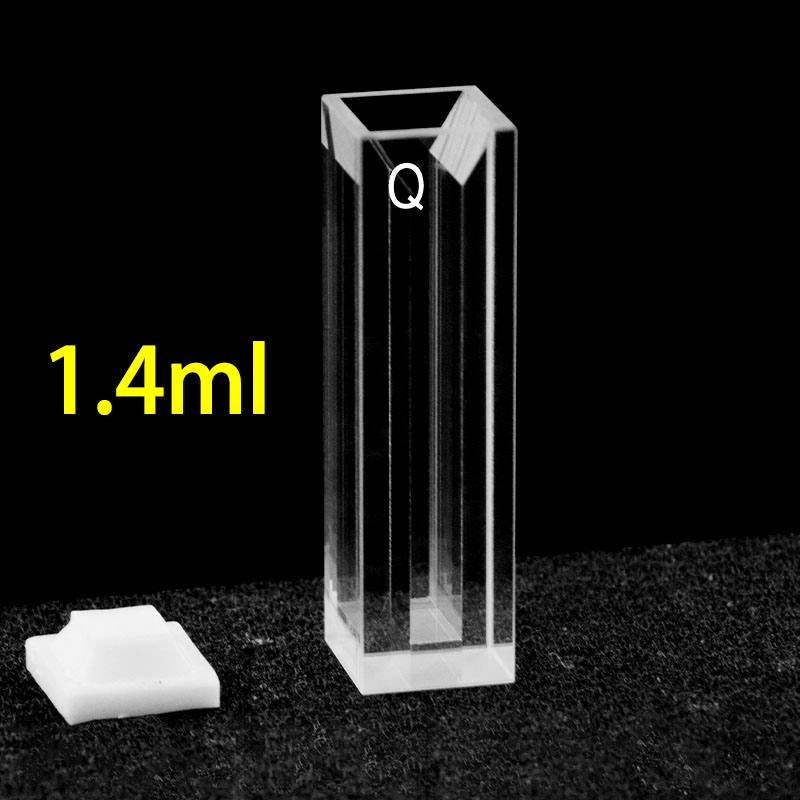
10 mm · standard · most applications
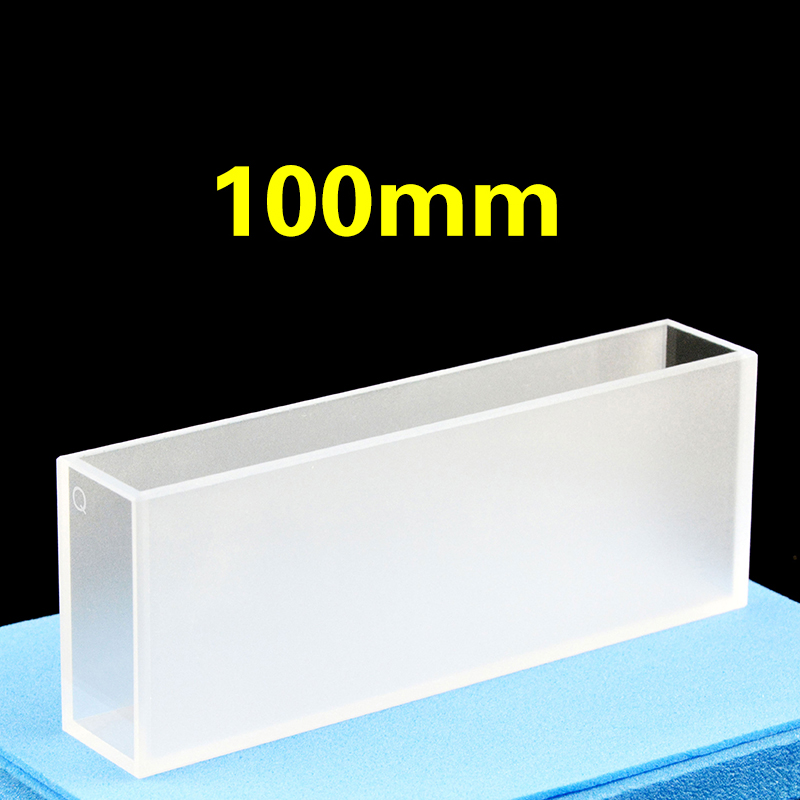
100 mm · dilute samples · trace analysis
Path length (also written as pathlength or light path) is the distance that a beam of light travels through the sample inside a cuvette. It is measured in millimeters and equals the internal width of the cuvette measured along the light beam direction — specifically, the distance between the two optically polished windows.
For a standard 10 mm cuvette, the light travels exactly 10 mm through the sample. For a 1 mm cuvette, it travels 1 mm. This single dimension has a direct, linear effect on how much light is absorbed by the sample, which is described by the Beer-Lambert Law.
Top-down cross-section: light enters through one optical window, travels the full path length through the sample, and exits through the opposite window. The two side walls are opaque.
Key definition: Path length = the internal distance between the two optically polished windows of a cuvette, measured along the direction of the light beam. Standard path length is 10 mm. It is not the same as Z-height (see Section 7).
Definition
What is path length in spectroscopy?
Path length in spectroscopy is the distance a beam of light travels through a sample inside a cuvette. It is measured in millimeters (mm) or centimeters (cm) and equals the internal gap between the two optical windows of the cuvette along the light beam axis. According to the Beer-Lambert Law (A = ε · c · l), path length directly and linearly controls how much light is absorbed: doubling path length doubles absorbance for the same sample concentration. The standard path length for UV-Vis spectrophotometry is 10 mm (1 cm).
Also called: light path, optical path length, pathlength (one word)
Section 2
Beer-Lambert Law: Why Path Length Matters
The Beer-Lambert Law is the fundamental relationship governing all UV-Vis absorbance measurements. It states:
A = ε · c · l
A = Absorbance (dimensionless)
ε = Molar absorptivity (L mol⁻¹ cm⁻¹) — a property of the molecule at a given wavelength
c = Concentration (mol L⁻¹)
l = Path length (cm) — the cuvette dimension you control
ε = Molar absorptivity (L mol⁻¹ cm⁻¹) — a property of the molecule at a given wavelength
c = Concentration (mol L⁻¹)
l = Path length (cm) — the cuvette dimension you control
Because path length (l) multiplies concentration (c) directly, doubling the path length doubles the absorbance for a given concentration. This means path length is a powerful lever for adjusting sensitivity:
Increase path length
Higher absorbance for the same concentration. Use when samples are dilute and absorbance would otherwise be too low to measure accurately (<0.05 A). Long path cuvettes (50–100 mm) extend detection to trace concentrations.
Decrease path length
Lower absorbance for the same concentration. Use when samples are highly concentrated and would saturate the detector (>2.0–3.0 A). Short path cuvettes (0.1–5 mm) allow direct measurement without dilution.
Optimal absorbance range
The linear range of Beer-Lambert Law is 0.1–1.0 absorbance units for most spectrophotometers. Choose path length and concentration together so your measurement falls in this window for best accuracy.
Practical rule: If your absorbance is too high (>1.5 A), use a shorter path length or dilute the sample. If your absorbance is too low (<0.05 A), use a longer path length or increase concentration. The 10 mm standard path is designed for dilute aqueous samples in the Beer-Lambert linear range.
Note that in the Beer-Lambert equation, path length is in centimeters (cm), not millimeters. Always convert mm to cm by dividing by 10 before using the formula.
Quick Reference: mm → cm Conversion for Beer-Lambert Calculations
| Cuvette path length (mm) | Path length in formula (cm) | Sensitivity vs 10 mm |
|---|---|---|
| 1 mm | 0.1 cm | 1/10× |
| 5 mm | 0.5 cm | 1/2× |
| 10 mm (standard) | 1 cm | 1× (baseline) |
| 50 mm | 5 cm | 5× |
| 100 mm | 10 cm | 10× |
Example: 1 mm cuvette, 1 mg/mL protein (ε = 43,824 L mol⁻¹ cm⁻¹) → A = 43,824 × c × 0.1 cm. Always use the cm value in the formula.
Beer-Lambert Law: path length l is the one variable you choose by selecting the cuvette. Bars show relative absorbance at the same sample concentration — doubling path length doubles absorbance.
Section 3
Standard Path Lengths and Their Primary Applications
0.1
mm
Extremely concentrated solutions, neat liquids, solid-state
0.2
mm
High-concentration protein, nucleic acid, pharmaceutical
0.5
mm
Concentrated API solutions, plasma samples undiluted
1
mm
Most common short path — dense proteins, oils, concentrated dyes
2
mm
Moderately concentrated samples, blood-derived assays
5
mm
Semi-concentrated, reduces volume vs 10 mm in narrow cells
10
mm
Standard. Aqueous dilutions, protein/DNA quantification, general UV-Vis
20
mm
Dilute samples needing 2× sensitivity over standard
30
mm
Environmental water analysis, dilute industrial streams
50
mm
Trace contaminant detection, drinking water standards
100
mm
Most common long path — wastewater, color, trace metals
200
mm
Ultra-trace analysis, highest sensitivity applications
| Path length | Volume (standard macro) | Typical application | Relative sensitivity vs 10 mm |
|---|---|---|---|
| 0.1 mm | ~0.035 mL | Neat solvents, concentrated polymer solutions | 1/100× |
| 0.5 mm | ~0.18 mL | Concentrated protein formulations, plasma | 1/20× |
| 1 mm | ~0.35 mL | Concentrated dyes, protein solutions >5 mg/mL | 1/10× |
| 2 mm | ~0.7 mL | Moderately concentrated samples, reduced dilution | 1/5× |
| 5 mm | ~1.75 mL | Semi-concentrated, mid-range applications | 1/2× |
| 10 mm | 3.5 mL | Standard — general UV-Vis, protein/DNA, most assays | 1× (baseline) |
| 20 mm | 7 mL | Dilute samples, extended linear range | 2× |
| 50 mm | 17.5 mL | Environmental trace analysis, drinking water | 5× |
| 100 mm | 35 mL | Wastewater, color measurement, trace contamination | 10× |
| 200 mm | 70 mL | Ultra-trace, ppb-level detection | 20× |
Left to right: 1 mm short path (narrow chamber, dense sample), 10 mm standard (most UV-Vis work), 100 mm long path (wide chamber, trace analyte). Path length arrows show the Beer-Lambert l dimension.
Section 4
How to Choose the Right Path Length
Step-by-step selection framework
1
Identify the molar absorptivity (ε) of your analyte at the measurement wavelength. This is a fixed property of the molecule — look it up in literature or your instrument’s method. Common values: BSA at 280 nm ≈ 43,824 L mol⁻¹ cm⁻¹; NADH at 340 nm ≈ 6,220 L mol⁻¹ cm⁻¹.
2
Know your sample concentration range. If you cannot dilute (limited sample volume, precious material) or cannot concentrate (dilute environmental sample), this constrains your path length choice.
3
Calculate expected absorbance at 10 mm. Use A = ε × c × l (with l = 1 cm). If A is in the range 0.1–1.0, the 10 mm standard cuvette is correct. If A > 1.5, use a shorter path. If A < 0.05, use a longer path.
4
Scale the path length to bring A into range. Target path length (mm) = 10 mm × (target A / calculated A at 10 mm). Round to the nearest available standard path length.
5
Check sample volume. Shorter path cuvettes have smaller internal volumes — a 1 mm macro cuvette holds ~0.35 mL. If you have limited sample, this is an advantage. If you need large volume (e.g., for fraction collection), a longer path cuvette may not suit micro formats.
Use the Path Length Calculator
Enter your analyte’s molar absorptivity, sample concentration, and target absorbance — the calculator recommends the optimal path length and shows the Beer-Lambert calculation.
Open Path Length Calculator →Section 5
Short Path Length Cuvettes (<10 mm)
Short path cuvette (1 mm shown): narrow sample chamber reduces effective Beer-Lambert path, bringing high-absorbance samples into the measurable range.
Short path cuvettes (0.1–5 mm) are used when samples have high absorbance at the measurement wavelength and cannot or should not be diluted. Common situations include:
Highly concentrated proteins
Monoclonal antibody formulations at 10–50 mg/mL, concentrated BSA stocks, protein therapeutics measured at 280 nm. A 1 mg/mL protein solution typically reads ~0.7 A at 280 nm in a 10 mm cuvette — at 10 mg/mL this becomes 7 A, well outside the linear range. A 1 mm cuvette brings this back to 0.7 A.
Pharmaceutical formulations
Active pharmaceutical ingredients (APIs) are often measured undiluted or at high concentration in formulation development. Short path cuvettes (0.5–2 mm) allow direct measurement without the dilution errors that can affect accuracy.
Neat liquids and oils
Measuring absorption of neat solvents, oils, polymer solutions, or organic synthesis reaction mixtures often requires 0.1–1 mm path lengths because the molar absorptivities and concentrations combine to produce absorbances in the hundreds without path length reduction.
Biological matrices
Whole blood, plasma, and serum samples contain high concentrations of multiple absorbing species. Short path cuvettes (0.5–2 mm) allow direct measurement and reduce interference from matrix effects compared to diluted aliquots.
1mm Cuvette: The Most Common Short Path Length
The 1mm cuvette (path length 1 mm, Beer-Lambert l = 0.1 cm) is the most widely used short path cuvette. It delivers exactly 1/10 the absorbance of a 10 mm cuvette for the same sample, which makes it ideal for any solution that would read above 1.5 A in a standard cuvette. A 1mm cuvette typically has an internal volume of ~0.35 mL in macro format, or ~70–100 µL in semi-micro format.
Common uses for a 1mm cuvette: concentrated monoclonal antibody formulations (>5 mg/mL), protein drug substance measurements at 280 nm, concentrated dye solutions in industrial QC, neat organic solvents, and reaction monitoring at high analyte concentration. Our 1mm cuvettes are among the most precision-critical items we manufacture — holding a 1 mm internal gap to ±0.02 mm tolerance requires tighter fixturing than a standard 10 mm cell. MachinedQuartz 1mm cuvettes are available in standard macro (10×10mm exterior), reduced volume, and flow cell configurations.
Cleaning note: Short path cuvettes are more difficult to clean than standard cuvettes because the narrow internal gap makes rinsing and drying harder. Use a syringe to flush solvent through repeatedly. Do not use cuvette brushes — they will scratch the optical windows. Compressed air or nitrogen drying is recommended.
Section 6
Long Path Length Cuvettes (>10 mm)
Long path cuvette (100 mm shown): the light beam travels 100 mm through the sample, accumulating 10× more absorbance per unit concentration than a standard cuvette — ideal for trace analysis.
Long path cuvettes (20–200 mm) extend detection capability to very dilute samples by multiplying the effective Beer-Lambert path. They are the standard tool for environmental and water analysis, and for any application where sample cannot be concentrated.
| Application | Typical analyte | Concentration range | Recommended path | Reference method |
|---|---|---|---|---|
| Drinking water color | Dissolved organic color | 1–50 PCU | 100 mm | APHA 2120 C |
| Wastewater nitrate | NO₃⁻ at 220 nm | 0.1–5 mg/L | 50–100 mm | EPA 300.0 |
| Trace chromium (VI) | CrO₄²⁻ | 0.01–0.5 mg/L | 100 mm | APHA 3500-Cr |
| Dissolved oxygen (indirect) | Winkler reagent | Dilute color | 50–100 mm | APHA 4500-O |
| Gas-phase absorbance | SO₂, NO₂ in gas cells | ppm level | 100–200 mm | EPA TO-11A |
| Dilute dye / pigment QC | Food colorants, textile dyes | 0.001–0.1 mg/L | 50–100 mm | In-house methods |
| Ultra-trace metals (colorimetric) | Fe, Mn via chelation | <0.1 mg/L | 100–200 mm | APHA 3500 series |
100mm Cuvette: Standard for Environmental and Trace Analysis
The 100mm cuvette (path length 100 mm, Beer-Lambert l = 10 cm) provides exactly 10× the sensitivity of a standard 10 mm cuvette. It is the most widely specified long path cuvette and is referenced by name in APHA, EPA, and ISO water analysis methods. A 100mm cuvette allows detection of analytes at concentrations 10× lower than what would produce a measurable signal in a standard cuvette.
Common uses for a 100mm cuvette: drinking water color measurement (APHA 2120C requires 100 mm path), trace chromium VI in wastewater (APHA 3500-Cr), nitrate at 220 nm in environmental monitoring, dissolved organic carbon proxy measurements, and any colorimetric analysis at ppb-level concentrations. We manufacture our 100mm cuvettes from JGS1 quartz — the same optical-grade material used in vacuum-UV instruments — to maintain full transparency down to 185 nm, which is critical for nitrate and nitrite detection at 220 nm. In practice, the 100 mm path is the most frequently requested non-standard size we fulfill, driven almost entirely by APHA and EPA method compliance requirements from environmental labs.
Volume consideration: A 100 mm macro cuvette holds 35 mL of sample. If sample volume is limited, a long path micro cuvette may not be practical. For water analysis where large sample volumes are available, 100 mm is standard. For environmental field samples with limited volume, consider flow-cell configurations.
Section 7
Path Length vs Z-Height: Understanding Both Dimensions
Path length and Z-height are two different cuvette dimensions that are frequently confused. Both matter, but they matter for completely different reasons.
Path length
The horizontal distance the light beam travels through the sample — the distance between the two optical windows. Determines absorbance sensitivity. You choose this based on your sample concentration and Beer-Lambert calculation. Affects your measurement result directly.
Z-height
The vertical distance from the bottom of the cuvette to the center of the light beam in your instrument. Fixed by your spectrophotometer model — not a user choice. Determines whether the light beam actually passes through the sample (not air above it). Wrong Z-height = no signal or incorrect readings.
Left: macro cuvette fills past the beam — Z-height irrelevant. Right: sub-micro cuvette has small volume — if Z-height doesn’t match your instrument, the beam misses the sample entirely.
Z-height only matters for micro and sub-micro cuvettes where the sample volume is small and the liquid level may not reach the instrument’s beam height. Standard macro cuvettes (3.5 mL in 10 mm path) fill well above any instrument’s beam and Z-height is not a concern.
| Cuvette type | Z-height | Instruments that use it |
|---|---|---|
| Standard macro (3.5 mL) | Not applicable — fills past all beam heights | All standard spectrophotometers |
| Semi-micro (400 µL) | 15–20 mm (typical) | Shimadzu UV-1900, Thermo GENESYS series |
| Sub-micro, Z=8.5 mm | 8.5 mm | Beckman DU series, Eppendorf BioPhotometer |
| Sub-micro, Z=12 mm | 12 mm | Jasco V-530/550/560/570 |
| Sub-micro, Z=15 mm | 15 mm | PerkinElmer Lambda, Shimadzu UV-1900, Thermo Evolution |
| Sub-micro, Z=20 mm | 20 mm | Agilent Cary 60, some PerkinElmer models |
Z-Dimension Lookup Tool
Not sure which Z-height your instrument requires? The MachinedQuartz Z-Dimension Lookup Tool lets you search by instrument brand and model to find the correct Z-height for any sub-micro or micro cuvette order.
Look up your instrument’s Z-height →Section 8
Path Length Accuracy and Tolerance
Path length accuracy matters most in quantitative applications where the cuvette’s actual path length directly affects calculated concentrations. A cuvette with a nominal 10 mm path length that is actually 9.8 mm will cause all Beer-Lambert calculations to be 2% in error — acceptable for screening, problematic for regulated assays.
| Tolerance grade | Path length error | Absorbance error at A=1.0 | Suitable for |
|---|---|---|---|
| Standard (±0.05 mm) | ±0.5% at 10 mm | ±0.005 A | Routine screening, general assays |
| Precision (±0.02 mm) | ±0.2% at 10 mm | ±0.002 A | Quantitative analysis, method development |
| Ultra-precision (±0.01 mm) | ±0.1% at 10 mm | ±0.001 A | Pharmacopoeial, reference standards, calibration |
For short path cuvettes, tolerance becomes proportionally more important. A ±0.05 mm error on a 1 mm cuvette is ±5% — ten times the relative error of the same absolute tolerance on a 10 mm cuvette. For path lengths below 2 mm, specify a tighter tolerance (±0.02 mm or ±0.01 mm) for quantitative work.
In our manufacturing process, path length is verified optically using precision interferometry on every cuvette before shipment — not estimated from tooling dimensions. Our 10 mm precision-grade cells consistently measure 9.998–10.002 mm, and we reject any cell outside ±0.02 mm for that grade. This gives us confidence in the tolerance data in the table above, which reflects actual production statistics rather than nominal specs.
Path length certificates traceable to ASTM E275 are available from MachinedQuartz upon request. These provide measured path length (not nominal) and transmission data at reference wavelengths, suitable for ISO/IEC 17025-accredited laboratory use.
Section 9
Path Length Calculator
Use the interactive calculators below to solve Beer-Lambert problems directly:
Path Length Calculator (Interactive)
Calculate recommended path length from your sample’s molar absorptivity and concentration, or solve for concentration from a measured absorbance. Supports custom ε values or lookup by common analyte.
Open interactive calculator →For quick reference, the table below gives path length recommendations for the most common UV-Vis applications:
| Application | Wavelength | Typical ε (L mol⁻¹ cm⁻¹) | Typical concentration | Recommended path |
|---|---|---|---|---|
| Protein (A₂₈₀, BSA) | 280 nm | 43,824 | 0.1–1 mg/mL | 10 mm |
| Protein, concentrated (>5 mg/mL) | 280 nm | 43,824 | 5–50 mg/mL | 1–2 mm |
| DNA / RNA (A₂₆₀) | 260 nm | ~10,000–50,000* | 0.01–1 mg/mL | 10 mm |
| NADH enzyme assay | 340 nm | 6,220 | 0.05–0.5 mM | 10 mm |
| Hemoglobin | 415 nm | 125,000 | 0.01–0.1 mg/mL | 10 mm |
| Chlorophyll a | 665 nm | 86,340 | 0.001–0.05 mg/mL | 10 mm |
| Nitrate in water | 220 nm | ~9,700 | 0.1–5 mg/L | 50–100 mm |
| Water color (Pt-Co) | 465 nm | Low | 1–100 PCU | 100 mm |
*DNA/RNA ε varies by sequence composition and length. Use sequence-specific extinction coefficients for precise quantification.
Need a Specific Path Length?
MachinedQuartz manufactures JGS1 quartz cuvettes in path lengths from 0.1 mm to 200 mm. Standard stock covers the most common sizes; custom path lengths available with 5–8 day lead time.
Trusted by university research labs, pharmaceutical QC departments, and EPA-certified environmental laboratories.
Browse by Path Length Custom Path Length QuoteSection 10
Frequently Asked Questions
What is the standard cuvette path length?
The standard cuvette path length is 10 mm (1 cm). This is the default for almost all UV-Vis spectrophotometry methods, instrument calibrations, and reported molar absorptivity (ε) values in literature. When a protocol simply says “measure absorbance at 280 nm” without specifying path length, it assumes a 10 mm cuvette.
How do I convert cuvette path length from mm to cm for Beer-Lambert calculations?
Divide the path length in mm by 10. A 10 mm cuvette = 1 cm. A 1 mm cuvette = 0.1 cm. A 100 mm cuvette = 10 cm. In the Beer-Lambert equation A = ε × c × l, path length (l) must be in centimeters because molar absorptivity (ε) is conventionally expressed in L mol⁻¹ cm⁻¹.
My absorbance reading is too high (>2.0). Should I use a shorter path length or dilute my sample?
Both are valid — the choice depends on your situation. If you have limited sample volume or cannot introduce dilution error (e.g., highly concentrated protein formulation where dilution changes behavior), use a shorter path cuvette (1–5 mm). If sample volume is not limiting and dilution is acceptable for your assay, dilute 5–10× and use your 10 mm cuvette. Short path cuvettes eliminate dilution arithmetic and associated pipetting error, which is an advantage in regulated assays.
What path length should I use for protein quantification at 280 nm?
For most routine protein work at 0.1–2 mg/mL, a 10 mm cuvette is correct. At concentrations above 5 mg/mL (common in antibody formulations and concentrated protein stocks), switch to a 1 mm or 2 mm cuvette to keep absorbance below 1.0. Above 10 mg/mL, consider 0.5 mm or 0.2 mm. The MachinedQuartz Path Length Calculator can compute the exact recommendation from your protein’s extinction coefficient and concentration.
Why does a 100 mm cuvette have 10× the sensitivity of a 10 mm cuvette?
Because Beer-Lambert’s law is linear: A = ε × c × l. Increasing l from 1 cm (10 mm) to 10 cm (100 mm) multiplies absorbance by 10 for the same concentration. This means you can detect a 0.01 mg/L analyte in a 100 mm cuvette at the same absorbance level as a 0.1 mg/L analyte in a 10 mm cuvette — 10× lower detection limit for the same instrument.
Is path length the same as Z-height?
No. Path length is the horizontal distance between the optical windows — it determines Beer-Lambert sensitivity and is measured in the direction of the light beam. Z-height is the vertical distance from the cuvette bottom to the instrument’s light beam center — it determines whether the beam passes through your (small) sample volume. Path length is a choice you make based on your concentration; Z-height is fixed by your instrument model. Only sub-micro and micro cuvettes require Z-height matching.
Key Takeaways
- 10 mm is the default — correct for almost all routine UV-Vis work at standard concentrations.
- Use short path (<10 mm) when your sample is concentrated and absorbance would exceed 1.5 A in a 10 mm cuvette.
- Use long path (>10 mm) when samples are trace-level and need higher sensitivity — 100 mm gives 10× the signal.
- Always use cm in Beer-Lambert — divide mm by 10 before entering l into the equation (A = ε · c · l).
- Path length ≠ Z-height — path length is your measurement choice; Z-height is fixed by your instrument and only matters for micro cuvettes.
- Tighter tolerance matters more at short paths — ±0.05 mm is ±5% error at 1 mm; specify ±0.02 mm or better for short-path quantitative work.
This guide is written by the MachinedQuartz technical team — quartz optical engineers who manufacture UV-Vis cuvettes to ASTM E275 tolerance standards and supply research labs, pharmaceutical QC departments, and EPA-certified environmental laboratories worldwide.
Why You Can Trust This Page
AuthorMachinedQuartz Technical Team
Reviewed byBryan Wright (Founder, 13+ yrs at MQ)
Production base1,300+ catalog SKUs · 40+ countries shipped
Last updatedApril 29, 2026 · Next review Oct 2026
Background: Path length tolerance, Beer-Lambert linearity limits, and short-path artifacts in this guide come from MQ's QC machining-floor data and customer-support archives. Where third-party standards apply, we cite NIST Beer-Lambert documentation, IUPAC Gold Book, and CRC Handbook directly.
Further reading
Shop & Custom Cuvette Options
Browse the full range of quartz cuvettes, explore custom quartz cuvettes for non-standard path lengths and geometries, or use the cuvette size chart to find the right fit. Need a quote? Contact our team.


Recent Comments