
Fused Quartz Labware: When to Upgrade from Borosilicate (17-Family Selection Guide)
Selection guide to MachinedQuartz’s 17 fused quartz labware families and 133 SKUs — when fused quartz beats borosilicate (and when it does not).
Selection guide to MachinedQuartz’s 17 fused quartz labware families and 133 SKUs — when fused quartz beats borosilicate (and when it does not).
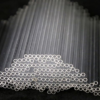
Quartz capillary tubes and rods are precision-drawn fused-silica tubes (hollow) and rods (solid) with outer diameters from 0.5 mm to 50 mm, used in X-ray diffraction, gas chromatography injectors, capillary electrophoresis, microfluidics, fiber-optic preforms, and high-temperature furnace tubes. Selection depends on three parameters: profile (round, square, rectangular, or D-shape), grade (JGS1/JGS2/JGS3 by wavelength), and finish
Choosing between quartz, sapphire, and CaF₂ optical windows is a decision driven by wavelength range, pressure rating, chemical compatibility, and cost. Quartz (185–3,500 nm) covers UV-Vis-NIR at the lowest cost; sapphire (170 nm–5.5 µm) extends into mid-IR with 3× compressive strength for high-pressure work; CaF₂ (130 nm–9 µm) reaches deepest into the mid-IR but is
Cuvette and spectrophotometer verification per USP and EP is a quarterly pharmacopeia-mandated qualification of UV-Vis instruments and their cells, used in pharmaceutical QC to confirm wavelength accuracy (±1 nm), absorbance accuracy (±0.005 AU at A = 1), stray light (< 0.01% at 200 nm), and resolution (≤ 2 nm bandwidth). The protocol uses certified reference
Diagnose UV-Vis spectroscopy problems — bubbles in cuvettes, interference fringes, baseline drift, sloping baselines, noise, negative absorbance. With cuvette-specific causes and fixes.
Step-by-step cuvette cleaning protocols for proteins, DNA, organic solvents, and stubborn stains. Chromic acid, piranha, Hellmanex compared, plus drying tips from MachinedQuartz.
Cuvette path length is the distance light travels through the sample inside a spectrophotometer cell — the L variable in the Beer-Lambert law A = ε · c · L. Standard cells are 10 mm; available path lengths range from 0.01 mm (sub-microliter ultra-thin cells) to 200 mm (long-path trace analysis). Doubling path length doubles
Selecting a cuvette is a five-decision process: (1) material — quartz, glass, or plastic by wavelength range; (2) path length — 0.1 to 200 mm by analyte concentration via Beer-Lambert; (3) form factor — standard, micro, sub-micro, large-window, flow cell, or screw-top by sample volume and application; (4) fabrication grade — Standard 80, Sintered 80/83,


Recent Comments