
Optical Windows: Quartz vs Sapphire vs CaF2 — Selection Guide
This post is also available in:
Choosing between quartz, sapphire, and CaF₂ optical windows is a decision driven by wavelength range, pressure rating, chemical compatibility, and cost. Quartz (185–3,500 nm) covers UV-Vis-NIR at the lowest cost; sapphire (170 nm–5.5 µm) extends into mid-IR with 3× compressive strength for high-pressure work; CaF₂ (130 nm–9 µm) reaches deepest into the mid-IR but is mechanically softer and slightly water-soluble. Wavelength is the primary filter; the other criteria refine the choice.
Material Selection · UV · Visible · IR
Optical Windows: Quartz vs Sapphire vs CaF₂ — Selection Guide
Pick the right optical window material for FTIR spectroscopy, laser systems, semiconductor process viewports, vacuum chamber ports, and high-pressure cells. Transmission curves, mechanical properties, chemical resistance, mounting options, and the tradeoff that decides which of the three dominant materials fits your application.
3
Material Classes
130–9000 nm
Combined Range
350+
Stock SKUs
2 pcs
Custom MOQ
An optical window is a deceptively simple component: a polished slab of transparent material that lets light pass while sealing one side from the other. The choice of material decides what wavelengths get through, how much pressure or temperature the window survives, what chemical exposures it tolerates, and how it bonds to the surrounding hardware. Picking the wrong material costs months of redesign; picking the right one is a single specification line in the BOM.
This guide compares the three dominant materials for laboratory and OEM optical windows: fused quartz (185–2500 nm), sapphire (170–5500 nm + extreme mechanical properties), and calcium fluoride CaF₂ (130–9000 nm IR specialty). Together they cover effectively the entire useful UV-Visible-IR range from deep-UV at 130 nm out to mid-IR at 9 µm. The decision between them comes down to four questions: what wavelength range, what mechanical environment, what chemical exposure, and what budget.
Who needs this guide. Optical-instrument OEMs (FTIR, Raman, UV-Vis, lidar), laser-system builders, semiconductor process equipment makers (CVD, PVD, etch chambers needing viewports), vacuum-chamber engineers, high-pressure cell designers, and the procurement teams sourcing the windows for any of these. If you have ever specified an optical window with a copy-paste from someone else’s BOM and hoped it would work, this guide is for you.
1. Why window material matters — the four selection axes
Specifying an optical window is a four-axis selection. Each axis can rule out one or more candidate materials.
Axis 1: Wavelength range
Where in the electromagnetic spectrum your application operates. Quartz cuts off above 2.5 µm; sapphire above 5.5 µm; CaF₂ above 9 µm. On the deep-UV end, CaF₂ reaches 130 nm; quartz reaches 185 nm; sapphire reaches 170 nm. Outside the transmission range a material is just opaque.
Axis 2: Mechanical environment
Pressure differential across the window, mechanical shock, vibration, temperature shock. Sapphire is by far the toughest (Mohs 9, second only to diamond) and works in pressure-vessel applications where quartz would fracture. Quartz is mechanically modest. CaF₂ is the most fragile of the three — soft (Mohs 4), brittle, and prone to thermal-shock cracking.
Axis 3: Chemical exposure
Solvents, acids, bases, plasma, water-vapor cycling. Quartz and sapphire are highly inert (the standard chemistry-lab and process-tool materials). CaF₂ is soluble in mineral acids, acidic vapours, and even prolonged water exposure — for IR cells, dry handling and storage in a desiccator are mandatory.
Axis 4: Cost & availability
Order-of-magnitude budgeting: fused quartz is the cheapest of the three (~$10–30 per typical 25 mm window). Sapphire is 3–10x quartz cost (single-crystal growth + polishing harder than amorphous quartz). CaF₂ is similar to sapphire in cost, sometimes cheaper, but harder to source in large diameters.
The most common selection mistake is using fused quartz for an application that needs to reach above 2.5 µm. The window appears to work at room-temperature alignment, then fails when the IR signal turns out to be 70% absorbed by the supposedly transparent window. Verify your application’s wavelength range against the material transmission edge before specifying.
2. The transmission spectra in detail
Fused quartz transmission
Type 1 / JGS1-grade fused quartz (the deep-UV synthetic grade) shows a transmission window from 185 nm to 2500 nm with greater than 90% transmission across most of the visible and NIR. Sharp cutoffs at both ends: below 185 nm the SiO₂ lattice absorption takes over; above 2500 nm hydroxyl (OH) absorption bands and Si-O lattice vibrations make the material opaque. JGS2 (standard UV grade) cuts off at 220 nm; JGS3 (IR grade with low OH) extends to ~3500 nm at the cost of slight UV transmission loss.
Sapphire transmission
Synthetic single-crystal sapphire (Al₂O₃) transmits from 170 nm to 5500 nm. Above 5.5 µm the Al-O lattice vibrations (multiphonon absorption) make the material rapidly opaque; the transmission drops from 80% at 5 µm to under 10% at 6 µm. The deep-UV cutoff at 170 nm is better than quartz, useful for excimer-laser applications (193 nm ArF). In the visible-NIR range sapphire’s transmission is comparable to fused quartz.
CaF₂ transmission
Calcium fluoride single crystal transmits the widest of the three: 130 nm in the vacuum-UV out to 9000 nm in the mid-IR. The 130 nm deep-UV cutoff makes CaF₂ the de facto choice for excimer-laser optics (193 nm ArF lasers) and synchrotron beamlines. The 9 µm IR transmission edge covers the entire fingerprint region of FTIR spectroscopy, making CaF₂ the standard window material for FTIR sample cells and ATR crystals.
Anti-reflection (AR) coatings can be applied to all three materials to boost transmission from typical uncoated 92% values to 99%+ at the design wavelength. AR coatings are wavelength-specific (single line, V-coat, broadband, or NIR/IR-broadband). Specify the working wavelength when ordering AR-coated windows; uncoated is fine for most non-laser work.
3. Fused quartz windows — the workhorse
Fused quartz (synthetic amorphous SiO₂) is the default optical window material for most lab and industrial applications. The combination of broad UV-Vis-NIR transmission, excellent chemical resistance, low thermal expansion, modest cost, and easy availability across diameters from 1 mm to 200+ mm makes it the first material to consider for any window application below 2.5 µm.
Grades
- JGS1 (Type 1 synthetic): deep-UV grade, transmission from 185 nm. Highest purity; lowest metallic impurities. The standard for UV laser optics, deep-UV spectroscopy windows, and excimer-adjacent applications. MachinedQuartz Plates and Discs use this grade by default (“Type 1 Material 185-2500 nm”).
- JGS2 (Type 2 fused quartz): standard UV-Vis grade; cutoff at 220 nm. Acceptable for UV-Vis spectrophotometer windows and visible-light applications; not for deep-UV.
- JGS3 (Type 3, low-OH IR grade): extends NIR transmission to ~3500 nm by removing hydroxyl impurities; trades slight UV transmission loss. Used for NIR-extending applications and laser welding optics.
Strengths
- UV transparency from 185 nm (JGS1) — covers UV-Vis-NIR almost completely
- Chemical inertness to all common solvents, dilute acids, and bases
- Low thermal expansion (0.55 × 10⁻⁶ /K) — stable over wide temperature range, excellent thermal shock resistance
- Working temperature up to 1100 °C continuous, 1200 °C short-term
- Cheap relative to sapphire and CaF₂ (~$10–30 typical 25 mm window in stock geometries)
- Available in any geometry within standard machining envelope without tooling fee
Limits
- Transmission cutoff at 2.5 µm — not for mid-IR applications
- Lower hardness than sapphire (Mohs 5.5–6.5) — scratches more easily during cleaning
- Brittle — impact resistance is modest; protect from sharp impacts during installation
- HF-soluble — do not use in environments containing hydrofluoric acid or fluoride plasma
For chemical and material details, see our UV cutoff guide and fabrication method guide.
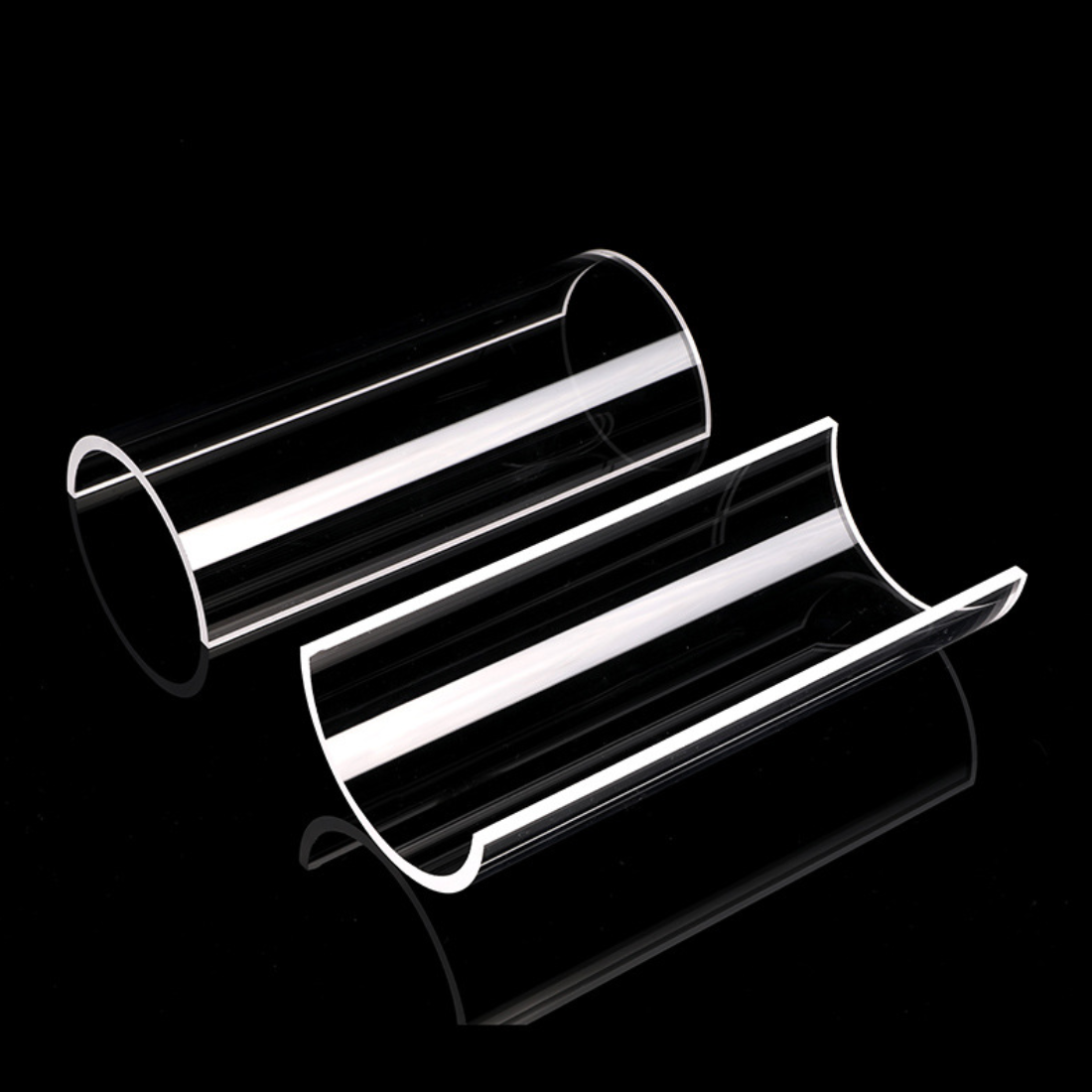
Quartz format examples
 Standard
Polished UV plate
Flat · transparent JGS1
 Frosted
Matte / diffuser disc
Ground rear face · uniform diffuser
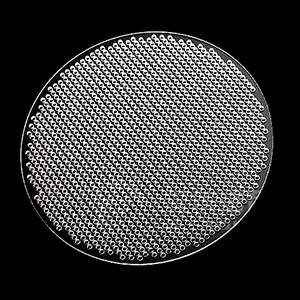 Sieve
SieveSieve / perforated
Patterned through-holes
 Stepped
Fluted / stepped sheet
Custom non-flat geometry
4. Sapphire windows — the mechanical specialist
Synthetic single-crystal sapphire (Al₂O₃, grown by Czochralski, Verneuil, EFG, or HEM methods) is the right choice when the window must survive a hostile mechanical environment: high pressure, mechanical impact, abrasive flow, hostile plasma, or extreme temperature. Sapphire is the second-hardest material in commercial use after diamond and is essentially inert to almost everything.
Strengths
- Hardness Mohs 9 — effectively scratch-proof in normal handling
- Compressive strength ~ 2 GPa — survives multi-bar pressure differentials in vessel viewports
- Wide transmission range 170–5500 nm — covers UV through mid-IR up to 5.5 µm
- High thermal conductivity (40 W/m·K vs 1.4 for quartz) — better at dissipating heat from absorbed laser power
- Working temperature up to 1500–1800 °C in inert atmosphere, 800 °C in air
- Inert to most acids, bases, and plasma; only attacked by hot phosphoric acid, molten alkalis, and HF at high temperature
- Birefringence is small but non-zero in the c-axis — specify “c-cut” or “0° cut” for polarisation-sensitive applications
Limits
- 3–10x cost of fused quartz of the same dimensions — single-crystal growth is expensive
- Mid-IR cutoff at 5.5 µm — not for FTIR fingerprint-region work beyond 5.5 µm
- Birefringence creates polarisation-dependent transmission — matters for polarised lasers, less so for incoherent sources
- Harder to fabricate than quartz — lapping and polishing are slower; complex geometries are more expensive
- Not recommended for HF or fluoride-plasma environments above 200 °C
Standard sapphire formats
Most catalog sapphire windows are round discs from Ø 1.5 mm to Ø 100 mm with thickness 0.2–5 mm. Custom rectangular plates are available with thickness 0.5–10 mm. Crystal orientation default is c-axis perpendicular to the window face (0° orientation); other orientations available on request for specific polarisation requirements.
5. Calcium fluoride (CaF₂) windows — the IR specialist
Calcium fluoride single crystal is the mid-IR specialty window material. Its 130–9000 nm transmission range is the widest of any commonly available optical material — the only practical alternative for FTIR work in the fingerprint region (5–9 µm), for excimer laser optics at 193 nm and 157 nm, and for combined deep-UV-and-IR applications.
Strengths
- Transmission 130–9000 nm — widest of the three; covers vacuum-UV through mid-IR
- Low refractive index (n ≈ 1.40 in the visible) — lowest Fresnel reflection of the three (~3% per surface uncoated)
- Insoluble in most organic solvents
- Standard for FTIR sample cells, ATR crystals, ArF excimer laser windows
Limits (this is the fragile one)
- Soft — Mohs 4, easily scratched during cleaning. Use only soft lens tissue or chamois leather; never paper towel or rough wipe
- Hygroscopic — degrades on prolonged exposure to atmospheric water vapour; surface fogs over months in humid environments. Store in desiccator or dry-N₂ cabinet
- Soluble in mineral acids and alkali, partially soluble even in tap water at low pH
- Thermal shock sensitive — cracks under sudden temperature changes > 50 °C/min. Slow ramping required
- Birefringent at certain orientations — specify (111) cut for non-polarising applications
- Larger diameters (Ø > 50 mm) become very expensive due to crystal-growth limitations
CaF₂ is the most demanding of the three to handle. Many “broken FTIR window” complaints come back to: storing the window in lab air for weeks (water-vapour fogging), using a paper towel during cleaning (scratching), or placing a hot sample directly on a cold window (thermal shock crack). For high-throughput labs, plan for a window-replacement budget; for low-throughput precision work, the right SOP makes a CaF₂ window last years.
6. Direct property comparison — what fits where
The table below maps property dimensions to material winners. “Best” means the material that wins outright on this axis; choose accordingly when one axis is the binding constraint.
| Selection axis | Best | Acceptable | Avoid |
|---|---|---|---|
| Deep UV (130–180 nm) transmission | CaF₂ | Sapphire (170+ nm) | Quartz |
| UV-Vis (200–700 nm) transmission | Quartz (cheap) | Sapphire | CaF₂ (overkill) |
| NIR (1–2.5 µm) transmission | Quartz (JGS3 best) | Sapphire | — |
| Mid-IR (2.5–5 µm) | Sapphire | CaF₂ | Quartz (opaque) |
| Mid-IR (5–9 µm fingerprint) | CaF₂ | — | Quartz, Sapphire (opaque) |
| High pressure (> 10 bar across window) | Sapphire | — | Quartz, CaF₂ (fracture risk) |
| Mechanical impact / shock | Sapphire | — | CaF₂ (very fragile) |
| Cost-sensitive volume order | Quartz | — | — |
| HF / fluoride plasma exposure | Sapphire (cold) | CaF₂ | Quartz (HF dissolves it) |
| Hygroscopic environment | Quartz | Sapphire | CaF₂ (fogs over months) |
| FTIR / ATR crystals | CaF₂ | (specialty: ZnSe, Ge for > 9 µm) | Quartz, Sapphire |
| UV laser optics (193 nm ArF) | CaF₂ | JGS1 quartz | JGS2 quartz |
 Quartz · 184 SKUs
Fused quartz plates & discs
JGS1 grade · 185-2500 nm · Ø 2 to 100 mm · the cost-effective workhorse
View quartz plates → Sapphire · 100 SKUs
Sapphire windows / sheets
Single crystal · 170-5500 nm · Mohs 9 hardness · for pressure / impact / IR-extending applications
View sapphire range →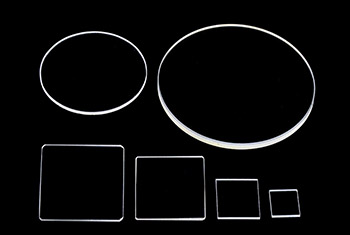 CaF₂ · 61 SKUs
Calcium fluoride windows
Single crystal · 130-9000 nm · widest range · the FTIR & deep-UV laser specialist
View CaF₂ range →7. Plates vs discs vs custom geometry
The optical industry has standardised on three form factors. Each fits different mounting hardware and applications.
Round discs (the dominant format)
Diameter Ø 1.5 mm to 200 mm; thickness 0.2 to 10 mm. Round discs fit standard optical mounts (one-inch, half-inch, mm-scale precision mounts), O-ring grooves, retaining-ring assemblies, and threaded barrel windows. The default for laser systems, FTIR sample-cell windows, vacuum-chamber viewports, and all general spectroscopy windows.
Square / rectangular plates
Common dimensions 10 × 10 mm to 100 × 100 mm; thickness 0.5 to 5 mm. Plates are used in: rack-mounted optical filters, custom holder slots, beam-splitter substrates, and applications where a round window cannot tile efficiently. MachinedQuartz’s quartz plate range starts at 1 × 1 mm (sub-miniature) up to 100 mm and beyond on request.
Custom geometry
Beyond the standard formats: bevelled-edge windows for laser cavities, wedged windows for fringe suppression, brewster-angle windows for polarised laser optics, drilled windows for through-feed cabling, ground-edge sealable windows for kovar-bonded chamber ports. All available on request with no tooling fee for designs that fit our standard machining envelope.
Wedged windows for fringe suppression. A flat-parallel window in a coherent laser beam path creates an etalon — the front and back surfaces interfere, producing fringes. A wedged window (front and back faces machined at 1°-3° non-parallel) breaks the etalon and eliminates fringes. Specify wedge angle when ordering for laser-cavity applications.
Custom geometry examples
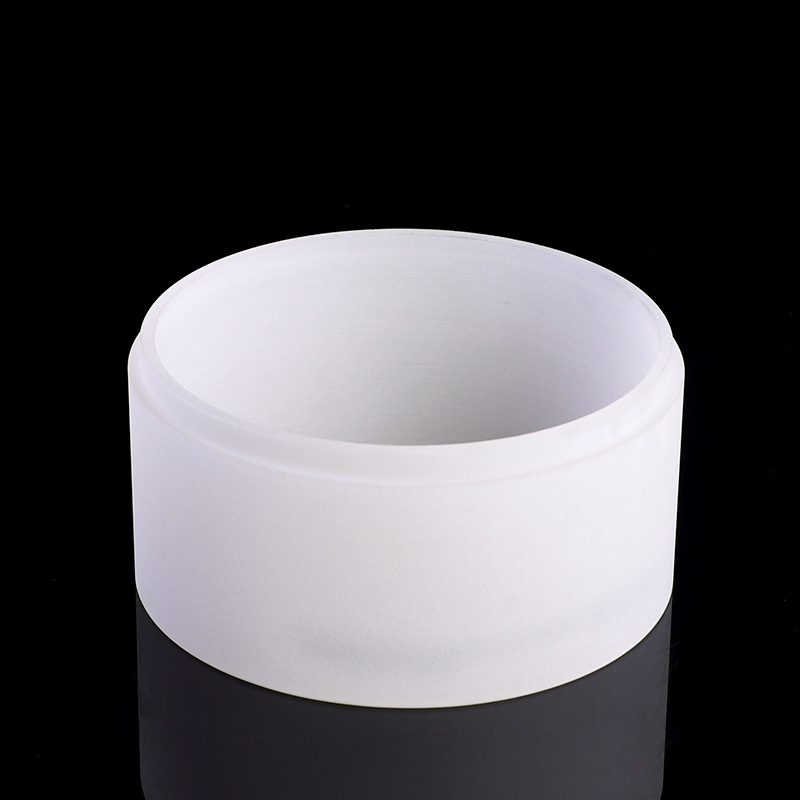 Discs / plates
Custom dimensions
Ø 2 to 100+ mm range
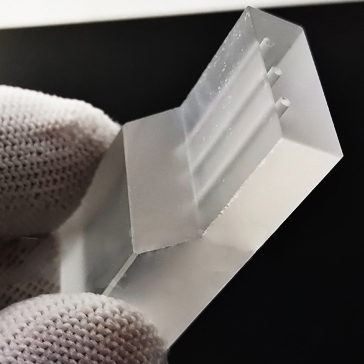 Drilled
Through-hole drilling
Cable / sensor pass-through
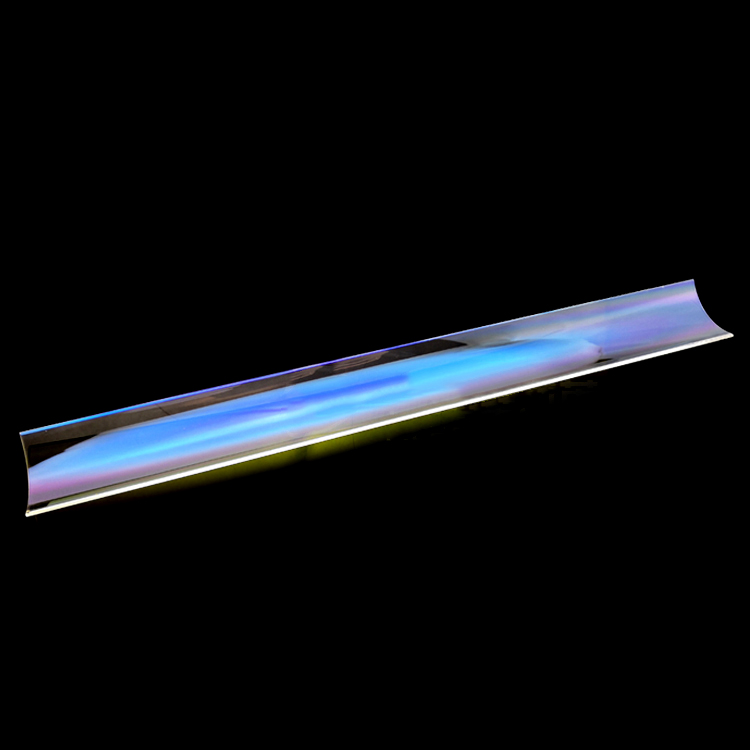 Curved
Curved / spherical
Lens substrate / window dome
 In stock
Stock plates
0.2 to 5 mm thicknesses
8. Mounting, sealing, and surface specifications
Mounting methods
- Threaded retaining ring: the standard method for laser optics and instrument viewports. Window sits in a recess; a threaded ring compresses against an O-ring or rubber gasket. Allows quick replacement; minimal mechanical stress on window.
- O-ring face seal: for vacuum and pressure applications. Window face presses against a Viton, EPDM, or PTFE O-ring; bolts compress evenly. Specify rated pressure for window thickness selection (sapphire required for > 10 bar).
- Epoxy bonding: for permanent installations. Optical-grade epoxy (Norland 61, EPO-TEK 301) bonds window to a metal flange. Cured assembly is gas-tight to ~10⁻⁶ mbar; low outgassing for vacuum work.
- Glass-to-metal seal (Kovar bond): for high-vacuum (< 10⁻⁶ mbar) and high-temperature applications. Quartz or sapphire is fused to a Kovar (or other matched-CTE alloy) flange via direct bonding or intermediate solder glass. Specialty fabrication.
- Indium / gold seal: for ultra-high vacuum (< 10⁻⁹ mbar) such as research vacuum systems and synchrotron beamlines. Soft-metal sealing rings; window face must be optically polished AND atomically flat at the seal surface.
Surface specifications you should specify
| Spec | Routine | Precision | Laser-grade |
|---|---|---|---|
| Surface flatness | λ/2 (310 nm) | λ/4 (155 nm) | λ/10 (60 nm) |
| Surface quality (scratch-dig) | 60-40 | 40-20 | 20-10 or 10-5 |
| Parallelism | < 5 arcmin | < 1 arcmin | < 10 arcsec |
| Surface roughness Ra | < 5 nm | < 2 nm | < 0.5 nm |
| AR coating | typically uncoated | broadband AR | V-coat or dual-band AR for design wavelength |
Specify “Routine” for industrial / process / non-laser work. “Precision” for laboratory spectrometers and most laser systems. “Laser-grade” only when the laser power density is high enough to require it (typically > 10 W/cm² CW or short-pulse high-PRF). Tighter specs cost more and longer lead times; do not over-specify.
9. Application examples
FTIR sample cells (CaF₂)
FTIR spectroscopy in the 5–9 µm fingerprint region requires CaF₂ windows. Standard FTIR sample-cell construction: two CaF₂ windows separated by a calibrated PTFE or lead spacer (path length 0.025 to 0.5 mm) clamped in a stainless-steel holder. The CaF₂ windows must be handled with extreme care — dry environment, soft-tissue cleaning only, store in desiccator between use. See our demountable cuvette guide for the cell construction details.
Excimer laser optics (CaF₂ or JGS1 quartz)
193 nm ArF and 248 nm KrF excimer laser systems use CaF₂ for the most demanding optics (cleavage windows, beam-shaping plates) and JGS1 fused quartz for less critical components. The deep-UV transmission and resistance to laser-induced damage are the binding constraints; surface quality scratch-dig 10-5 is typical for laser-cavity components.
Process viewports (sapphire)
CVD chambers, PVD systems, semiconductor etch tools, and high-pressure reactors use sapphire viewports for the combination of mechanical robustness, plasma resistance, and optical clarity. Typical specification: Ø 25–100 mm sapphire disc, thickness 5–10 mm for pressure rating, mounted in Conflat (CF) flange via metal-to-glass seal or Viton O-ring.
Vacuum chamber viewports (quartz or sapphire)
UHV (10⁻⁹ to 10⁻¹¹ mbar) vacuum systems use either quartz or sapphire windows. Quartz is cheaper and adequate for non-pressurised viewing; sapphire for windows under pressure differential or in plasma exposure. Both materials bond to Kovar or molybdenum-glass flanges; Conflat-mounted viewports are commercially standardised.
Laser cavity end mirrors (sapphire substrate)
High-power laser systems (Nd:YAG, Ti:Sapphire) use sapphire substrates for output couplers and back mirrors because of sapphire’s high thermal conductivity (heat dissipation from the absorbed laser power) and mechanical durability. Coated with appropriate dielectric stack on each face.
UV-curing systems (JGS1 quartz)
Deep-UV (200–300 nm) curing systems for adhesives, coatings, and 3D-printer resin use JGS1 quartz windows in the lamp housing. Cost-sensitive application; quartz is the obvious choice over sapphire or CaF₂.
Pyrometer windows (sapphire or quartz)
Industrial pyrometers viewing high-temperature processes (steel mills, glass furnaces, semiconductor RTP chambers) use sapphire for the highest-temperature applications and quartz for moderate-temperature work. Specify NIR-broadband AR coating for pyrometer wavelengths (typically 0.9–1.6 µm).
10. Decision matrix — application to material
| Application | Recommended | Alternative | Notes |
|---|---|---|---|
| UV-Vis spectrophotometer window | JGS1 fused quartz | Sapphire | Quartz is universal default; sapphire only if mechanical environment demands |
| FTIR sample cell windows | CaF₂ | ZnSe (5-15 µm extension) | CaF₂ standard for 1-9 µm; ZnSe for 5-15 µm or moisture-resistant alternative |
| 193 nm ArF excimer laser optics | CaF₂ | JGS1 fused quartz | CaF₂ for highest power density; JGS1 for budget-constrained alternative |
| Vacuum chamber viewport (UHV, no pressure) | JGS1 fused quartz | Sapphire | Quartz fits Kovar; cheaper and adequate for viewing only |
| High-pressure cell viewport (> 10 bar) | Sapphire | Quartz, CaF₂ | Sapphire only material with sufficient compressive strength |
| Plasma chamber viewport | Sapphire | Quartz (mild plasma) | Sapphire resists fluorine and chlorine plasma; quartz erodes in fluorine plasma |
| Process pyrometer window (high T) | Sapphire | JGS1 fused quartz | Sapphire for furnace temperatures > 1000 °C; quartz for moderate |
| UV-curing lamp housing | JGS1 fused quartz | CaF₂ (overkill) | Cost matters; JGS1 covers 200–300 nm UV-curing band |
| Raman spectroscopy probe window | JGS2 fused quartz | Sapphire | Quartz for visible Raman; sapphire if probe contacts harsh environment |
| Telescope corrector plate | JGS1/JGS2 fused quartz | BK7 (cheaper) | Quartz for low thermal expansion; BK7 for cost-sensitive amateur work |
| High-power laser output coupler substrate | Sapphire | JGS1 fused quartz | Sapphire’s thermal conductivity dissipates absorbed power |
| Fiber-optic feedthrough window | JGS1 fused quartz | Sapphire | Quartz matches CTE of common fiber jacket materials |
11. MachinedQuartz catalog ranges
MachinedQuartz manufactures windows in all three materials across hundreds of stock SKUs. Custom geometry is available with no tooling fee on standard-envelope designs; 2-piece minimum order applies.
| Category | SKU count | Standard range | Browse |
|---|---|---|---|
| Fused quartz plates (square) | 184 | 1 × 1 mm to 100 × 100 mm; thickness 0.2–3 mm; JGS1 default | Quartz plates |
| Fused quartz discs (round) | 106 | Ø 2 mm to 100 mm; thickness 0.5–5 mm; JGS1 default | Quartz discs |
| Sapphire sheets / discs | 100 | Ø 1.5 mm to 100 mm; thickness 0.2–5 mm; c-axis cut default | Sapphire range |
| Calcium fluoride (CaF₂) windows | 61 | Ø 6 mm to 50 mm; thickness 0.6–3 mm; (111) cut default | CaF₂ windows |
Custom fabrication options
- Wedged windows (1–5 arcmin wedge angle for fringe suppression)
- Brewster-angle windows for polarised laser optics
- Bevelled or ground edges for sealing applications
- Drilled windows (through-holes for cabling, gas feed, sensor pass-through)
- AR coatings (V-coat single line, broadband UV/Vis/NIR/IR)
- Ground / matte rear face for diffuser applications
- Specific crystal orientation (sapphire c-cut, a-cut, r-cut; CaF₂ (111) or (100))
Custom optical window quote
Send the material, dimensions, surface specs, AR-coating requirement (if any), and quantity. We respond within one business day with a quote and lead time, plus a free 2D drawing for sign-off on custom geometry.
Request quote →OEM & bulk programs →Browse the catalog
Related guides
12. Frequently asked questions
Can I use a fused quartz window for FTIR work?
No, not for the fingerprint region. Fused quartz transmits up to about 2.5 micrometres; the FTIR fingerprint region runs from 5 to 9 micrometres where quartz is essentially opaque. For FTIR sample cells, ATR crystals, and any mid-IR optical work above 2.5 micrometres, use CaF2. For FTIR work above 9 micrometres, ZnSe or Ge are the standard alternatives.
What is the difference between JGS1, JGS2, and JGS3 fused quartz?
JGS1 is synthetic high-purity deep-UV grade; transmits from 185 nm; lowest metallic impurities; used for UV laser optics and deep-UV applications. JGS2 is standard UV-Vis grade; cuts off at 220 nm; cheaper than JGS1; the default for visible-light windows. JGS3 is low-OH grade with extended NIR transmission to about 3500 nm; trades slight UV transmission loss; used for laser welding optics and NIR-extending applications. For optical windows on this page, MachinedQuartz uses JGS1 (Type 1 Material) by default.
Why does sapphire cost so much more than fused quartz?
Single-crystal growth. Synthetic sapphire is grown from molten Al2O3 by Czochralski, Verneuil, EFG, or HEM methods at temperatures over 2000 degrees Celsius in expensive iridium or molybdenum crucibles. Each boule takes days to weeks to grow. Fused quartz is amorphous, made by melting natural quartz sand or chemically depositing SiO2 from gas phase; much faster and cheaper per kilogram. Single-crystal growth costs are inherent to sapphire; expect 3 to 10 times the per-window cost of equivalent fused quartz.
Is CaF2 safe to handle?
CaF2 is non-toxic in solid form. The hazard is fragility, not toxicity. CaF2 is hygroscopic (degrades on moisture exposure over months to years), soft (Mohs 4 — scratches easily), thermal-shock-sensitive (cracks under sudden temperature change above 50 degrees per minute), and slightly soluble in mineral acids. Handle with cotton gloves or finger cots; clean only with soft lens tissue or chamois leather; store in a desiccator. With proper handling a CaF2 window lasts years; with poor handling it lasts weeks.
Do I need anti-reflection (AR) coating on my optical window?
For most applications no. Uncoated quartz, sapphire, and CaF2 windows transmit about 92 percent (8 percent loss to two-surface Fresnel reflection). For laser optics where every percent matters, single-line V-coat AR pushes transmission to 99 percent or higher at the design wavelength. For broadband applications, multi-layer broadband AR coatings give 95 to 98 percent over 200 to 1000 nm range. Specify the working wavelength when ordering AR-coated windows; uncoated is the default for industrial and most lab applications.
What surface specifications should I specify for a window?
For routine industrial work: surface flatness lambda over 2, scratch-dig 60-40, parallelism less than 5 arcminutes. For laboratory spectrometers and most laser systems: lambda over 4 flatness, scratch-dig 40-20, parallelism less than 1 arcminute. For laser-grade optics with high power density: lambda over 10 flatness, scratch-dig 20-10 or 10-5, parallelism less than 10 arcseconds. Specify what you actually need; tighter tolerances cost more without delivering benefit.
Can I use a sapphire window in an HF-containing environment?
Cold HF: yes, sapphire is essentially inert. Hot HF (above about 200 degrees Celsius) or hot phosphoric acid: sapphire is slowly attacked. Fluorine plasma: sapphire is resistant. By contrast fused quartz is rapidly dissolved by HF at any temperature, so quartz is wrong for HF environments. CaF2 is the most fluorine-resistant of the three (it is calcium fluoride after all) but CaF2’s other limitations usually rule it out for chamber viewport work.
What is a wedged window and when do I need one?
A wedged window has its two optical faces ground at a non-parallel angle (typically 1 to 5 arcminutes wedge). The wedge breaks the etalon effect that flat-parallel windows create in coherent laser beams (front and back surface reflections interfere, producing fringes in the beam profile and noise in spectroscopic measurements). For incoherent light or wavelength-modulated systems, parallel windows are fine. For single-frequency continuous-wave laser work, narrow-linewidth lasers, and any high-precision interferometric work, specify wedged windows.
Does MachinedQuartz make AR coatings in-house?
We outsource AR coating to qualified vacuum-deposition partners. We accept the customer’s specified coating design (e.g., ‘V-coat at 633 nm with R less than 0.5 percent’, ‘broadband AR 400-700 nm with R less than 2 percent average’), source the coating from a partner, and ship the finished AR-coated windows. Lead time for AR-coated parts is 25 to 35 working days versus 7 to 14 days for uncoated.
How do I clean a sapphire or CaF2 window?
Sapphire is robust. Use compressed-air dust removal first; then a drop of acetone or isopropanol on a lint-free wipe (lens-quality tissue, not Kimwipe); wipe in one direction (do not scrub). For stubborn contamination, a dilute soap-and-water rinse followed by IPA. CaF2 is fragile. Compressed-air dust removal first; then a drop of dry methanol on chamois leather or lens tissue; wipe gently in one direction. Never use water alone (CaF2 is slightly soluble); never scrub; store in desiccator immediately after cleaning. For both materials, fingerprints are a real problem — wear cotton gloves.
13. Disclaimer & notes
Material specifications on this page are typical values for commercial-grade single-crystal sapphire and CaF₂, and synthetic fused quartz (JGS1 / JGS2 / JGS3). Specific material properties depend on the supplier, growth method, and specific lot. For binding specifications, refer to the certificate of analysis supplied with each shipment.
Application recommendations are general guidance based on typical optical-engineering practice. Specific applications may have requirements (laser-induced damage threshold, vacuum-compatibility certification, biocompatibility, regulatory compliance) that constrain the choice further. Verify against your application’s full specification before ordering.
Anti-reflection coating is outsourced to vacuum-deposition partners. Coating performance specifications come from the coating vendor’s certificate; MachinedQuartz integrates and ships the coated windows but does not deposit coatings in-house.
Trademark notice. Norland 61 and EPO-TEK 301 are trademarks of their respective owners. References to specific competitive products (ZnSe, Ge for far-IR) are for technical comparison only.
Information currency: last reviewed May 2026. Material availability and stock SKU range subject to change.


Recent Comments