
Cuvette Selection Guide 2026: Material, Path Length & Volume Chart
This post is also available in:
Selecting a cuvette is a five-decision process: (1) material — quartz, glass, or plastic by wavelength range; (2) path length — 0.1 to 200 mm by analyte concentration via Beer-Lambert; (3) form factor — standard, micro, sub-micro, large-window, flow cell, or screw-top by sample volume and application; (4) fabrication grade — Standard 80, Sintered 80/83, or Molded 83 by solvent compatibility and temperature requirement; and (5) window count — 2-window for absorbance, 4-window for fluorescence. MQ publishes selection matrices for each of the five decisions.
Cuvette Selection Guide: Material, Path Length, Volume & Caps
On this page
- What Is a Cuvette?
- Cuvette Material Types: Quartz, Glass, and Plastic
- Cuvette Material Comparison Table
- Cuvette Path Length Guide: 0.5 mm to 100 mm
- Cuvette Types by Application
- How to Choose the Right Cuvette: A 5-Step Decision Process
- Cuvette Volume and Sizes
- How to Clean a Cuvette Without Damaging It
- 2-Window vs 4-Window Cuvettes
- Cuvette Z Dimension: Why It Matters
- Dual Path Length Cuvettes
- Cuvette Caps and Stoppers
- MachinedQuartz Custom Cuvettes
- Frequently Asked Questions
MachinedQuartz · Buyer’s Guide
Cuvette Selection Guide: Material, Path Length, Volume & Caps
Pick the right quartz, glass, or plastic cuvette in five steps. Covers material trade-offs, path length math, sample volume, window count, Z dimension, and caps — with photos, decision diagrams, and a worked Beer–Lambert example.
12 sections
18 product photos
4 SVG diagrams
5-step decision flow
Contents
- What is a cuvette?
- Cuvette material types: quartz, glass, plastic
- Material comparison table
- Cuvette path length guide
- Cuvette types by application
- How to choose the right cuvette
- Cuvette volume and sizes
- 2-window vs 4-window cuvettes
- Z dimension guide
- Dual path length cuvettes
- Caps and stoppers
- How to clean a cuvette
- MachinedQuartz custom cuvettes
- FAQ
Section 1
What Is a Cuvette?
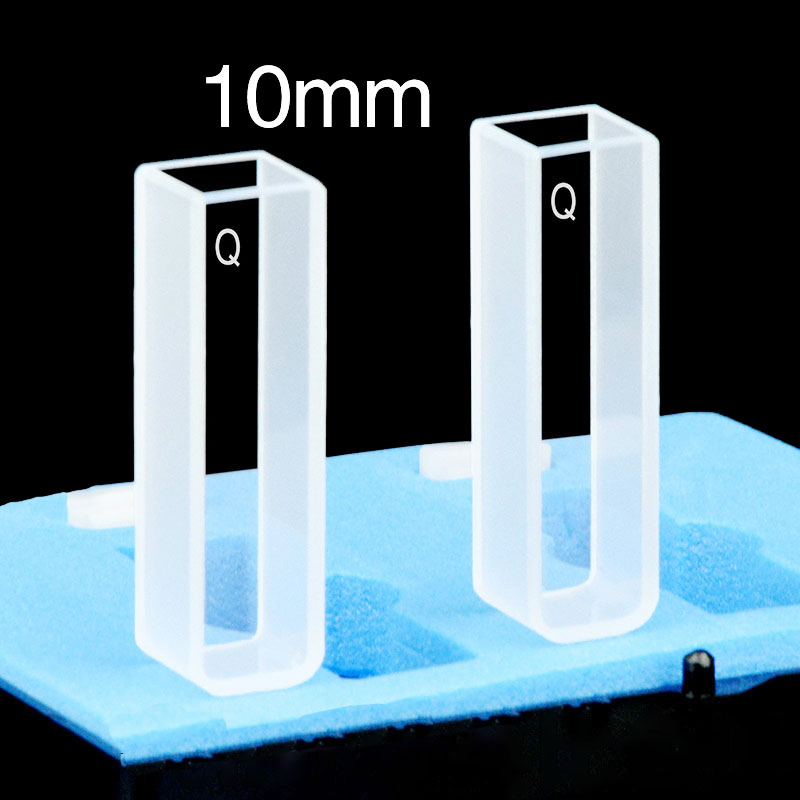
Standard quartz
10 mm path · UV-Vis
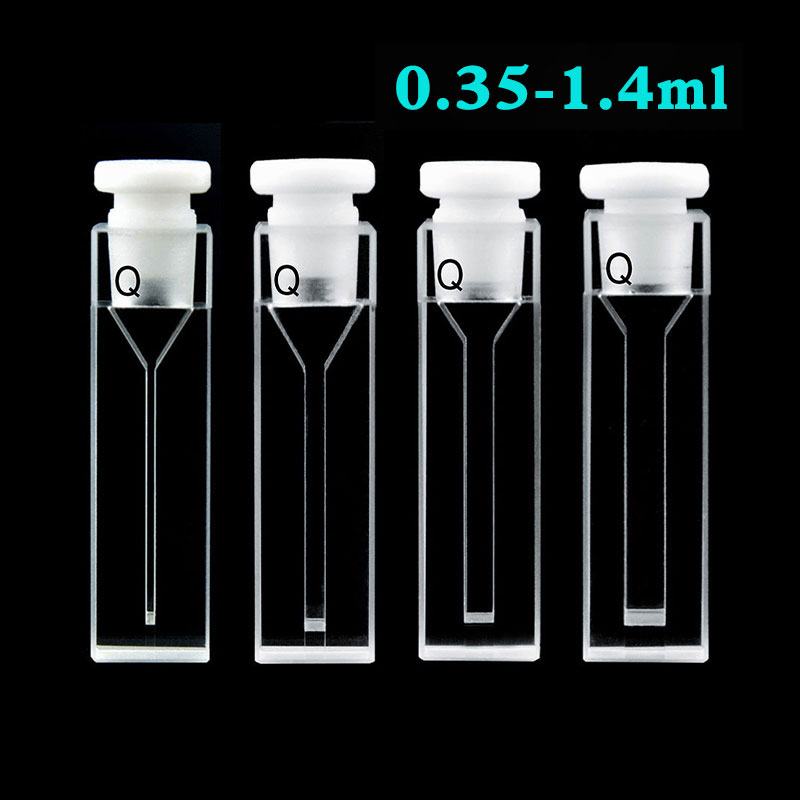
Two-way light
1 mm slit · stoppered
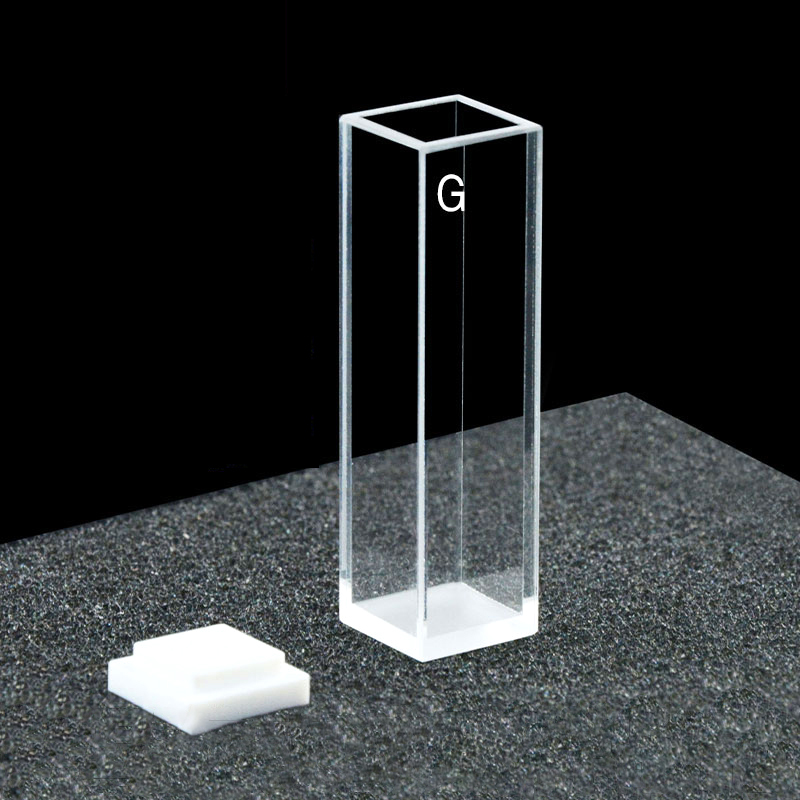
Quartz pair
standard 10 mm · packed in 2
A cuvette is a small, optically transparent container used to hold liquid or solid samples during spectroscopic measurements. It sits in the light path of instruments such as UV-Vis spectrophotometers, fluorometers, and Raman spectrometers, allowing the instrument to measure how much light the sample absorbs, transmits, or emits at specific wavelengths.
The relationship between absorbance and concentration follows the Beer-Lambert law: A = εcl, where A is absorbance, ε is the molar absorptivity, c is concentration, and l is the path length — the distance light travels through the sample inside the cuvette. Choosing the right path length and material is therefore not a matter of preference; it directly affects the accuracy of your measurement.
Key principle: Cuvette material determines which wavelength range you can work in. Path length determines your optimal concentration range. Choosing wrongly on either axis introduces systematic error that no software correction can fully remove.
Section 2
Cuvette Material Types: Quartz, Glass, and Plastic
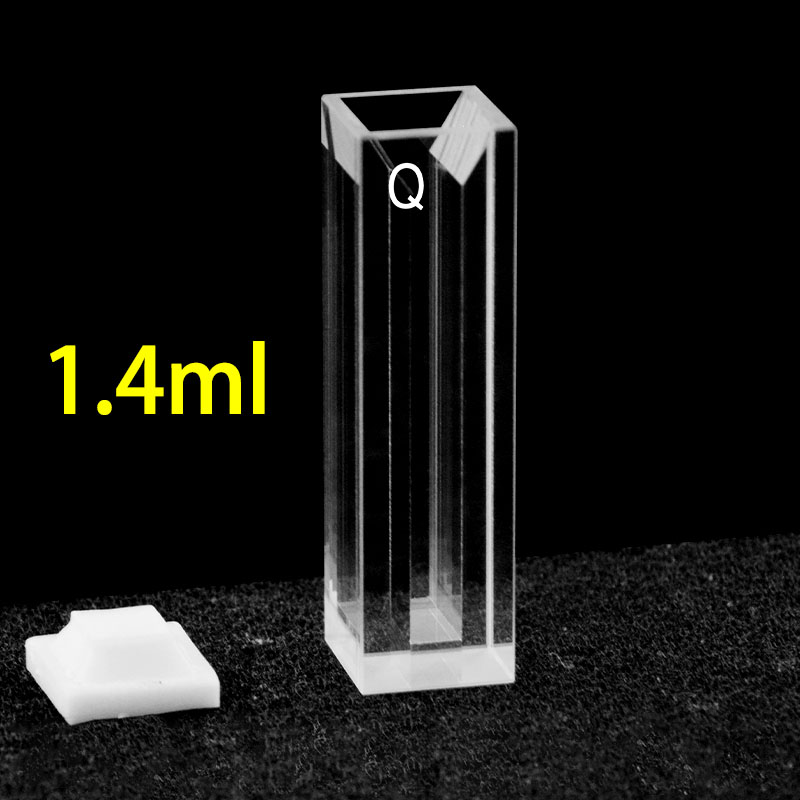
Synthetic fused silica (JGS1) · UV–NIR · 185–2,500 nm
Glass · VIS · 340–2500 nm
Glass · standard · cost-effective
Section 3
Cuvette Material Comparison Table
Use this table to match your wavelength range, solvent, and budget to the right material before ordering.
| Property | Fused silica (JGS1) | Optical Glass | Plastic |
|---|---|---|---|
| UV transmission | 185–2,500 nm ✓ | 320+ nm (optical glass) | PS ~340; PMMA ~300; UV-grade ~220 |
| Visible transmission | Excellent | Excellent | Good (varies) |
| Organic solvents | Resistant ✓ | Limited | Not compatible |
| Strong acids/bases | Resistant ✓ | Not compatible | Not compatible |
| Temperature limit | ~1,100 °C continuous (material) | ~500 °C | ~60 °C |
| Reusable | Yes ✓ | Yes ✓ | Single use |
| Typical cost | $$–$$$ | $–$$ | $ (bulk) |
| Custom dimensions | Yes ✓ | Limited | No |
Bottom line: if you ever need to read below 340 nm, switch to organic solvents, or work above 60 °C, plan on quartz from the start. Saving cost on glass or plastic upfront often means rebuying as your method evolves — and method validation forces you back to quartz the moment you publish or commercialise.
Reference Data
Quartz Grade Transmittance Reference: JGS1 vs JGS2 vs JGS3
Fused-silica (quartz) cuvettes are supplied in three optical grades. The grade sets the usable wavelength window — pick the grade whose transmission range covers your measurement before you choose a cuvette. The table below is a quick reference for matching grade to wavelength; it is free to quote or link to.
| Wavelength / property | JGS1 (UV grade) | JGS2 (standard) | JGS3 (IR grade) |
|---|---|---|---|
| Usable transmission range | 185–2,500 nm | 220–2,500 nm | 260–3,500 nm |
| Deep UV / UV-C (185–220 nm) | Transmits ✓ | Cut off <220 nm | Cut off <260 nm |
| UV-C 254 nm (DNA, sterilization) | Excellent | Excellent | Near cut-off |
| Near-UV & Visible (300–700 nm) | Excellent | Excellent | Excellent |
| NIR (700–2,000 nm) | Excellent | Excellent | Excellent |
| OH (water) band ~2,730 nm | Strong absorption | Strong absorption | Low OH — transmits |
| Mid-IR to 3,500 nm | Cut off at 2,500 nm | Cut off at 2,500 nm | Transmits to 3,500 nm |
| Typical use | Deep-UV & UV-C, DNA/RNA at 260 nm, UV validation | General UV-Vis lab work | NIR / IR spectroscopy |
Values are nominal usable ranges for fused-silica optical grades; exact cut-off depends on path length and polish. Reference: MachinedQuartz, Cuvette Selection Guide (2026), machinedquartz.com/cuvette-selection-guide/#quartz-grade-transmittance.
Section 4
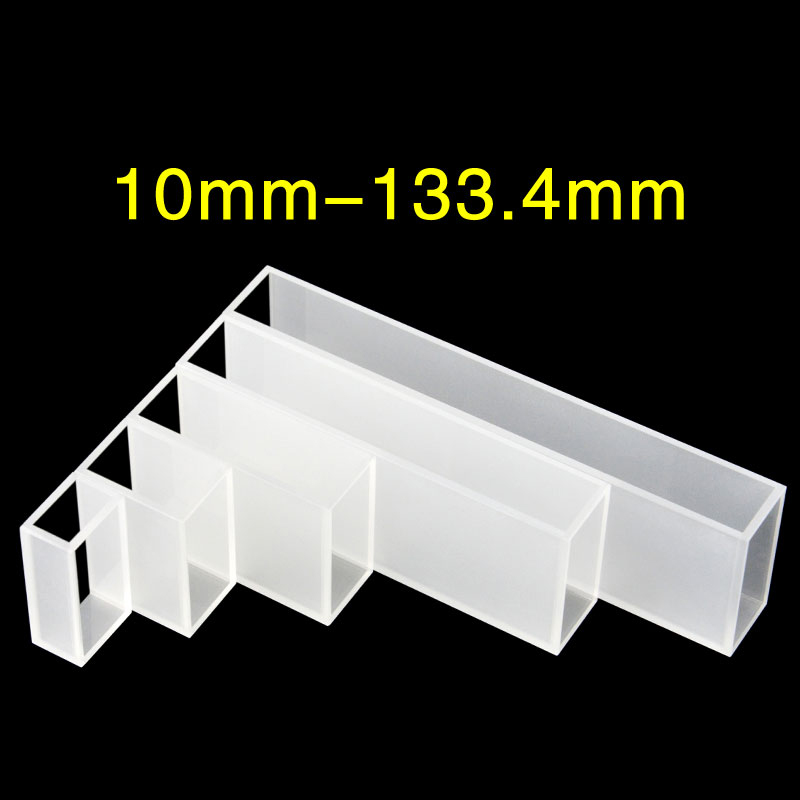
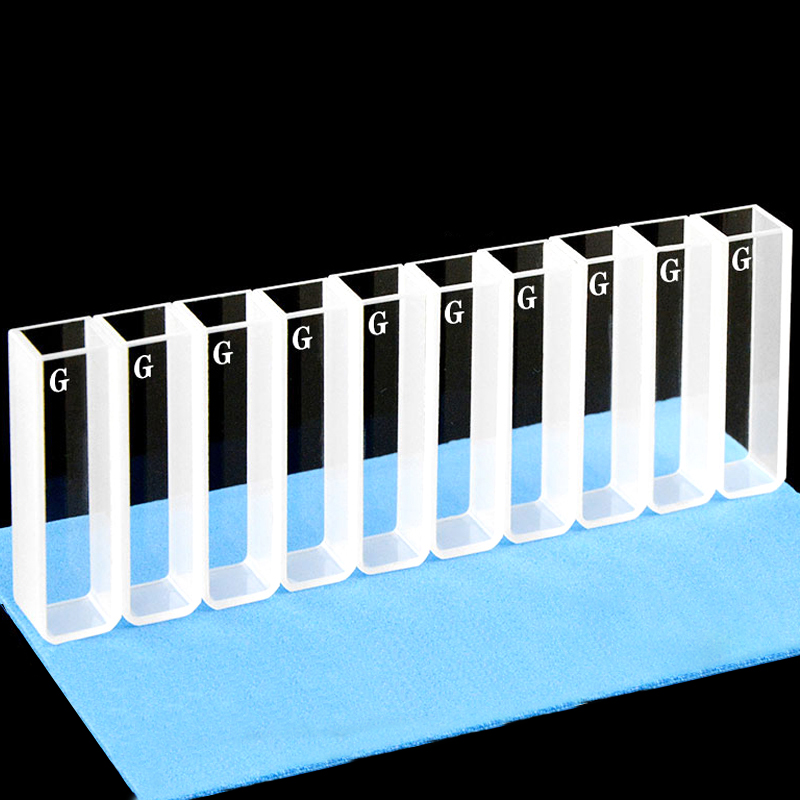
Cuvette Path Length Guide: 0.5 mm to 100 mm
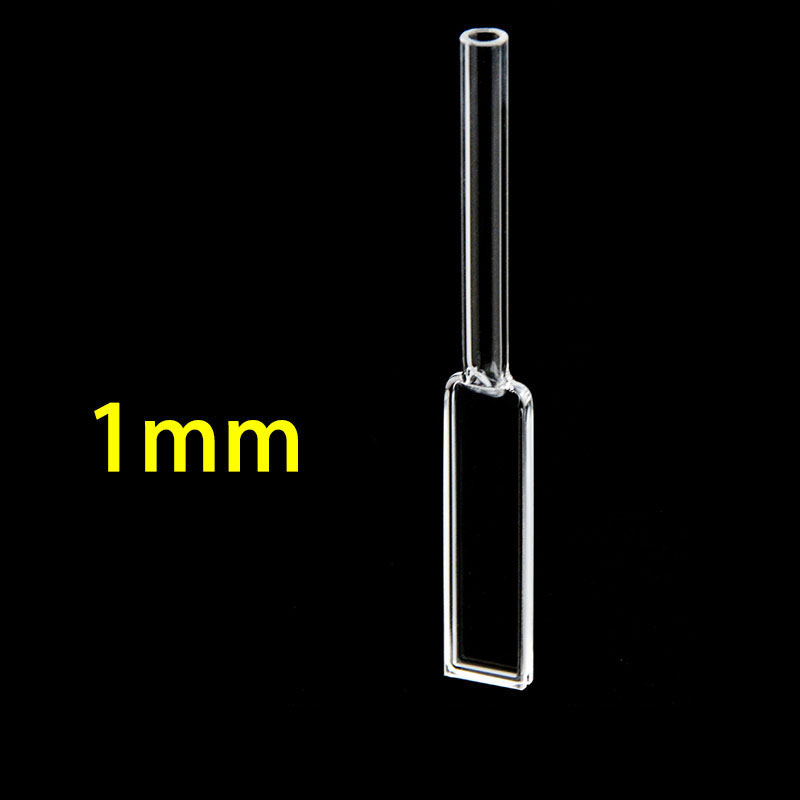
Short · 1 mm · high-concentration
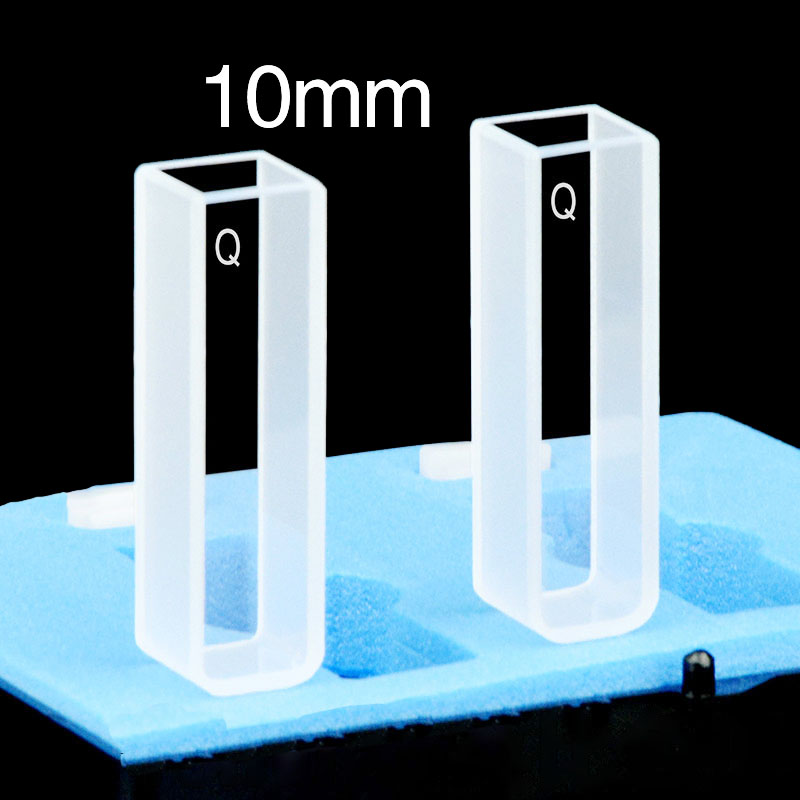
Standard · 10 mm · the default
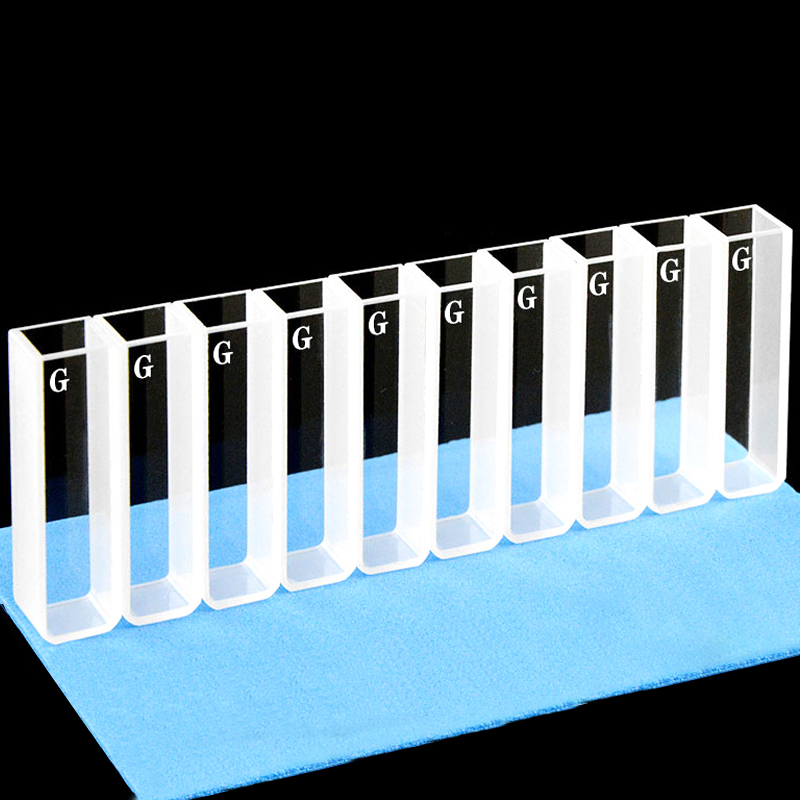
Long · 100 mm · trace detection
Section 5
Cuvette Types by Application
Beyond material and path length, cuvette geometry determines which analytical technique you can run. Here are the main application-specific types:
| Cuvette Type | Key Feature | Application | Window Config |
|---|---|---|---|
| Standard UV-Vis | 2 clear optical windows | Absorbance spectroscopy, Beer-Lambert measurements | 2-sided |
| Fluorescence | 4 polished optical windows | Fluorescence emission/excitation, FRET | 4-sided |
| Micro / Sub-micro | Reduced internal volume (5–350 µL) | Rare samples, nanodrop-style analysis, precious biologics | 2 or 4-sided |
| Flow Cell | Continuous-flow inlet/outlet | HPLC detection, online process monitoring | 2-sided + ports |
| Demountable | Separable windows | Viscous or solid samples, easy cleaning | Custom |
| Long-path / Gas | 50–100 mm or longer | Trace gas, environmental, high-purity liquid | 2-sided |
| Cylindrical Reflectance | Circular cross-section | Diffuse reflectance, powder/suspension measurements | Cylindrical |
For sub-micro cuvettes used with instruments like the Shimadzu UV-1900 or Thermo NanoDrop 2000c (in cuvette mode), Z dimension (the height of the light beam from the cuvette base) becomes a critical specification — typically 8.5 mm or 15 mm depending on the instrument.
Section 6
How to Choose the Right Cuvette: A 5-Step Decision Process
Follow these steps in order:
1
Identify your wavelength range. If you need to measure below 340 nm, quartz is mandatory. For visible-only work (340 nm+), optical glass or plastic may be sufficient.
2
Check solvent compatibility. Organic solvents (methanol, acetonitrile, DMSO, chloroform) require quartz. Aqueous buffers are compatible with glass. Never use plastic with organic solvents.
3
Estimate sample absorbance at 10 mm path. If A > 1.5, use a shorter path length. If A < 0.05, use a longer path length or concentrate the sample.
4
Check sample volume. Standard cuvettes require 2–4 mL. If your sample is limited (< 500 µL), choose a micro or sub-micro cuvette. Confirm the Z dimension matches your instrument.
5
Decide on geometry. For fluorescence measurements, use a 4-sided (all-faces-clear) cuvette — see the fluorescence cuvette guide for autofluorescence and inner-filter detail. For standard absorbance, 2-sided is sufficient. For continuous-flow analysis, use a flow cell.
Section 7
Cuvette Volume and Sizes
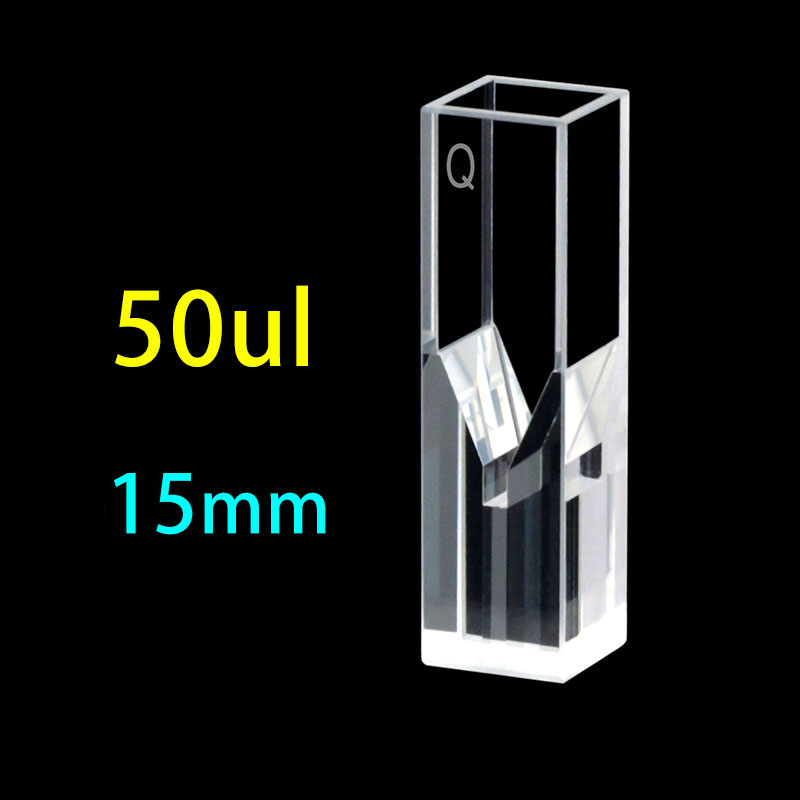
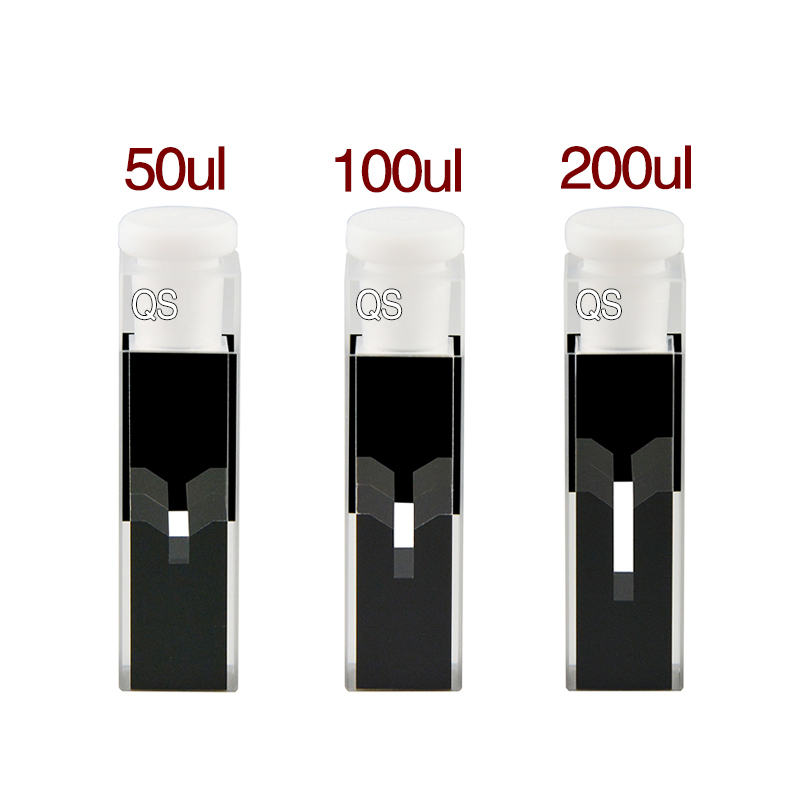
Sub-micro · 50 µL · 8.5 mm Z
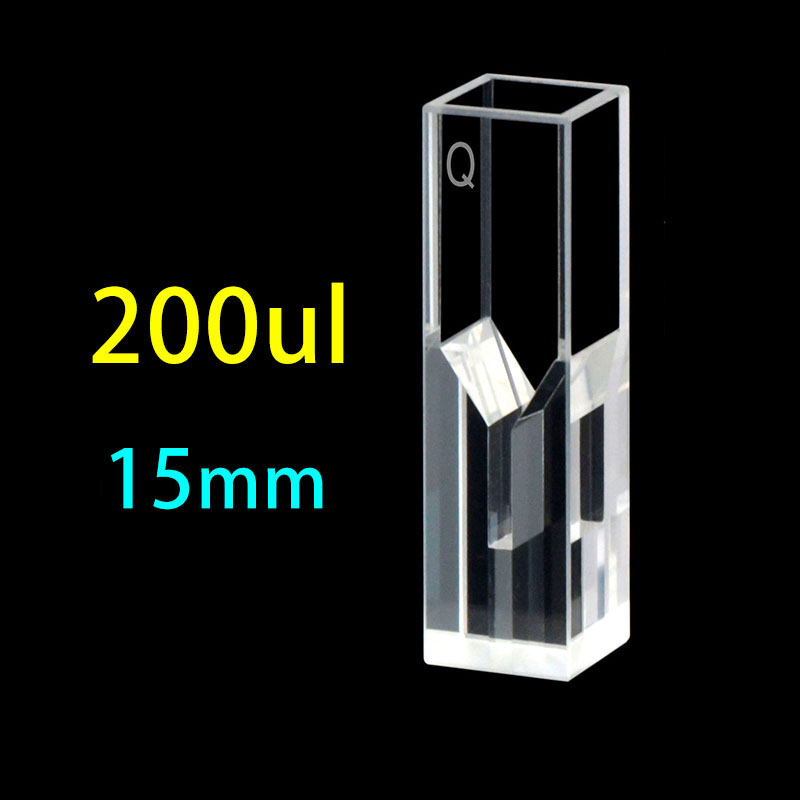
Micro · 200 µL · 15 mm Z
Large volume · 100 mm path
Cuvette volume isn’t a single number — it spans nearly three orders of magnitude across catalog options. Picking the wrong size doesn’t just waste sample; if the liquid level falls below the optical beam, your absorbance reading is meaningless.
| Class | Total Volume | Fill Range | Typical Use |
|---|---|---|---|
| Macro | 3.5 – 4.5 mL | 1.5 – 4 mL | Standard UV-Vis absorbance, abundant sample |
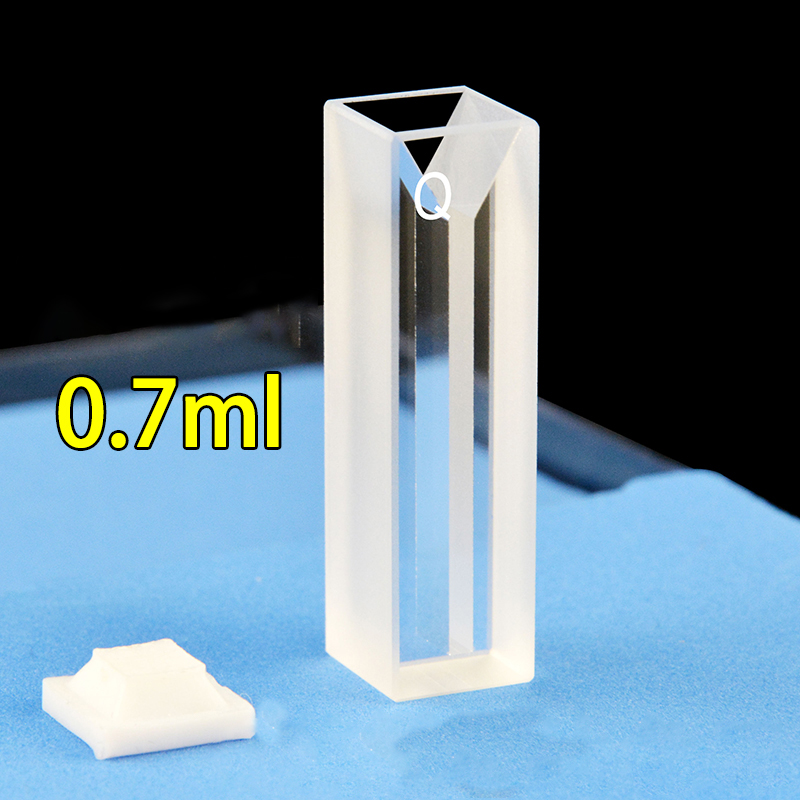
| Semi-micro | 1.4 – 1.75 mL | 0.7 – 1.5 mL | Buffer studies, kinetics with limited reagent |
| Micro | 0.7 – 1 mL | 200 – 700 µL | Dilute biologics, expensive reference standards |
| Sub-micro | 50 – 350 µL | 5 – 350 µL | Protein A280, nucleic-acid quantification, precious samples |
Minimum-fill rule: the liquid surface must sit at least 3 mm above the beam center — typically Z + 3 mm from the cuvette base, where Z is the beam-center height (8.5 or 15 mm). For a 15 mm-Z standard cuvette that means 18 mm of fluid, roughly 1.5 mL in a 10 mm-path body. Filling lower introduces meniscus refraction and unstable baselines.
Practical tips for sub-micro work:
- Pre-wet the cuvette with the same buffer before measurement. Dry quartz pulls droplets up the wall via surface tension, leaving an air gap at the bottom.
- Pipette down the wall, not into the center — direct injection traps bubbles in narrow micro chambers, and even one small bubble in the beam path can introduce tens of mAU of false absorbance, depending on bubble size and position.
- Tap, don’t shake to dislodge bubbles. Hold the cuvette by the frosted sides and tap the base on a soft surface.
- For 5–50 µL sub-micro chambers, use a positive-displacement pipette. Air-displacement tips lose volume to dead space, and you may load less than you think.
- Verify Z-dimension match before ordering: a 200 µL cuvette designed for 8.5 mm Z (e.g. Beckman DU 800) will give a flat baseline on a 15 mm-Z instrument because the beam misses the liquid entirely.
For instruments with limited sample availability — single-cell biology, forensic trace analysis, costly reference materials — the sub-micro tier saves orders of magnitude on sample consumption. Pair it with the right Z dimension and a pre-wetting protocol, and you’ll get readings indistinguishable from a full macro cuvette.
Section 8
How to Clean a Cuvette Without Damaging It
Proper cleaning extends cuvette life from months to years. The optical windows of a quartz cuvette are ground to sub-micrometre flatness — scratches, chemical residue, or improper drying will all degrade measurement quality permanently.
1
Rinse immediately after use. Do not let sample dry inside the cuvette. Flush three times with the same solvent used in the measurement to dilute and remove residue.
2
Wash with distilled water. Follow with 3 rinses of deionised or distilled water to remove buffer salts and aqueous residue.
3
Flush with spectroscopy-grade ethanol or acetone. This removes organic residues and speeds drying. Use 2–3 rinses.
4
For stubborn residues: soak in dilute acid. 1–5% HNO₃ for 15–30 minutes dissolves most protein, nucleic acid, and inorganic deposits. Rinse thoroughly with distilled water afterwards.
5
Dry with nitrogen gas or air-dry inverted. Stand the cuvette upside-down on clean, lint-free tissue to drain. If available, flush with dry nitrogen gas to speed drying without leaving fibres.
6
Verify cleanliness with a blank scan. Before use, run a baseline scan from 190–700 nm with distilled water. Any residue will show as increased baseline absorbance, particularly below 250 nm.
Never do the following: Use paper tissue, dry cloths, or abrasive materials to wipe optical faces — any contact abrasion permanently scratches quartz. Do not use hydrofluoric acid (HF) — it etches quartz. Do not put glued (Standard 80) cuvettes in an ultrasonic bath — ultrasonic vibration dissolves optical adhesive joints. Do not autoclave cuvettes with caps in place.
For dye staining that persists after acid soaking, commercial cuvette cleaning concentrates (e.g. Hellmanex® III) are safe and effective for most biological stains. Follow the manufacturer’s recommended dilution and contact time.
Section 9
2-window · absorbance
4-window · fluorescence
IR fluorescence · stoppered
2-Window vs 4-Window Cuvettes
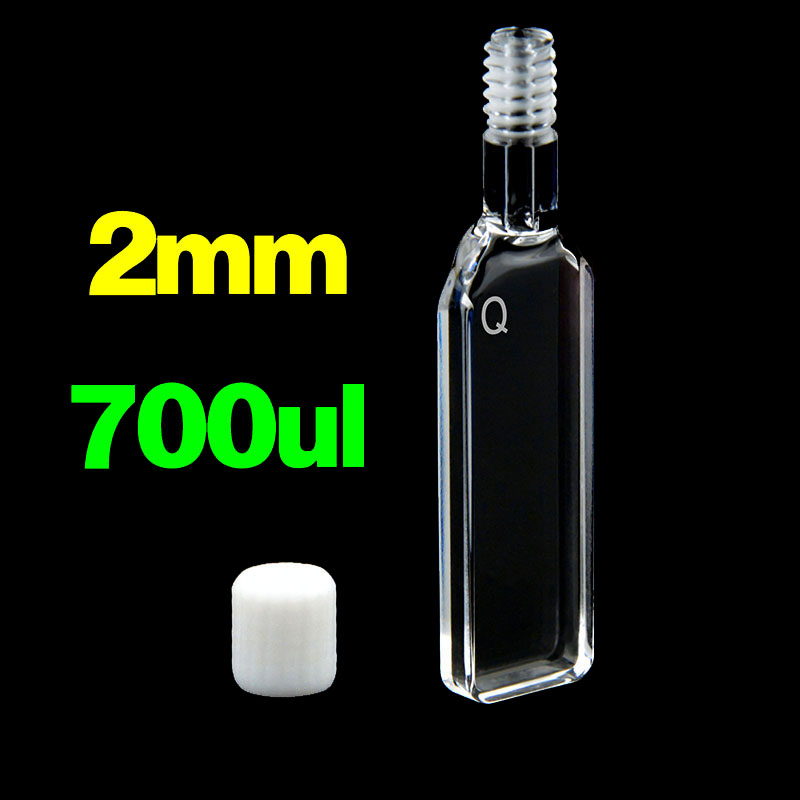
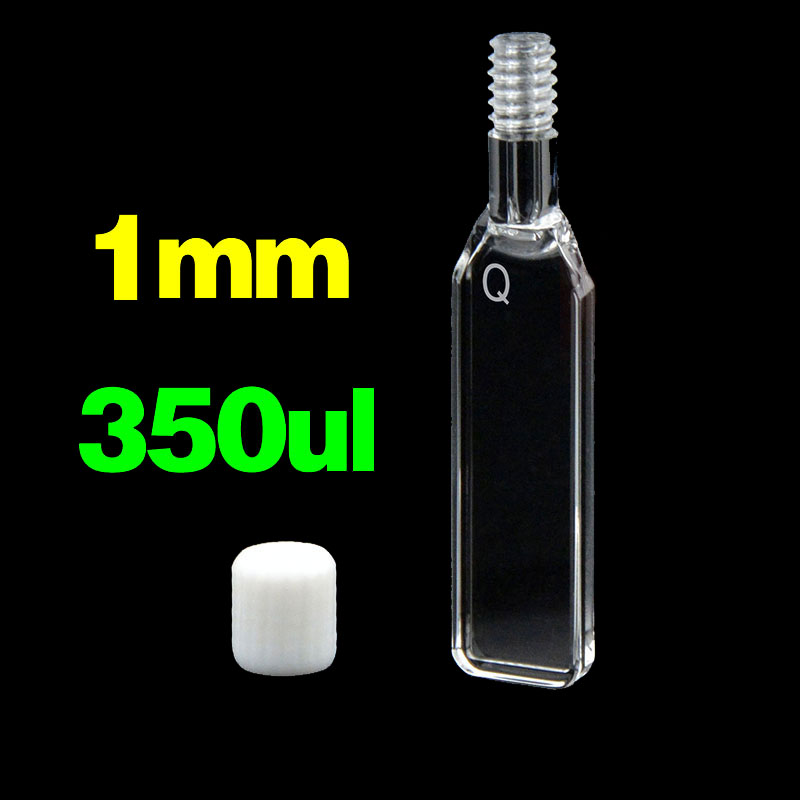
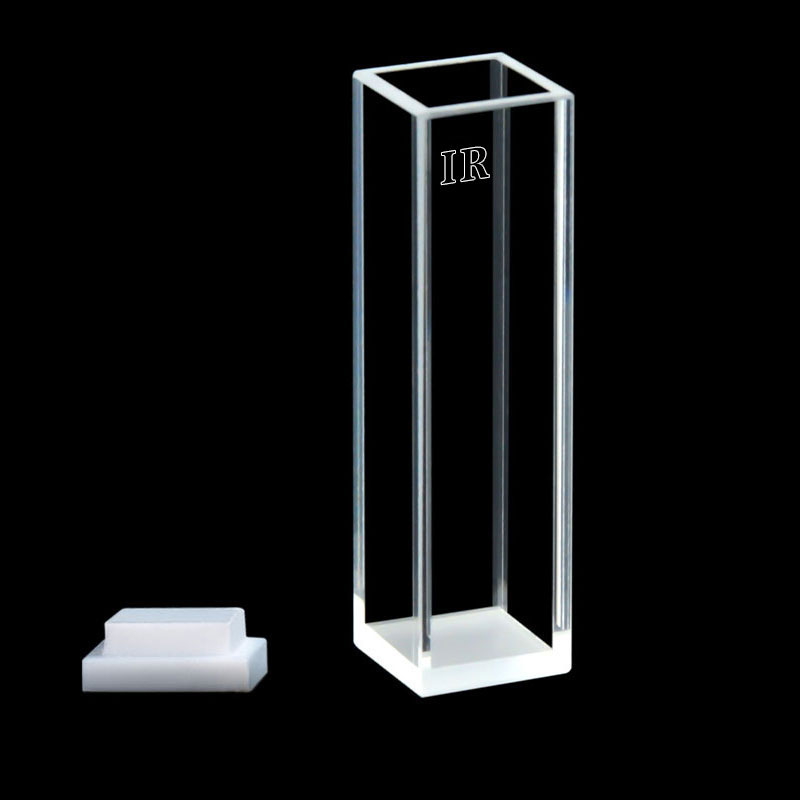
Cuvettes are manufactured with either two polished optical faces (2-window) or four polished faces (4-window / all-sides clear). The choice depends entirely on your measurement technique.
2-Window (2 clear faces)
- Two opposite faces are optically polished and transparent
- The other two faces are frosted or black — not transparent
- Used for standard absorbance / transmittance measurements
- Light enters one polished face and exits the opposite face
- Lower cost than 4-window equivalents
- Best for: UV-Vis, colorimetry, OD measurements
4-Window (all-sides clear) Fluorescence
- All four vertical faces are polished and transparent
- Allows excitation from one face and emission collection from the perpendicular face
- Required for fluorescence, phosphorescence, and light scattering measurements
- Also allows visual inspection of sample from all angles
- Best for: Fluorometry, phosphorimetry, right-angle scattering
If you are purchasing a cuvette for a fluorometer, always confirm it is a 4-window design. Standard 2-window cuvettes placed in a fluorometer will block the emission path and give a near-zero signal regardless of fluorophore concentration.
Section 10
Cuvette Z Dimension: Why It Matters
Z dimension (also called Z height or beam height) is the distance from the bottom of the cuvette to the center of the instrument’s light beam. It is one of the most frequently overlooked specifications — and one of the most common causes of flat baselines, erratic readings, and signal loss when switching to micro or sub-micro cuvettes.
How Z dimension causes measurement errors: If a cuvette’s liquid fill level does not intersect the instrument’s light beam, the beam passes above or below the sample — giving an absorbance reading close to zero regardless of sample concentration. This is particularly critical for micro and sub-micro cuvettes where the liquid level is only a few millimetres deep.
| Z dimension | Compatible instruments (examples) | Typical cuvette volume |
|---|---|---|
| 8.5 mm | Beckman DU series; Eppendorf BioPhotometer / BioSpectrometer; Thermo Genesys and Evolution series; ABX Cobas analyzers | Micro (50–350 µL) and sub-micro (10–70 µL) |
| 10 mm | Hitachi U-series (U-1100 through U-4001); some clinical analyzers | Micro and semi-micro |
| 15 mm | Most standard macro cuvette holders; Agilent Cary 60–300; Shimadzu UV series; PerkinElmer Lambda series; Agilent 8453; Jasco V-630 and newer; many educational lab spectrophotometers | Macro (1.5–3.5 mL) and semi-micro (0.35–1.7 mL) |
| 20 mm | Agilent Cary 4000 / 5000 / 6000i research spectrophotometers; some dedicated fluorometers (Horiba FluoroMax with adapter) | Macro cuvettes with extended path |
| Custom | Inline process monitors, fibre optic probes, microfluidic readers | Custom fabricated |
MachinedQuartz publishes Z dimension specifications for all cuvette products. See our Z Dimension Reference Guide for a table mapping common spectrophotometer models (Shimadzu UV-1900, Thermo NanoDrop, PerkinElmer Lambda, etc.) to their required Z height. If your instrument is not listed, contact us with your instrument model — we can confirm compatibility or fabricate a custom cell.
Section 11
Dual Path Length Cuvettes
A dual path length cuvette provides two different optical path lengths in a single cell by rotating the cuvette 90°. This is useful when your sample has a wide concentration range and you want to switch path lengths without changing cuvettes or preparing new standards.
How it works
The cuvette has an asymmetric internal cavity. When placed with the narrow dimension facing the beam, you get the short path (e.g. 2 mm). Rotate 90° so the wide dimension faces the beam, and you get the long path (e.g. 10 mm). Both path lengths use the same sample fill.
Common configurations
2 × 10 mm — the most popular; covers a 5× concentration range in one cell.
5 × 10 mm — useful for moderately concentrated samples.
10 × 20 mm — extends sensitivity range for dilute samples.
10 × 50 mm — trace analysis with sensitivity switching.
Dual path length cuvettes are particularly useful in enzyme kinetics studies (where substrate concentration changes rapidly during the assay) and in process monitoring applications where sample dilution is not practical.
Section 12
Screw cap · fully sealed
PTFE stopper · ultra-micro
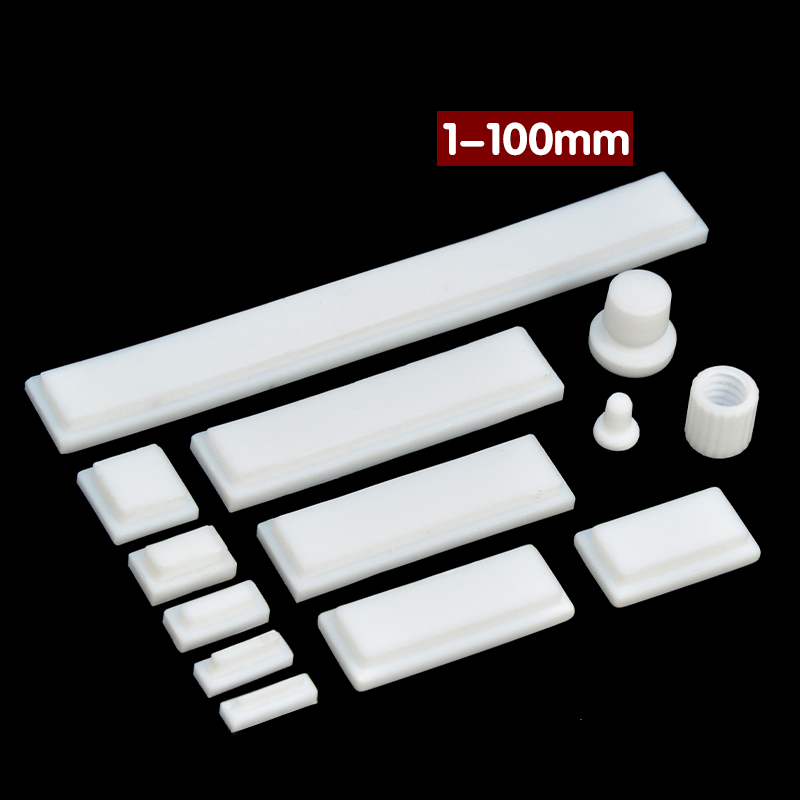
PTFE cap · 100 mm path
Cuvette Caps and Stoppers
Standard open-top cuvettes are fine for most bench measurements. However, when working with volatile, hazardous, or air-sensitive samples, a capped or sealed cuvette is essential — both for safety and to prevent evaporation that would shift your sample concentration during long measurements.
PTFE Stopper Cap
Push-in PTFE cap that fits the standard 12.5 mm cuvette opening. Chemically inert, compatible with nearly all solvents. Best for volatile organics and moderately hazardous reagents.
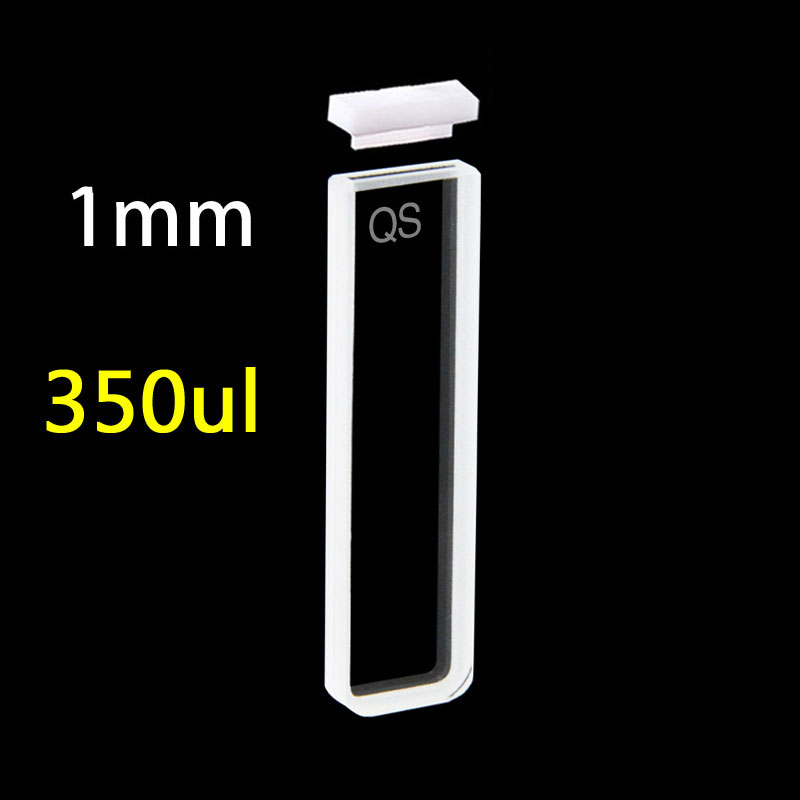
PTFE Screw Cap
Threaded cuvette body with matching PTFE screw cap. Creates a pressure-rated seal for highly volatile or toxic samples. Common in sealed-Raman experiments and reaction monitoring.
Silicone Stopper
Flexible push-in stopper. Good for aqueous buffers and mild solvents. Less chemically resistant than PTFE; not suitable for aggressive organics or concentrated acids.
PTFE Screw Vials
Fully enclosed quartz vials with screw top — for sample storage or reactions inside the optical path. Used when the cuvette must serve as both sample vessel and measurement cell.
No cap (open top)
Suitable for aqueous samples at room temperature with short measurement times. The standard configuration for most UV-Vis absorbance work where evaporation is not a concern.
Tapered glass stopper
Ground-glass taper stopper for applications requiring an inert, non-PTFE seal. Used in titration cells and applications where PTFE extractables are a concern.
Section 13
MachinedQuartz Custom Cuvettes
Standard catalog cuvettes cover most routine measurements, but OEM instruments, non-standard path lengths, and specialized geometries often require custom fabrication. MachinedQuartz manufactures precision quartz cuvettes to customer specifications with tolerances by fabrication method (Molded ±0.01 mm; Sintered/bonded ±0.06–0.08 mm), no minimum order quantity, and typical lead times of 1–2 weeks.
Our fabrication methods include four grades depending on your performance and chemical resistance requirements:
| Method | Assembly | Transmission | Max Temp | Best For |
|---|---|---|---|---|
| Standard 80 | Optical adhesive | UV-Vis curve, JGS2 substrate1 | ~100 °C (adhesive limit) | Aqueous samples, standard UV-Vis |
| Sintered 80 | Powder sintered fusion | UV-Vis curve, JGS2 substrate1 | ~600 °C (sinter joint limit) | Acid/solvent-heavy environments |
| Sintered 83 | High-purity sintered | UV-Vis curve, JGS1 substrate1 | ~600 °C (sinter joint limit) | Pharma QC, high-precision UV |
| Molded 83 | One-piece integral fusion | UV-Vis curve, JGS1 substrate1 | ~1,100 °C continuous (material limit) | High-temperature, no-joint designs |
For a detailed comparison of cuvette models by fabrication method, see our comparative analysis guide. To browse standard stock cuvettes, visit the full cuvette catalog.
Need a cuvette that isn’t in any catalog?
MachinedQuartz manufactures custom quartz cuvettes to your exact dimensions — non-standard path lengths, OEM geometries, small batch orders. No MOQ, 1–2 week lead time.
Reference & Citation
Cite or link to this guide
MachinedQuartz. (2026). Cuvette Selection Guide: Material, Path Length, Volume & Caps.
Retrieved from https://machinedquartz.com/cuvette-selection-guide/
Section 14
Frequently Asked Questions
What is the difference between a quartz and glass cuvette?
Synthetic fused silica (JGS1, the “UV-quartz” standard) transmits from ~185 nm upward, making it the only practical choice for spectroscopy below 320 nm. Lower-grade fused silica (JGS2) cuts off near 220 nm — still well into the UV. Optical glass cuvettes (e.g. N-BK7-based) only transmit from ~320 nm, so they are limited to visible and NIR work. Fused silica is also more chemically resistant to solvents and acids (excluding HF) and tolerates much higher temperatures than optical glass.
What path length cuvette should I use?
The standard 10 mm (1 cm) path length works for most measurements when sample absorbance falls in the 0.1–1.5 AU range. If your sample is too concentrated and reads above 2.0 AU, switch to a 1 mm or 2 mm path length. If your sample is very dilute and reads below 0.05 AU, use a 50 mm or 100 mm cuvette to improve signal-to-noise ratio.
How do I choose between a 2-sided and 4-sided cuvette?
Use a 2-sided cuvette (two clear optical windows, two frosted sides) for standard absorbance measurements — it is cheaper and sufficient for most UV-Vis work. Use a 4-sided cuvette (all four sides optically polished) for fluorescence measurements, where the excitation beam enters from one side and emission is detected at 90 degrees from a perpendicular face. All-clear cuvettes also allow visual inspection of the sample from any angle.
Can I use plastic cuvettes for UV measurements?
It depends on the plastic. Polystyrene cuvettes cut off around 340 nm; PMMA around 300 nm. UV-grade disposable plastic cuvettes (e.g. Eppendorf UVette, Brand UV-Cuvette) transmit from ~220 nm and are suitable for routine A260/A280 work, but still do not match fused silica below 220 nm or in long-term transmission stability. For any quantitative measurement below ~220 nm, fused silica is required.
What is Z dimension in a cuvette?
Z dimension (also called Z height) is the distance from the bottom of the cuvette to the center of the instrument’s light beam. Common values are 8.5 mm (Beckman DU series; Eppendorf BioPhotometer / BioSpectrometer; Thermo Genesys / Evolution) and 15 mm (Shimadzu UV series, Agilent 8453, PerkinElmer Lambda; most standard macro cuvette holders). Using a cuvette with the wrong Z dimension means the light beam misses the liquid in the cell, giving a flat or erratic baseline. Always confirm Z dimension with your instrument’s spec sheet before ordering sub-micro or micro cuvettes.
How do I clean a quartz cuvette without scratching it?
Rinse the cuvette immediately after use with the same solvent used in the measurement, then flush with deionized water, followed by spectroscopy-grade ethanol or acetone. Allow to air dry or use dry nitrogen gas — never wipe the optical windows with paper tissue or rough cloths. For stubborn residues, soak in 1–5% nitric acid solution for 15–30 minutes. For persistent biological or dye stains, a commercial cuvette cleaning concentrate such as Hellmanex® III is the preferred option. Never use ultrasonic cleaners on bonded (Standard 80) cuvettes, as vibration can loosen the adhesive joints; sintered and one-piece molded cells tolerate ultrasonic cleaning.
How long do quartz cuvettes last and what is the lead time for custom orders?
A well-cared-for fused-silica cuvette can last many years of regular lab use; lifetime depends on sample chemistry, cleaning protocol, and assembly type. The optical windows themselves are virtually indestructible — what wears out is the surface finish (from improper cleaning) or the adhesive on Standard 80 cells (after solvent exposure). Sintered and molded one-piece cuvettes have no joints to fail. For custom geometry or non-catalog path lengths, MachinedQuartz typical lead time is 5–8 business days for in-stock quartz blanks, and 2–3 weeks for premium synthetic-grade fabrication. Standard catalog SKUs ship in 1–2 business days from US stock.
Free Tools & Resources
Why You Can Trust This Page
AuthorMachinedQuartz Technical Team
Reviewed byBryan Wright (Founder, 13+ yrs at MQ)
Production base1,300+ catalog SKUs · 40+ countries shipped
Last updatedApril 27, 2026 · Next review Oct 2026
Background: Decision-tree advice, path-length and material recommendations in this guide come from MQ's customer-support archives spanning 40+ countries. Where third-party standards apply, we cite NIST Beer-Lambert documentation, ASTM E275, and Heraeus quartz datasheets directly.
Further reading
Shop & Custom Cuvette Options
Browse the full range of quartz cuvettes, explore custom quartz cuvettes for non-standard path lengths and geometries, or use the cuvette size chart to find the right fit. Need a quote? Contact our team.


Recent Comments