
Quartz Cuvettes for DNA & RNA Quantification (260 nm)
Application Guide
Quartz Cuvettes for DNA & RNA Quantification
Nucleic-acid concentration is read at 260 nm — deep in the UV, where glass and plastic do not transmit. This guide covers why UV-grade quartz (JGS1) is required, how to read A260/A280 purity, how to turn absorbance into concentration, and how to pick the right path length and volume for accurate, reproducible measurements.
The 260 nm rule
Why DNA/RNA quantification needs a quartz cuvette
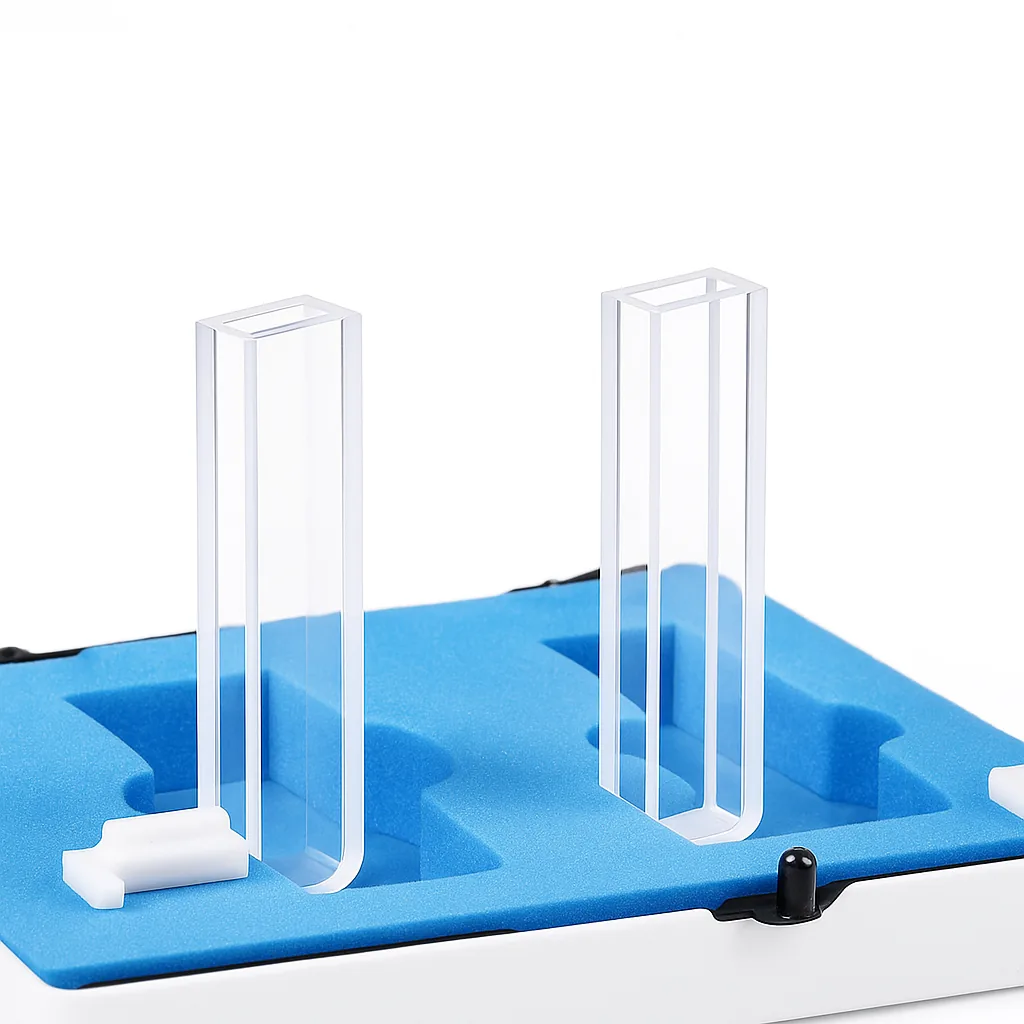
DNA and RNA absorb maximally at 260 nm, and the purity ratios A260/A280 and A260/A230 are read across the 230–280 nm band. That whole window lies below the UV cut-off of optical glass (~320 nm) and of most disposable plastics — a glass or PMMA/PS cuvette absorbs the very light you need, so the reading is artificially low or meaningless. Only UV-grade fused silica (quartz) transmits cleanly through 220–280 nm.
Which grade? MachinedQuartz DNA/RNA cuvettes are made from JGS1 fused quartz (185–2,500 nm), which covers the entire nucleic-acid window (A230, A260, A280) with margin to spare — including the deep UV below 220 nm.
Reading purity
A260/A280 and A260/A230: what the ratios mean
A spectrophotometer reads absorbance at several wavelengths so you get both concentration (A260) and purity. Because all of these wavelengths sit in the UV, the cuvette must transmit the whole 230–280 nm range — another reason a single quartz cell is used.
| Ratio | Expected (pure) | A low value suggests |
|---|---|---|
| A260 / A280 | ~1.8 (DNA), ~2.0 (RNA) | Protein or phenol carry-over |
| A260 / A230 | ~2.0–2.2 | Guanidine, phenol, carbohydrate or solvent residue |
| A320 | ~0 (baseline) | Turbidity / particulates — subtract as background |
Absorbance to concentration
Turning A260 into a concentration
For a standard 10 mm path, one absorbance unit at 260 nm corresponds to a fixed mass concentration:
| Nucleic acid | 1 A260 (10 mm) equals |
|---|---|
| Double-stranded DNA | ~50 µg/mL |
| RNA | ~40 µg/mL |
| Single-stranded DNA / oligos | ~33 µg/mL |
So concentration = A260 × factor × dilution. Worked example: a dsDNA sample reads A260 = 0.18 in a 10 mm cuvette → 0.18 × 50 = 9 µg/mL. The key is keeping A260 inside the accurate 0.1–1.0 absorbance band; outside it, detector linearity and stray light degrade the result. Our Beer-Lambert path-length calculator and cuvette size calculator help you land in that band.
Match the cuvette to the sample
Path length and volume for nucleic acids
Nucleic-acid samples are often small and sometimes concentrated, so path length and volume matter as much as material:
Standard 10 mm
Reference geometry for calibrations and dilute extracts. Needs ~1–3.5 mL, or a reduced-volume insert.
Micro & sub-micro
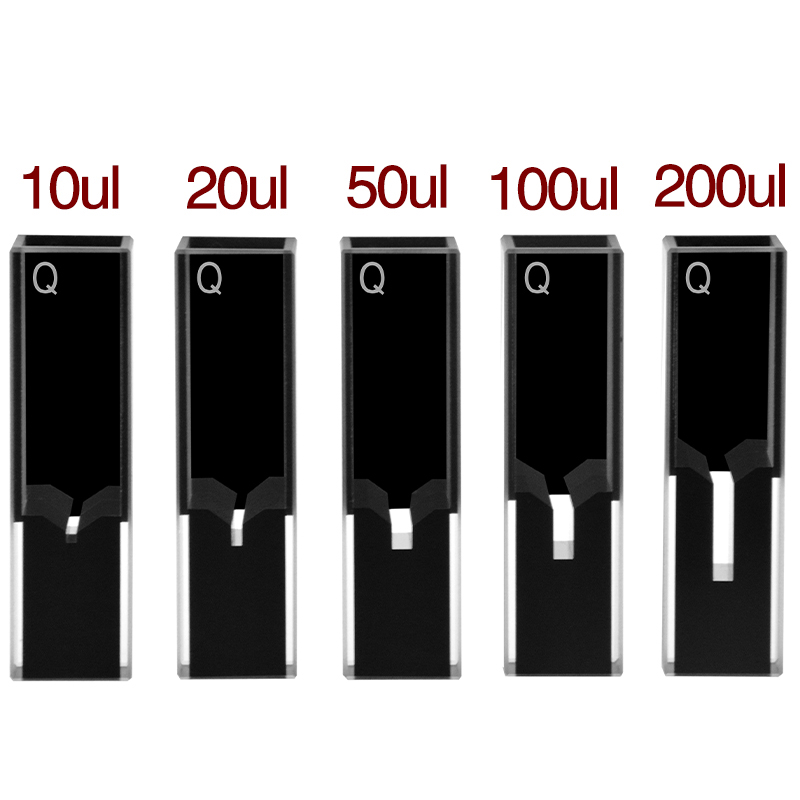
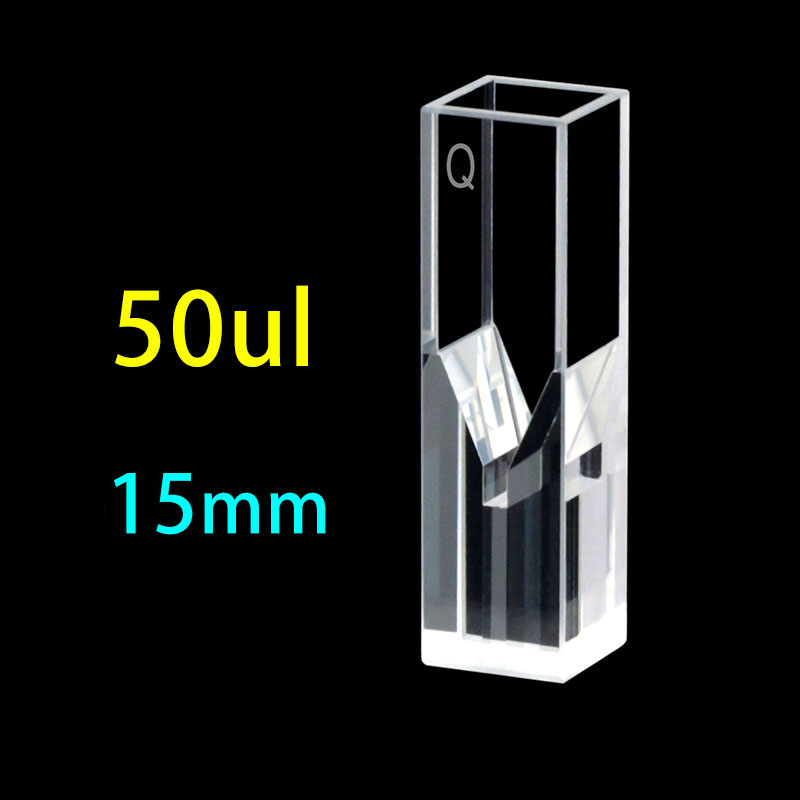
For 5–100 µL of precious sample — a narrow chamber keeps the 10 mm path while wasting almost nothing. Z-height must match your reader.
Short path 0.1–2 mm
For concentrated stock, a short path keeps A260 on-scale without diluting — the dilution-free alternative to re-pipetting.
| Sample situation | Path length | Volume class | Grade |
|---|---|---|---|
| Routine, dilute extract | 10 mm | Standard / semi-micro | JGS1 |
| Small precious sample (5–100 µL) | 10 mm | Micro / sub-micro | JGS1 |
| Concentrated stock (high A260) | 0.1–2 mm | Short-path / demountable | JGS1 |
| DNA melting / Tm studies | 10 mm | Stoppered / thermostatted | JGS1 |
Accuracy
Cuvette vs pedestal reader
Pedestal (drop) readers are fast and convenient for 1–2 µL, but they use a very short, variable path and are most accurate at higher concentrations. A calibrated quartz cuvette with a defined 10 mm path gives better reproducibility and low-concentration accuracy, which matters for dilute extracts, sequencing libraries and quantitative qPCR input. Many labs quantify on a pedestal for speed and confirm critical samples in a cuvette. See cuvette vs NanoDrop: when to use each; for melting curves and kinetics see thermostatted cuvettes for DNA melting & enzyme kinetics.
Avoiding errors
Common sources of error — and how to avoid them
- Air bubbles & particulates: scatter light and inflate A260. Mix gently, let bubbles clear, and subtract A320 as a turbidity baseline.
- Fingerprints on optical faces: skin oils absorb in the UV. Handle by the frosted sides and wipe optical windows with lint-free lens tissue.
- Carry-over / nuclease contamination: rinse with nuclease-free water (and dilute acid or ethanol between sample types); a re-usable quartz cuvette must be cleaned, unlike single-use plastic.
- Wrong path or off-scale reading: keep A260 in 0.1–1.0 by choosing path length, not by over-diluting precious sample.
- Mismatched Z-height: if the beam misses the chamber the reading drops — match cuvette Z-height to your spectrophotometer.
Custom DNA/RNA cuvettes in JGS1 — low MOQ
MachinedQuartz makes standard, semi-micro, micro, sub-micro and short-path quartz cuvettes in JGS1, plus custom path lengths, Z-heights and chamber volumes built to your spectrophotometer and sample. Low minimum order quantities, per-unit QC and worldwide shipping.
Request a quoteFAQ
Frequently asked questions
Can I use a glass or plastic cuvette for DNA/RNA?
No. DNA/RNA is read at 260 nm, below the ~320 nm UV cut-off of optical glass and most plastics, so they block the signal and give a low or zero reading. Use UV-grade fused-silica (quartz).
Which quartz grade do you use for DNA/RNA cuvettes?
We make DNA/RNA cuvettes in JGS1 fused quartz (185-2,500 nm), which transmits cleanly at 260 nm and across the whole 230-280 nm purity-ratio window, with margin into the deep UV.
How do I convert A260 to concentration?
In a 10 mm cuvette, 1 A260 equals about 50 ug/mL dsDNA, 40 ug/mL RNA, or 33 ug/mL ssDNA/oligos. Multiply A260 by that factor and any dilution. Keep A260 between 0.1 and 1.0 for accuracy.
What do A260/A280 and A260/A230 tell me?
A260/A280 ~1.8 indicates pure DNA and ~2.0 pure RNA; lower values suggest protein or phenol. A260/A230 should be ~2.0-2.2; a low value points to guanidine, phenol or carbohydrate carry-over.
How little sample can a micro quartz cuvette hold?
Micro and sub-micro quartz cuvettes read from roughly 5-100 uL by narrowing the chamber while keeping a 10 mm path. The cuvette Z-height must match your spectrophotometer’s beam height.
Quartz cuvette or a NanoDrop-style pedestal?
Pedestals are fast for tiny drops; a calibrated quartz cuvette gives better reproducibility and low-concentration accuracy for dilute samples and quantitative work. Many labs use both.
Reference: MachinedQuartz, Quartz Cuvettes for DNA & RNA Quantification (2026). See the Cuvette Selection Guide · Last reviewed June 2026.