
Long-Path Cuvettes (50, 100, 200 mm) for Trace UV-Vis Analysis
This post is also available in:
A long-path cuvette is a quartz cell with path length above 10 mm — typically 50, 100, or 200 mm — used for trace UV-Vis analysis where extremely dilute analytes need amplification of the Beer-Lambert signal. A 10× longer path boosts absorbance by 10×, dropping detection limits from ~ppm to ~ppb. Common applications include drinking water UV-T254, environmental nitrate at 220 nm, and dilute biomolecule quantification below 1 µg/mL.
Long-Path Cells · Trace UV-Vis
Long-Path Cuvettes (50, 100, 200 mm) for Trace UV-Vis Analysis
When concentrations sit in the µg/L range — chlorine, nitrate, phosphate, dye traces, residual pharmaceutical impurities — standard 10 mm cuvettes leave you below the linear-detection threshold. 50, 100, and 200 mm path-length cells push the absorbance back into the workable window without diluting the analyte that you are trying to measure.
5×–20×
Sensitivity Boost
50–200 mm
Standard Long Paths
JGS1
Default Quartz Grade
ppb
Detection Floor
Standard UV-Vis cuvettes are 10 mm path length. The convention exists because most lab traffic — protein quantitation, fermentation broth, transition-metal colorimetric chemistry — sits in the 0.1–100 mg/L range where 10 mm gives a comfortable 0.1–1.0 AU reading. But the moment you step into trace analysis — drinking-water QC at sub-mg/L, environmental nitrate at µg/L, residual pharmaceutical impurities at µg/L, decolourisation efficiency in textile wastewater — a 10 mm cell starts returning absorbance values below the linear detection floor of your spectrophotometer.
The fix is mechanical: a longer path length cell. A 50 mm cuvette gives you 5× the absorbance of a 10 mm cell at the same concentration. A 100 mm cell gives you 10×. A 200 mm cell, used for the most demanding trace work, gives 20×. Long-path cuvettes are dimensionally just elongated versions of the standard cell — same JGS-grade quartz, same machining and polishing tolerances, just a longer outer envelope. This guide covers when to use them, how to choose between 50/100/200 mm, the geometry constraints, instrument compatibility, and the SKUs MachinedQuartz keeps in stock.
Who reaches for long path. Drinking-water utilities, environmental laboratories, pharmaceutical impurity-profiling labs, dye and pigment QC, semiconductor ultrapure-water QC, fermentation analytics for early-time-point growth tracking, and academic groups working on trace ions or low-concentration UV-active organics. If your standard 10 mm cell consistently reads below 0.05 AU, this is the article for you.
1. Why standard 10 mm cuvettes fail at trace concentrations
Modern UV-Vis spectrophotometers have a reliable detection threshold of approximately 0.05 AU. Below this value, photometric noise (instrument drift, baseline noise, cuvette positioning variability) starts to dominate the measurement. The relative noise on a 0.02 AU peak might be 10–30 %; on a 0.005 AU peak, you are essentially measuring noise.
For a typical trace analyte — say nitrate at 0.5 mg/L NO₃-N reading at 220 nm with ε ≈ 0.1 (mg/L)⁻¹ cm⁻¹ — the absorbance in a 10 mm cell is:
A = 0.1 × 0.5 × 1.0 cm = 0.05 AU
Right at the detection threshold. Run the same sample in a 50 mm cell and you get 0.25 AU. In a 100 mm cell, 0.50 AU. In a 200 mm cell, 1.0 AU. Your analyte has moved from “barely detectable” to “comfortably mid-window” without dilution, concentration, or any change to the chemistry.
The dilution alternative is worse. The other way to “improve” a trace measurement is to concentrate the sample (evaporate, solid-phase extract, freeze-dry) — introducing recovery losses, contamination risk, and a slow workflow. Long-path cuvettes give you the same effective sensitivity boost without touching the sample. For ppb-level analyte work this is the difference between a 5-minute method and a 5-hour method.
2. Picking 50, 100, or 200 mm
The choice between long-path lengths is a function of the concentration of your analyte and the regulatory or analytical limit you need to detect.
| Path length | Signal vs 10 mm | Best for | Sample volume |
|---|---|---|---|
| 50 mm | 5× | 0.1–5 mg/L analytes; drinking-water QC; typical environmental work | ~ 17 mL |
| 100 mm | 10× | 10–500 µg/L analytes; trace nitrate, phosphate, chlorine; pharmaceutical impurity profiling | ~ 35 mL |
| 200 mm | 20× | 1–100 µg/L; ultrapure-water QC; ultratrace environmental | ~ 70 mL |
Sample volumes shown are for the standard square cross-section (12.5 × 12.5 mm internal) used in most flat-window long-path cells. Cylindrical long-path cells with smaller internal diameters carry less volume but require flow-cell or syringe-fill setups.
Diminishing returns past 100 mm
The signal benefit scales linearly with path length but two practical factors push back against going to 200 mm:
- Solvent absorbance scales too. Water reads about 0.02 AU/cm at 220 nm. A 100 mm water blank already shows 0.2 AU baseline. A 200 mm water blank reads 0.4 AU before you add any sample. For UV work below 230 nm, this is the binding constraint.
- Beam alignment matters more. Long cells need the spectrophotometer beam centred precisely on the optical axis. Beam scatter from holder edges contributes more error in a 200 mm cell than in a 50 mm cell.
For most trace water work, 100 mm is the sweet spot: 10× sensitivity, manageable solvent baseline, fits standard accessory holders. Step up to 200 mm only when you genuinely need the additional 2× sensitivity at the visible wavelengths where solvent baseline does not bite.
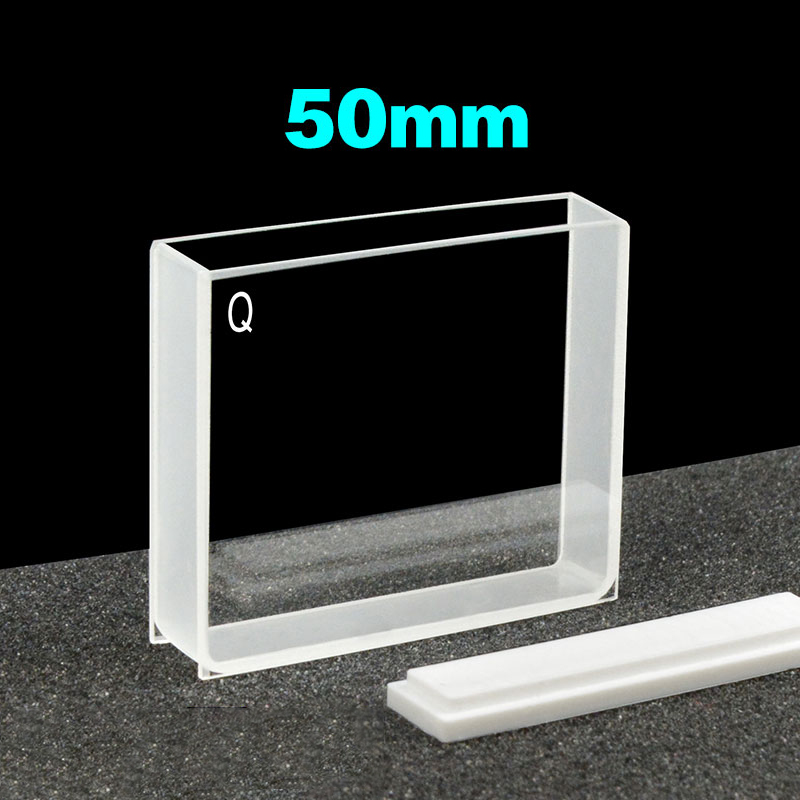 5× sensitivity
C502CA5 — 50 mm long-path
17.5 mL · two-way light · drinking-water QC, environmental, dye trace
View C502CA5 →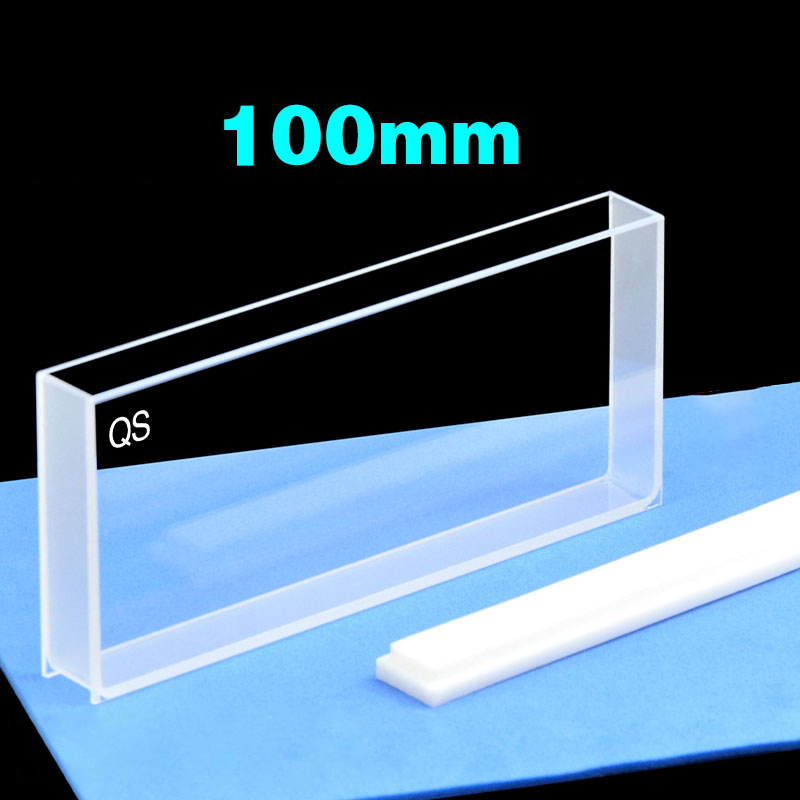 10× sensitivity
C1002CR — 100 mm long-path
35 mL · two-way light · trace nitrate, phosphate, chlorine, pharma impurity
View C1002CR → Hach format
C1002CS8 — 100 mm Hach-style
35 mL · open-top · for Hach DR-series water-quality spectrophotometers
View C1002CS8 →3. Drinking water and environmental analysis
The largest single market for long-path cuvettes. Standard Methods, EPA, and ISO water-quality protocols specify long-path cells for many of the regulated trace analytes.
EPA 300.1 / ISO 13395
Nitrate / Nitrite
Drinking-water nitrate-N at 1–10 mg/L: 50 mm cell, UV at 220 nm. Source-water trace nitrate at < 0.5 mg/L: 100 mm. Cadmium-reduction visible method at 540 nm uses standard 10 mm but UV direct read is faster.
Standard Methods 4500-Cl
Free / total chlorine
DPD method at 530 nm. 10 mm cell at 0.1–5 mg/L; 50 mm cell at 5–500 µg/L for distribution-system tail-end and ultrapure-water QC; 100 mm for sub-µg/L semiconductor-grade water.
Standard Methods 4500-P
Phosphate (molybdenum-blue)
880 nm. 10 mm cell at 0.1–5 mg/L PO₄-P; 50 mm at 10–500 µg/L; 100 mm at 1–50 µg/L for receiving-water and lake monitoring.
Standard Methods 4500-NH3
Ammonia (Nessler / phenate)
425 nm Nessler or 640 nm phenate. 10 mm at 0.1–5 mg/L NH₃-N; 50 mm for trace ammonia in finished drinking water and aquaculture.
EPA / ISO methods
Heavy metals (after complexation)
Iron-phenanthroline at 510 nm, copper-neocuproine at 457 nm, manganese-periodate at 525 nm. 10 mm for 0.1–10 mg/L; 50 mm for trace work; ICP-OES preferred below 10 µg/L.
UV 254 surrogate
UV 254 organic carbon
Surrogate for dissolved organic carbon (DOC) and disinfection by-product precursors. 10 mm cell standard; 50 mm cell for clean drinking water. Routine in drinking-water utility QC.
4. Pharmaceutical impurity profiling and trace assay
Three pharmaceutical use cases drive the long-path cell market.
Impurity profiling at ICH limits
ICH Q3A/Q3B impurity thresholds for new drug substances are typically 0.05–0.15 % of the active. For an active at 1 mg/mL working concentration, the impurity at 0.05 % is 500 ng/mL. UV detection of impurities at 254 nm at this concentration in a 10 mm cell is borderline; a 50 mm cell makes the impurity peak clearly above baseline noise.
Cleaning validation residue
USP/PIC/S cleaning validation requires demonstrating residue limits below 1–10 µg/cm². UV-Vis is the rapid screen method for many APIs (typically read at the lambda-max of the molecule). 100 mm cells let you read the dilute swab-rinse extracts directly without concentration steps.
Dissolution dissolved-drug assay
USP <711> dissolution testing: at early time points (5, 10, 15 minutes), concentration is well below the assay design point. A 50 mm flow cell coupled to the autosampler keeps the early time points in the linear absorbance window without method-dependent dilution.
For pharma applications, JGS1 deep-UV-grade quartz is the default substrate. Active compounds frequently absorb in the 200–220 nm range (where JGS2 begins to attenuate), and the validation lot needs supplier-of-origin traceability that JGS1 documentation provides. See our UV cutoff guide for the JGS1/JGS2/JGS3 trade-off.
5. Dye, pigment and food-color trace analysis
Two distinct cases:
Decolourisation efficiency
Textile wastewater treatment, food-processing wastewater, and dye-house effluent all need to demonstrate residual dye below regulatory or licensing limits (often expressed in mg/L). At the residual concentrations after biological or oxidative treatment (sub-mg/L to single mg/L), 50 mm or 100 mm cells give clean spectra where 10 mm cells return baseline noise.
Trace food-colour residue
Migration testing for food-contact materials, residue testing of food dyes in finished products, and forensic identification of unknown colourants all benefit from long-path cells. The visible chromophores typically have ε in the 10,000–30,000 M⁻¹ cm⁻¹ range, so trace concentrations (sub-µM to µM) need 50–100 mm to lift into the linear window.
Visible-only work uses optical glass. If your dye or pigment work is strictly above 350 nm, optical-glass long-path cells are 30–50 % cheaper than quartz and perform equivalently. Switch to JGS-grade quartz only when the method also reads in the UV.
6. Geometry and sample volume tradeoffs
Long-path cuvettes are square in cross-section by default — a 12.5×12.5 mm internal aperture is the universal standard, matching the same outer envelope as standard 10 mm cuvettes. Path length is the only dimension that changes. This means:
- Sample volume scales linearly with path length. 10 mm holds about 3.5 mL; 50 mm holds 17 mL; 100 mm holds 35 mL; 200 mm holds 70 mL.
- The same accessory holders work for the standard 12.5 mm aperture, but the cuvette body extends past the standard cell-holder — you need a long-path adapter or extended-rail sample holder. Most modern spectrophotometers have these as accessories.
- Cleaning is more demanding than for 10 mm cells. The longer chamber needs careful rinse-and-drain to avoid cross-contamination between samples; long-path cells benefit from dedicated cleaning protocols (see our cuvette cleaning protocol).
Cylindrical long-path cells
For lower sample volume requirements, cylindrical long-path cells with internal diameters of 5–10 mm reduce the volume to 2–15 mL but require flow-cell or syringe-fill setups (you cannot pipette into a cylindrical cell as easily as a square one). They are also more sensitive to bubble formation and require careful filling discipline.
7. Instrument compatibility
The major UV-Vis spectrophotometer families all support long-path cuvettes via accessory holders. Compatibility checklist:
| Vendor / Platform | 50 mm support | 100 mm support | 200 mm support |
|---|---|---|---|
| Agilent Cary 60 / 3500 | Native (long-path holder) | Native (extended rail) | Custom holder; ask Agilent |
| PerkinElmer Lambda 365 / 1050 | Native | Native | Lambda 1050 only (custom) |
| Shimadzu UV-1900 / UV-2700 | Native (CPS-100) | Native (UV-2700) | UV-2700 only (custom) |
| Thermo Evolution One Plus | Native | Adapter rail | Custom holder |
| JASCO V-770 | Native | Native | Custom holder |
| Hach DR6000 (water QC) | Native (50 mm specific) | Native (100 mm specific) | Not supported |
| Beckman DU 800 / Genesys 50 | Native | Adapter | Not supported on Genesys 50 |
For older or non-standard spectrophotometers, the binding constraint is sample-compartment depth. Most modern instruments have 100–120 mm of compartment depth, easily fitting 100 mm cells. 200 mm cells require either a long-cell sample stage (typical of dedicated UV-Vis benchtops in the $20K+ range) or a custom holder.
Hach DR6000 and dedicated water-quality instruments are designed around 50 and 100 mm cells from the factory; the catalog includes specific Hach-format part numbers. Send us your instrument model and we will confirm cuvette compatibility before quote.
8. Handling and cleaning long-path cells
The long, narrow chamber of a 50–200 mm cell makes routine handling more demanding than a standard 10 mm cuvette.
Filling
- Tilt the cell at 30–45° while filling to let air escape past the meniscus. Vertical filling traps bubbles in the long chamber that can take 5–10 minutes to rise out.
- Use a long-tipped serological pipette or a narrow filling funnel reaching at least halfway down the chamber to avoid splashing.
- Fill to within 5 mm of the top — long cells used in extended sample compartments need the meniscus well above the optical beam.
Cleaning
- Rinse three times with the next sample (or clean solvent) before measurement. Carryover from the previous sample is a major error source in long-path work because the surface area is large.
- For acid-soluble residues, soak with 5% nitric acid for 15 minutes between sample sets, then rinse with deionised water and methanol.
- For organic residues, soak with chromic-sulfuric acid or piranha (with appropriate hood, PPE, and disposal protocols).
- Final rinse with HPLC-grade water and methanol; dry inverted on a lint-free wipe.
Storage
Store long-path cells horizontally in foam-cushion boxes — vertical storage with a partial fill leaves a meniscus mark on the inside that becomes a permanent contamination band. Long cells are also more vulnerable to thermal shock; bring to room temperature before measurement.
9. Stock SKUs and ordering
MachinedQuartz keeps standard long-path cuvettes in stock across the most common vendor formats. Custom path lengths between 50 and 200 mm carry no tooling fee on geometry within our standard envelope.
| Path length | Outer dimensions | Volume | Material grade | Use case |
|---|---|---|---|---|
| 50 mm | 12.5 × 12.5 × 56 mm | ~ 17 mL | JGS1 / JGS2 | Drinking-water QC, environmental analysis, dye trace |
| 100 mm | 12.5 × 12.5 × 106 mm | ~ 35 mL | JGS1 / JGS2 | Trace water, pharma impurity, ultrapure-water QC |
| 100 mm Hach format | 27 × 27 × 106 mm (with collar) | ~ 35 mL | JGS2 | Hach DR-series spectrophotometers |
| 200 mm | 12.5 × 12.5 × 206 mm | ~ 70 mL | JGS1 | Ultratrace environmental, semiconductor-grade water |
| 50 mm cylindrical | Ø 22 × 56 mm (10 mm bore) | ~ 4 mL | JGS2 | Reduced-volume trace work, flow-cell setups |
| 100 mm cylindrical | Ø 22 × 106 mm (10 mm bore) | ~ 8 mL | JGS2 | Reduced-volume trace, syringe-fill |
Need a long-path quote?
Send the path length, vendor compatibility (instrument model), and JGS-grade requirement. We respond within one business day.
Request quote →Bulk & OEM programs →Related guides & tools
10. Frequently asked questions
Do I need a 100 mm cuvette for drinking water nitrate analysis?
For typical regulated drinking water at 1 to 10 mg per litre nitrate-nitrogen, a 50 mm cell at the 220 nm UV reading or a 10 mm cell at the visible 540 nm cadmium-reduction reading both work. For trace source-water nitrate below 0.5 mg per litre, step up to a 100 mm cell. The choice is method-dependent: EPA 300.1 (cadmium reduction) usually uses 10 mm; direct UV reading at 220 nm benefits from longer paths.
How much sample do I need for a 100 mm cuvette?
Approximately 35 millilitres for a standard square 12.5 by 12.5 mm internal cross-section. Cylindrical 100 mm cells with a 10 mm bore reduce sample volume to about 8 millilitres but require syringe-fill or flow-cell setup. For sample-limited applications, the cylindrical format is the right choice.
Can I use a 50 mm cell on my Cary 60 spectrophotometer?
Yes. The Agilent Cary 60 supports a 50 mm long-path cell with the standard long-path cell holder (Agilent part number varies by configuration). 100 mm support requires the extended-rail sample stage. 200 mm support is only available with a custom holder. For the Cary 3500 and 4000 series, both 100 and 200 mm are supported with native accessories.
Why does my 100 mm water blank read 0.2 AU at 220 nm?
Pure water has an intrinsic absorbance of about 0.02 AU per centimetre at 220 nm. A 100 mm path length gives 10 cm of water, which is 0.2 AU baseline before you add any analyte. This is a fundamental limit, not an instrument problem. For deep-UV trace work below 230 nm, a 50 mm cell is often the practical maximum because beyond that the solvent baseline starts to dominate.
Does long-path cuvette quality matter as much as standard 10 mm?
More, actually. A 100 mm cell has 10 times the optical path of a 10 mm cell, which means small fabrication errors (window non-parallelism, slight wedge in the path, surface contamination) get amplified in the measured absorbance. Hellma, Starna, and MachinedQuartz all hold tighter specs on long-path cells than on standard 10 mm cells: typical path-length tolerance is plus or minus 0.05 mm on 100 mm path length.
How do I clean a 100 mm cuvette without leaving residue?
Rinse three times with the next sample or clean solvent before each measurement. For inorganic residues, soak with 5 percent nitric acid for 15 minutes, rinse with deionised water, then methanol. For organic residues, soak with chromic-sulfuric acid or piranha (with appropriate hood and PPE), then water and methanol. Long cells benefit from dedicated cleaning racks because the long chamber needs careful drainage to avoid water spots.
What is the typical path length tolerance on a 100 mm long-path cuvette?
MachinedQuartz holds plus or minus 0.05 mm on 100 mm path length cells (0.05 percent), and plus or minus 0.10 mm on 200 mm cells. Both tighter than the typical industry standard of plus or minus 0.5 percent. For ultraviolet pharmacopoeial work or method-defined cells, we hold to whatever tolerance the method requires (USP 851 specifies 0.005 cm tolerance on the path length itself for path-length verification cells, achievable on request).
Can I substitute a 200 mm cell for two passes through a 100 mm cell?
No. A 200 mm cell is one continuous optical path through 200 mm of sample. A two-pass arrangement using a mirror at the back of a 100 mm cell would in theory give the same path length, but the mirror introduces 4 to 8 percent additional losses per surface (Fresnel reflection), it changes the geometry the spectrophotometer expects, and it is not how trace methods are calibrated. Use the path length your method specifies.
Are long-path cuvettes available in optical glass instead of quartz?
Yes for visible-only work above 350 nm. Optical glass long-path cells are 30 to 50 percent cheaper than quartz and perform equivalently for visible methods (dye and pigment work, transition-metal colorimetric chemistry, OD600 alternatives). For UV work below 350 nm, you need fused quartz; below 230 nm, JGS1 deep-UV grade is the right choice.
Can MachinedQuartz make a custom path length between 50 and 200 mm?
Yes. Custom path lengths within 50 to 200 mm carry no tooling fee on geometry within our standard envelope. We routinely make 60, 70, 75, 80, and 150 mm cells for instrument OEMs and specialty methods. Lead time is 12 to 18 working days for custom path lengths. Send the spec; we send a free 2D drawing for sign-off before machining.
11. Disclaimer & notes
Path length recommendations are general guidance based on typical analyte concentrations and the 0.1–1.0 AU detection window. Your specific assay, sample matrix, regulatory requirement, or instrument geometry may require different choices. For pharmacopoeial methods (USP, EP, JP), EPA water-quality methods, ASTM standards, and Standard Methods, follow the path length specified in the method.
Instrument compatibility data is current to the platforms and accessory generations available at the time of writing. Verify with your spectrophotometer vendor before ordering a long-path cell, and send us your instrument model in the quote request so we can confirm fit.
Path-length tolerance claims are typical MachinedQuartz tolerances on stock and custom long-path cells. Tighter tolerances are available on request and are routine for OEM contracts. Refer to the product certificate of analysis for the lot-specific path-length verification.
Trademark notice: Hach, Agilent, PerkinElmer, Shimadzu, JASCO, Thermo, Beckman, USP, EP, JP, EPA, ASTM are referenced for compatibility and method context only. All trademarks belong to their respective owners.
Information currency: last reviewed May 2026. Capacity and lead times may change.


Recent Comments