
Calcium Fluoride (CaF2) Windows for FTIR, ATR & Mid-IR Applications
This post is also available in:
A calcium fluoride (CaF₂) optical window is an alkali fluoride single-crystal window with high transmission from 130 nm (vacuum UV) to 9 µm (mid-IR), used in FTIR cells, ATR accessories, mid-IR laser optics, and X-ray spectroscopy where standard quartz becomes opaque above 3.5 µm and sapphire above 5 µm. CaF₂ is mechanically softer than quartz (Knoop 158 vs 540) and water-soluble at long timescales, but its IR window beyond quartz makes it indispensable for hydrocarbon, biomolecule, and gas-phase IR work.
Single-Crystal CaF₂ · FTIR · ATR · Mid-IR · Excimer Laser
Calcium Fluoride (CaF₂) Windows for FTIR, ATR & Mid-IR Applications
CaF₂ covers the widest spectral range of any common optical material — 130 nm in the vacuum-UV through 9000 nm in the mid-IR. It is the standard window material for FTIR sample cells, ATR crystals, and 193 nm ArF excimer laser optics. This guide covers transmission characteristics, the soft-and-hygroscopic handling reality, FTIR sample-cell construction, ATR geometry, mounting in desiccated environments, and the custom CaF₂ geometry MachinedQuartz makes for OEM partners.
130–9000 nm
Widest Range
Mohs 4
Soft — Handle Carefully
61
Stock SKUs
2 pcs
Custom MOQ
Calcium fluoride is the optical material that uniquely covers the widest useful wavelength range. From 130 nm in the vacuum-UV (deep enough for ArF excimer laser work and synchrotron beamlines) through 9 µm in the mid-IR (covering the entire FTIR fingerprint region), CaF₂ transmits where neither fused quartz nor sapphire can. That single advantage makes it the de facto window material for FTIR sample cells, ATR crystals, photolithography optics, and any application that combines deep-UV and mid-IR requirements in one optical path.
The trade-off is mechanical and chemical fragility. CaF₂ is Mohs 4 (soft, scratches easily), partially soluble in water and acids, hygroscopic over months, and sensitive to thermal shock. Working with CaF₂ productively means treating it differently from sapphire or quartz: dry storage in a desiccator, lens-tissue cleaning only, controlled temperature ramping. This guide covers when CaF₂ is the right material, how to handle it correctly, and the FTIR sample-cell, ATR-crystal, and excimer-optic applications where it is essentially irreplaceable. The 61-SKU MachinedQuartz CaF₂ range covers stock dimensions from Ø 6 mm to Ø 50 mm; custom geometry is routine for OEM work.
What MachinedQuartz wants you to know. Custom CaF₂ geometry from 2 pieces — you do not need a 50-piece commitment to get a custom diameter, custom thickness, or wedged geometry. Lead time for custom CaF₂ is typically 18–30 working days (slightly longer than sapphire because the supply chain is narrower). For specialty needs (specific orientation, AR coatings tuned to your laser wavelength, ATR crystal angles), we work with qualified vacuum-coating and crystal-orientation partners. Send a sketch and quantity; we respond within one business day.
1. Why CaF₂ — the spectral-range argument
Calcium fluoride is justified for one specific reason: spectral coverage that no other common optical material matches. The 130–9000 nm range covers vacuum-UV (synchrotron beamlines, ArF excimer lasers at 193 nm), the entire UV-Vis-NIR (where quartz and sapphire also work), and crucially the mid-IR fingerprint region (5–9 µm) where neither quartz nor sapphire transmits.
Where CaF₂ is the only practical choice
- FTIR sample cells in the fingerprint region (5–9 µm): sapphire cuts off at 5 µm, quartz at 2.5 µm. CaF₂ covers the entire FTIR analytical band. ZnSe and Ge extend beyond 9 µm but are darker and more expensive.
- 193 nm ArF excimer laser optics: CaF₂ transmits cleanly at 193 nm; fused quartz starts to absorb significantly there; sapphire is at its UV cutoff. CaF₂ is the standard for ArF photolithography optics, ophthalmic surgery, and 193 nm research.
- VUV / vacuum-UV applications below 190 nm: CaF₂ transmits to ~130 nm (the only common material with significant transmission below 150 nm). Used in synchrotron beamline windows, vacuum-UV spectroscopy, and astrophysics instruments.
- Combined deep-UV + mid-IR applications: when an optical path needs both UV and mid-IR (multi-wavelength sensors, cross-coupled spectroscopy systems), CaF₂ is the single-material solution.
Where CaF₂ is NOT the right choice
- UV-Vis routine work (200–700 nm): fused quartz at 1/3 to 1/10 the cost is the better choice; CaF₂ is overkill
- High-pressure or mechanical-stress applications: CaF₂ is soft (Mohs 4) and brittle — sapphire is the right material for pressure cells
- Hygroscopic environments (long-term humid air exposure): CaF₂ degrades over months; choose sapphire or quartz
- Mid-IR beyond 9 µm: ZnSe (transparent to 14 µm) or germanium (to 14 µm) take over
- Aggressive acid environments (mineral acid splash): CaF₂ is slowly soluble in HCl, HNO₃, H₂SO₄ — not for direct acid exposure
For broader window-material selection, see our optical windows comparison guide and the related sapphire windows deep dive. CaF₂ is the third article in this trilogy.
2. CaF₂ fundamentals — growth methods and grades
Calcium fluoride is a cubic single-crystal material (fluorite structure) grown synthetically. Three production methods cover the commercial market.
Growth methods
- Bridgman-Stockbarger: the dominant method. Molten CaF₂ in a graphite or Pt crucible is slowly translated through a temperature gradient, producing single-crystal boules up to 200–300 mm diameter. Used for almost all optical-grade CaF₂ windows.
- Czochralski: the same method used for sapphire and silicon. Less common for CaF₂ because Bridgman gives better optical homogeneity for fluorides. Used for very-high-purity laser-grade material.
- Naturally occurring fluorite: mined fluorite (the same mineral) is sometimes used in budget IR optics, but contains impurities that degrade transmission and is not used for analytical FTIR work. All MachinedQuartz CaF₂ is synthetic single crystal.
Grades
- UV grade (sometimes called “UV-grade” or “VUV-grade”): highest purity, lowest scatter, transmission optimised for 130–300 nm. Used for ArF excimer laser optics, VUV spectroscopy. ~ 50% premium over standard.
- IR grade / standard grade: the workhorse for FTIR sample cells, ATR crystals, mid-IR optics. Slightly higher impurity than UV-grade but sufficient for the 1–9 µm range where standard CaF₂ impurities don’t absorb. The MachinedQuartz default.
- Laser grade: tighter scatter and absorption specifications for high-power 193 nm ArF laser cavity optics; ~ 100% premium. Available on request for OEM laser-system orders.
Crystal orientation and birefringence
CaF₂ is cubic (no inherent birefringence). Standard windows are typically supplied with the (111) crystal plane parallel to the polished face because this is the natural cleavage plane and provides slightly better polish quality. (100) orientation is also available but more expensive to polish. For most window applications the orientation is not specified explicitly.
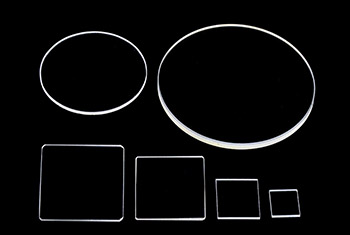


3. Transmission spectrum — what makes CaF₂ unique
The 130–9000 nm transmission range is what justifies CaF₂’s premium over fused quartz for specific applications. The key features:
Deep-UV cutoff at 130 nm
CaF₂ transmits down to about 130 nm in the vacuum ultraviolet. This is below the practical cutoff of every other common optical material: fused quartz cuts off at 190 nm, sapphire at 185 nm, MgF₂ at 120 nm (better than CaF₂ in the deep-UV but with worse mid-IR), LiF at 105 nm (best UV but mechanically weak). For 193 nm ArF excimer laser work, CaF₂ gives 92% transmission per surface uncoated, vs 88% for fused quartz and 85% for sapphire.
Excellent UV-Vis-NIR transmission
Across the standard UV-Vis-NIR range (200–1500 nm), CaF₂ transmits at > 92% per surface. This is comparable to fused quartz and sapphire; CaF₂ offers no UV-Vis advantage that justifies its cost for routine visible-light work.
Mid-IR transmission to 9 µm
This is the killer application. The mid-IR fingerprint region (5–9 µm, equivalent to 2000–1100 cm⁻¹) is where most organic molecular vibrations show up: C-H bend, C-N stretch, C-O stretch, P=O stretch. CaF₂ transmits cleanly through this entire range; sapphire cuts off at 5 µm and quartz at 2.5 µm. For FTIR sample cells covering the analytical fingerprint region, CaF₂ is the standard.
Where CaF₂ cuts off
Above 9 µm the Ca-F lattice vibrations begin to absorb and transmission drops sharply: 80% at 9 µm, 50% at 10 µm, near zero by 12 µm. For FTIR work above 9 µm, ZnSe (8% absorption per surface, transparent to 14 µm) is the standard alternative; for the far-IR above 14 µm, KBr or polyethylene-windowed cells take over.
Refractive index and dispersion
CaF₂ refractive index at 588 nm: 1.434 (lower than quartz at 1.458 and sapphire at 1.768). The low refractive index gives CaF₂ the lowest Fresnel reflection of the three (~3% per surface uncoated, vs 4% for quartz and 7.4% for sapphire). For broadband uncoated windows, this is a small but real efficiency advantage.
4. The soft-and-fragile reality — mechanical properties
CaF₂ is mechanically the most fragile of the three common optical-window materials. This shapes how it must be handled and where it should not be specified.
| Property | CaF₂ | Sapphire | Fused quartz |
|---|---|---|---|
| Hardness (Mohs) | 4 | 9 | 5.5-6.5 |
| Vickers HV (kg/mm²) | 158 | 1900 | 600 |
| Knoop (kg/mm²) | 140-160 | 1370 | 540 |
| Compressive strength | ~ 100 MPa | ~ 2 GPa | ~ 1 GPa |
| Tensile strength | ~ 35 MPa | ~ 350 MPa | ~ 50 MPa |
| Young’s modulus | 76 GPa | 345 GPa | 73 GPa |
| Density (g/cm³) | 3.18 | 3.97 | 2.20 |
| Thermal expansion | 19 × 10⁻⁶ /K | 5.6–6.6 | 0.55 |
| Max temperature (dry) | 800 °C | 1500–1800 °C | 1100 °C |
| Cleavage | (111) perfect | none | none |
What “Mohs 4” means in handling practice
- Sand particles scratch CaF₂: any silica or quartz dust above ~5 µm can leave a visible scratch under normal hand pressure. Always blow-clean before wiping.
- Paper towel (Kimwipe) leaves micro-scratches: use only lens tissue, chamois leather, or laser-cleaning wipes designed for soft optics.
- Tweezers contact damages the optical face: always handle by the edge using gloves; never let metal tweezers contact the polished face.
- Cleavage along (111) plane: CaF₂ cleaves naturally along the (111) crystallographic plane. Avoid impact loads — sharp impact can split a window cleanly along the cleavage direction.
Thermal shock sensitivity
CaF₂’s thermal expansion coefficient is 19 × 10⁻⁶ /K — about 35x that of fused quartz and 3x that of sapphire. This high CTE combined with the (111) cleavage makes CaF₂ highly sensitive to thermal shock:
- Maximum thermal ramp: ~50 °C/min during heating; ~30 °C/min during cooling
- Sudden contact between hot CaF₂ and cold solvent (e.g., dropping a 60 °C window into 20 °C cleaning bath) causes immediate cracking
- Hot windows must be allowed to cool to within 30 °C of ambient before any cleaning step
- Mounting in thermally cycling environments requires CTE-tolerant mounting (O-ring face seal or floating mount, not direct epoxy bond)
The most common CaF₂ failure modes we see in customer feedback. (1) Scratched window from rough wipe (Kimwipe instead of lens tissue) — ~30% of broken-window claims. (2) Surface fogging from humid storage (no desiccator) — ~25%. (3) Crack from thermal shock during cleaning (hot sample + cold rinse) — ~20%. (4) Edge chip from tweezers contact — ~15%. (5) Cleavage crack from drop or impact — ~10%. All five are preventable with proper handling SOP; with discipline, a CaF₂ window lasts years.
5. Hygroscopic handling & chemical resistance
CaF₂ degrades on prolonged exposure to atmospheric water vapour. The degradation is slow but cumulative: over months, an exposed surface develops a translucent fog (the result of slow hydrolysis to Ca(OH)₂ and HF). Surface roughness increases, transmission drops, and the polished face becomes irreparable.
Storage protocol
- Active use: store windows in a desiccator with fresh silica gel or anhydrous calcium sulfate, RH < 10%. Replace desiccant when it changes color (typically blue silica gel turns pink at saturation).
- Long-term storage: dry-N₂ purged cabinet or vacuum desiccator, RH < 5%. Premium reference standards (laser-grade laboratory work) sometimes use sealed evacuated containers.
- In-mounted use (FTIR cell): the assembled cell with O-ring seal protects the inner faces from air. The outer faces of the windows are still exposed and need protection during storage of the assembled cell.
- Travel / shipping: CaF₂ windows ship in foam-cushion boxes with a small desiccant packet. The desiccant should be replaced if the package has been in transit more than 30 days.
Cleaning protocol
- Remove dust by air: compressed air or rubber bulb (no liquid) blows away particles that would scratch during wipe
- Lens tissue with dry methanol: a single drop of HPLC-grade methanol on lens tissue (Kimtech laser-cleaning, Thorlabs lens tissue, or equivalent); wipe gently in one direction only
- Inspect under lamp: hold under a strong oblique-angle light; any visible streaking or droplet marks means re-clean
- Air-dry inverted: on lens tissue or in the desiccator
- Never use water alone: CaF₂ is partially soluble in water; even pure water leaves a slight surface etch
- Never use acetone repeatedly: some commercial acetone contains traces of HF or HCl that slowly etch CaF₂; methanol or anhydrous ethanol is preferred
Chemical resistance
| Chemical | Compatibility | Notes |
|---|---|---|
| Pure water (room T) | Slightly soluble | ~ 16 mg/L solubility; surface etches over hours |
| Pure water (hot) | Soluble | Avoid; cleanly attacks CaF₂ |
| Mineral acids (HCl, HNO₃, H₂SO₄) | Soluble | Direct contact dissolves CaF₂ |
| HF (hydrofluoric acid) | Resistant | Common ion suppression; CaF₂ is the F-source mineral |
| NaOH, KOH (dilute, room T) | Resistant | Slow attack at high pH; usually OK for short exposure |
| Methanol, ethanol, isopropanol | Inert | Standard cleaning solvents |
| Acetone | Generally inert | Trace acid impurities can cause slow etch; use sparingly |
| Hexane, heptane, toluene | Inert | Standard non-polar solvents |
| Chlorinated solvents | Generally inert | Traces of HCl from photolysis can etch over time |
The cardinal rule: any aqueous cleaning step must be followed immediately by a methanol or anhydrous-ethanol rinse to displace residual water. Never let CaF₂ sit wet, especially with traces of acid or salt in the water.
6. FTIR sample cells — the dominant CaF₂ application
The FTIR sample cell is what most CaF₂ windows are used for. The standard construction is two CaF₂ windows separated by a calibrated PTFE (or lead) spacer that defines the optical path length, all clamped in a stainless steel demountable holder. Sample is loaded between the windows as a thin film, neat liquid, or solution. The IR beam passes through one window, through the sample film, and out the second window to the detector.
Standard FTIR cell dimensions
| Component | Standard dimension | Selection notes |
|---|---|---|
| Window diameter | 13, 25, or 32 mm | Choose to match holder; 25 mm is most common |
| Window thickness | 1, 2, 3, or 4 mm | Thicker = better mechanical robustness; 2 mm typical |
| Spacer thickness | 25, 50, 100, 200, 500 µm | Defines sample optical path length |
| Spacer material | PTFE (default) or lead | PTFE for routine; lead for hot or solvent-incompatible work |
| Sample volume per fill | 10–500 µL | Function of spacer thickness and window diameter |
| Holder format | Demountable threaded | Standard from Specac, PIKE, Pearl, ThermoFisher, or in-house |
Path-length selection by sample type
- Neat liquids (organics, oils): 25–50 µm spacer (the chromophores are concentrated; thin path needed)
- Aqueous samples (proteins, carbohydrates): 50–100 µm (water absorbs strongly in the fingerprint region; thicker paths saturate)
- Dilute samples in non-aqueous solvent: 100–500 µm
- Polymer films cast on window: film thickness 5–25 µm typical, no spacer needed
- Thin solid samples (KBr pellets, mulls): 0.5–1 mm; uses single window backing
Custom FTIR cell windows. If you are designing a new FTIR cell or need replacement windows for an existing holder, send the diameter, thickness, and any AR-coating requirement. We routinely supply 13, 25, and 32 mm CaF₂ windows in 1–4 mm thicknesses; custom sizes within 6–100 mm diameter and 0.5–5 mm thickness ship in 18–30 working days. 2-piece minimum on custom.
7. ATR crystals — surface analysis at 45°
Attenuated Total Reflectance (ATR) is the dominant FTIR technique for solid samples, polymers, biofilms, biological tissues, and any sample where preparing a thin film for transmission FTIR is impractical. The IR beam enters a bevelled crystal at 45°, undergoes multiple total internal reflections, and exits through the opposite bevel. At each TIR point on the top face, the evanescent field penetrates ~1 µm into whatever sample is in contact with the crystal — this is what produces the ATR spectrum.
CaF₂ vs other ATR crystal materials
- Diamond (single-bounce ATR): the modern standard for routine FTIR-ATR. Hard, chemically inert, broad spectral range. We do not supply diamond ATR crystals; outside our manufacturing scope.
- Zinc selenide (ZnSe): the workhorse for multi-reflection ATR. 600 nm to 15 µm range; refractive index 2.4 (shallower penetration than CaF₂); moderate chemical resistance. We do not supply ZnSe crystals; specialised crystal-growth chain.
- Germanium (Ge): for high-refractive-index work where shallow penetration matters. 2–15 µm; opaque to visible (no visual alignment); inert to most chemicals. Specialty supply.
- CaF₂: available, but limited to mild samples because of CaF₂’s solubility. Used for short-path single-bounce work where sample is non-aqueous and non-acidic. Most ATR work uses ZnSe or diamond instead of CaF₂.
When CaF₂ ATR makes sense
CaF₂ ATR is used when the application combines UV-Vis-IR multi-modal detection on the same sample (CaF₂ transmits visible/UV in the same crystal where ATR provides mid-IR analysis) or when the sample is genuinely non-aqueous and stable (e.g., dry polymer films, organic crystals, neat oils). For typical biological or aqueous samples, ZnSe or diamond is the right ATR material; CaF₂ ATR is a specialty.
What MachinedQuartz supplies for FTIR. We make the standard CaF₂ transmission window (round or square plate) used in standard demountable cell holders. We do not currently supply trapezoidal ATR crystals, multi-bounce ATR optics, or ZnSe/Ge crystals — those are downstream specialty optical-fabrication shops. For FTIR transmission cell windows, we are a competitive supplier; for ATR crystal assemblies, refer to specialised ATR vendors (Specac, PIKE, Crystran ATR products, or comparable).
Custom CaF₂ window for your FTIR cell?
Send diameter, thickness, AR coating (if any), and quantity. 2-piece MOQ. Reply within one business day.
8. 193 nm ArF excimer laser optics
Argon fluoride excimer lasers at 193 nm have become a major industrial technology: photolithography for advanced semiconductor manufacture (DUV process at 193 nm), refractive eye surgery (LASIK at 193 nm), and research-grade photochemistry. CaF₂ is the standard window material for these lasers because:
- 193 nm transmission: CaF₂ transmits ~92% per surface uncoated; fused quartz absorbs significantly even in JGS1 deep-UV grade; sapphire is at its UV cutoff
- Low absorption: CaF₂’s 193 nm absorption coefficient is < 0.001 cm⁻¹ for laser-grade material; this matters for high-power systems where absorbed power becomes thermal load
- High laser-induced damage threshold (LIDT): CaF₂ LIDT at 193 nm is ~ 5–15 J/cm² for short-pulse work, sufficient for almost all commercial ArF systems
Photolithography
193 nm DUV photolithography
Advanced semiconductor lithography (sub-100 nm node) uses 193 nm ArF lasers. CaF₂ for projection lens elements, beam-shaping optics, mask substrates. Demanding optical specifications (lambda/10 flatness, scratch-dig 5-2, IBS-coated AR).
Eye surgery
LASIK / PRK ophthalmic lasers
Excimer laser corneal ablation systems use CaF₂ for output coupler, beam-delivery optics, and patient-side window. FDA-regulated medical-device application; compliant supply chain matters.
Research
193 nm research lasers
Coherent ExciStar, Lambda Physik, GAM Laser, and similar research-grade 193 nm sources. CaF₂ for beam-steering optics, output coupler, sample interface. Custom dimensions per system.
Photochemistry
Photochemistry & photolysis
193 nm photolysis cells for radical chemistry, photodissociation, atmospheric chemistry research. CaF₂ cell windows enable transmission of the 193 nm photolysis wavelength while passing the longer-wavelength probe.
9. Mid-IR spectroscopy applications
Beyond benchtop FTIR sample cells, CaF₂ serves several specialty mid-IR applications.
Process FTIR (in-line monitoring)
FTIR analysers integrated into chemical process lines (pharma, polymer, petrochemical) use CaF₂ windows for the sample interface. Process pressure typically modest (1–5 bar), temperature 25–80 °C, with continuous flow of process medium past the window. Window replacement cadence: 6 months to 2 years depending on process aggressiveness.
Mid-IR sensors (gas detection, leak detection)
Non-dispersive infrared (NDIR) sensors for CO₂, CO, CH₄, NO₂, and other small-molecule gas detection use CaF₂ windows in the optical path. Long-path absorption cells (50–100 cm folded path) for atmospheric or industrial monitoring also use CaF₂ or ZnSe end windows.
Microspectroscopy & imaging FTIR
FTIR microscopy (Bruker Hyperion, ThermoFisher Continuum, PerkinElmer Spotlight) uses CaF₂ or BaF₂ substrates and condensers. Sample-cell formats are smaller (~ 5–13 mm) and need tighter dimensional tolerance for the focused-beam geometry.
Synchrotron mid-IR beamlines
Synchrotron-source mid-IR beamlines (typically 4 µm to 100 µm via combined CaF₂ + diamond windows) use CaF₂ for the visible/UV-end window where wide-band transmission is needed. Specialty work; usually custom-quoted.
10. VUV / synchrotron applications below 200 nm
Below 200 nm in the vacuum-ultraviolet (VUV), most materials become opaque. CaF₂ is one of the few that transmits down to 130 nm:
- Synchrotron beamline windows: CaF₂ or LiF entrance/exit windows for VUV synchrotron beamlines. For wavelengths below 130 nm, MgF₂ (transmits to ~120 nm) or LiF (to ~105 nm) are the alternatives.
- VUV spectroscopy: astrophysics, atmospheric chemistry, plasma diagnostics in the 130–200 nm range use CaF₂ cell windows. Examples: Lyman-alpha (121.6 nm) detection requires LiF; molecular absorption at 150–180 nm typically uses CaF₂.
- Excimer lamp optics: 172 nm xenon excimer lamp systems use CaF₂ for the lamp envelope or external optical window when light extraction matters.
- Vacuum monochromators: McPherson, Acton VUV monochromator systems use CaF₂ or MgF₂ entrance/exit windows depending on the wavelength range required.
VUV optics handling. The same hygroscopic and soft-material warnings apply as for general CaF₂, but VUV applications are more sensitive to surface contamination because thin contamination layers absorb VUV more strongly than visible light. VUV-grade CaF₂ needs cleanroom handling, specific UHV-compatible cleaning protocols, and scheduled re-polishing or replacement.
11. Mounting & sealing — the desiccated environment problem
CaF₂ mounting has all the standard considerations of optical-window mounting (vacuum compatibility, thermal cycling, mechanical compression) plus the unique constraint of moisture protection. Three approaches dominate.
O-ring face seal (the standard for FTIR cells)
Window compresses against a Viton O-ring in a stainless steel holder. O-ring seal is gas-tight to ~10⁻⁶ mbar; the inner faces of the windows are protected from atmospheric moisture by the seal. Outer faces remain exposed and need protection during storage of the assembled cell. Standard FTIR sample cell holders (Specac, PIKE, ThermoFisher) all use this approach.
Epoxy bonding (for permanent installations)
For one-piece sealed assemblies (industrial process probes, aerospace optics), CaF₂ can be epoxy-bonded to a metal flange. Use low-outgassing optical epoxy (Norland 61, EPO-TEK 301) and CTE-matched flange material (Invar at CTE 1.6, or aluminium at 23 with controlled bondline thickness). Direct bond to stainless steel (CTE 17) is the worst combination because of differential thermal expansion vs CaF₂ at 19 — small but cumulative stress over thermal cycles.
Brazing or metallised bond (for UHV / high-temperature)
CaF₂ can be metallised and brazed to a Kovar or molybdenum flange for ultra-high-vacuum applications. The metallisation chemistry is different from sapphire (different surface chemistry); typical process: vapour-deposited Cr/Au layer, then nickel-plated, then brazed with Au-Sn or Cu-Ag eutectic. Specialty operation; longer lead times. Used for synchrotron beamline windows and high-temperature process probes.
CTE mismatch tolerance
CaF₂’s thermal expansion (19 × 10⁻⁶ /K) is high relative to sapphire (5.6) but close to typical metal flanges. For thermal-cycling environments:
- Aluminium flange (CTE 23) is reasonable match for CaF₂ — CTE differential ~ 4 ppm/K; tolerates ~100 °C cycle without significant stress
- Stainless steel (CTE 17) is also reasonable — differential ~ 2 ppm/K
- Invar (CTE 1.6) is the wrong match for thermal cycling because the differential is 17 ppm/K; window will see significant stress during cycling
- For high-cycle-count or wide-temperature applications, use a soft-metal or O-ring seal to absorb the mismatch
12. Custom geometry & what MachinedQuartz makes
The 61-SKU stock catalog covers standard round windows from Ø 6 to 50 mm. For OEM partners and specialty applications, custom geometry is the norm.
Standard custom variations (no tooling fee, in-envelope)
- Custom round diameters: Ø 5 mm to Ø 100 mm routine; larger up to ~150 mm with longer lead time
- Custom thicknesses: 0.5 to 8 mm
- Square / rectangular plates: any L × W up to 75 × 75 mm
- Wedged windows: 1–5 arcmin wedge for laser cavity etalon suppression
- Bevelled or chamfered edges: for sealing applications and stress reduction
- Pair-matched windows: two windows matched within transmission tolerance for FTIR sample cells
- AR coatings: single-line V-coat at your design wavelength; broadband or dual-band; outsourced to qualified vacuum-coating partners (V-coat for 193 nm or 9 µm commonly requested)
Specialty custom (one-time engineering or external partner)
For specialty needs beyond the standard machining envelope, we work with partners on:
- Trapezoidal ATR crystals (45° bevels): available through partner relationship; longer lead time and 5-piece MOQ
- Hemispherical IR domes: small (Ø < 50 mm) on request; large diameters require specialty fabrication
- Brazed CaF₂ to Kovar UHV assemblies: outsourced to ceramic-metal bonding partner; 5-piece MOQ
- VUV-grade laser optics: sourced through laser-grade material chain; longer lead time
- Specific crystal orientation ((111) vs (100)): (111) is the natural cleavage plane and is the default; (100) available on request through orientation-controlled supply
Custom CaF₂ MOQ = 2 pieces. Most specialty CaF₂ suppliers (Crystran, EKSMA, Specac material division) want 25–100 piece commitments before they will quote a custom geometry. We routinely make custom CaF₂ from 2 pieces — the only adders are the engineering review (free) and the production lead time (18–30 working days for most custom geometry within standard machining envelope; longer for AR coatings or specialty assemblies). Send a sketch and quantity; we respond within one business day.
13. Catalog & ordering
The MachinedQuartz CaF₂ catalog has 61 stock SKUs covering Ø 6 mm to Ø 50 mm round windows with thickness 0.6 to 3 mm. All stock SKUs are optical-grade single-crystal CaF₂ with 130–9000 nm transmission. Custom geometry is the default for OEM work.
Stock dimensional range
| Format | Diameter | Thickness | Material grade |
|---|---|---|---|
| Small round | Ø 6–13 mm | 0.6–2 mm | optical-grade single-crystal CaF₂ |
| Medium round | Ø 13–25 mm | 1–3 mm | optical-grade single-crystal CaF₂ |
| Large round | Ø 25–50 mm | 1–3 mm | optical-grade single-crystal CaF₂ |
| Custom rectangular | up to 75 × 75 mm | 0.5–5 mm | optical grade; UV or IR grade on request |
| Custom shapes | per drawing | per drawing | per drawing |
Need a CaF₂ window quote?
Send the diameter (or shape), thickness, surface specs (or “routine”), AR coating requirement (or none), quantity, and the application (FTIR / 193 nm laser / VUV / mid-IR sensor). Lead time 18–30 working days for standard custom; longer for AR coating or specialty assemblies. 2-piece MOQ.
Request quote →Browse 61 stock SKUs →Browse the catalog
14. Frequently asked questions
Why is CaF₂ used for FTIR instead of fused quartz?
Fused quartz cuts off above about 2.5 micrometres; the FTIR fingerprint region runs from 5 to 9 micrometres where most organic molecular vibrations show up. CaF2 transmits cleanly through the entire fingerprint region. Sapphire reaches 5 micrometres but stops there. For FTIR sample cells covering the analytical 1000 to 2000 wavenumber range (5 to 10 micrometre wavelength), CaF2 is the standard window material. Beyond 9 micrometres, ZnSe (transparent to 14 micrometres) or KBr (to 25 micrometres) take over.
How fragile is CaF₂ really?
Mohs 4 hardness — about as hard as iron sheet but much more brittle. CaF2 is sensitive to: scratches from rough wipes (Kimwipe causes micro-scratches; use lens tissue only), tweezers contact (always handle by edges with cotton gloves), thermal shock above 50 degrees Celsius per minute (cracks), and prolonged moisture exposure (surface fogs over months). With the right SOP — desiccator storage, lens-tissue cleaning, dry methanol rinses, careful temperature ramping — a CaF2 window lasts years. Without it, weeks.
Can I clean a CaF₂ window with water?
Pure water alone is borderline — CaF2 has solubility about 16 mg per litre in water and even a few minutes of contact leaves a slight surface etch. Better practice: clean with HPLC-grade methanol or anhydrous ethanol on lens tissue. If you must use water (e.g., to remove an aqueous sample residue), follow immediately with a methanol rinse to displace residual water from the surface, then air-dry inverted on lens tissue. Never let CaF2 sit wet. Never use mineral acids (HCl, HNO3) — they dissolve CaF2 cleanly.
How do I store CaF₂ windows when not in use?
Desiccator with fresh silica gel or anhydrous calcium sulfate — relative humidity below 10 percent. Replace desiccant when the indicator changes colour. For long-term storage of premium windows (laser-grade reference standards), use a sealed dry-N2 cabinet at less than 5 percent RH. Avoid lab benches and unsealed drawers — atmospheric humidity over months causes surface fogging that is irreversible without re-polishing. Used CaF2 windows in sealed assemblies (FTIR cells with O-ring seals) are protected on their inner faces but the outer faces still need protection.
Will CaF₂ work in an excimer laser at 193 nm?
Yes — CaF2 is the standard window material for ArF excimer laser systems at 193 nm. CaF2 transmits about 92 percent per uncoated surface at 193 nm; with V-coat AR (single-line at 193 nm) reaches over 99 percent. Fused quartz starts to absorb significantly at 193 nm; sapphire is at its UV cutoff. For high-power systems, specify laser-grade CaF2 (lower scatter and absorption); for routine output coupler windows, optical-grade is sufficient. Laser-induced damage threshold typically 5 to 15 J per cm squared for short-pulse work.
What is the largest CaF₂ window MachinedQuartz can make?
Standard custom up to about 100 mm diameter, with longer lead times for sizes above 75 mm. The supply chain for large-diameter optical-grade CaF2 boules is narrower than for sapphire or quartz; above 100 mm we quote custom because the material sourcing is the limiting factor. For 150 mm or larger CaF2 (some FTIR microscopy and synchrotron applications), expect 8 to 12 weeks lead time and a separate quote based on current material availability.
Can CaF₂ be AR coated?
Yes. Anti-reflection coatings are applied by qualified vacuum deposition partners (we outsource the coating step). Common designs: V-coat for 193 nm ArF (greater than 99 percent transmission at the design wavelength), V-coat for 9 micrometre FTIR fingerprint, broadband mid-IR (3 to 9 micrometres at 95 percent average), broadband UV-Vis-NIR (250 to 1000 nm at 96 percent average). Specify the working wavelength when ordering AR-coated CaF2. Lead time is 25 to 35 working days for AR-coated parts versus 18 to 30 days for uncoated.
Does MachinedQuartz make ATR crystals?
We make standard CaF2 transmission windows used in FTIR sample cells. We do not currently manufacture trapezoidal ATR crystals, multi-bounce ATR optical assemblies, or ZnSe / Ge / diamond ATR crystals — those require specialised crystal-fabrication chains. For ATR work, we recommend Crystran ATR products, Specac ATR accessories, or PIKE Technologies as the primary suppliers. We can supply CaF2 substrate material to ATR-specialty fabricators on request.
Why is CaF₂ slightly soluble in water?
Calcium fluoride has an equilibrium solubility of about 16 mg per litre in pure water at room temperature — it is one of the more soluble fluoride minerals. The dissolution is slow (kinetically limited by surface processes) but cumulative. In practice this means: do not let CaF2 sit in water for more than a few minutes; use anhydrous solvents for cleaning; protect from atmospheric humidity (water vapour also slowly hydrolyses CaF2 to Ca(OH)2 plus HF, the slow surface fogging mechanism). Sapphire and fused quartz are essentially insoluble in water and do not have this constraint.
How does CaF₂ compare to barium fluoride (BaF₂) for FTIR?
BaF2 has slightly extended IR transmission (to 12 micrometres vs 9 for CaF2) and slightly lower refractive index (1.39 vs 1.43). However BaF2 is even more soluble in water, more brittle, and more expensive. For routine FTIR work in the 1 to 9 micrometre range, CaF2 is the standard. For applications specifically needing transmission to 12 micrometres (some specialty mid-IR work), BaF2 is the right choice. We do not currently stock BaF2; for that material refer to specialty optics suppliers.
15. Disclaimer & notes
Specifications on this page are typical values for commercial-grade single-crystal calcium fluoride produced by Bridgman-Stockbarger or Czochralski growth. Specific transmission, absorption coefficient, and surface specifications depend on the supplier, growth method, and specific lot. For binding specifications refer to the certificate of analysis supplied with each shipment.
Application recommendations are general guidance based on typical optical-engineering practice. Specific applications may have requirements (laser-induced damage threshold, vacuum-compatibility certification, biocompatibility, regulatory compliance for medical or pharmaceutical use) that constrain the choice further.
What MachinedQuartz makes vs sources. We manufacture standard transmission CaF₂ windows in round and rectangular formats. Specialty assemblies (trapezoidal ATR crystals, hemispherical domes, brazed-to-Kovar UHV assemblies, AR coatings) are produced through partner relationships; lead times and minimum order quantities differ accordingly. We do not currently manufacture ZnSe, Ge, BaF₂, or diamond windows.
Hygroscopic and handling warnings on this page are based on typical commercial-CaF₂ behaviour. Premium laser-grade and synchrotron-grade material may have tighter handling SOPs than described. Follow your laboratory or institution’s specific protocols for the application.
Trademark notice. Bridgman-Stockbarger, Czochralski are growth method designations. Specac, PIKE, ThermoFisher, Bruker, PerkinElmer, Crystran, EKSMA, Norland 61, EPO-TEK 301, Coherent, Lambda Physik, GAM Laser are trademarks of their respective owners. References are for technical comparison and supply-chain context only.
Information currency: last reviewed May 2026. Catalog and SKU range subject to change.


Recent Comments