
Quartz Mortars and Pestles for ICP-MS, Geochemistry, and Trace-Metal Sample Prep (5-Set Selection Guide)
This post is also available in:
A quartz mortar and pestle is a fused-silica grinding tool for trace-metal sample preparation in ICP-MS, geochemistry, and high-purity chemistry workflows where conventional agate or porcelain mortars would contaminate the sample with Si, Al, Fe, or rare-earth elements. Quartz contributes < 1 ppb of these elements to the ground sample, compared to 10–1,000 ppb from agate — critical for ICP-MS at ppt detection limits.
Quartz Mortars & Pestles — Selection & Use Guide
Quartz Mortars and Pestles for ICP-MS, Geochemistry, and Trace-Metal Sample Prep
Five stock sizes from 30 mL to 180 mL bowl capacity, $400 to $600 per matched set. Where agate adds Fe and alumina adds Al, fused quartz contributes only Si — the one element your ICP-MS already ignores. This guide covers when the 4–8× price premium over agate is worth it, when it is not, and how to grind, clean, and care for a tool that should last a decade.
5 sets
Stock sizes
30–180 mL
Bowl capacity
Si only
Sample contamination
2 sets
Custom MOQ
Who wrote this: the MachinedQuartz fabrication team. We machine these mortars from solid fused-silica blocks one set at a time — bowl and pestle finished and matched before they leave the shop. The recommendations below come from material properties (hardness, contamination profile, fracture behaviour), not from claimed customer testimonials. Where agate, alumina, zirconia, and tungsten carbide are referenced for comparison, those are factual material properties; we do not manufacture in those materials and have no commercial reason to disparage them. Most labs do not need quartz mortars — we will tell you when. Last reviewed May 2026.
1. When quartz is worth $400+ over agate
An agate mortar from any catalogue supplier costs $50–200. A quartz mortar costs $400–600. The 4–8× premium has to be earned, and it is not earned by general-purpose grinding work. The two scenarios where the upgrade pays back are narrow and specific:
- Your analyte is Fe at sub-ppm levels. Agate is natural chalcedony — microcrystalline silica with iron oxide impurities at 100–1000 ppm. Every grinding stroke transfers Fe into your sample. For ICP-MS analysis where Fe is the analyte (or where Fe creates a doubly-charged interference on Ca, Mg, Si isotopes), agate disqualifies the mortar from the workflow. Alumina is similarly disqualified because it adds Al; tungsten carbide adds W + Co; zirconia adds Zr. Quartz adds only Si — and most ICP-MS workflows already treat Si as a matrix element, not an analyte.
- You need total mortar contamination below 1 ppm. For semiconductor reagent prep, isotope reference materials, ultra-trace pharmaceutical impurity work, and certified reference material production, the contamination budget is too tight for any natural mineral mortar. Synthetic-grade fused quartz is the practical floor for hand-grinding tools.
Outside those two cases, agate or alumina is the right answer. Stop reading and buy an agate mortar from VWR if your analysis is not contamination-budget-driven. The 4–8× price difference is not earned by hardness, durability, or aesthetic — it is earned strictly by the element you do not put into the sample.
2. The five stock sizes
Five stock sizes cover the routine sample-prep range from 0.5 g micro-samples to 50 g bulk grinding. Each set ships with a bowl and a matched pestle finished in the same lot — pestle curvature is shaped to the bowl radius for full sample contact and minimal residue.
| SKU | Outer dimensions | Bowl capacity (working) | Sample mass (typical) | Price |
|---|---|---|---|---|
| MQM440 | 50 × 60 × 20 mm | ~30 mL | 0.5–10 g | $400 |
| MQM441 | 60 × 70 × 25 mm | ~45 mL | 1–15 g | $450 |
| MQM442 | 75 × 90 × 33 mm | ~85 mL | 5–30 g | $525 |
| MQM443 | 80 × 100 × 37 mm | ~120 mL | 10–40 g | $550 |
| MQM444 | 90 × 110 × 40 mm | ~180 mL | 20–50 g | $600 |
Pick the smallest size your sample fits. Smaller bowls give better contamination control (less surface area for residue capture) and better tactile feedback when grinding small samples. The 30 mL MQM440 is the workhorse for ICP-MS prep where you are grinding 0.5–5 g of sample at a time. Larger sizes are for geochemistry-style bulk prep.
3. Mortar and pestle anatomy
A quartz mortar is one solid block of fused silica with the bowl ground out. The pestle is a separate piece, drawn or cast and then ground to match the bowl curve. Wall thickness is 15–20 mm — heavy enough to absorb grinding force without flexing or transmitting strain to the bench surface.
What you cannot order separately
Bowl and pestle are sold as a set. We do not stock standalone replacement pestles because each pestle is shaped to its specific bowl in the same machining lot — a pestle from a different lot will not match perfectly and you lose the close-contact grinding action. If you crack the pestle, you replace the set. If you need a custom replacement pestle for an existing bowl (uncommon — pestles outlast bowls in normal service), we can quote a custom job, but it requires shipping the bowl back to us so we can match the curve.
4. What ‘trace-metal-clean grinding’ means
The phrase has a precise definition in the ICP-MS / ICP-OES community. It means the mortar contributes less to the sample’s analyte signal than the analytical method’s quantitation limit. For sub-ppb-level work, that puts the mortar’s contamination contribution below 0.1 ppb — three orders of magnitude better than a natural agate mortar can deliver.
What gets contributed during grinding
- Mortar wear particles. Even a Mohs-7 quartz mortar wears slightly when grinding Mohs 6+ samples. The wear releases SiO2 microparticles into the sample. For Si-matrix samples (silicate rocks, ceramic precursors) this is invisible. For metal-matrix samples (alloys), the SiO2 wear is detectable but does not interfere with metal analysis.
- Adsorbed contamination from previous samples. The bowl surface has microscopic roughness that retains 10–100 µg of previous-sample residue even after acid wash. For high-throughput work, dedicate one mortar per sample type or run a thorough clean (see Section 12) between samples.
- Atmospheric particle deposition. An open bowl on the bench picks up sub-µg quantities of dust per minute. For sub-ppb work, cover the bowl between grinding strokes and work in a clean fume hood.
Quartz is not a substitute for clean technique. A perfect mortar in a dirty lab gives dirty samples. Trace-metal-clean grinding requires the full chain — clean reagents, clean tools, clean atmosphere, clean operator gloves — not just the mortar. The mortar removes one source of contamination; the rest of the protocol still has to be clean.
5. Mohs hardness — what you can grind
Quartz sits at Mohs 7 on the standard mineral hardness scale. The general rule for hand-grinding: your sample must be softer than the mortar. If the sample is harder, the sample wins and the bowl scratches — every stroke now adds wear particles to the sample at increasing rate.
Routine grinding (Mohs < 7) — go ahead
- Pharma APIs and excipients (Mohs 1–4)
- Polymer pellets and granulates (Mohs 1–3)
- Most rocks: feldspar (6), most carbonates (3–4), gypsum (2), talc (1)
- Soft metals and oxides: most metallic Cu, Pb, Zn samples; FeO, Cu2O
- Cellulose, biomass, crop residues
- Most pigments and salts
Marginal (Mohs ≈ 7) — slow wear of mortar
- Quartz-rich rocks, weathered granite, sandstone (Si is the matrix — wear is invisible)
- Synthetic silica powders (silica gel, fumed silica)
- Si-Ge semiconductor reactant powders
Do not grind in quartz (Mohs > 7)
- Topaz (8), zircon (7.5), beryl (7.5)
- Spinel (7.5–8), corundum / sapphire (9), SiC (9), boron carbide (9.5)
- Diamond and diamond-bearing samples (10) — use boron carbide or a diamond mortar
- WC, Cr3C2, TiC tool-steel carbides
For samples above Mohs 7, switch to boron carbide ($500–1500) or use a mechanical mill (planetary, vibratory, or shatterbox).
6. Application 1 — ICP-MS / ICP-OES sample prep
The strongest case for a quartz mortar. Sample prep for trace-metal analysis has to deliver a homogenised powder small enough to dissolve in acid digestion, without adding any analyte signal from the grinding tool. Quartz is the only mortar material that ships clean against the standard ICP-MS analyte list.
Typical workflow with quartz mortar
- Soft sample (geological reference material, dried biological tissue, dried marine sediment): grind to fine powder in MQM440 or MQM441 — 30 minutes for 1–5 g.
- Transfer powder to a clean PFA or quartz vessel for acid digestion.
- Digest with concentrated HNO3 / HCl / HF mix in a microwave or hot plate.
- Dilute to volume with ASTM Type I water in a quartz volumetric flask or PFA bottle.
- Analyse on ICP-MS with internal standard correction.
Pair the mortar with quartz vials and reagent bottles
Trace-metal-clean grinding is wasted if the sample then sits in a borosilicate vial leaching Na and B. Our quartz screw vials and reagent bottles complete the contamination-clean chain from grinding to storage to analysis.
What sample mass to grind
- Reference materials, dried tissue, sediments: 0.5–5 g per ICP-MS run. MQM440 is sized for this.
- Geological samples (whole-rock): 5–20 g for representative homogenisation. MQM441 or MQM442.
- Bulk environmental samples (soils): 20–50 g for sub-sampling. MQM443 or MQM444.
7. Application 2 — Geochemistry and rock analysis
Geochemistry sample prep faces a particular dilemma: most rocks are silicate-matrix, so adding silica from the mortar is invisible — but most rocks also contain Fe at percent levels, so an agate mortar adds 10–100 ppm Fe per gram of sample (negligible for whole-rock analysis at percent levels, but a problem for trace Fe isotope work).
When quartz beats agate for geological samples
- Iron isotope analysis (δ56Fe, δ57Fe). Agate adds isotopically distinct Fe from a different reservoir than the sample. Quartz adds none.
- Trace-metal partitioning studies in silicate rocks. Where the analyte (Cr, Ni, Co, Cu) is at sub-ppm and the contamination from agate matters.
- Mineral separates (single-mineral picking from crushed rock). Where the picked mineral fragments are sub-mg and any contamination is significant relative to sample mass.
- Cosmochemical samples (meteorites, presolar grains). Where sample is irreplaceable and contamination invalidates the analysis.
Where agate is fine
- Whole-rock major-element XRF analysis (Si, Al, Fe, Mg, Ca, Na, K at percent levels).
- Routine ICP-OES at the > 1 ppm level for most analytes.
- Soil and sediment grain-size prep for environmental work.
- Routine teaching-lab work.
8. Application 3 — Semiconductor reagent grinding
Semiconductor process chemistry uses ultra-pure powders — dopant precursors, sputter targets, CVD reactant powders — where any metallic contamination at the ppb level disqualifies the lot. Grinding these powders down to homogeneous particle size before use requires a mortar that contributes nothing measurable.
Typical semi-grade applications
- Dopant precursor mixing: grinding As2O3, Sb2O3, P2O5, B2O3 to homogeneous powder for diffusion source preparation.
- Sputter target raw-material prep: blending oxide and metal powders for hot-press or HIP consolidation.
- CVD precursor powders: grinding metal-organic precursors (β-diketonate complexes, alkoxide mixtures) before sublimation.
- Wafer-cleaning chemistry powder dilution: mixing dry powders into solution chemistry for SC-1, SC-2, or RCA-style processes.
Many semi-grade powders are hazardous. As2O3, Sb2O3, and similar dopants are acutely toxic. Pyrophoric powders (some MOCVD precursors) ignite in air. The mortar is the easy part of the protocol — the hazard control around it (glovebox, fume hood, PPE, waste handling) is the hard part. We make the tool; we do not advise on the chemistry.
9. Application 4 — Pharmaceutical API characterization
Pharmaceutical R&D and quality work occasionally requires hand-grinding API powders for crystal-form characterization (XRD, DSC, NIR), particle-size analysis, or compatibility testing. Most of this work uses agate mortars without complaint — APIs are organic, soft, and the trace metals from agate (Fe ~100 ppm) are below the typical ICH residual-metal limits.
When quartz might be specified
- Trace metal impurity profiling per ICH Q3D. The ICH limits for Class 1 elements (As, Cd, Hg, Pb) are at ppm-level. Agate Fe contamination is well within limits, but if the API itself contains Fe or if you are measuring Class 2A/2B elements at sub-ppm, the contamination contribution becomes relevant.
- Reference standard production. Where the standard will be used to calibrate trace-metal assays in finished product, the standard itself must be metal-clean.
- API + excipient grinding for compatibility study. Where you do not want to introduce Fe as a confounding variable in degradation studies.
For most pharma routine work, agate is the right tool. Quartz is the right tool when the regulatory framework specifically requires mortar contamination accountability.
10. Application 5 — Forensic and archaeological microsamples
Forensic chemistry and archaeological materials science share a constraint: samples are small, irreplaceable, and the analytical chain has to be defensible in a regulatory or peer-review context. Quartz mortars appear in both fields when the sample is silicate-rich (soil traces, rock fragments, ceramic shards) and the analyte is trace metal.
Forensic applications
- Soil-trace evidence: grinding sub-gram soil samples for ICP-MS comparison to suspect-location reference samples.
- Glass-fragment analysis: grinding sub-mm glass shards from a crime scene for trace-element fingerprinting.
- Gunshot-residue prep: grinding swab residues for ICP-MS Pb/Sb/Ba analysis.
- Drug seizure cutting-agent identification: grinding mixed powders for ICP-MS to identify trace-metal markers of synthesis route.
Archaeological applications
- Pottery and ceramic provenance: grinding sub-gram potsherds for ICP-MS comparison to clay-source reference materials.
- Pigment analysis on artwork: grinding micro-samples (sub-mg) of pigment for trace-element fingerprinting.
- Lithic-tool material sourcing: grinding obsidian or chert sub-samples for trace-element matching to geological source.
- Bone and tooth dietary analysis: grinding archaeological bone for Sr/Ca, Ba/Ca, or trace-metal isotope ratios.
11. Grinding technique — load size and recovery
Quartz mortars reward technique. Grinding too aggressively cracks the pestle; grinding too lightly leaves heterogeneous powder; over-loading the bowl wastes sample and increases recovery loss.
Load the bowl correctly
- Fill bowl to 10–25 % of capacity for grinding. The MQM440 (30 mL working) takes 3–7 mL of starting material — typically 1–5 g for a moderate-density powder.
- Add sample in stages if you have more than 5 g — grind one portion, transfer to a clean container, then grind the next portion in the same bowl.
- For sub-gram samples, place the powder at the bottom-centre of the bowl where the pestle has full contact. The cone slope keeps it there.
Grinding stroke
- Hold the pestle with the curved tip in full contact with the bowl floor. Apply moderate downward pressure (a few kg, not a few tens of kg).
- Rotate the pestle in small circular motions, working from the centre out and back. Periodically scrape sample from the bowl walls back to the centre with a clean spatula.
- Grinding time depends on starting particle size and target fineness — typically 5–15 minutes for routine ICP-MS prep, 30+ minutes for fine homogenisation of geological samples.
- Stop when the powder feels uniformly fine to the pestle (no audible coarse-particle clicking).
Recovery
- Use a clean PTFE or quartz spatula to scrape powder out of the bowl. Brush corners with a clean ESD-safe brush if you need every milligram.
- Expect 1–5 % residual sample in the bowl after recovery — that is mortar carry-over and the reason for the cleaning protocol in the next section.
- For trace-metal sample-prep work, the carry-over is the dominant source of contamination between samples, not the mortar material itself.
12. Cleaning protocol — between samples and sample types
The mortar lasts decades. The cleaning protocol determines whether your samples cross-contaminate over those decades.
Standard cleaning (between samples of the same type)
- Brush dry residue out of the bowl with a clean ESD-safe brush. Tip residue into appropriate waste.
- Rinse three times with deionised water.
- Rinse twice with the analyte-appropriate solvent (acetone for organics; isopropanol for general; dilute HCl for trace metals).
- Air-dry on a clean Kimwipe in a covered container.
Deep cleaning (between sample types, ICP-MS workflow)
- Steps 1–3 above.
- Soak bowl and pestle in fresh aqua regia (3:1 HCl:HNO3), room temperature, for 1–4 hours.
- Rinse five times with ASTM Type I water.
- Bake at 200 °C in a clean oven for 1 hour (oven temperature is for drying — not for thermal etching of the surface).
- Cool in a covered container; store with a dust cover until next use.
What requires dedicated mortars (no shared use)
- Radioactive samples — mortar is contaminated permanently.
- Ultra-trace Hg, Pb, Cd, As prep — even after deep cleaning, sub-ppb residues persist on rough surfaces.
- Photoresist or semi-grade chemistry where film-forming residues mark the bowl surface.
- Forensic chain-of-custody samples — fresh dedicated mortar per case is the legal-defensibility default.
Aqua-regia soaks are safe for the mortar but hard on you. Aqua regia is corrosive and releases NO2 / Cl2 fumes. Always do the soak in a fume hood with a covered vessel; never in an open lab. The mortar tolerates the chemistry indefinitely; the operator does not.
13. Lifetime, replacement, and breakage
A quartz mortar that survives the first 30 days of use will survive a decade. The two failure modes are mechanical (drop, crack) and chemical (acid attack on the inside surface).
Mechanical lifetime
- Bowl: indefinite for normal grinding. Will crack if dropped from bench height onto a hard floor.
- Pestle: 5–10 years of daily use. Tip wears slowly; eventually the curve no longer matches the bowl and grinding becomes less efficient. Replace as a set.
- Bench surface matters. Always work on a soft mat (silicone bench cover or rubber gridded mat). Grinding directly on a stone or metal benchtop transmits shock back into the bowl on each stroke and shortens its life.
Chemical lifetime
- Standard cleaning (HCl, aqua regia, hot DI water) does not measurably etch the surface over decades.
- HF will destroy the bowl. Any HF-containing acid, including BHF, dissolves quartz. Never use HF in a quartz mortar — for HF-containing protocols, transfer the powder to PFA before adding acid.
- Boiling NaOH or KOH etches the surface. Brief contact during cleaning is fine; prolonged contact (hours) is not.
What to do if the bowl cracks
A cracked bowl is unsafe for grinding (sharp edges, particle contamination from the crack itself) and is not repairable. Order a replacement set. The pestle from the cracked-bowl set may still work with a custom-matched new bowl, but the practical answer is to replace as a set.
14. Custom sizes and specifications
Roughly 20 % of mortar orders are custom dimensions. Lead time for custom is 4 weeks; MOQ is 2 sets.
Routine custom variations (no tooling charge)
- Bowl outer diameter (40 mm to 130 mm)
- Bowl depth (15 mm to 50 mm)
- Wall thickness (heavier for repeated heavy grinding; standard 15–20 mm)
- Spout for liquid pour-out (modified bowl rim)
- Pestle length and grip diameter (longer pestle for deeper bowls)
- Knurled vs polished pestle grip
Higher-touch customisations (4–6 weeks)
- Type 3 (synthetic) fused silica for sub-ppm trace-metal applications
- Type 1 (low-OH) for autoclave or 1000 °C bake-out
- Bowl with a flat-bottom variant (for slurry mixing rather than dry grinding)
- Multi-bowl mortar (parallel grinding of multiple sub-samples)
- Lid for closed grinding of hazardous powders (with ground-glass joint)
What we do not make
- Mechanical mill jars, planetary mill cups, or vibratory mill bowls — different geometry, different grinding mechanism
- Boron carbide, alumina, or zirconia mortars — different supply chain
- Stand-alone replacement pestles for mortars not from our shop
- Mortars below 30 mL or above 250 mL bowl capacity — outside our normal blowing tooling
- Antique-style ornate carved mortars — we make functional analytical tools, not display pieces
15. Full 5-SKU catalog
Stock as of May 2026. Prices in USD per matched bowl + pestle set. FOB Texas, FedEx International Priority. Stock orders ship within 1–2 business days; custom dimensions 4 weeks.
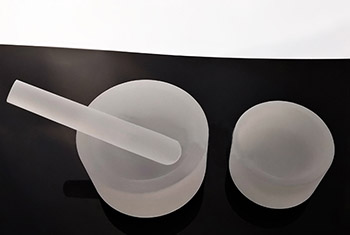 In stock
Five matched sets
30 mL through 180 mL bowl capacity. Each set ships with a bowl and a pestle finished and matched in the same machining lot.
Browse mortar catalog →CustomCustom geometry — 2-set MOQ
Non-stock dimensions, Type 3 synthetic silica, multi-bowl, flat-bottom, lidded variants. 4-week lead time.
Request custom →| SKU | Outer dimensions | Bowl capacity | Sample mass | Price USD |
|---|---|---|---|---|
| MQM440 | 50 × 60 × 20 mm | ~30 mL | 0.5–10 g | $400.00 |
| MQM441 | 60 × 70 × 25 mm | ~45 mL | 1–15 g | $450.00 |
| MQM442 | 75 × 90 × 33 mm | ~85 mL | 5–30 g | $525.00 |
| MQM443 | 80 × 100 × 37 mm | ~120 mL | 10–40 g | $550.00 |
| MQM444 | 90 × 110 × 40 mm | ~180 mL | 20–50 g | $600.00 |
16. FAQ
When is a quartz mortar worth $400 over a $100 agate one?
Two cases. First, when your analyte is Fe at sub-ppm levels — agate is natural chalcedony with 100–1000 ppm Fe oxide impurity that transfers into the sample on every grinding stroke. Second, when total mortar contamination has to stay below 1 ppm for ICP-MS, semiconductor reagent prep, isotope reference materials, or certified reference material production. Outside those two cases, agate is the right answer at one-quarter the price. We will tell you so.
Why does quartz only contribute Si — what about Al, Na, K from the silica matrix?
Standard Type 2 fused silica contains about 25 ppm Al and 3 ppm Na+K — much lower than agate’s iron content but not zero. For sub-ppb ICP-MS analysis of Al or Na, request Type 3 (synthetic CVD silica) on the quote — total trace metals drop below 1 ppm. The default Type 2 is fine for sub-ppm trace-metal work; Type 3 is for ppt-level work.
Can I grind hard samples like sapphire, SiC, or diamond in a quartz mortar?
No. Mohs 7 quartz cannot grind Mohs 8+ samples — the sample will scratch the bowl and contaminate the powder with quartz wear particles at increasing rate. For sapphire (9), SiC (9), boron carbide (9.5), or diamond (10), use a boron carbide mortar (rated for hardness 9.5) or use a mechanical mill (planetary, vibratory, shatterbox). For Mohs-7 samples (silica gel, fumed silica, granite) the quartz mortar works but wears slowly; expect a usable lifetime of a few years rather than a decade for those samples.
Can I autoclave a quartz mortar?
Yes. The quartz body tolerates autoclaving at any standard cycle — 121 °C wet steam for 30 min, or 134 °C, indefinitely. Dry-heat sterilisation works up to 1100 °C if you have a use case for that. Note that the mortar’s thermal mass is large; allow 30–45 minutes to cool from autoclave temperature before next use. For routine cleaning, the aqua-regia soak protocol in Section 12 is more effective at removing trace-metal residue than autoclaving.
How do I clean between samples for ICP-MS work?
Standard between-sample cleaning: brush, three DI rinses, dilute HCl rinse, air dry. Between sample types or after suspected contamination: full aqua regia soak (1–4 hours, room temperature), five DI rinses, 200 °C oven dry. For radioactive, Hg/Pb/Cd/As, photoresist, or forensic chain-of-custody work, dedicate a fresh mortar per sample type — even thorough cleaning leaves sub-ppb residue on the rough surface.
What’s the difference between Type 2 and Type 3 fused silica for mortars?
Type 2 is flame-fused natural crystal — about 25 ppm Al, 3 ppm Na+K, 200–400 ppm OH. Default for our stock mortars and the right answer for sub-ppm trace-metal work. Type 3 is synthetic CVD silica — total trace metals below 1 ppm, OH around 1000 ppm. Type 3 is a custom order with a 3–5× price premium; specify only when your analytical method requires sub-ppt mortar contamination.
How long does a quartz mortar last?
Indefinite for the bowl under normal grinding (no drops, no HF, no aggressive base). The pestle wears slowly — 5–10 years of daily use before the curve no longer matches the bowl. Replacement is as a matched set; we do not stock standalone replacement pestles because each pestle is shaped to its specific bowl in the same machining lot. The dominant failure mode is mechanical drop, not wear or chemical attack.
Can I use HF in the quartz mortar for sample digestion?
No. HF dissolves silica at any concentration. For HF-containing digestion protocols, grind the dry sample in the quartz mortar, then transfer the powder to a PFA digestion vessel before adding HF. The grinding step does not need HF; the digestion step does. Keeping the two steps in different vessels protects the mortar.
Do you sell pestles separately from bowls?
Generally no — bowl and pestle are sold as a matched pair from the same machining lot, so the pestle curve fits the bowl exactly. We can quote a custom replacement pestle for an existing bowl, but we need the bowl shipped back to us so the pestle can be machined to match the actual curve (which varies between lots). For most customers, replacing as a set when the pestle wears out is the practical answer.
What do you NOT make in mortars?
We do not manufacture or supply: mechanical mill jars, planetary mill cups, ball mill grinding media, or vibratory mill bowls (different geometry and supply chain); boron carbide, alumina, zirconia, or porcelain mortars; stand-alone replacement pestles for mortars from other shops; mortars below 30 mL or above 250 mL bowl capacity (outside our normal blowing tooling); or ornate / decorative carved mortars (we make functional analytical tools). For any of these, we will point you at a specialist vendor.
Related guides
17. Notes and honest limits
What this guide does not claim
• Quartz is the universal best mortar. It is not. Agate is correct for 90 percent of grinding work. Quartz is the right answer specifically when contamination from agate’s Fe or alumina’s Al would invalidate sub-ppm trace-metal analysis. Outside that case, the 4–8× price premium is not earned.
• Sample hardness limits. Quartz is Mohs 7. Samples above Mohs 7 (sapphire, SiC, boron carbide, diamond, WC, TiC) will scratch the bowl. Use boron carbide or a mechanical mill instead.
• HF resistance. Quartz dissolves in HF at any concentration. For HF-containing protocols, grind in the mortar dry, then transfer powder to PFA before adding HF.
• Dropping. Quartz is brittle. A 1-metre drop onto a hard floor cracks the bowl. Always work on a soft mat.
• Standalone replacement pestles. We sell as matched bowl + pestle sets only. Custom replacement pestles for existing bowls require shipping the bowl back for curve matching.
VWR is a registered trademark of Avantor. Wheaton is a registered trademark of DWK Life Sciences. ICH Q3D is a guideline of the International Council for Harmonisation. References to ASTM Type 1 / 2 / 3 fused silica grades follow the ASTM C162 and Corning Glass Works classification. Mohs hardness scale references follow the standard mineralogical convention.
Last reviewed May 2026 by the MachinedQuartz technical team. Pricing and stock availability change over time — confirm current SKU availability and pricing on the catalogue page or email [email protected] before specifying a final BOM.
Ready to spec your quartz mortar set?
Five stock sizes 30 mL – 180 mL. Custom geometry on 2-set MOQ, 4-week lead time. Type 3 synthetic silica available for sub-ppt ICP-MS work.
Browse the catalog →Request a custom quote →

Recent Comments