Quartz cuvette compatibility is controlled by three instrument-specific parameters: the Z-dimension (beam height above the cell holder base, typically 8.5 mm or 15 mm), the body footprint (standard 12.5 × 12.5 mm or oversized 20 × 20 mm), and the path length declared by the instrument’s calibration. A 10 mm path cell from one vendor will read identically on a Cary 60, Agilent 8453, and Shimadzu UV-1900 if all three parameters match — but a Z-dim mismatch produces a 1–5% systematic offset that no software correction can fix.
Quartz Cuvette × Spectrophotometer Compatibility: Z-Dimension by Instrument
A working reference for which quartz cuvette fits which spectrophotometer — every major instrument family from Agilent Cary, Shimadzu UV, PerkinElmer Lambda, Thermo Evolution and GENESYS, Jasco, BMG, Tecan, Hach, Hitachi, Beckman, and Biochrom. Z-dimension tables, beam-height notes, and what to order from a custom fabricator’s view.
5 instrument families40+ models covered8.5 / 15 / 20 mm referenceCustom Z available
Last updated: May 12, 20263,200 words · 12 min readFor: lab managers · OEM engineers · QC chemists
Reviewed by the MachinedQuartz fabrication team — engineers and technicians who have built optical-grade quartz cells, capillaries, and custom Z-dimension cuvettes for spectroscopy labs and OEM customers since 2026. The instrument-by-instrument data below comes from manufacturer hardware guides cross-checked against the cells we have actually built and shipped into these compartments.
Section 1
What Is Z-Dimension and Why It Decides Compatibility
Z-dimension is the height from the bottom of a cuvette to the center of the spectrophotometer’s light beam. If the cuvette window does not span the height the instrument’s beam passes through, the beam either misses the sample entirely (low Z, beam above the liquid) or hits the cuvette wall (high Z, beam blocked) — and you get a flat baseline, zero signal, or numbers that drift between cuvettes.
For full-volume macro cuvettes this is almost never an issue. The cell is taller than any standard beam height, the optical face is full-height, and the beam passes through liquid no matter what. The problem appears the moment you switch to a masked or sub-micro cell — those have a small, deliberately bounded optical aperture, and that aperture has to sit exactly where the beam is.
Three values dominate the industry: 8.5 mm (older / portable / some sub-micro accessories), 15 mm (modern default, roughly 80% of the installed base), and 20 mm (legacy double-beam UV-Vis-NIR research benches). For background on how Z affects small-volume work specifically, see our Z dimension of sub-micro cuvettes reference.
Quick read: Z-dimension is where the beam is, not how big the cuvette is. Mismatch a sub-micro cuvette’s Z to your instrument and the measurement fails before any chemistry begins.
Z-dimension is the height from the cuvette’s bottom to the center of the instrument’s light beam. The three industry-standard values are 8.5 mm, 15 mm, and 20 mm; modern UV-Vis spectrophotometers default to 15 mm.
Section 2
The Three Industry-Standard Z-Dimensions
Spectrophotometer designers converged on a small set of standard beam heights in the 1990s and 2000s. Knowing which standard your instrument follows is the first decision in every cuvette purchase that involves a masked or sub-micro cell.
Z-dimension
Where you find it
Typical year & market
8.5 mm
Thermo GENESYS, Beckman DU 800, older Cary sub-micro accessories, some Shimadzu specialty holders, many portable / handheld spectrophotometers
1990s standard, still widely deployed for compact and field instruments
15 mm
Almost every modern benchtop UV-Vis: Cary 60–300, Shimadzu UV-1900 / 2600 / 3600i, PerkinElmer Lambda 365 / 465, Thermo Evolution, Agilent 8453 / 8454, Jasco V-series, Biochrom Libra
Industry default since ~2005; ~80% of installed base
20 mm
Agilent Cary 4000 / 5000 / 6000i and other high-end double-beam UV-Vis-NIR research benches
High-end research line; a minority of installs
One more value rounds out the picture: a small set of instruments — notably the Hitachi U-series — run a 10 mm Z. And the high-end PerkinElmer Lambda 650 / 850 / 950 NIR benches, despite their elaborate accessories, keep the standard 15 mm Z on the default holder (covered in Section 6).
When in doubt, assume 15 mm. Every major manufacturer’s flagship benchtop instrument shipped in the last 15 years runs 15 mm Z. If you cannot find documentation for your model and it was built after roughly 2008, ordering 15 mm cuvettes is the safe default. The Section 9 diagnostic flow covers verification.Three Z-dimensions cover roughly 99% of installed UV-Vis spectrophotometers. 15 mm is the modern default across Agilent, Shimadzu, PerkinElmer, Thermo, and Jasco. The 8.5 mm and 20 mm values appear in older or specialty instruments.
Why Z-dimension matters for sub-micro and masked cuvettes. Full-volume macro cells span the full vertical beam range; sub-micro cells have a deliberately narrow aperture that has to sit exactly where the beam is. Mismatch the Z and the beam either strikes the mask above or below the aperture — the data fails before any chemistry happens.
Section 3
Agilent Cary Series (Cary 60, 100, 300, 3500, 5000)
The Cary family covers everything from the entry-level Cary 60 (single beam, fast xenon flash, 130 × 523 × 123 mm sample compartment) to the research-grade Cary 5000 (double beam, UV-Vis-NIR, 175–3300 nm range). Most of the line — Cary 60, 100, 300, and 3500 — shares a 15 mm Z-dimension on the standard cell holder, while the high-end Cary 4000 / 5000 / 6000i research instruments use 20 mm. Source: Agilent Cary hardware guides and supplies quick-reference (publication 5991-1659EN).
Model
Type
Z-dimension
Notes
Cary 60
Single beam, xenon flash, 190–1100 nm
15 mm standard
8.5 mm sub-micro accessory available; fiber-optic dip probe option
Cary 100 / 300
Double beam, 190–900 nm
15 mm
QC and routine analysis workhorse
Cary 3500
Multi-cell parallel measurement
15 mm
Up to 8 cells simultaneous; multi-cell turret design
Cary 4000 / 5000 / 6000i
Double beam, UV-Vis-NIR
20 mm; large NIR sample compartment
175–3300 nm; PbS detector for NIR
The Cary 60’s compact xenon flash design means the beam is brief and intense, which is friendly to scratched or marginal cuvettes — but the 15 mm Z is rigid. For sub-micro work in a Cary 60, you either use Agilent’s own 8.5 mm sub-micro accessory or a 15 mm-Z sub-micro cuvette with a window centered at 15 mm from the cell bottom.
The 8453 and 8454 are the diode-array workhorses of pharmaceutical QC and dissolution labs. No monochromator scan — the photodiode array reads the entire 190–1100 nm spectrum in a single ~1 second acquisition. Cuvette holder is fixed 15 mm Z-dimension; the single-cell standard holder is part G1103-60010, with multi-cell turret options for parallel measurement.
Because the entire spectrum hits the cuvette at once on a diode array instrument, stray light contributions from cuvette walls and dust are accumulated across the band rather than rejected by a slit. This makes cuvette cleanliness noticeably more important on a 8453/8454 than on a scanning instrument — a smudge that wouldn’t bother a Cary scan can shift the entire 8453 baseline.
For 8453 / 8454: 15 mm Z 10 mm path-length quartz cuvettes are the daily driver. For flow-through dissolution work or fixed-aperture multi-cell, see our custom flow cell page. Pair the cell with the dissolution sipper tubing your method calls for.
Shimadzu’s “UV-i” line — UV-1900i, UV-2600i, UV-3600i Plus — runs a standard 15 mm Z-dimension on the default sample compartment, but the line is unusual in that the sample compartment is modular and swap-out: you can drop in an 8.5 mm cell holder, a multi-cell turret, a thermostatted Peltier holder, or a film holder without changing the instrument. That flexibility is why Shimadzu is over-represented in academic labs running mixed methods.
Because Shimadzu’s sample compartments are modular, the answer to “what Z-dim do I need?” sometimes depends on which holder you have installed rather than which model the instrument is. The 8.5 mm holder (Shimadzu part 206-60184-0X variants) and the 15 mm holder look superficially similar; before ordering, look at the holder itself or check the most recent purchase order.
For Shimadzu UV-i: 15 mm Z is the default order. If you have the 8.5 mm sub-micro holder installed, order 8.5 mm Z sub-micro cells — confirmed by checking the holder, not the instrument model. For long-path 100 mm cells on UV-3600i Plus, see the size chart.
Section 6
PerkinElmer Lambda Series (365, 465, 650, 850, 950)
The PerkinElmer Lambda family splits cleanly into two design groups, and the Z-dimension story is different for each.
Entry / mid-range: Lambda 365 and 465 (15 mm)
The Lambda 365 and the newer Lambda 365+ / 465 use a 15 mm beam Z-height on the standard cuvette holder. They are compatible with conventional 15 mm Z quartz cuvettes and with the NanoCuvette™ One micro-volume accessory. Specifications confirmed from the PerkinElmer Lambda 365 hardware guide and SpectroKnowledge™ instrument reference.
Research-grade: Lambda 650 / 850 / 950 (15 mm)
The high-end Lambda 650 / 850 / 950 are the most accessory-rich members of the family. These are double-beam UV-Vis-NIR instruments with a wide range of accessories: integrating spheres, universal reflectance, polarizers, depolarizers. Despite that optical complexity, the standard cuvette holder runs the same 15 mm Z as the rest of the Lambda family, so conventional 15 mm Z quartz cuvettes drop in directly. Source: PerkinElmer Lambda 650/850/950 hardware guide.
The accessories change the sampling geometry, not the cuvette Z. Two cases apply:
Use standard 15 mm Z quartz cuvettes in the default cell holder for routine transmission work, OR
Use custom Z-dim cuvettes only when integrating non-standard sample optics — process monitoring, OEM, or embedded benches with a relocated beam
Model
Beam Z
Wavelength range
Cuvette compatibility
Lambda 365 / 365+
15 mm
190–1100 nm
Standard 15 mm Z quartz; NanoCuvette One micro-volume
Lambda 465
15 mm
190–800 nm (array)
Standard 15 mm Z
Lambda 650 / 850 / 950
15 mm
175–3300 nm (950)
Standard 15 mm Z quartz; custom Z only for embedded optics
For Lambda 365 / 365+ / 465: standard 15 mm Z quartz cuvettes. For Lambda 650 / 850 / 950: if you are integrating non-standard sample optics (process work, OEM, embedded systems), custom Z-dim is exactly the case we build for — see custom quartz cuvettes or request a quote with your beam geometry.
Custom Z-dimension built to your beam geometry
JGS1 deep-UV grade down to 185 nm
4-window fluorescence absorbance + emission
Section 7
Thermo Scientific Evolution & GENESYS
Thermo Scientific markets two parallel UV-Vis lines: the Evolution series (research-grade, scanning) and the GENESYS series (routine analytical, single-beam workhorse). The Evolution line runs a 15 mm Z-dimension on current models; the GENESYS line uses an 8.5 mm Z on its standard holder — confirm which line you have before ordering masked cells.
Model
Line
Z-dimension
Notes
Evolution 220
Compact double beam
15 mm
Bench QC and academic
Evolution One / One Plus
Single beam, fast scan
15 mm
Replaces older Evolution 60
Evolution Pro
Double beam, scanning
15 mm
Replaces Evolution 300/600/220
GENESYS 10S
Single beam, fixed wavelength
8.5 mm
Teaching and routine
GENESYS 30 / 40 / 50
Diode array
8.5 mm
Compact, similar to older Spectronic 20
GENESYS 140 / 150 / 180
Scanning UV-Vis
8.5 mm
Modern replacement for GENESYS 10 series
One Thermo-specific detail: the GENESYS line traces its design lineage back to the old Spectronic 20, which used round 1-inch test-tube-style cells. Modern GENESYS instruments accept standard rectangular cuvettes, but many Thermo labs still have a tube adapter sitting on the shelf. If you inherit a GENESYS with a round cuvette holder, that’s the legacy adapter — swap to the rectangular holder before ordering 10 mm path-length quartz cells.
For Thermo Evolution: 15 mm Z 10 mm path-length quartz cuvettes are the daily driver; for GENESYS: order 8.5 mm Z cells. For 1-cm round cells on legacy Spectronic-style holders, the geometry is different — check holder before ordering.
Section 8
Other Common Instruments: Jasco, BMG, Tecan, Hach, Hitachi, Beckman, Biochrom
Beyond the four big OEMs, a handful of regional and specialist brands round out most lab installed bases. The Z-dimension picture for these is more varied.
Brand / Model
Z-dimension
Compatibility notes
Jasco V-630 / V-730 / V-770
15 mm
Standard quartz cuvettes drop in; ETC-815 thermostatted holder same Z
Beckman DU 800 / DU 730
8.5 mm (DU 800) / 10 mm (DU 730)
Mostly retired from new sales but very common in academic labs; confirm model — DU 800 is 8.5 mm, DU 730 is 10 mm
Biochrom Libra S22 / S60 / S80
15 mm
Libra S-series, S80, and Ultrospec all use standard 15 mm Z quartz cuvettes
Hitachi U-2900 / U-5100
10 mm
The Hitachi U-series uses a 10 mm Z; confirm with a sub-micro cell before ordering masked cuvettes
BMG Clariostar / FLUOstar
Microplate-based
Not standard cuvette geometry; use 96/384-well plate or LVis plate accessory
Tecan Spark
Microplate-based
NanoQuant plate for cuvette-style measurements
Hach DR3900 / DR6000
Special cell adapters
Round 1-inch cells + 10/50 mm rectangular adapters; non-standard pairing
Avantes / Ocean Optics / StellarNet
Fiber-optic dip / 10 mm cuvette holder
Modular spectrometers; cuvette holder is a separate accessory (CUV-UV/Vis, etc.) with its own Z
Special cases to flag: microplate readers (BMG, Tecan) and water-quality kit instruments (Hach) are not cuvette instruments by default — they use plates or proprietary cells. If your method calls for a quartz cuvette in one of these, you are almost certainly using an accessory plate adapter, and the geometry follows the adapter, not the instrument body.
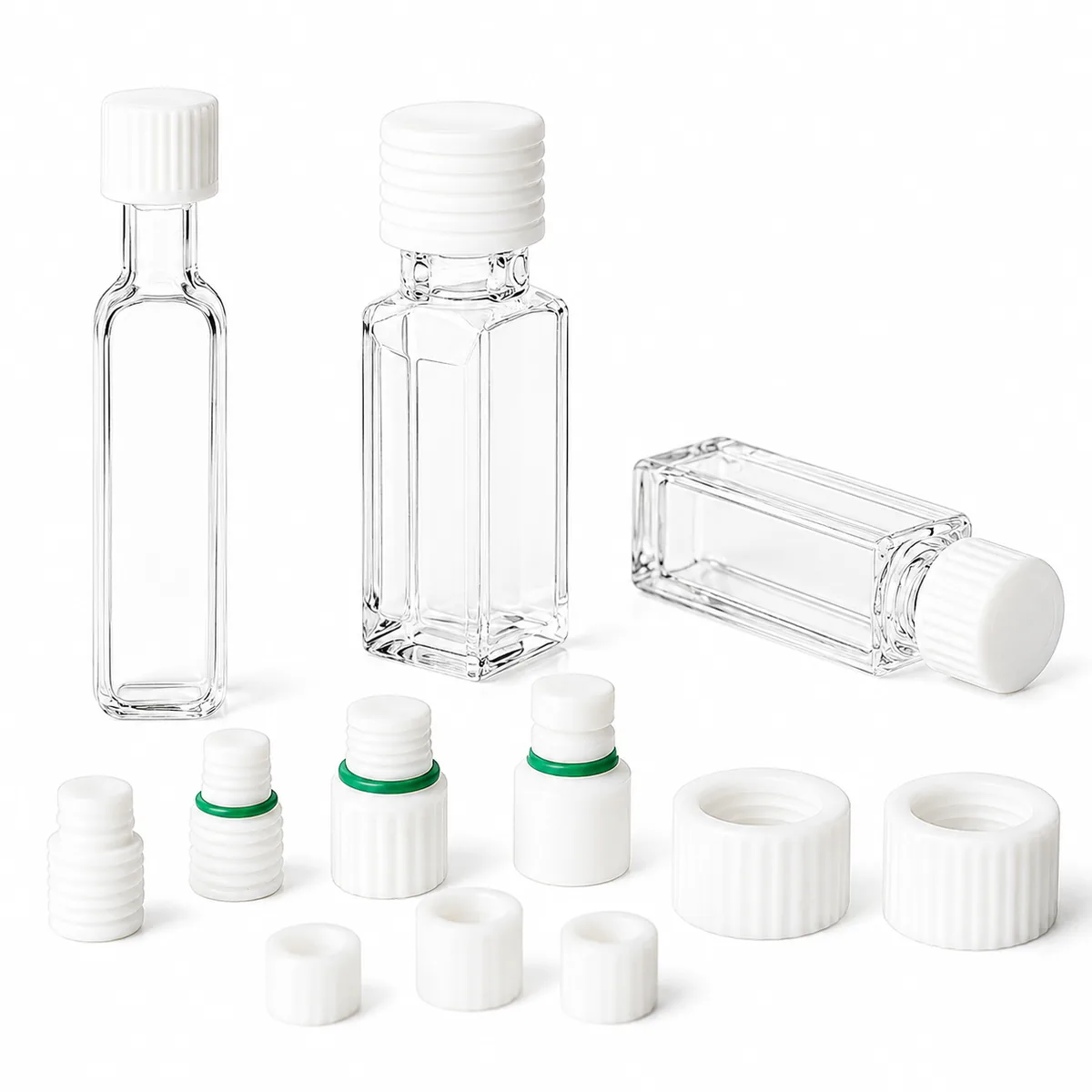
PTFE stopper volatile / air-sensitive
Screw cap sealed measurements
Sealed cuvettes reactive chemistry
Section 9
How to Find Your Instrument’s Z-Dimension Without the Manual
You inherit a spectrophotometer from a retiring colleague, the manual is gone, and the manufacturer’s website only carries the current generation. Here is the diagnostic flow we walk customers through when they ask for a Z value we can’t immediately confirm from the model name.
The paper-card test in four steps. Cut a card to fit a standard cuvette, punch three small holes at 8.5, 15, and 20 mm from the cell bottom, place the cuvette + card in the sample holder, and run a wavelength scan. Whichever hole transmits light tells you the instrument’s Z-dimension. Confirms within 1 mm and works on any UV-Vis system.
The four-step Z-finding decision tree
1
Check the instrument’s spec plate and sample compartment. Modern instruments (post-2010) often have the Z-dim printed on a label on the cell holder itself or on the inside of the sample compartment lid. Look for “Z = X mm” or “BCH X mm” (beam center height).
2
Search the user / hardware manual. Manufacturer manuals usually list Z in the “Sample Accessories” or “Cell Holder” section, not in the main spec sheet. Search the PDF for “Z dimension”, “beam height”, or “center height”. Agilent, Shimadzu, PerkinElmer, and Thermo all publish hardware guides as public PDFs — search “[model] hardware guide site:[brand].com”.
3
The paper-card test. Cut a card to fit snugly inside a standard 10 mm cuvette. Mark three small holes at 8.5 mm, 15 mm, and 20 mm from the cell bottom. Drop the cuvette + card into the holder, run a wavelength sweep, and watch which hole transmits light. The transmission peak tells you which Z the instrument uses. Confirms within 1 mm.
4
Ask the cuvette fabricator. Send us the instrument make, model, and serial number — we can usually confirm Z from our reference database of cells we have shipped into that instrument, often within a few hours. Contact the team with your instrument details.
The paper-card test is what we recommend for older or non-mainstream instruments. It takes ten minutes and gives you a definitive answer that no documentation search can match. Once you know the Z, the rest of cuvette selection follows the path-length and material logic in our selection guide.
Section 10
When Standard Doesn’t Fit — Custom Z-Dimension Cuvettes
Catalog cuvettes work for the standard 8.5 / 15 / 20 mm Z values. The remaining cases — and there are more of them than the SERP suggests — are where custom fabrication comes in.
The most common reasons we build a non-standard Z-dim cell:
Pre-2000 instruments with proprietary sample compartments (some old Hitachi, Beckman, Varian, and Bausch & Lomb instruments use Z values that don’t match any current standard)
OEM analytical instruments — process monitors, embedded UV-Vis on chromatography systems, online sensors. The instrument designer chose a beam height that fit the rest of the optical bench; the cuvette has to match
Multi-cuvette experimental rigs built in research labs — flow stoppers, electrochemical cells with combined optical paths, photolysis-coupled spectrophotometers
Specialty accessories on the PerkinElmer Lambda 650/850/950 or Cary 5000 (integrating spheres, polarizers, sample masking systems with non-standard beam positions)
High-throughput / multi-cell turrets where the geometric tolerance has to be tighter than catalog stock
What we need to quote a custom Z-dim cuvette:
Z-dimension in mm (from the paper-card test, manufacturer doc, or your existing cell)
Path length (1 mm, 2 mm, 5 mm, 10 mm, longer — whatever the absorbance window calls for)
Material grade (JGS1 for deep UV, JGS2 for standard UV-Vis, JGS3 for NIR, sapphire for high-T or high-pressure)
Window count (two-window for absorbance, four-window for fluorescence)
Fabrication method (Standard 80 glue-assembled for aqueous, Sintered 80/83 for solvents/acids, Molded 83 for high-temperature) — see our fabrication method guide
The six specifications needed for a custom-Z cuvette quote. When you send all six (Z-dimension, path length, sample volume, material grade, window count, fabrication method), turnaround on a quote is under 24 hours; production lead time is typically one to two weeks.
Have an instrument we haven’t listed?
Send us the make, model, and serial number — we’ll confirm Z-dimension and recommend the right cuvette in under 24 hours. Custom Z-dim cells ship in 1–2 weeks with no MOQ.
Z-dimension is the height from the bottom of the cuvette to the center of the spectrophotometer’s light beam. The three industry standards are 8.5 mm, 15 mm, and 20 mm. For full-volume macro cells the Z value rarely matters because the optical face covers the full beam range; it becomes critical for masked sub-micro cuvettes where the optical aperture is small and must sit exactly where the beam is.
Why do cuvettes have different beam heights?
Different generations of spectrophotometers were designed around different sample compartment optics. The 8.5 mm height comes from older, portable, and some routine instruments (Thermo GENESYS, Beckman DU 800); 15 mm is the modern default, used by Agilent, Shimadzu, PerkinElmer, Jasco, and Biochrom; 20 mm is a legacy value on older double-beam UV-Vis-NIR research benches. A handful of instruments use 10 mm — notably the Hitachi U-series.
What Z-dimension is the Agilent Cary 60?
The Cary 60 uses a 15 mm Z-dimension on the standard cuvette holder, like the Cary 100, 300, and 3500; the high-end Cary 4000 / 5000 / 6000i use 20 mm instead. An 8.5 mm sub-micro accessory holder is available from Agilent for small-volume work, but the default cuvette geometry is 15 mm.
What Z-dimension is the Shimadzu UV-1900?
The Shimadzu UV-1900i runs a 15 mm Z-dimension on the default sample compartment. Shimadzu’s sample compartments are modular, so an 8.5 mm sub-micro holder can be swapped in. Confirm by looking at the installed cell holder rather than the model number alone.
Can I use a 15 mm cuvette in an 8.5 mm holder?
For full-volume macro cuvettes, yes — the optical face is full height and the beam passes through liquid regardless of where the 8.5 mm holder positions the cell. For sub-micro or masked cuvettes, no: the small optical aperture will be in the wrong vertical position and the beam will either miss it or be blocked by the masked wall, producing a flat baseline or nonsense readings.
How do I measure my spectrophotometer’s Z-dimension?
The paper-card test: cut a card to fit a standard 10 mm cuvette, mark holes at 8.5 mm, 15 mm, and 20 mm from the cell bottom, drop the cuvette with card into the holder, and run a wavelength sweep. Whichever hole transmits light tells you the Z value. Takes ten minutes and gives a definitive answer.
Are all 10 mm path-length cuvettes the same?
No. Two cuvettes can share a 10 mm path length and still differ in Z-dimension, window height, material grade (JGS1 vs JGS2 vs glass), fabrication method (Standard 80 vs Sintered vs Molded), and aperture (clear-wall vs black-masked). Path length is one specification among six or seven that all need to match for a cell to drop into a given instrument and method.
Can I order cuvettes with a custom Z-dimension?
Yes. Custom Z-dimension is one of the more common custom orders we build. The minimum information needed is Z value (mm), path length, sample volume, material grade, and window count. Lead time is typically 1–2 weeks, no MOQ. Contact us with your instrument model or beam geometry.
Peter Malek is a Technical Sales Engineer at MachinedQuartz. He specifies custom fused quartz fabrication — cuvettes, micro capillaries, XRD specimen holders and machined quartz parts — reviewing customer drawings, dimensional tolerances and material grades (JGS1/JGS3 fused quartz, sapphire, CaF2) on a daily basis. Peter supports spectroscopy and materials-science labs with path-length selection, fabrication-method trade-offs and OEM integration questions.
Product Catalog 2026
All 2,561 in-stock cuvettes, capillaries, optics & labware with prices - in one PDF.



Recent Comments