
How to Test Glass Hardness: 4 Standard Methods + Typical Values (2026)
Glass hardness is measured by four standard methods: the Mohs scratch test (qualitative, 5.5 for soda-lime, 6 for borosilicate, 7 for quartz), the Knoop hardness test (HK, used for brittle materials per ASTM C730), the Vickers hardness test (HV, with a diamond pyramid indenter per ASTM C1326), and the Brinell test (rarely used on glass). For routine lab QC, the Mohs test with mineral picks identifies bulk material in seconds; for quantitative ranking, Knoop HK values are reported as 480-540 for soda-lime, 530-590 for borosilicate, and 580-650 for fused quartz. Hardness correlates with scratch resistance but not impact resistance — borosilicate is harder than soda-lime but both shatter under bending stress. Last updated: June 2026.
🔬
Why trust this guide? Cross-referenced against ASTM C730 (Knoop indentation hardness of glass), ASTM C1326 (Vickers hardness of advanced ceramics), NIST SRD 30 (Mohs hardness data), and the Heraeus / Schott / Pyrex / Corning technical handbooks.
On this page
- Why test glass hardness?
- 4 test methods compared
- Mohs scratch test — fastest field method
- Knoop hardness (HK) — quantitative standard
- Vickers hardness (HV) — for thin films & small parts
- Brinell — rarely used on glass
- Typical hardness values by glass type
- Hardness vs. fracture toughness — don’t confuse them
- FAQ
Why test glass hardness?
Glass hardness testing answers two practical lab questions: “What material is this?” (a Mohs pick distinguishes soda-lime from borosilicate from quartz in seconds) and “Will this surface scratch in normal use?” (a Knoop or Vickers number predicts scratch resistance and helps select the right material for an application).
Hardness testing is also a fast incoming-QC step for procurement — if a supplier ships borosilicate beakers, a quick Mohs pick verifies they aren’t soda-lime substitutes, which is a documented counterfeit issue in budget glassware markets.
4 test methods compared
| Test | Standard | Indenter | Output | Glass-suited? |
|---|---|---|---|---|
| Mohs scratch | None (Mohs scale) | Mineral picks (1-10) | Qualitative rank | Yes — fastest |
| Knoop hardness | ASTM C730 | Elongated diamond pyramid | HK number (~kgf/mm²) | Yes — standard for brittle materials |
| Vickers hardness | ASTM C1326 | Square diamond pyramid | HV number (kgf/mm²) | Yes — for thin parts |
| Brinell hardness | ASTM E10 | Hardened steel ball | HB number | No — cracks glass |
Mohs scratch
Pick of known hardness drags across surface. Visible scratch = softer than pick.
Knoop HK
Elongated diamond → shallow indent. Best for thin or brittle materials.
Vickers HV
Square pyramid → diamond-shaped indent. Symmetric; easier optical reading.
Mohs scratch test — fastest field method
How to perform the Mohs test on glass
The Mohs hardness scale ranks materials 1 (talc) to 10 (diamond) by mutual scratching. A material is “harder” than another if it can scratch it. To test a glass sample, you need a Mohs pick set — pen-shaped probes tipped with reference minerals from 2 to 9. Press the pick firmly across the glass surface at ~45°. If the pick leaves a visible scratch, the glass is softer; if the pick slides without marking, the glass is harder than that pick.
Procedure: (1) clean the glass surface with isopropanol; (2) start with a Mohs 5 pick (apatite-equivalent); (3) drag firmly at 45° for ~5 mm; (4) inspect for scratch under 10× magnification; (5) move up to a 6 (orthoclase) and 7 (quartz) pick until you find the threshold. For example, a glass that resists 5 but is scratched by 6 = Mohs 5.5 (soda-lime range).
Result interpretation: soda-lime = 5.5, borosilicate = 6, fused quartz = 7, sapphire = 9. Note that these are approximate — Mohs is qualitative.
Knoop hardness (HK) — quantitative standard
How a Knoop test works
Per ASTM C730, the Knoop test presses an elongated diamond pyramid (length 7× width) into the glass surface under a fixed load (typically 100 g to 500 g) for 15 seconds. The resulting indent is roughly diamond-shaped but elongated. The long-axis diagonal is measured optically, and the Knoop hardness number HK is calculated from the load and diagonal length.
HK = 14.229 × F / L² where F is the load in kgf and L is the long-axis diagonal in mm.
Knoop is the preferred test for glass because the elongated indenter produces a shallow scratch that doesn’t initiate cracks the way deeper indenters do. Typical Knoop values: soda-lime 480-540, borosilicate 530-590, fused quartz 580-650, sapphire 1,800-2,200.
Vickers hardness (HV) — for thin films & small parts
How a Vickers test works
Per ASTM C1326, the Vickers test uses a symmetrical square-pyramid diamond indenter at a fixed load. Both diagonals of the resulting indent are measured and averaged. Vickers HV is more commonly cited than Knoop in materials-science papers and finds wide use in QC of thin glass films, optical coatings, and small glass parts where a symmetric indent is easier to image.
Typical Vickers values: soda-lime 520-580 HV, borosilicate 580-630 HV, fused quartz 640-720 HV, sapphire 2,000-2,400 HV.
Brinell — rarely used on glass
The Brinell test (ASTM E10) presses a hardened steel ball into the material. While standard for metals, the deep indent and high stress concentration crack glass instead of leaving a clean impression. Brinell numbers for glass are rarely reported and not directly comparable to Knoop or Vickers values. Use Knoop or Vickers for glass.
Typical hardness values by glass type
| Glass Type | Mohs | Knoop HK (kgf/mm²) | Vickers HV | Notes |
|---|---|---|---|---|
| Soda-lime (window glass) | 5.5 | 480-540 | 520-580 | Softest common lab glass |
| Borosilicate (Pyrex 7740, Duran) | 6 | 530-590 | 580-630 | Standard lab glass |
| Fused quartz (JGS1/2/3) | 7 | 580-650 | 640-720 | Hardest pure silica glass |
| Aluminosilicate (Corning Eagle) | 6-6.5 | 550-620 | 610-680 | Used in display panels |
| Sapphire (single crystal Al₂O₃) | 9 | 1,800-2,200 | 2,000-2,400 | 3× harder than quartz |
| Fused silica (synthetic) | 6.5-7 | 590-640 | 650-700 | Similar to fused quartz |

Hardness vs. fracture toughness — don’t confuse them
One of the most common mistakes when selecting glass for an application is conflating hardness (resistance to indentation and scratching) with fracture toughness (resistance to crack propagation). They are different properties:
- Quartz is harder than borosilicate (Mohs 7 vs 6) — but both have similar fracture toughness around 0.8 MPa·m^0.5.
- Sapphire is much harder than glass (Mohs 9) and significantly tougher (~3 MPa·m^0.5), which is why it survives applications where quartz fails.
- Tempered glass has the same hardness as untempered glass — but is 4-5× stronger because compressive surface stresses resist crack initiation.
For routine scratching resistance (counter surfaces, optical windows, cuvettes that are wiped frequently), choose for hardness. For impact and bending resistance, choose for fracture toughness or use tempered/laminated forms.
Need high-hardness quartz parts for QC, optics, or harsh environments?
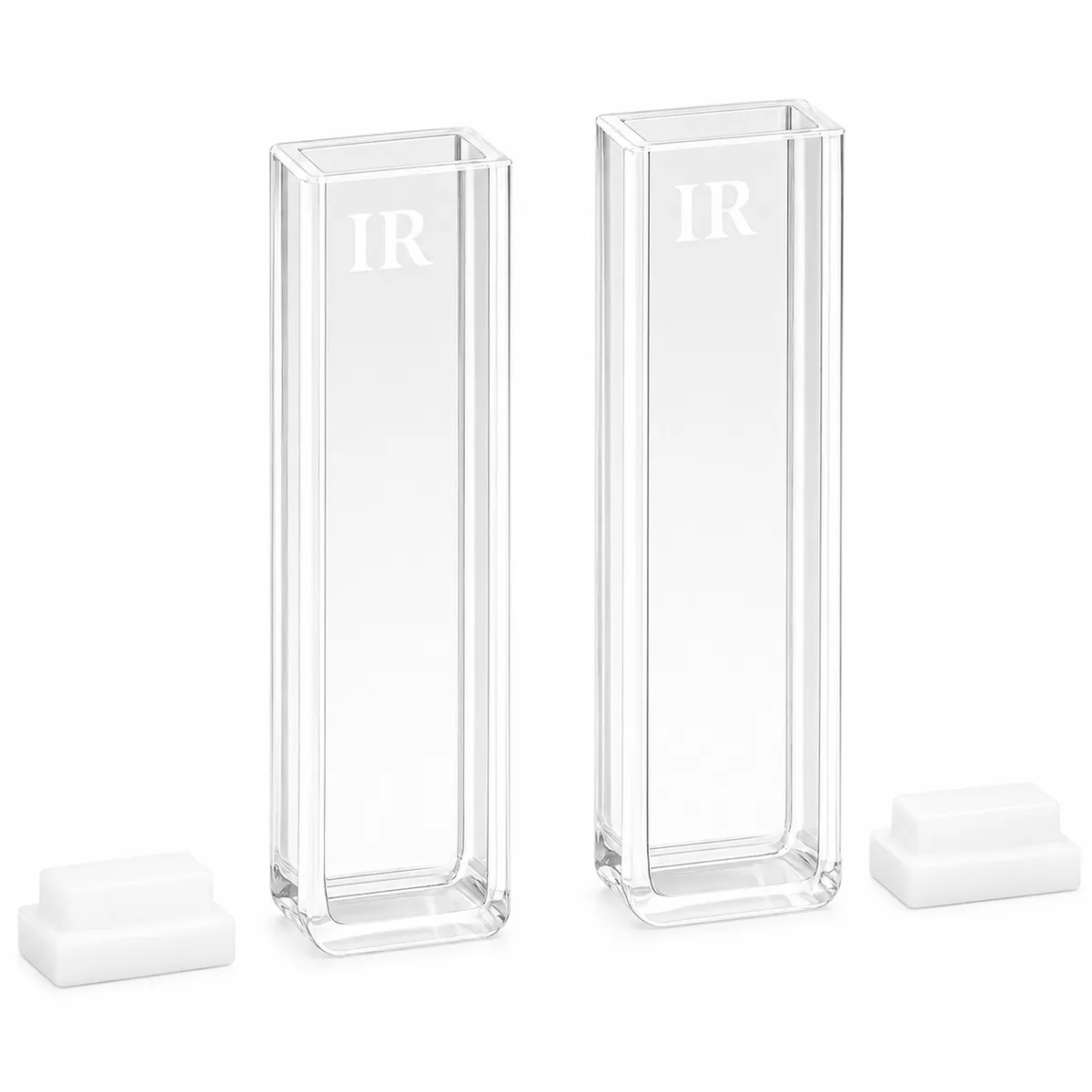
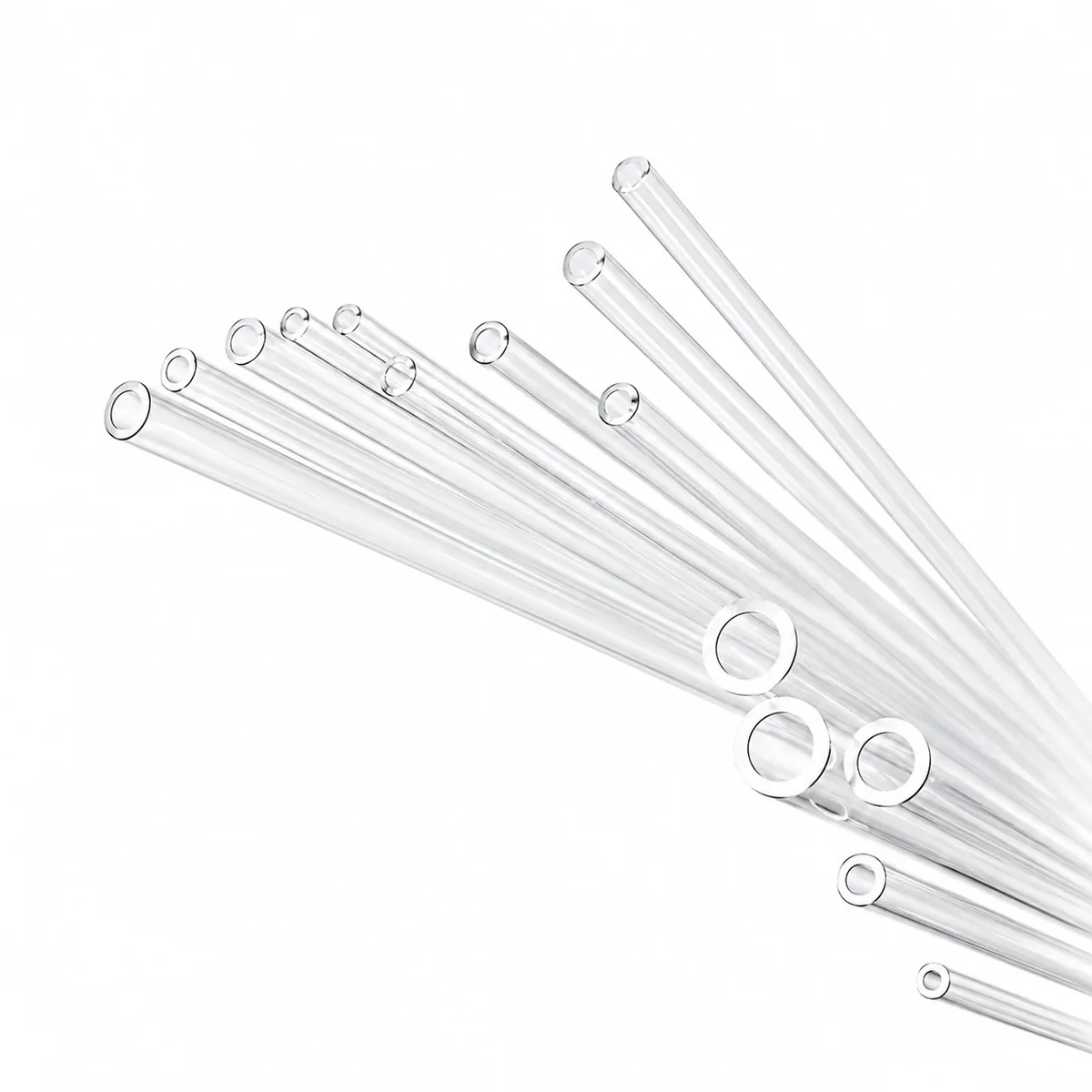
MachinedQuartz fabricates Mohs-7 fused quartz components to spec — cuvettes, windows, tubes, custom shapes.
Request Custom QuoteFrequently asked questions
What is the Mohs hardness of glass?
Standard window glass (soda-lime) is Mohs 5.5. Borosilicate glass (Pyrex, Duran) is Mohs 6. Fused quartz is Mohs 7. Sapphire is Mohs 9. The Mohs scale is qualitative — for quantitative comparison, use Knoop HK or Vickers HV.
How do I test glass hardness at home without lab equipment?
Use a Mohs pick set (US$30-60 online) and the procedure described in this guide. As a rough field test, a steel knife blade is approximately Mohs 5.5 — if it scratches the glass, the glass is softer than soda-lime (rare). If it doesn’t scratch, the glass is at least borosilicate or harder. For quantitative numbers, you need a Knoop or Vickers microhardness tester (US$5,000+).
Why is fused quartz harder than borosilicate glass?
Fused quartz is pure SiO₂ with a continuous Si-O-Si tetrahedral network. Borosilicate glass contains 12-15% boron oxide (B₂O₃) plus minor alkali oxides, which interrupt the network and lower bond density. Lower bond density = lower hardness. Quartz: Mohs 7, Knoop 580-650. Borosilicate: Mohs 6, Knoop 530-590.
Does higher hardness mean the glass won’t break?
No. Hardness measures resistance to scratching and indentation, not impact or bending resistance. Quartz (Mohs 7) and borosilicate (Mohs 6) have similar fracture toughness (~0.8 MPa·m^0.5) and both shatter under bending stress. For impact resistance, choose tempered glass or sapphire instead.
Is the Knoop or Vickers test better for glass?
Knoop (ASTM C730) is generally preferred because the elongated diamond indenter produces shallow indents that don’t initiate cracks. Vickers (ASTM C1326) is widely cited in literature and is easier to image for small parts. Both give similar relative ranking of glass types. For lab QC, either is acceptable; for published research, follow the convention of your field.
Can I use a Mohs pick on a glass cuvette without damaging it?
Test only on a non-optical surface or sacrificial spot — the optical windows of a cuvette must remain scratch-free. Use the test region on the cuvette base or sidewall away from the light path. Even a Mohs 7 pick will leave a faint mark on a softer glass — visible under 10× magnification but not in normal use.
What is the hardest glass-like material commonly available?
Sapphire (single-crystal Al₂O₃) is Mohs 9 — second only to diamond. It is significantly harder than any silica glass and is used for high-wear optical windows, watch crystals, and laser host materials. Polycrystalline alumina ceramic is in the same hardness range. For pure silica options, fused quartz at Mohs 7 is the hardest commonly available.


Recent Comments