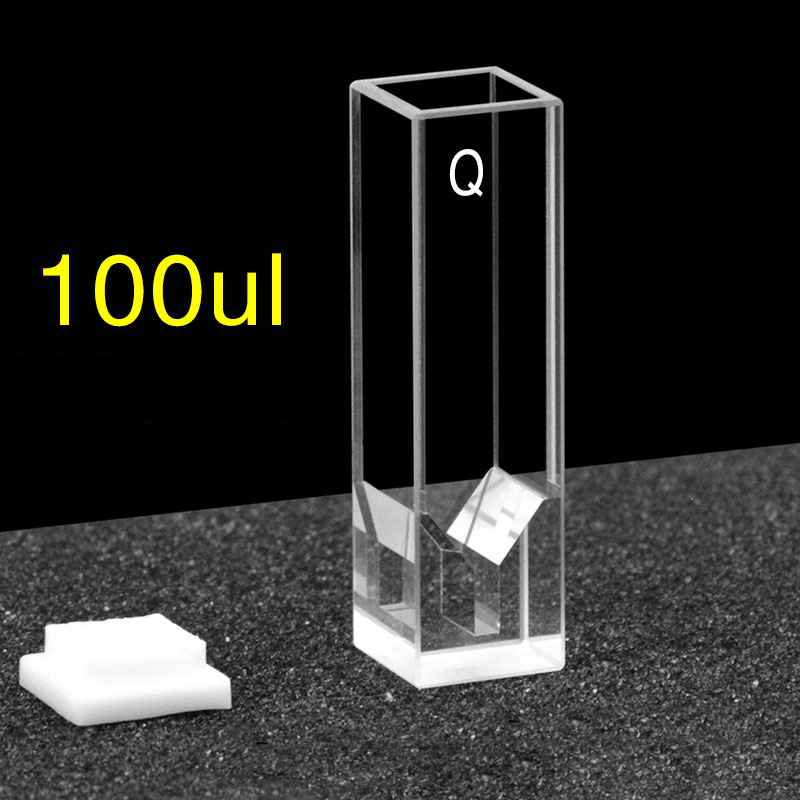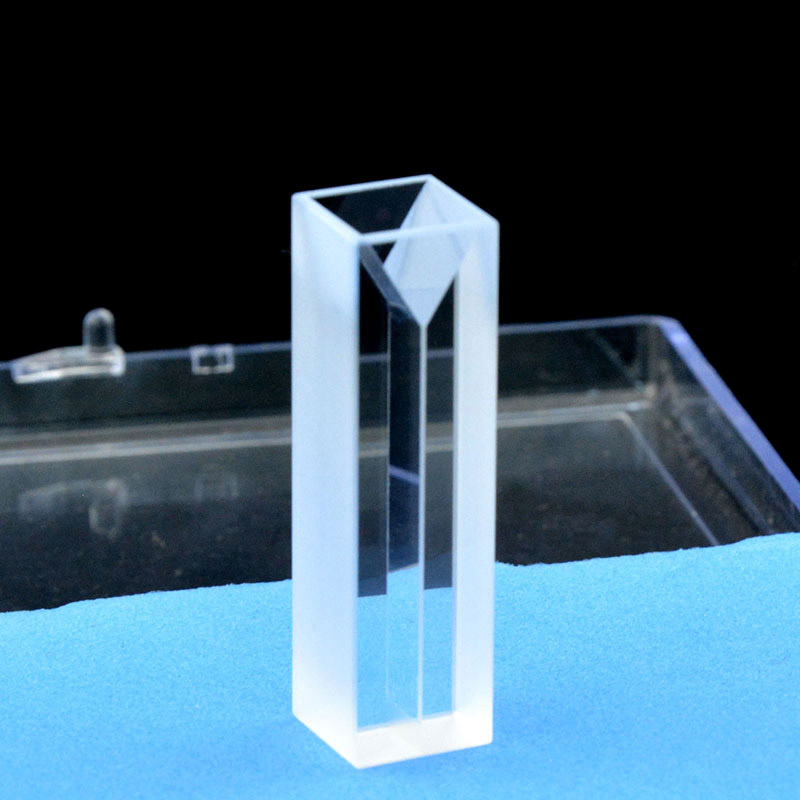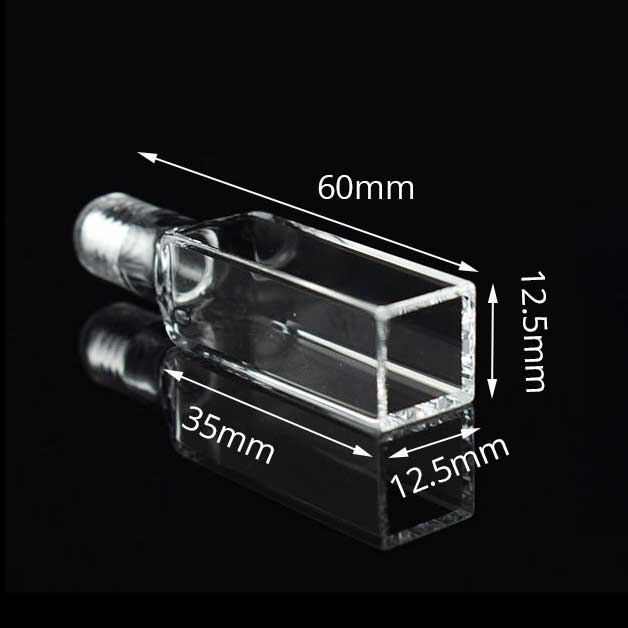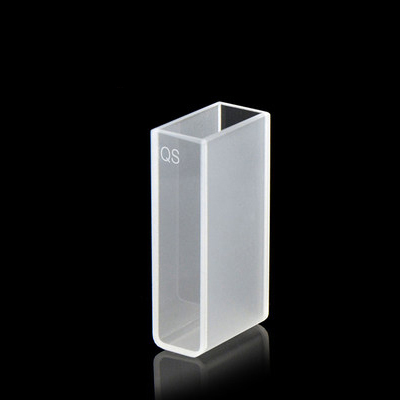
Custom Quartz Cuvettes
Custom Quartz Cuvettes Machined to Your Exact Specs
Any path length. Any geometry. Standard 80, Sintered 80/83, or Molded 83 — MOQ 2–4 pcs, ships in 5–30 business days.
Custom quartz cuvettes are precision-machined optical cells fabricated from fused silica (quartz glass) to customer-specified dimensions, path lengths, and window configurations. Unlike standard catalog cuvettes, custom-machined cells accommodate non-standard path lengths (0.1 mm to 200 mm), special geometries, and application-specific features such as flow ports, stopcocks, and reduced-volume chambers — enabling accurate spectrophotometric measurements across UV (from 170 nm), visible, and near-infrared (to 3,500 nm) wavelength ranges where plastic or borosilicate glass cells are unsuitable.
This page covers: how to specify a custom quartz cuvette, which JGS grade to select for your wavelength range, lead times and pricing, how our order process works, and how we compare to Hellma and Starna. If you know your spec, jump to the quote checklist →
Quick Quote Estimator
Enter your specs to get an instant price range and lead-time estimate. For an exact quote, your inputs auto-fill our contact form.
- Standard path length and volume
- JGS1 quartz (170–2500 nm transmission)
- Sintered 83 fabrication (T > 83%)
When Standard Cuvettes Don’t Fit
Catalog cuvettes cover common path lengths. But real experiments don’t always fit catalog dimensions — and the wrong cell geometry means scattered baselines, wasted sample, and delayed results.
Non-Standard Path Lengths
0.1 mm micro-cells to 200 mm long-path cells. If the catalog doesn’t list it, we machine it.
Instrument-Specific Holders
Custom external dimensions to fit non-standard fluorometers, stopped-flow instruments, or cryostat stages.
Micro & Sub-Micro Volume
Reduced aperture windows and minimal dead volume for 1–10 µL samples in genomics and proteomics work.
Special Configurations
Flow-through, stopcock-fitted, gas-tight, high-pressure, and demountable cells on request. Browse flow cells →
Choose the Right Quartz Grade
Optical performance starts with material. MachinedQuartz stocks all three JGS grades — specify the one that matches your wavelength range.
| Grade | Transmission Range | Best For | Typical Use |
|---|---|---|---|
| JGS1 Synthetic | 170 – 2500 nm | Deep UV, vacuum UV | Laser optics, UV-C validation, sub-220 nm spectroscopy |
| JGS2 High-Purity | 220 – 2500 nm | UV-Vis spectrophotometry | DNA/protein quantification, routine lab measurements |
| JGS3 IR Grade | 260 – 3500 nm | Near-IR and mid-IR | NIR process monitoring, mid-IR reaction analysis |
| Shipping | Worldwide | Worldwide | Worldwide |
| Payment | Credit card & PO | Invoice / bank transfer | Invoice / bank transfer |
Not sure which grade? Contact us with your wavelength range and we’ll recommend the correct material.
Key Facts — Quartz vs. Other Optical Materials
- Fused quartz (fused silica) transmits UV light from approximately 170 nm (refractive index data), versus ~310 nm for borosilicate glass and ~350 nm for PMMA plastic — making it the only viable material for deep-UV and UV-C spectrophotometry.
- Sintered fused quartz cuvettes withstand continuous temperatures up to 1,200 °C and are chemically resistant to most acids, alkalis, and organic solvents that dissolve optical adhesives in bonded-glass cells.
- Custom path lengths from 0.1 mm to 200 mm extend Beer-Lambert law linearity across analyte concentrations from trace-level environmental samples (long-path) to high-concentration industrial streams (short-path). Path length selection follows guidance in ASTM E169 (standard practices for UV-Vis spectrophotometry).
- MachinedQuartz stocks JGS1, JGS2, and JGS3 fused silica — the three grades defined by Chinese national optical glass standard GB/T 12442 — covering the 170–3,500 nm spectral window.
Data for reference only. Actual performance may vary with material grade and cuvette design. UV-Vis spectrophotometric measurements follow ASTM E275 practices for wavelength calibration and transmittance measurement.
or written spec
lead time confirmed
& dimensionally inspected
tracking & cert docs
Where Custom Quartz Cuvettes Are Used
As analytical instruments push toward smaller sample volumes, shorter path lengths, and wider spectral ranges, the demand for application-specific optical cells has grown significantly. Modern stopped-flow instruments, for instance, require dead volumes below 50 µL — impossible to achieve with standard 10 mm catalog cuvettes. Similarly, the shift toward miniaturized UV-Vis spectrometers in pharmaceutical process analytics (PAT) has driven demand for sub-millimeter path cells capable of measuring high-concentration API streams inline.
🔧 Need a cell that disassembles? See the Demountable Cuvette Guide — detachable quartz cells (0.5/1/2 mm), plus DIY mid-IR cells with CaF₂ or sapphire windows.
📡 Working in NIR or IR? See the Quartz IR Cuvette Guide — 190–2500 nm range, water-band path length tips, and fabrication choice.
🔬 Working with tiny samples? The Micro Cuvette Guide covers semi-micro, sub-micro and ultra-micro classes (5–200 µL), aperture geometry, Z dimension, and pipetting accuracy.
🧼 Need to clean these cells? See the Cuvette Cleaning Protocol — 10 cleaning agents, 6 analyte cases, daily & deep cleaning steps.
⚡ Stopped-Flow Kinetics
Low dead volume, specific port positions, and pressure-rated construction for millisecond mixing experiments. View stopped-flow cells →
🧪 Long-Path Trace Analysis
5 cm to 200 mm path lengths for environmental water analysis and dilute sample detection below standard detection limits. View long-path cells →
🧬 Micro & Semi-Micro Volume
Sub-µL micro cells and semi-micro formats for DNA/RNA quantification and protein absorption measurements when precious sample volume must be conserved.
🌡️ Low-Temperature Fluorescence
Four-window polished cells sized for cryostat stages and variable-temperature fluorescence systems.
📘 Need more depth? Read the full Fluorescence Cuvette Guide for 4-sided polish, autofluorescence, and 90° detection geometry — covers all materials, volumes, and fluorometer compatibility.
🏭 Process Monitoring
CIP-compatible flow cells for inline pharmaceutical and chemical process UV-Vis measurements.
🔭 Custom Instrument Fit
Exact-fit cells for legacy instruments, OEM replacement, or prototype optical systems with non-standard sample compartments.
MachinedQuartz Custom Cuvette Capabilities
What Information Do You Need to Provide?
The more detail in your initial request, the faster we can confirm feasibility and return a price. Here is exactly what helps us quote accurately.
Dimensions (Required)
- External dimensions: L × W × H (mm)
- Optical path length (mm)
- Window aperture size
- Wall thickness (if specified)
- Inner chamber dimensions
Optical Requirements (Required)
- Wavelength range (e.g. 220–800 nm)
- Number of polished windows (2 or 4)
- Transmission grade: JGS1 / JGS2 / JGS3
- Surface flatness or parallelism tolerance
Configuration (If Applicable)
- Fabrication type: Standard 80 / Sintered 80 / Sintered 83 / Molded 83
- Flow-through: inlet/outlet port size & position
- Stopcock type (if needed)
- Black quartz masking walls
- Optical coatings (AR, reflective)
- Matching requirement (matched pairs)
Order Details
- Quantity needed (MOQ 2–4 pcs)
- Target delivery date (if any)
- Competitor part number (if replacing existing)
💡 Tip: A dimensioned drawing (even a hand sketch with measurements) is the single most useful thing you can send. If you’re replacing an existing cuvette, a sample or competitor part number works equally well.
MachinedQuartz offers four types — each with different chemical resistance, thermal rating, and optical quality:
Standard 80 (glue-assembled, aqueous use) · Sintered 80 (powder sintered, solvent/acid resistant, up to 600 °C) · Sintered 83 (high-transmission sintered, T>83%, pharmaceutical QC) · Molded 83 (one-piece integrally fused, T>83%, up to 1200 °C, zero-variation). See full fabrication guide →
Three-Stage Inspection Before Every Shipment
Every custom cuvette goes through a documented inspection process before it leaves our facility. A part that fails any stage is rejected and remade.
We have machined and delivered custom fused quartz cuvettes to research laboratories, pharmaceutical QC departments, and instrument manufacturers across more than 50 countries. Our customers include university spectroscopy labs, national research institutes, and OEM instrument manufacturers who rely on consistent dimensional accuracy for calibration-grade optical cells. Over the years we have found that the most common reasons for rejection are surface defects on polished windows and dimensional drift during the sintering step — which is why our inspection protocol specifically targets these two failure modes with dedicated tooling at each stage.
Stage 1 — Dimensional
Calipers and optical profiler verify all external and internal dimensions against your drawing. Standard tolerance: ±0.01–0.05 mm on critical dimensions, consistent with ISO 9001 dimensional inspection requirements.
Stage 2 — Optical Surface
High-magnification loupe inspection of all polished surfaces for chips, scratches, seam defects, or inclusions that would affect transmission.
Stage 3 — Transmission
Spectrophotometer scan confirms optical transmission meets the specified wavelength range for the stated quartz grade. Inspection report available on request. In our standard production runs, dimensional conformance (within ±0.05 mm) exceeds 96% on first inspection; optical surface pass rate exceeds 98% after polishing. Parts that fail either check are re-machined or re-polished at no additional charge.
🌍 Worldwide Shipping: We ship to over 50 countries. Payment by credit card or Purchase Order (PO) accepted. Custom orders backed by our quality guarantee — full refund if parts arrive defective or out-of-spec. Just specify at time of order.
MachinedQuartz vs. Hellma vs. Starna
All three supply precision quartz cuvettes. Here is how they compare on factors that matter most for custom orders:
| Factor | MachinedQuartz | Hellma Analytics | Starna Scientific |
|---|---|---|---|
| MOQ | 2–4 pcs | Typically 10–50 pcs for custom | Typically 10+ pcs for custom |
| Lead Time (Custom) | 5–30 days | 4–12 weeks typical | 4–10 weeks typical |
| Geometry Flexibility | Full custom — any path length, dimension, window config | Wide catalog + custom options | Strong catalog + custom |
| Quartz Grades | JGS1, JGS2, JGS3 | UV-Vis, IR fused silica | UV, IR, far-UV grades |
| Prototype-Friendly | ✅ MOQ 2 pcs | Limited | Limited |
| Quality Guarantee | ✅ Full refund if defective | ✅ Available | ✅ Available |
Competitor information sourced from publicly available product pages and quotation documentation (Hellma Analytics, Starna Scientific); contact each supplier for current pricing and lead times.
Common Questions
About MachinedQuartz
Founded in 2013, MachinedQuartz is a precision quartz fabrication specialist supplying custom optical cells, cuvettes, and fused silica components to research institutions, instrument manufacturers, and industrial laboratories worldwide. Our engineering team includes optical fabrication specialists with combined experience in CNC quartz machining, sintering process development, and metrology for precision optical components. We stock JGS1, JGS2, and JGS3 quartz blanks and machine to order with a standard lead time of 5–8 business days. Our customers include university research laboratories, national research institutes, pharmaceutical QC departments, and OEM instrument manufacturers. Learn more about us →
Page last reviewed: April 2026 · Specifications subject to change · Technical content reviewed by MachinedQuartz engineering team · Contact us for current availability