
Screw-Top Cuvette Guide: Sealed Cells for Anaerobic & Long-Acquisition Work
This post is also available in:
A screw-top cuvette is a sealed quartz cell with a PTFE-lined threaded cap, used for anaerobic chemistry (O₂-sensitive samples), long-acquisition kinetics where evaporation would shift the concentration, and any measurement above 40 °C where an open cell loses solvent. Available in 0.5 mm to 10 mm path lengths with standard 12.5 × 12.5 mm footprint, screw-top cells trade slightly higher cost (~30%) for measurement integrity in demanding workflows.
On This Page
Sealed Cells · Anaerobic Spectroscopy
Screw-Top Cuvette Guide: Sealed Cells for Anaerobic & Long-Acquisition Work
🔧 Seeing weird spectra? Bubbles, interference fringes, baseline drift, sloping baselines, noise — diagnose 8 common UV-Vis symptoms in our UV-Vis Troubleshooting Guide with a 3-step rotate-the-cuvette triage that isolates cell vs. instrument problems in 30 seconds.
When evaporation, oxygen ingress, or sample volatility ruins your spectrum — the screw-cap quartz cuvette is the answer. PTFE liners, septa, anaerobic protocols, and the MachinedQuartz line of sealed cuvettes from 0.5 mm to 10 mm path.
0.5 / 1 / 5 / 10 mm
Path lengths
175 µL – 3.5 mL
Volume range
~99% seal
PTFE-lined cap
2 / 4-Way
Light configurations
Reviewed by the MachinedQuartz Technical Team. We have manufactured screw-top quartz cuvettes for spectroscopy laboratories since 2026, with 0.5 mm to 10 mm path lengths in continuous production for pharmaceutical QC, photophysics, and process-monitoring customers. Cap material recommendations and oxygen-quenching data come from internal QC measurements and customer reference setups for anaerobic and long-acquisition work.
What is a screw-top cuvette?
A screw-top (or screw-cap) cuvette is a quartz cell that closes with a threaded cap mechanism rather than an open top, snap-on lid, or gravity-only closure. The cap thread engages a matching thread on the cuvette neck; a PTFE liner inside the cap compresses against the cuvette rim under hand-tight torque, sealing the chamber against atmospheric ingress.
Compared to other closure types, the screw cap occupies the middle ground between routine convenience and full anaerobic sealing:
- Open cuvettes have no cap and let oxygen, water vapor, and dust ingress freely. Acceptable for quick measurements (under 30 seconds), unacceptable for anything else.
- Snap-on PTFE caps use friction fit — about 70% effective at sealing — and serve mostly to keep dust out. They’re the cheapest cap option but inadequate for oxygen-sensitive samples or long acquisitions.
- Screw caps with PTFE liner seal at ~99% effectiveness. The threaded mechanical engagement plus the elastic PTFE gasket compress to give a true seal that holds for hours to days.
- Septum caps add a self-resealing rubber disk under the cap. Seal quality matches screw-cap (~99%), with the added ability to inject through the septum for N₂ purging, sample addition during measurement, or temperature-controlled additions.
- Ground glass stoppers use a tapered greased joint — ~99% seal, infinitely chemically resistant, and the classical choice in photophysics laboratories.
For most routine sealing work — long fluorescence acquisitions, oxygen-sensitive samples, kinetic studies, sample transport — the PTFE-lined screw cap is the right default. The MachinedQuartz screw-top cuvette catalog covers 0.5 mm to 10 mm path lengths in this configuration.
When you actually need a sealed cuvette
Five scenarios where the screw-top cuvette pays for itself:
1. Long fluorescence acquisitions (10+ minutes)
Most fluorometers run in stop-and-go mode where each scan takes 30 seconds to a few minutes. For lifetime measurements, anisotropy decay, time-correlated single-photon counting (TCSPC), and extended kinetic studies that run hours, the cell sits in the holder while atmospheric oxygen slowly diffuses into the buffer. Even fluorophores with mid-nanosecond lifetimes lose 5–15% intensity over 30 minutes from oxygen quenching alone; longer-lived chromophores (lanthanide complexes, ruthenium dyes, pyrene) lose 30–80%. A screw-cap cuvette holds the baseline stable.
2. Oxygen-sensitive analytes
Reduced metal complexes (Cu(I), Fe(II) without chelator), photoredox catalysts in oxidation states that revert in air, and many native protein conformations are lost within minutes of air exposure. Open cells force you to race the measurement; sealed cells give you 24+ hours of working time after initial filling.
3. Volatile samples
Dilute solutions in DCM, hexane, or other low-boiling solvents evaporate noticeably during scans — a 2 mL sample in DCM loses about 3% mass in a 5-minute scan at 22 °C in an open 10 mm cuvette. The concentration of analyte rises proportionally; the absorbance you measure at the end is not the absorbance at the start. Screw-cap seals stop solvent loss completely.
4. Sample transport between instruments
For multi-instrument workflows — running the same sample through UV-Vis, then fluorescence, then mass spec — the cell needs to travel between rooms or buildings without spilling. Snap caps leak in transit; ground glass stoppers don’t survive being dropped. PTFE-lined screw caps seal tight enough to invert the cell without leakage and survive normal lab transport.
5. Storage and re-measurement
Many photophysics experiments require the same sample to be measured at multiple time points — minutes, hours, days. A sealed cuvette holds the sample stable in storage between measurements, eliminating sample-prep variability between time points.
How the screw-cap mechanism actually seals
The seal is a two-stage mechanical clamp, not a simple gasket. Understanding both stages helps you tighten correctly without overtorquing:
Stage 1 — Thread engagement
The cap thread engages the cuvette thread with about 2–3 turns of contact when fully seated. The thread itself is a precision-ground match between the quartz cuvette’s neck and the cap’s internal thread. Quartz threads are surprisingly delicate — overtorquing strips the thread or cracks the neck, and the cell becomes unusable. Hand-tighten only; never use pliers or wrench.
Stage 2 — PTFE liner compression
The PTFE liner inside the cap compresses against the polished cuvette rim under hand-torque. The liner is typically 1–2 mm thick PTFE, sometimes with a foam backing for additional give. Compressing the liner ~30% creates the seal — over-compression doesn’t improve sealing and risks cracking the cuvette neck.
Sealing performance vs torque
Hand-tight (50–100 mN·m) gives ~99% seal. Light additional torque adds nothing. Over-tight (above 200 mN·m) cracks quartz necks; this is the most common cause of premature cell failure in lab work.
Pro tip: If you can’t easily unscrew the cap by hand, you over-tightened it. Use thumb and forefinger only, never a wrench or grippers. PTFE liner compression is forgiving — there’s a 10-N margin between “fully sealed” and “starts to crack.”
Cap and liner material selection
The cap body is usually polypropylene (chemical resistance) or aluminum (high-temp). The liner is what actually contacts the sample, and that’s where material choice matters:
PTFE — the universal default
Pure PTFE liners are chemically inert in essentially every common laboratory chemistry: aqueous buffers (pH 1 to 14), all common organic solvents (alcohols, ketones, hydrocarbons, chlorinated, DMSO, DMF, acetonitrile), strong acids (HCl, HNO₃, H₂SO₄ except piranha), and oxidizers (chromic acid, peroxides). Stable to 200 °C continuous, 250 °C transient.
For 95% of lab work, the PTFE-lined screw cap shipped with MachinedQuartz cuvettes is the right answer. No need to upgrade or substitute.
Silicone — soft and self-resealing for septa
Silicone is used as the rubber septum disk in septum-cap configurations. It’s chemically OK in aqueous buffers but swells in DMSO, DMF, and chlorinated solvents — for those samples, butyl or Viton septa are required. Silicone also leaches trace Si-containing compounds at 80+ °C, contaminating UV measurements below 250 nm.
Viton (FKM) — for aggressive chemistries
Fluoroelastomer with chemical resistance broader than PTFE for some specific chemistries (concentrated nitric acid, fuming H₂SO₄, hot aromatics). Slightly less inert in fluorinated solvents than PTFE. Use Viton when prolonged contact with strong acids or hot aromatic solvents is expected; otherwise PTFE wins on universal compatibility.
Butyl rubber — anaerobic septum
Butyl rubber is the standard septum material for true anaerobic work — N₂ purging, gas-tight sample addition, anaerobic glove-box transfer. The rubber holds a needle puncture well and reseals without leaking. Avoid for organic solvents (swells); strictly aqueous samples only.
EPDM — cheap aqueous-only option
EPDM rubber is used in budget septum caps for routine aqueous work. Less expensive than butyl but with worse chemical resistance and lower temperature ceiling.
Ground glass — classical photophysics
For laboratories that prefer the classical greased ground-joint approach, MachinedQuartz makes screw-top cells with a quartz cover plus a ground-joint shoulder for ground glass stoppers — combining modern threading convenience with traditional greased-seal reliability. This configuration is particularly common in academic photophysics labs studying long-lived photochemistry where any contamination risk is unacceptable.
The MachinedQuartz screw-top cuvette line
MQ’s screw-top cuvette line covers four path lengths and the standard 2-way / 4-way light geometries, with multiple cap variants:
| Path length | Volume | Light config | Best use |
|---|---|---|---|
| 0.5 mm | 175 µL | 4-way light · Molded 83 | High-concentration UV-Vis with anaerobic seal |
| 1 mm | 0.35 mL | 2-way + 4-way · Molded 83 | NIR water bands, oxygen-sensitive low-volume |
| 5 mm | 1.75 mL | 2-way · Sintered 83 | Mid-range absorbance, transport-stable |
| 10 mm ★ | 3.5 mL | 2-way + 4-way · Sintered 83 | Default · long fluorescence acquisitions |
Three variants of the cap mechanism cover different lab workflows:
Standard screw cap
The default — cap sits above the cuvette body, hand-tightens with normal lab grip. Adds ~5 mm to the total cuvette height; works in standard fluorometer holders without modification.
Internal screw / low-profile
The cap thread is recessed into the cuvette top so the cap finishes flush with the cuvette body. No extra height added — important for tight fluorometer holders or high-throughput rigs where standard caps would interfere with the next-cell loading mechanism.
Large screw cap
Wider cap diameter for easier hand torque on viscous samples or oxygen-sensitive work where you want maximum sealing margin. Adds slightly more height than standard cap.
For full SKU range with stock status see the screw-top cuvettes catalog; for septum-cap variants and anaerobic-specific configurations, contact MachinedQuartz with the wavelength range and sample type for a custom quote.
Anaerobic protocol — N₂ or Ar purging
True anaerobic measurement requires more than a sealed cuvette — the buffer itself has to be deoxygenated before the cell is closed. Standard protocol:
- Pre-purge the buffer reservoir for 15–30 minutes with N₂ or Ar flowing at low pressure. The dissolved oxygen drops from ~250 µM (air-saturated water at 25 °C) to < 5 µM. Verify with a dissolved-oxygen meter if anaerobic conditions matter at the µM level.
- Transfer to the cuvette in a glove box or under a continuous N₂/Ar stream. Pour, pipette, or syringe — minimize the time the buffer surface contacts air.
- Cap the cuvette immediately while it’s still in the inert atmosphere. PTFE-lined screw cap or septum cap, hand-tight.
- If using a septum cap, you can inject sample (the analyte itself) through the septum after the cell is sealed — this lets you keep the buffer anaerobic during sample prep at the bench rather than inside the glove box.
- Check for residual O₂ before the experiment by running a baseline scan with the buffer-only cell. If a long-lived fluorescent indicator (pyrene, ruthenium tris-bipyridine) is added, its lifetime should match the published anaerobic value within 5%; faster decay indicates residual oxygen and the protocol needs improvement.
Note on glove boxes: O₂ levels < 1 ppm are achievable in modern glove boxes; this is sufficient for almost all photophysics. For sub-ppm work (extreme oxidation-sensitive transition metal photochemistry, single-molecule TIRF), bench-top freeze-pump-thaw protocols still beat glove boxes — three cycles of solidify-evacuate-thaw pulls dissolved gas to < 0.1 ppm.
Transport and storage of sealed cells
Beyond anaerobic work, screw-top cells solve practical lab logistics: moving samples between rooms, between buildings, or to off-site instruments. Three practical considerations:
Hand-carry transport
A sealed screw-top cuvette can be inverted, carried in a foam-lined case, and walked across campus without leakage. Use the original packaging foam or a benchtop foam cell holder ($15–30) — cells that bang against each other in a drawer scratch the optical faces. For valuable matched sets, a cushioned hard case is worth the $40 once.
Refrigerated storage
Photochemically-sensitive samples often require 4 °C or -20 °C storage between measurements. Sealed cuvettes survive these temperatures fine, but condensation forms on the optical face when removed from the freezer — let the cell warm to room temperature before measurement (15–20 minutes for 4 °C, 30+ minutes for -20 °C) to avoid baseline artifacts.
Vapor transport restrictions
When shipping cells with samples to a remote facility, regulations on volatile or hazardous content apply. Consult IATA shipping guidelines for chemicals and biological samples; in most cases the sealed cuvette + outer secondary container + leak-absorbent packaging meets standard “Limited Quantity” shipping requirements.
Don’t: store a sealed cuvette at elevated temperature with a volatile sample. Vapor pressure builds up inside; eventually either the cap pops off or the cuvette neck cracks. For samples held at 60+ °C, use a vented closure (Teflon-tape over the threads to prevent over-pressurization) or transfer to a vial with a real pressure relief mechanism.
Cleaning screw-cap cuvettes — disassemble the cap
Cleaning a screw-cap cuvette is the same as cleaning a regular cuvette plus one extra step: clean the cap separately. The PTFE liner accumulates trace sample on the underside, and that residue contaminates the next sample if not removed.
Standard protocol:
- Remove the cap while still in the analytical fume hood (in case sample is volatile or hazardous)
- Empty the cuvette normally (rinse with sample solvent, then detergent, etc. — see the cuvette cleaning protocol guide for the full procedure)
- Disassemble the cap if possible — some cap designs have a removable PTFE liner that lifts out for separate cleaning. If the liner doesn’t lift out, just rinse the cap as a unit.
- Rinse the cap with the same solvents as the cell — same-solvent rinse, then detergent, then DI water, then ethanol, then air-dry. Don’t put the cap in the ultrasonic bath; the PTFE liner can shift position from cavitation.
- Air-dry the cap separately from the cell, both rim-up
- Reassemble when both are fully dry — wet PTFE against wet quartz can grip and tear the liner
For aged samples that left visible residue on the PTFE liner, soak the cap in 1% Hellmanex at 50 °C for 30 minutes. Don’t use chromic acid on cap parts — the polymer cap body and PTFE liner are fine, but the cap thread inserts (sometimes brass or stainless) corrode in chromic acid.
Recommended MachinedQuartz screw-top cuvettes
The MQ screw-top cuvette line covers four standard path lengths in 2-way and 4-way light variants. Below are the most-ordered configurations:
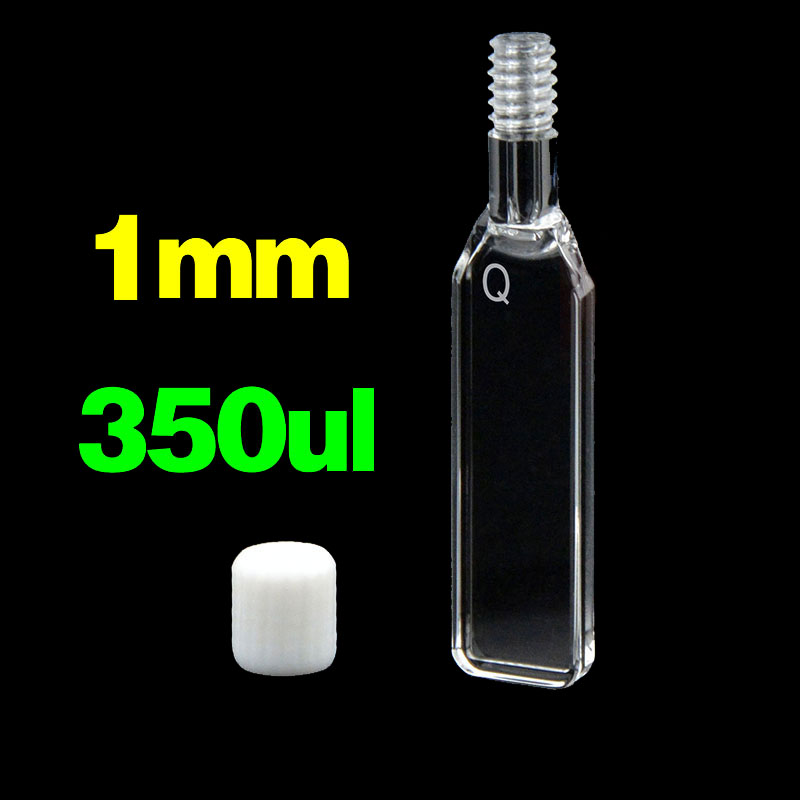
1 mm Screw-Cap 4-Way
0.35 mL · Molded 83 · oxygen-sensitive
View options →
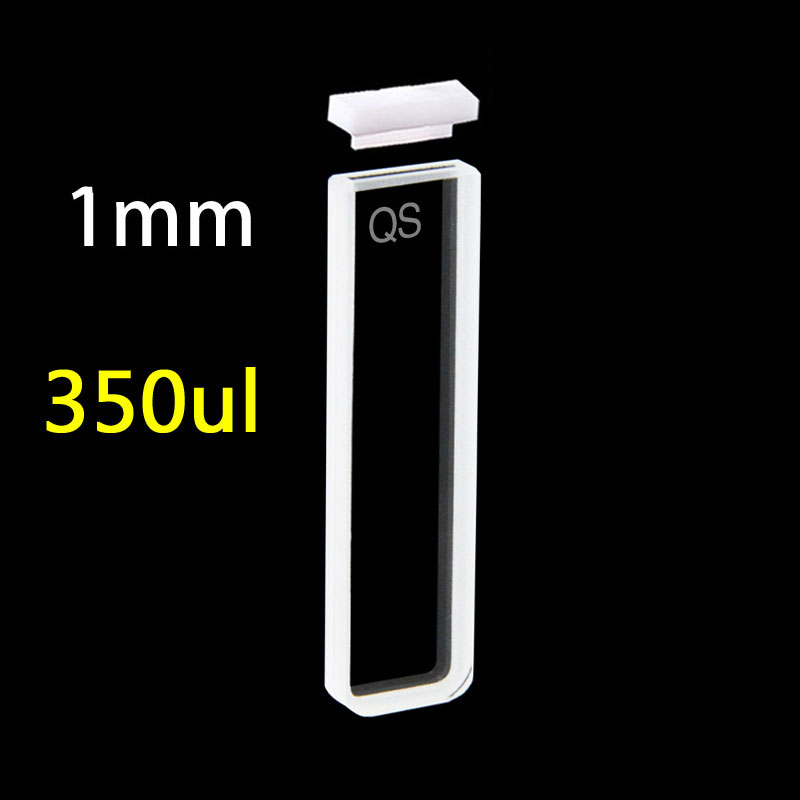
10 mm Screw-Cap 2-Way ★
3.5 mL · Sintered 83 · default
View options →
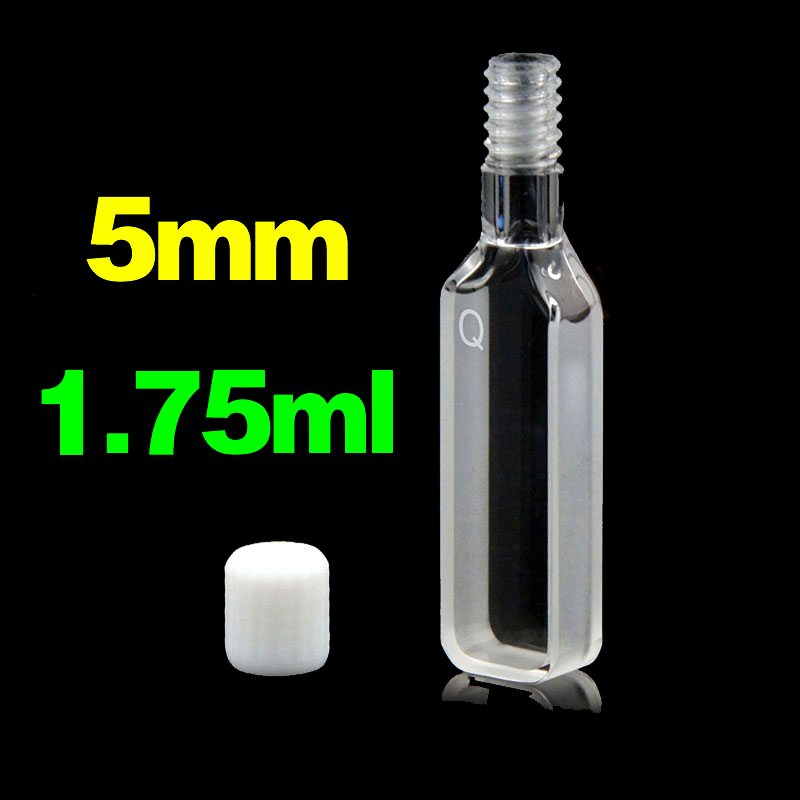
5 mm Screw-Cap 2-Way
1.75 mL · Sintered 83 · transport
View options →
For 4-way light variants (compatible with both fluorescence and absorbance), low-profile internal-screw variants, and septum-cap configurations for anaerobic work, contact MachinedQuartz with the wavelength range and sample type. Standard SKUs ship 1–3 days; custom configurations 4-week lead time. For path-length math before ordering, use the Beer-Lambert path length calculator.
Frequently asked questions
What is a screw-top cuvette?
A quartz cuvette that closes with a threaded cap mechanism — the cap thread engages a matching thread on the cuvette neck, and a PTFE liner inside the cap compresses against the cuvette rim under hand-tight torque. The seal is ~99% effective against atmospheric oxygen and water vapor, suitable for long acquisitions, oxygen-sensitive samples, volatile solvents, and sample transport.
When do I need a screw-top cuvette versus a regular open cuvette?
Five scenarios: (1) Long fluorescence acquisitions over 10 minutes — atmospheric oxygen quenches long-lived fluorophores. (2) Oxygen-sensitive analytes — reduced metals, photoredox catalysts, native protein conformations. (3) Volatile samples in DCM, hexane, or other low-boiling solvents — stops evaporation. (4) Sample transport between instruments — sealed cells survive transport. (5) Storage and re-measurement — same sample at multiple time points without prep variability.
What’s the difference between a screw cap and a septum cap?
Both seal at ~99% effectiveness. Screw cap uses a PTFE liner that compresses against the cuvette rim — closes the chamber permanently until you unscrew it. Septum cap adds a self-resealing rubber disk under the cap — you can pierce the rubber with a syringe to inject sample or N₂ gas without breaking the seal. For routine sealed-cell work, screw cap is sufficient; for anaerobic work where you need to add reagents or purge with inert gas mid-experiment, use a septum cap.
How tight should I tighten a screw-cap cuvette?
Hand-tight only — about 50–100 mN·m of torque, which is what you can apply with thumb and forefinger. Never use pliers, wrenches, or any mechanical aid. Quartz cuvette necks are precision-machined and crack at about 200 mN·m. If the cap is hard to unscrew, you over-tightened it. PTFE liner compression is forgiving — there’s a wide margin between ‘fully sealed’ and ‘cracks the neck.’
What cap material should I use for organic solvents?
PTFE for the liner — chemically inert in essentially every solvent, the default shipped with MachinedQuartz screw-cap cuvettes. Silicone and EPDM swell in DMSO, DMF, and chlorinated solvents, contaminating the sample and losing seal quality. Viton (FKM) is the upgrade for prolonged contact with strong acids or hot aromatic solvents. For anaerobic work with septum caps, butyl rubber is the standard — though it swells in organics, so use only with aqueous samples.
Can I use a screw-cap cuvette for fluorescence?
Yes — specify the 4-way light variant. Standard 2-way light screw-cap cells are designed for absorbance only (frosted side faces). The 4-way light version has all four side faces polished, suitable for both absorbance and fluorescence. MachinedQuartz stocks both 2-way and 4-way variants in standard path lengths. For deep-UV fluorescence (tryptophan, tyrosine), Sintered 83 or Molded 83 fabrication is required to keep the optical path adhesive-free.
How do I clean a screw-cap cuvette?
Standard cuvette cleaning protocol with one extra step: clean the cap separately. Remove the cap, empty and rinse the cuvette normally (sample-solvent rinse → detergent → DI water → ethanol → air-dry). For the cap, rinse with the same solvents but don’t sonicate (cavitation can shift the PTFE liner). For aged residue on the PTFE liner, soak the cap in 1% Hellmanex at 50 °C for 30 minutes. Reassemble only when both cell and cap are fully dry.
Will a sealed cuvette explode if I heat it?
Possibly — sealed cells with volatile samples can build internal pressure when heated. For samples expected to reach above 60 °C, use a vented closure (loose Teflon tape over the threads) or transfer to a real pressure-rated vial. The screw-cap mechanism doesn’t tolerate more than about 1 atm overpressure — beyond that the cap pops off (best case) or the neck cracks (worst case). For high-pressure spectroscopy, specialized high-pressure cells from Specac or Pike are the right choice, not standard screw-cap cuvettes.
What’s the path-length range available?
MachinedQuartz screw-top cuvettes come in 0.5 mm (175 µL), 1 mm (0.35 mL), 5 mm (1.75 mL), and 10 mm (3.5 mL) standard path lengths. The 10 mm path is the default workhorse. The 5 mm path serves transport-stable mid-range absorbance work. The 1 mm path is preferred for NIR water-band measurements (water saturates at 10 mm above 1300 nm). The 0.5 mm path handles high-concentration UV-Vis with anaerobic sealing requirements. For other path lengths, custom 4-week lead time.
Can I use a screw-cap cuvette in a high-throughput holder?
Yes, with the low-profile (internal screw) variant. Standard screw caps add ~5 mm to the cuvette height, which can interfere with rapid-changer rigs and 8-cell turret mechanisms. The internal-screw variant has the cap thread recessed into the cuvette top so the assembled cell has the same height as a standard sealed cuvette — fits any holder without modification. Specify ‘internal screw’ or ‘low-profile’ when ordering for high-throughput applications.
About this guide. MachinedQuartz manufactures screw-top quartz cuvettes for spectroscopy laboratories doing oxygen-sensitive, long-acquisition, or transport-stable work. Sealing performance numbers, cap material recommendations, and anaerobic protocol guidance come from internal QC measurements and customer reference setups across pharmaceutical, photophysics, and process-monitoring applications.
Next step: pick path length, pick cap variant
For routine sealed-cell work, the 10 mm Sintered 83 screw-top cuvette is the default — covers 95% of fluorescence and absorbance applications that need a tight seal. For specialty work — high-throughput rigs, anaerobic septum injection, low-volume oxygen-sensitive samples — the line offers low-profile, large-cap, and 4-way light variants.


Recent Comments