
Quartz Screw Sample Vials for Trace-Metal, UV, and Long-Term Storage (8 Sizes + Septa)
This post is also available in:
A quartz screw-top sample vial is a sealed fused-silica vial with a PTFE-lined cap, used for trace-metal storage, UV-stable sample retention, and long-term archival of standards and reference materials. Quartz body prevents the leaching seen in borosilicate glass (which contributes 1–10 ppb B, Al, Na to stored samples) and the UV photolysis of analytes that occurs in polypropylene vials. Available in 1.5–60 mL capacities in sizes compatible with most autosamplers.
Quartz Screw Sample Vials — Selection & Use Guide
Quartz Screw Sample Vials for Trace-Metal, UV, and Long-Term Sample Storage
Eight stock sizes from 2 mL to 100 mL with PP screw caps and PTFE-faced silicone septa. Where borosilicate leaches sodium and polypropylene leaches additives, fused quartz contributes nothing measurable to the sample. This guide covers when to spec quartz over the alternatives, how the cap and septum stack works, and how to size, clean, and re-use the vials properly.
2–100 mL
Eight stock sizes
PTFE / silicone
Septum stack
< 1 ppb
Na leach (Type 3)
2 pcs
Custom MOQ
Who wrote this: the MachinedQuartz fabrication team. We make these vials and ship them every week. The applications and recommendations below come from what is technically possible with Type 2 fused silica, a PP cap, and a PTFE-faced silicone septum — not from claimed customer testimonials. We will not invent industry data we do not have. Where competitor product names appear (Wheaton, Savillex, VWR), they are referenced for compatibility context only; we are not affiliated with those vendors. Last reviewed May 2026.
1. Why quartz, not borosilicate, plastic, or PFA
The standard 2 mL screw-cap vial — Wheaton, VWR, Agilent — is borosilicate glass with a PP cap and PTFE-faced silicone septum, costs $1–4, and works for the overwhelming majority of bench chemistry. Most labs do not need quartz vials. The four scenarios where the upgrade is worth the 5–25× price premium are:
- Trace-metal sensitivity at the ppb level. Borosilicate leaches Na, K, B, Al into solution at the 1–100 ppb level over weeks. For ICP-MS or ICP-OES analyses with sub-ppb detection limits, this puts contamination directly into your sample. Type 2 quartz drops total leached metal to single-digit ppb; Type 3 (synthetic) drops it to sub-ppb.
- UV-Vis monitoring through the wall. Borosilicate cuts off around 290 nm. Quartz transmits cleanly from 200 nm through near-IR. For samples you want to characterise spectroscopically without uncapping (UV-grade water, photoresist, fluorescent dyes), the wall has to be transparent across your read range.
- No polymer contamination of the sample. PP and PE vials slowly release plasticisers, antioxidants, and trace catalyst residues. For mass-spec samples especially, these show up as ghost peaks. Quartz contributes zero organics.
- Long-term archival (months to years). Borosilicate continues leaching the longer the sample sits. Polymer vials creep and sometimes crack. Quartz at room temperature is functionally inert for the lifetime of the sample.
Below those four cases, borosilicate is correct and the price difference matters. We will tell you so.
2. The eight stock vial sizes
Stock catalogue covers 2 mL through 100 mL across eight sizes. Common laboratory diameters (12 mm, 18 mm, 22 mm, 28 mm, 34 mm, 40 mm) correspond to standard autosampler trays from Agilent, Thermo, PerkinElmer, and Shimadzu — most rack inserts will accept our matching diameters without modification.
The 2 mL vial (MQM375, $22.50) is the most common autosampler footprint and the entry point for trace-metal work. The 100 mL bottle (MQM382, $67.50) is intended as a long-term reagent reservoir — pour-out from a larger reagent bottle into a quartz vial when the sample needs to be moved between benches without contamination pickup from intermediate handling.
Why no 1.5 mL “small autosampler” vial in stock? The 2 mL × 12 mm geometry covers 1.5 mL HPLC autosampler positions in nearly every commercial tray (Agilent G1313, Waters 2767, Shimadzu SIL series). If your specific tray needs a non-standard 11 mm or 9 mm body, that is a custom job — 2-piece MOQ, 2-week lead time.
3. The cap and septum system
The vial is one component of a three-piece seal stack. The cap and septum are sourced (PP and PTFE-faced silicone are commodity items); the quartz vial is what we manufacture. This is the standard configuration shipped with every stock SKU.
| Component | Material | What it does | Replaceable? |
|---|---|---|---|
| Vial body | Type 2 fused quartz (default) | Holds sample; transparent to UV-Vis-NIR; chemically inert to all but HF and hot strong base | No — that’s what you bought |
| Screw cap | Polypropylene (PP) | Mechanical retention; centred hole for septum puncture (autosampler) or solid cap (storage) | Yes; standard 8-410 / 13-415 / 18-400 thread |
| Septum (PTFE side) | 0.1 mm PTFE film | Sample-facing seal; chemically inert to acids, organics, > 200 °C; punctures cleanly for autosampler | Yes — replenishment packs MQM384–MQM388 |
| Septum (silicone backing) | 1.5 mm silicone | Spring force pushes PTFE into vial neck; allows multiple punctures without leak | Bonded to PTFE; replaced as one piece |
The septum is the consumable, not the vial. PTFE-faced silicone septa survive 3–5 autosampler punctures before the seal degrades and ghost peaks appear in subsequent runs. For static storage (one cap-on, one cap-off), the septum lasts the life of the sample. Order replenishment packs MQM384 (2 mL × 100 pc) through MQM388 (10 mL × 100 pc) when your septa start failing.
4. Material grade — Type 2, 3, and when to upgrade
Stock vials are Type 2 fused silica (flame-fused natural crystal). This is the default for laboratory glassware: ~150–400 ppm OH, 20–30 ppm Al, 1–4 ppm Na+K, full UV transparency from 200 nm. For 90 percent of vial applications it is the right answer.
| Grade | Trace metal background | Typical use | Premium vs Type 2 |
|---|---|---|---|
| Type 2 (default) | Al ~25 ppm, Na+K ~3 ppm | All routine trace-metal storage; UV monitoring; archival to 6 months | 1× |
| Type 3 (synthetic CVD) | Total < 1 ppm | Sub-ppb ICP-MS standards; semiconductor reagent storage; ultra-pure photoresist | 3–5× (custom order) |
| Type 1 (electric-fused, low-OH) | Al ~25 ppm, Na+K ~3 ppm; OH < 5 ppm | Vials going into hot autoclave or 600 °C bake; outgas-sensitive vacuum work | 2× (custom order) |
If your protocol cites “ultrapure” or “Type 3 fused silica” or “CVD synthetic quartz” — request Type 3 on the quote. Otherwise, Type 2 ships from stock.
5. Application 1 — ICP-MS / ICP-OES trace-metal storage
The strongest case for quartz vials. ICP-MS detection limits for elements like Pb, Cd, Hg, As are at the ppt level (parts per trillion). At those concentrations, the vial wall itself becomes the dominant contamination source for borosilicate or polymer storage.
What to spec for ICP-MS work
- Standards storage: 10 mL or 30 mL vials (MQM377 or MQM379). Match to your dilution scheme.
- Digestion samples: 20–50 mL vials (MQM378–MQM381). Loose cap during hot-acid digestion in fume hood; tight cap for storage between analysis runs.
- Calibration blanks: dedicated set of vials, never used for samples. Re-use across calibration cycles.
- Material grade: Type 2 is fine for ppb-level work. Specify Type 3 (custom order) for ppt-level Na, B, or Al sensitivity.
The blank protocol matters more than the vial. Even a perfect vial cannot make up for contaminated reagents, dirty pipette tips, or atmospheric particle deposition during open-cap handling. Quartz vials remove the wall as a contamination source — the rest of the protocol still has to be clean.
6. Application 2 — UV-grade water and reagents
UV-grade water (Milli-Q, ASTM Type I) is qualified by absorbance below 220 nm. Storing it in a vial that absorbs at 220 nm masks the spec entirely — you cannot verify purity through the wall.
Why quartz wins for UV-grade water
- Wall transmits 200–2500 nm; you can run a UV-Vis through the vial without uncapping.
- No leached UV-active organics from polymer additives (a common contamination route in PE / PP storage).
- Caps with PTFE-faced septa give a clean storage seal — UV-grade water survives a month in a quartz vial without measurable absorbance creep.
Recommended sizes
- Working aliquot (10–30 mL): MQM377 or MQM379. Pour from larger reservoir; cap; use within a week.
- Reagent reservoir (50–100 mL): MQM381 or MQM382. Long-term, sealed against lab air. Refill from your bench Milli-Q every 2–4 weeks.
7. Application 3 — Photoresist and semiconductor chemistry
Photoresist polymer solutions, semiconductor photolithography developers, and high-purity acid stripping chemistry need storage that contributes zero organics, zero metals, and zero particle shedding. Quartz handles the first two; particle control depends on cleanroom protocol around the vial.
What MQ vials handle for semi work
- Photoresist aliquots for spin-coating tests — small volumes (2–10 mL), uncapped briefly during draw, recapped. The PTFE-faced septum survives photoresist solvents (PGMEA, EBR, edge-bead-removers).
- SC-1, SC-2, BHF, and other RCA-style cleaning chemistry in 50–100 mL reservoirs at the bench. Loose cap during use, tight cap for storage.
- Custom-trace-metal acids stored at semi-grade purity (Hf, Ti dopant precursors, etc.).
BHF (buffered HF) destroys quartz. If your cleaning chemistry uses BHF, store and dispense from PFA — not quartz, not borosilicate. The vials we make are silicate; HF dissolves silicates.
8. Application 4 — Long-term sample archival
For samples stored months to years (forensic libraries, reference standards, contractual retain samples, isotope reference materials), the vial material slowly determines what you find when you re-open it.
| Storage period | Borosilicate risk | Polymer risk | Quartz risk |
|---|---|---|---|
| Days–weeks | Negligible for non-ICP work | Negligible if no plasticisers issue | Negligible |
| 1–6 months | Na/B/Al accumulating in solution | Plasticiser leaching begins; some absorption of organics into wall | Negligible |
| 1+ year | Significant Na/B contamination; pH drift toward neutral via hydrolysis | Wall creep, possible gas exchange across PE wall | Negligible (room temp); thermal cycling can crack vials over many cycles |
| 5+ years | Sample is no longer representative | Polymer degradation; plasticiser bloom on wall | Sample stable; cap and septum may need replacement |
For pharmacopoeia retain samples (USP/EP requirement, 6–12 months minimum), quartz is overkill — borosilicate is the standard. Quartz becomes the right answer when the retain-sample analysis is by ICP-MS or by deep-UV spectroscopy, where the alternative materials would invalidate the future analysis.
9. Application 5 — Autosampler vials for GC-MS / LC-MS
Most autosamplers are designed around the standard 2 mL × 12 mm vial — Agilent G1313, Waters 2767, Shimadzu SIL, Thermo TriPlus. Our MQM375 (2 mL, 12 × 32 mm) drops into these trays.
When to use quartz autosampler vials
- Trace-organic LC-MS where polymer or borosilicate ghosting is a problem — e.g., extractable / leachable studies; pharmaceutical impurity profiling at sub-ppb levels.
- UV-monitored HPLC fractions stored for re-injection — prevents UV-absorbing leachate from polymer caps.
- Method development where you want to eliminate the vial as a variable; once you know it’s not the vial, switch to standard borosilicate for routine production runs.
Septum life in autosampler service
The PTFE-faced silicone septum tolerates 3–5 needle punctures before the seal degrades. For autosampler workflows that re-inject from the same vial multiple times, plan to replace septa frequently — order MQM384 (2 mL × 100 pc) replenishment packs.
Need a vial that’s not in stock?
Custom diameters, heights, neck threads, or wall thickness ship in 2–4 weeks on a 2-piece MOQ. Send a sketch with body OD, height, and thread spec.
10. Application 6 — Sealed photochemistry
Small-volume photochemistry (UV-induced reactions, photo-catalysis screening, photo-degradation kinetics) benefits from a vial that transmits UV through the wall and seals tight against atmosphere.
Recommended setup
- 5–20 mL reaction volumes: MQM376 (5 mL) or MQM378 (20 mL). Cap with intact septum; punch a small needle into septum for gas inlet/outlet if running under inert atmosphere.
- UV lamp options: wall transmits 200–2500 nm, so any standard UVA (365 nm), UVB (310 nm), UVC (254 nm), or visible-light source works through the vial body.
- Stir bar: standard PTFE-coated bar fits any size. Magnetic stirrer underneath the vial.
- Temperature: vial tolerates 0 °C to 200 °C with a tight cap (silicone septum is the limiting component above 200 °C). For higher-temperature photo-reactions, use a quartz round-bottom flask instead — the vial is for sealed bench work.
For continuous-flow photochemistry the geometry is wrong — flow chemistry uses a quartz capillary or flat-bed reactor, not a vial. Vials are for batch screening of conditions before scale-up. See our quartz capillary selection guide for the flow-reactor option.
11. Septum replenishment and cap re-use
The vial outlasts the septum 10–100×. Order replenishment packs separately rather than replacing whole vials.
| Pack SKU | For vial | Quantity | Price |
|---|---|---|---|
| MQM384 | MQM375 (2 mL) | 100 pieces | $24.50 |
| MQM385 | MQM376 (5 mL) | 50 pieces | $24.50 |
| MQM386 | MQM376 (5 mL) | 100 pieces | $49.00 |
| MQM387 | MQM377 (10 mL) | 50 pieces | $25.00 |
| MQM388 | MQM377 (10 mL) | 100 pieces | $50.00 |
When to replace the septum
- Visible puncture deformation (more than one obvious needle hole)
- Visible discolouration from solvent attack
- Cap is over-tightened and the septum has cold-flowed (PTFE indented permanently)
- Routinely after every 3–5 autosampler injections
- After contact with strong oxidisers (concentrated nitric, peroxides) — silicone backing degrades
Cap re-use
The PP cap itself is durable; re-use indefinitely if undamaged. Replace if the threads are stripped, if the cap is cracked, or if a different thread spec is needed (8-410 vs 13-415 vs 18-400). New caps are commodity items from any laboratory consumables vendor — we do not stock-sell PP caps separately, only as the bundled-with-vial assembly.
What we do not supply: sterilised pre-packaged vial sets (cap + septum + vial), bar-coded vials, vials with NIST-traceable individual volume calibration, ICH-grade lyophilisation vials, or crimp-top serum vials. These are different product categories with their own supply chains.
12. Cleaning and re-use protocol
Quartz vials are designed to be re-used. The cap and septum are consumables; the vial body is the durable part.
Standard cleaning (between samples of the same type)
- Pour out sample. Tip residue into appropriate waste.
- Rinse three times with deionised water.
- Rinse once with the sample’s solvent (acetone for organics, dilute HCl for trace metal).
- Drain and dry in air or in a desiccator.
Deep cleaning (between sample types, or after suspected contamination)
- Soak vial body 1 hour in fresh aqua regia (3:1 HCl:HNO3), room temperature.
- Rinse five times with ASTM Type I deionised water.
- Bake at 200 °C in a clean oven for 1 hour (with cap and septum removed).
- Cool in covered desiccator. Store with cap loose until next use.
What requires fresh vials, no re-use
- Radioactive samples — vial is contaminated permanently.
- Trace Hg, Pb, Cd, As work where carry-over of even sub-ppt residue would matter.
- Photoresist or semi-grade chemistry where previous samples may have left film residue.
- Forensic chain-of-custody samples — fresh vial per sample is the legal-defensibility default.
13. Custom geometry and sizes
The 60 mL VCQV60 (pictured below) is one example of a custom vial we ship regularly — a non-stock 30 × 128 mm body with a 24-410 thread for a customer’s autosampler tray. Custom work is 2-piece MOQ with no tooling charge on standard variations.
Routine custom variations (no tooling charge)
- Body diameter and height (any combination from 8 mm to 50 mm OD)
- Thread size — 8-410, 13-415, 15-415, 18-400, 22-400, 24-410
- Wall thickness (heavier for thermal cycling, thinner for fast UV transmission)
- Conical bottom vs flat bottom (for low-volume sampling at the cone)
- Frosted ID label area for handwritten sample numbers
- Serialised laser-etched markings (lot, date, sequence)
Higher-touch customisations
- Type 1 (low-OH) or Type 3 (synthetic) fused silica — for above-1100 °C, deep-UV, or sub-ppb trace-metal applications
- V-vials with extended drawn-down for low-volume LC-MS injection
- Crimp-cap necks (we make the vial; the crimp cap is sourced)
- Embedded thermocouple ports or sample-port flanges
- Volumes > 250 mL — custom blowing tooling required
What we do not make
- Sterilised pre-packaged vial sets for biological work
- Crimp-top serum vials (we make the body; crimp-top closures are a different supply chain)
- NIST-traceable Class A volumetric vials
- Lyophilisation (freeze-dry) vials with stoppers — that’s a different geometry and stopper system
- BPA-free, ICH-Q1A-stable polymer alternatives — those are polymer products, not quartz
14. Full 13-SKU catalog
Stock as of May 2026. Prices in USD, FOB Texas, FedEx International Priority. Stock vials ship within 1–2 business days; septum replenishment packs ship same-day for orders before 14:00 CT.
 In stock
Eight stock vial sizes
2 mL through 100 mL, all with PP screw cap and PTFE-faced silicone septum. Ships from Texas warehouse 1–2 business days.
Browse vial catalog →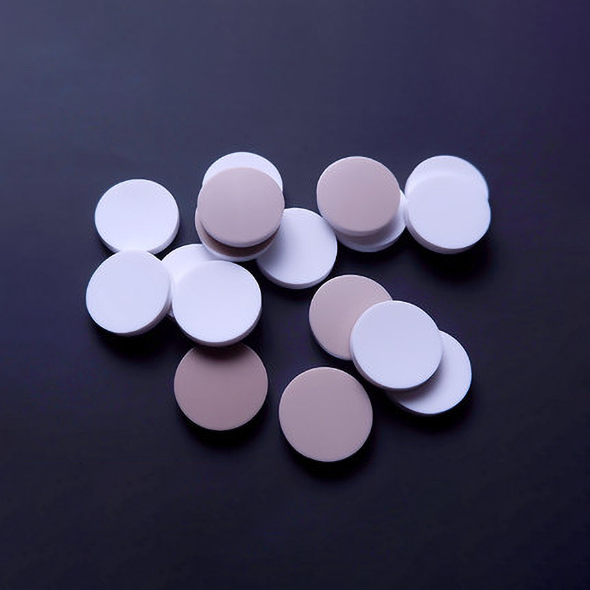 Septa
SeptaSeptum replenishment packs
50 or 100 piece bags for 2 / 5 / 10 mL vials. Replace after 3–5 punctures or whenever seal performance degrades.
Browse septa → Single vial
Single-vial close-up
Polished neck thread; clear-quartz body for visible sample volume; hex-corner cap for tweezer or wrench tightening.
View product line →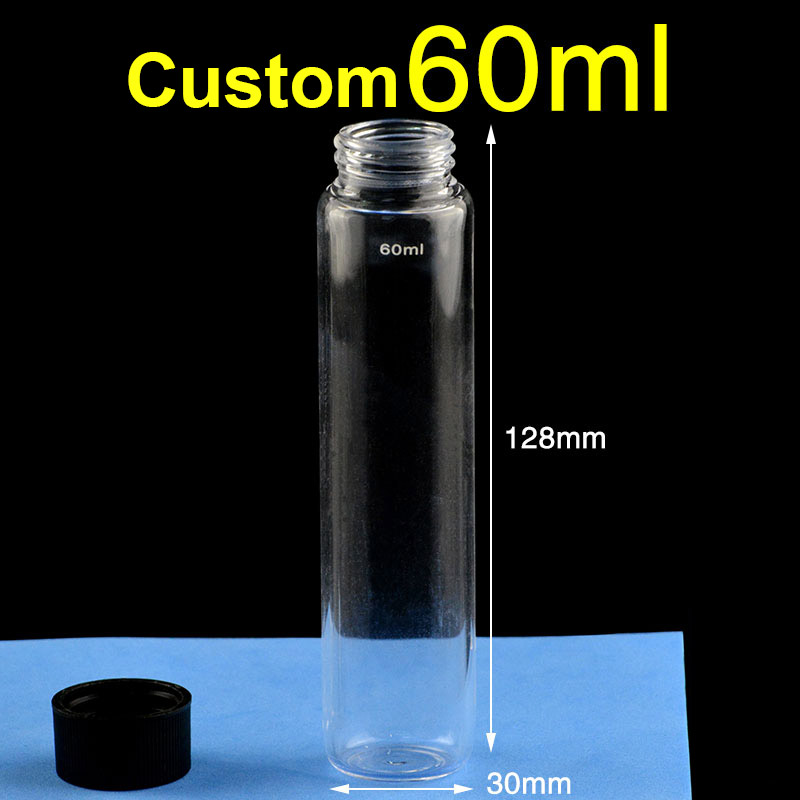 Custom
Custom example — VCQV60 (60 mL)
Non-stock geometry: 30 mm OD × 128 mm tall body for a customer’s autosampler. 2-piece MOQ on custom dimensions; 2-week lead time.
Request custom →| SKU | Type | Volume / Pack | Size | Price USD |
|---|---|---|---|---|
| MQM375 | Vial | 2 mL | 12×32 mm | $22.50 |
| MQM376 | Vial | 5 mL | 18×45 mm | $24.50 |
| MQM377 | Vial | 10 mL | 22×50 mm | $26.25 |
| MQM378 | Vial | 20 mL | 28×57 mm | $33.75 |
| MQM379 | Vial | 30 mL | 28×72.5 mm | $37.50 |
| MQM380 | Vial | 40 mL | 28×105 mm | $45.00 |
| MQM381 | Vial | 50 mL | 34×80 mm | $49.00 |
| MQM382 | Vial | 100 mL | 40×115 mm | $67.50 |
| MQM384 | Septum pack — 2 mL | 100 pc | — | $24.50 |
| MQM385 | Septum pack — 5 mL | 50 pc | — | $24.50 |
| MQM386 | Septum pack — 5 mL | 100 pc | — | $49.00 |
| MQM387 | Septum pack — 10 mL | 50 pc | — | $25.00 |
| MQM388 | Septum pack — 10 mL | 100 pc | — | $50.00 |
15. FAQ
When is a quartz vial worth the price over a borosilicate one?
Four cases: (1) ICP-MS or ICP-OES analysis where sub-ppb sodium, boron, or aluminium background would interfere with detection; (2) UV-grade water or photoresist storage where the vial wall must transmit below 290 nm so you can monitor purity through it; (3) trace-organic LC-MS work where polymer or borosilicate leachates create ghost peaks; (4) long-term archival (months to years) where slow Na/B leaching from borosilicate would invalidate the future analysis. Outside those four cases, borosilicate is the right answer at 5–25× lower cost.
Can quartz vials handle hydrofluoric acid?
No. HF dissolves silica at any concentration. There is no quartz vial that resists HF. The only laboratory material that does is fluoropolymer — PFA, PTFE, or FEP. Savillex and VWR sell PFA vials in standard autosampler footprints; for HF, BHF, or fluoride-containing chemistry, use those instead.
Are these autosampler-compatible?
Yes. The 2 mL × 12 mm body (MQM375) drops into Agilent G1313, Waters 2767, Shimadzu SIL, and Thermo TriPlus autosampler trays without modification. Larger sizes match common standalone autosampler racks. If your specific autosampler needs a non-standard body diameter or thread, send the spec and we’ll quote a custom on a 2-piece MOQ.
How long does a PTFE-faced silicone septum last?
3–5 needle punctures for autosampler service before the seal degrades and ghost peaks appear in subsequent injections. For static storage (one cap-on, one cap-off cycle), the septum lasts the lifetime of the sample — months to years. After contact with strong oxidisers (concentrated nitric, peroxides), silicone backing degrades faster; replace immediately. We sell replenishment packs in 50 and 100 piece quantities (MQM384–MQM388).
Can I autoclave the vials?
The quartz body tolerates standard wet autoclaving (134 °C, 30 min) and dry-heat sterilisation up to 1100 °C. The PP cap is the limiting component — autoclave at 121 °C maximum, and replace the cap if it shows any deformation. Silicone septum survives wet autoclaving but degrades above 200 °C dry-heat. For high-temperature sterilisation, remove cap and septum first.
What does Type 2 vs Type 3 mean for vials?
Type 2 fused silica is flame-fused natural crystal — about 25 ppm Al, 3 ppm Na+K, 200–400 ppm OH. Default for our stock vials and the right answer for ppb-level work. Type 3 is synthetic CVD silica — total trace metals below 1 ppm, OH around 1000 ppm. Specify Type 3 (custom order, 3–5× price premium) for sub-ppb ICP-MS standards or semiconductor reagent storage where every ppb counts.
Can you make custom thread or neck dimensions?
Yes. Standard threads we routinely make: 8-410, 13-415, 15-415, 18-400, 22-400, 24-410. Other thread specs are available with a 2-piece MOQ and 2-week lead time. Send the thread callout (the GPI standard or a measured pitch and diameter) and we’ll quote. Do not send a sample of the cap — we machine the vial body, not the cap.
Do these come pre-sterilised for biology work?
No. Our quartz vials are industrial / chemical labware, not bio-supply. We do not certify sterility, do not ship in sealed sterilised packs, and do not validate for cell-culture compatibility. If your protocol requires gamma-irradiated or pre-sterilised vials, source from a bio-supply vendor (Corning, Thermo Nunc) — those are different product categories with sterility documentation we do not duplicate. You can autoclave our vials in your own facility before use, but the responsibility for sterilisation validation is on you.
Can I store strong base (NaOH, KOH) in quartz vials?
Yes for cold dilute (≤ 1 M), with limits. NaOH and KOH at room temperature etch fused silica slowly — for sub-week storage at sub-1 M concentrations the etch is not measurable. At higher concentrations or warm temperatures, the etch accelerates rapidly. For sodium-fusion or KOH-fusion sample prep, switch to a nickel or zirconium crucible, not a quartz vial.
What do you NOT make in vials?
We do not manufacture or supply: pre-sterilised vial sets for cell culture or bio-pharma; crimp-top serum vials; lyophilisation (freeze-dry) vials with stoppers; NIST-traceable Class A volumetric vials; ICH-Q1A polymer alternatives; or vials with bar-coded individual sample tracking. We make the precision quartz body. Caps, septa, and accessories are sourced — we ship them as part of the assembly but do not custom-manufacture them. For any of the above categories, we’ll point you at a specialist vendor.
Related guides
16. Notes and honest limits
What this guide does not claim
• HF resistance. Fused quartz dissolves in HF at any concentration. For HF, BHF, or fluoride-containing chemistry, use PFA — not quartz.
• Hot strong base resistance. NaOH and KOH at the boil etch fused silica. Cold dilute base is fine for short-term storage; concentrated or hot base is not.
• Bio sterility certification. We are an industrial labware shop. We do not validate for cell culture, do not ship pre-sterilised, and do not provide ISO-13485 medical-device documentation. Customer is responsible for sterilisation validation.
• NIST-traceable Class A volumetric accuracy. Our vials are storage and transfer containers, not calibrated volumetric standards.
• Septum lifetime under autosampler service. The 3–5 puncture life is typical, not guaranteed. Aggressive solvents (DMSO, DMF, halogenated organics) can degrade septa within a single puncture. Test in your specific solvent before specifying.
Wheaton is a registered trademark of DWK Life Sciences. VWR is a registered trademark of Avantor. Agilent, Waters, Shimadzu, and Thermo Fisher are registered trademarks of their respective owners. Savillex is a registered trademark of Savillex LLC. References to product part numbers and instrument models are for compatibility context only; we are not affiliated with these vendors and do not duplicate their lot certification or QA documentation. References to ASTM Type 1 / 2 / 3 fused silica grades follow the ASTM C162 and Corning Glass Works classification.
Last reviewed May 2026 by the MachinedQuartz technical team. Pricing and stock availability change over time — confirm current SKU availability and pricing on the catalogue page or email [email protected] before specifying a final BOM.
Ready to spec your quartz vials?
Eight stock sizes 2 mL – 100 mL plus septum replenishment packs. Custom geometry on 2-piece MOQ, 2-week lead time. ISO-9001 documentation on request.
Browse the catalog →Request a custom quote →

Recent Comments