
Quartz Cuvettes for Protein Quantification (A280, Bradford, BCA)
Application Guide
Quartz Cuvettes for Protein Quantification
Direct A280 protein readings sit at 280 nm in the UV, where glass and plastic do not transmit. This guide covers when you need a UV-grade quartz cuvette (A280, A205) versus when a colorimetric assay (Bradford, BCA, Lowry) lets you use any cell, plus path length, volume and grade selection.
When quartz is required
A280: why direct protein readings need quartz
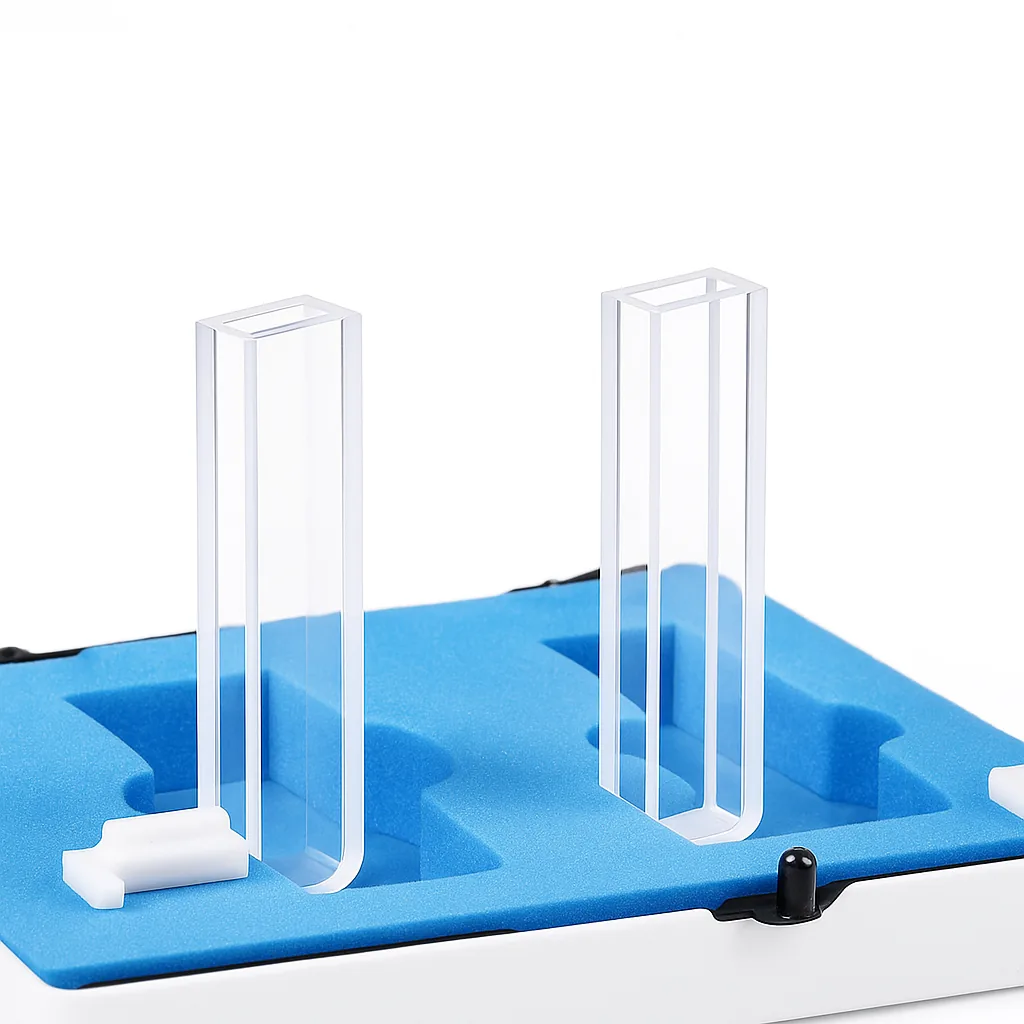
The fastest, label-free way to quantify protein is to read absorbance at 280 nm, where the aromatic residues tryptophan and tyrosine absorb. 280 nm is in the UV — below the ~320 nm cut-off of optical glass and most plastics — so a direct A280 reading is only valid in a UV-grade quartz cuvette. MachinedQuartz protein cuvettes are made from JGS1 fused quartz (185–2,500 nm), which transmits 280 nm cleanly and reaches the peptide-bond band at A205 (useful for proteins lacking Trp/Tyr) in the deep UV. See the grade transmittance reference.
Choosing a method
A280 vs colorimetric assays — which need quartz?
| Method | Read at | Cuvette | Notes |
|---|---|---|---|
| A280 direct UV | 280 nm | Quartz (JGS1) | Fast, non-destructive, recoverable sample; needs Trp/Tyr and a known extinction coefficient |
| A205 peptide bond | 205 nm | Quartz (JGS1) | Works for proteins without aromatic residues; deep UV |
| Bradford | 595 nm | Glass cuvette (or quartz) | Coomassie dye-binding; quick endpoint |
| BCA | 562 nm | Glass cuvette (or quartz) | Cu reduction; detergent-compatible |
| Lowry | 750 nm | Glass cuvette (or quartz) | Classic, sensitive |
Colorimetric assays (Bradford, BCA, Lowry) read in the visible, so a Glass cuvette works for those; direct A280 needs JGS1 quartz. MachinedQuartz supplies both — plus quartz micro cuvettes for small, precious protein.
Absorbance to concentration
Turning A280 into a concentration
For a 10 mm path, concentration follows Beer–Lambert: c = A280 / ε, using the protein’s specific extinction coefficient (ε0.1%, the A280 of a 1 mg/mL solution). As a rough rule of thumb, a “generic” protein gives A280 = 1.0 ≈ 1 mg/mL, but real values vary widely — BSA ε0.1% ≈ 0.66 (A280 1.0 ≈ 1.5 mg/mL); a typical IgG ≈ 1.4 (A280 1.0 ≈ 0.7 mg/mL). Always use your protein’s ε when known.
Check purity with the A260/A280 ratio: a clean protein reads ~0.57; a higher ratio signals nucleic-acid contamination. Keep A280 in the accurate 0.1–1.0 band — the Beer-Lambert calculator picks the path length, the size calculator matches volume.
Match the cuvette to the sample
Path length and volume for protein
Standard 10 mm
Reference geometry for dilute protein and calibration. Needs ~1–3.5 mL or a reduced-volume insert.
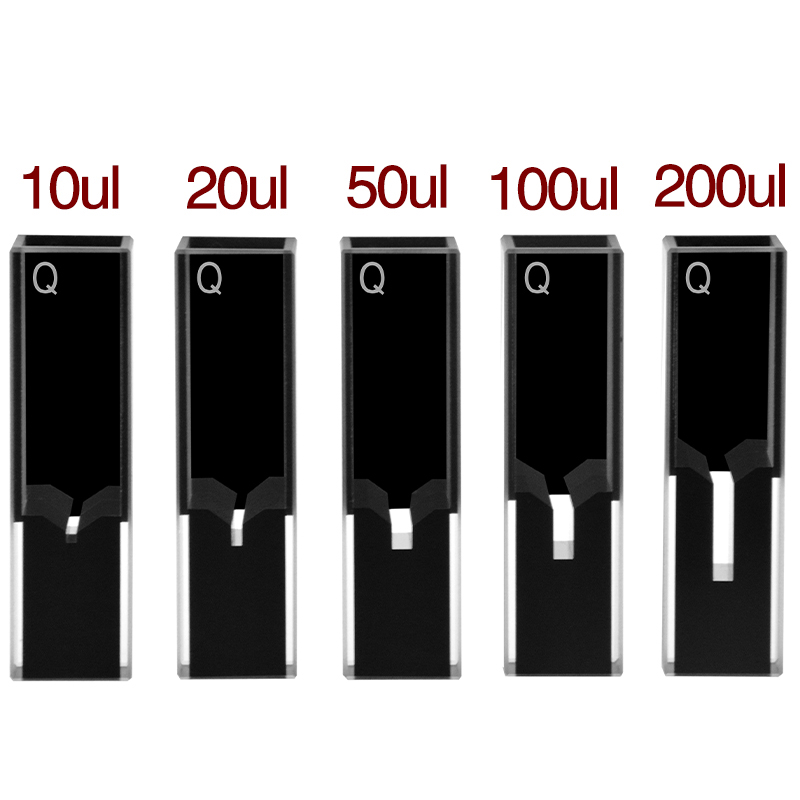
Micro & sub-micro
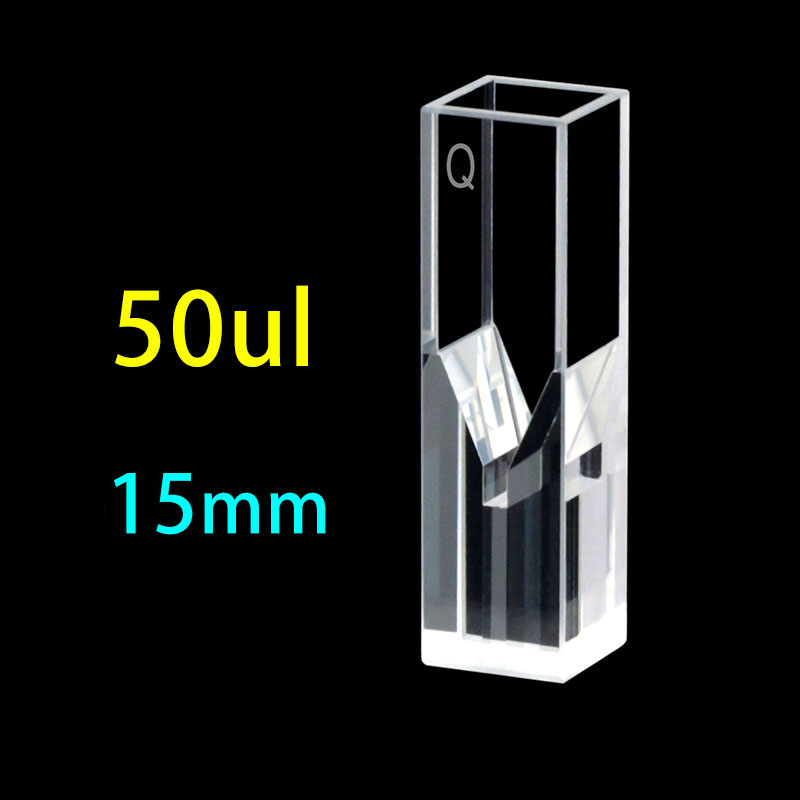
For 5–100 µL of precious protein — a narrow chamber keeps the 10 mm path. Z-height must match your reader.
Short path 0.1–2 mm
For concentrated stock (high A280), a short path stays on-scale without diluting the sample.
| Situation | Path length | Volume class | Grade |
|---|---|---|---|
| Routine dilute protein (A280) | 10 mm | Standard / semi-micro | JGS1 |
| Small precious sample (5–100 µL) | 10 mm | Micro / sub-micro | JGS1 |
| Concentrated stock (high A280) | 0.1–2 mm | Short-path / demountable | JGS1 |
| A205 peptide-bond read | 10 mm | as needed | JGS1 |
Accuracy
Cuvette vs pedestal reader
Pedestal (drop) readers quantify 1–2 µL of protein fast, but use a short, variable path best suited to higher concentrations. A calibrated quartz cuvette with a defined 10 mm path gives better reproducibility and low-concentration accuracy for dilute protein and quantitative work. See cuvette vs NanoDrop, and for nucleic acids the companion DNA/RNA quantification guide.
Avoiding errors
Common sources of error
- Light scatter / aggregation: turbid protein inflates A280. Subtract A320 as a baseline; centrifuge or filter aggregated samples.
- Nucleic-acid contamination: a high A260/A280 means co-purified DNA/RNA is adding to your reading.
- Fingerprints on optical faces: skin oils absorb in the UV — handle by the frosted sides, wipe with lens tissue.
- Wrong extinction coefficient: using a generic ε for an atypical protein skews results; use the sequence-derived value when possible.
- Off-scale or mismatched Z-height: keep A280 in 0.1–1.0 with path length, and match cuvette Z-height to your spectrophotometer.
Custom protein cuvettes in JGS1 quartz and Glass — low MOQ
MachinedQuartz makes standard, semi-micro, micro, sub-micro and short-path quartz cuvettes in JGS1 (plus Glass cuvettes for visible-only assays), plus custom path lengths, Z-heights and volumes built to your spectrophotometer and sample. Low minimum order quantities, per-unit QC and worldwide shipping.
Request a quoteFAQ
Frequently asked questions
Do I need a quartz cuvette for protein quantification?
For direct A280 (and A205) UV readings, yes — 280 nm is below the ~320 nm cut-off of glass and plastic, so only UV-grade quartz gives a valid result. For colorimetric assays (Bradford, BCA, Lowry) read in the visible, glass or plastic also works.
Which quartz grade for A280?
We make protein cuvettes in JGS1 fused quartz, which transmits 280 nm cleanly and reaches the A205 peptide-bond band in the deep UV. For visible-only colorimetric assays a Glass cuvette also works.
How do I convert A280 to protein concentration?
Use c = A280 / extinction coefficient for a 10 mm path. A generic protein is roughly A280 1.0 = 1 mg/mL, but values vary (BSA about 1.5 mg/mL, IgG about 0.7 mg/mL per A280). Use your protein’s specific coefficient when known.
What does the A260/A280 ratio tell me for protein?
A clean protein reads about 0.57. A higher A260/A280 indicates nucleic-acid contamination adding absorbance at 260 nm.
Can I measure tiny protein volumes in a cuvette?
Yes — micro and sub-micro quartz cuvettes read from roughly 5–100 uL on a full 10 mm path. Match the cuvette Z-height to your spectrophotometer.
Reference: MachinedQuartz, Quartz Cuvettes for Protein Quantification (2026). See the Cuvette Selection Guide · Last reviewed June 2026.