
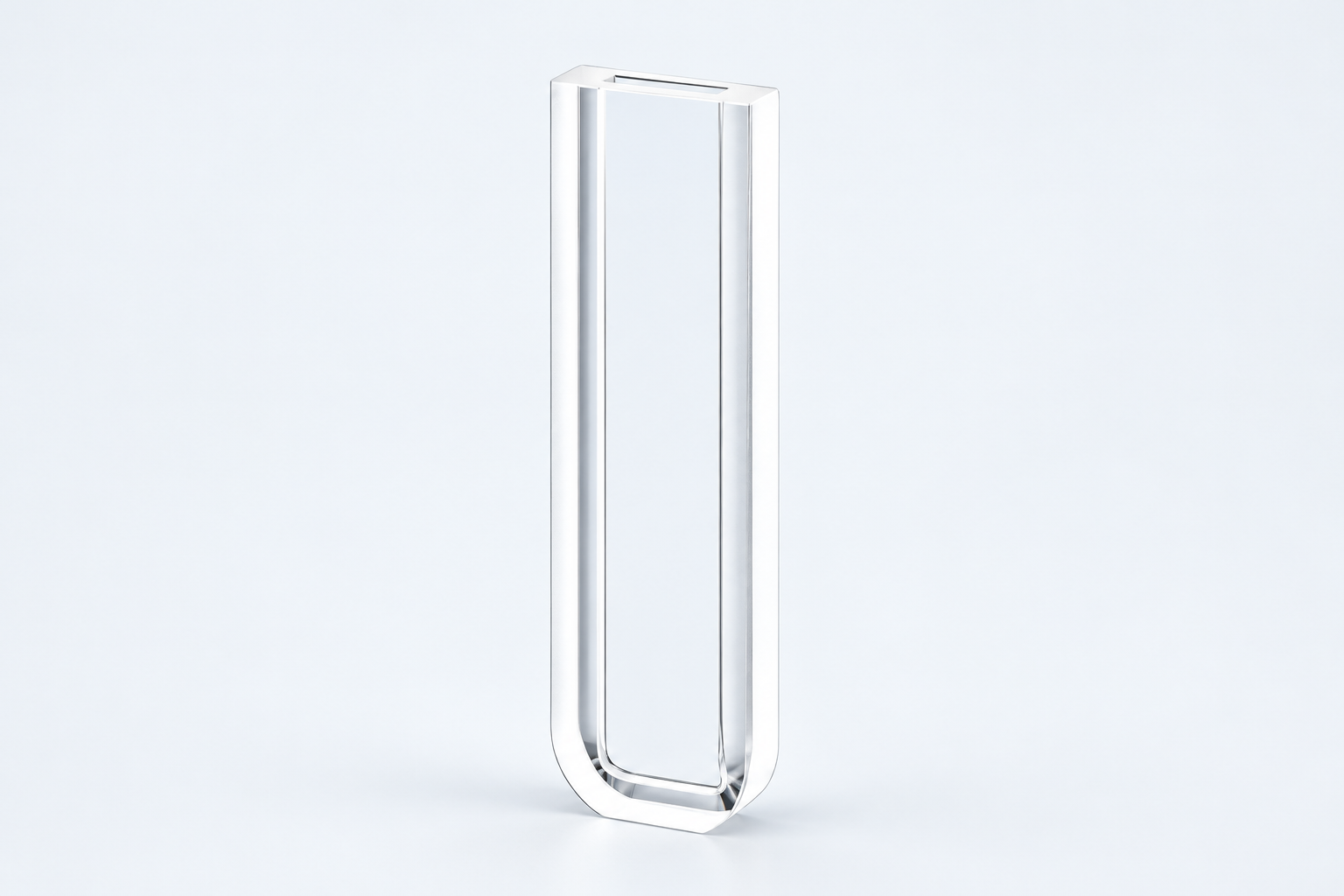
1 mm Quartz Cuvette with a Rounded Base: Sampling and Support
CUSTOM DESIGN GUIDE · MQQCU016
MQQCU016 provides a 1 mm sample path in a narrow quartz body with a rounded, thickened lower profile. The short gap is the optical choice; the rounded base is the mounting choice. Understanding both helps turn this unusual cuvette into a useful starting point for a custom holder or cell.
Use and purpose · Specifications · In practice · Custom example · Buy or enquire
What the 1 mm path changes
In absorption work, a short path is relevant when the method needs to reduce absorbance while keeping the sample concentration. The sample gap controls the distance through the liquid. It does not, by itself, set the outside thickness or the amount needed to cover the beam. [1]
This configuration has a recorded 12.5 × 3.5 × 45 mm body and nominal 280 µL capacity. The dimensions distinguish a narrow upright chamber from a miniature cell: much of the selection task still concerns positioning that chamber in the instrument.

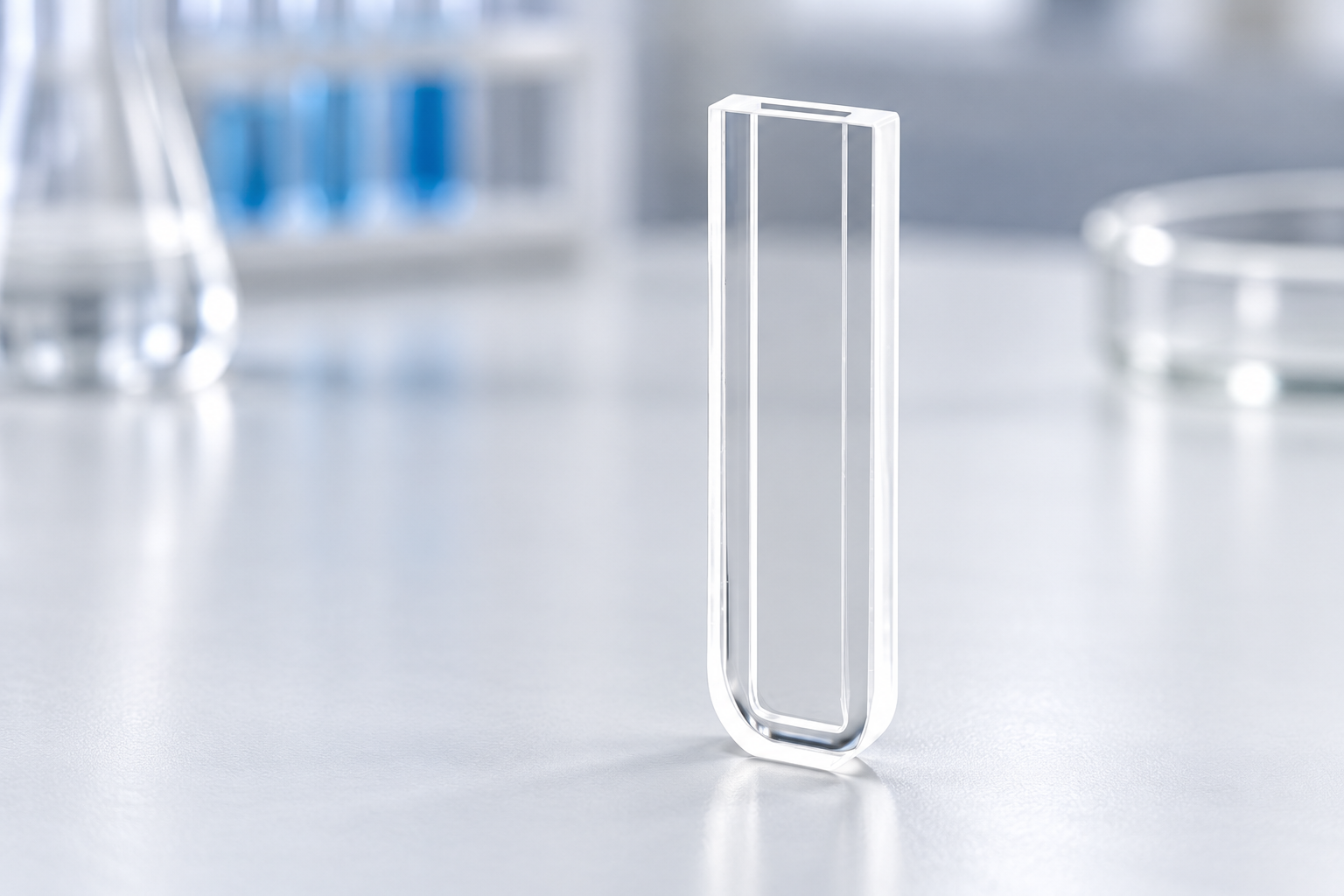
MQQCU016 configuration
A curved lower outline needs a deliberate seat
A flat-bottom cuvette commonly takes its position from a flat support. The rounded lower region changes that relationship. A seat or side support must hold the body at the intended optical height without assuming that the lowest visible point is a broad seating face.
For repeatable placement, the important detail is the contact between the cell and holder. A section through that contact is more informative than an angled product view. The base outline can be retained or adapted independently of the 1 mm sample path.
Work through filling and retrieval
The listed option has an open top and no included closure. Loading therefore takes place from above, with enough access for the chosen pipette or other tool. The holder should also leave a route for removing the cell and retrieving the sample.
For a narrow chamber, it helps to consider where the liquid sits relative to the beam before using nominal capacity as a working quantity. The useful design is one that can be loaded and positioned consistently, rather than one selected on path length alone.
A custom example: fit the lower form to an existing support
ILLUSTRATIVE DESIGN EXAMPLE
Suppose the method calls for the 1 mm gap but the instrument has a fixed support. A proposed version can retain the chamber and define the lower contact from that support. The sketch relates the new seat to the beam height, so a change to the base does not unintentionally move the measurement region.
Order the listed configuration or discuss a change
View MQQCU016 and current pricing. For a custom version, send a labelled sketch that separates the features to retain from the changes you want.
Reference MQQCU016 with a section through the holder seat and the required beam position. Identify the path to keep and the lower outline to change. Add the loading method, sample conditions, quantity, destination and requested date.


Recent Comments