
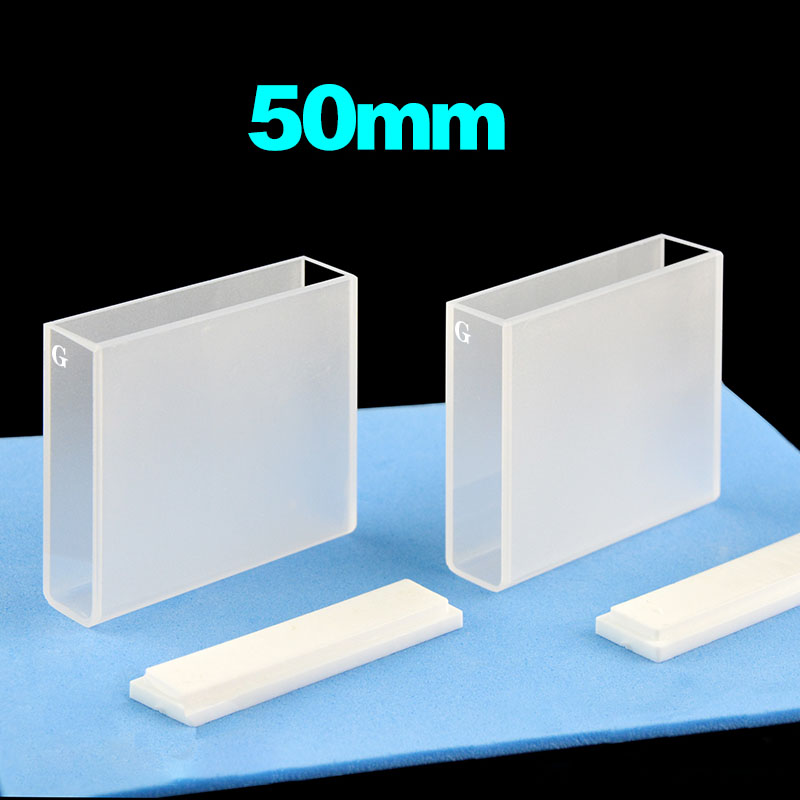
Glass 50mm Glass Cuvette, 17.5ml, Sintered 83, Two-way Light, PTFE Cap, Pack of Two, C502CR1
9%
Original price was: $37.00.$34.00Current price is: $34.00.
Glass 50 mm round-corner cuvette, 17.5 ml, Sintered 83 (>80%). Two-Way Light. 340–2500 nm. PTFE Cap. Pack of four. SKU: C502CR1. In Stock.
In Stock
Description
The C502CR1 is a pack of four of round-corner optical glass cuvettes, each with a 50 mm optical path length and 17.5 ml volume. Built with Sintered 83 fabrication for economical high-throughput use. Round corners reduce chipping risk during handling. Transmits across 340–2500 nm with >80% transmittance.
| Specifications — C502CR1 | |||
|---|---|---|---|
| Material | Optical Glass (Sintered 83) | SKU | C502CR1 |
| Type | Standard Cell (Two-Way Light) | Path Length | 50 mm |
| Volume | 17.5 ml | Optical Windows | 2 (frosted sides) |
| Corner Style | Round Corner | Fabrication | Sintered 83 |
| Transmittance | > 80% (340–2500 nm) | Wavelength Range | 340 – 2500 nm |
| Exterior Dimensions | 52.5 × 12.5 × 45 mm | Interior Dimensions | 50 × 10 × 43 mm |
| Cap Type | PTFE Cap | Package | Pack of four |
Spectroscopy Applications
🔬UV-Vis Spectroscopy
Absorbance and transmittance measurements across 340–2500 nm🏥Clinical Diagnostics
Blood chemistry, serum protein, and biomarker analysis💊Pharmaceutical Analysis
Drug concentration, purity, and dissolution testing🌊Environmental Monitoring
Water quality, pollutant detection, and nutrient analysis🍷Food & Beverage Testing
Color measurement, additive analysis, and quality control🎓Educational Laboratories
Teaching spectroscopy principles with durable, affordable cells⚗️Chemical Analysis
Reaction kinetics, titration monitoring, and concentration assays🧪Quality Control
Industrial process monitoring and raw material verification
Absorbance and transmittance measurements across 340–2500 nm🏥Clinical Diagnostics
Blood chemistry, serum protein, and biomarker analysis💊Pharmaceutical Analysis
Drug concentration, purity, and dissolution testing🌊Environmental Monitoring
Water quality, pollutant detection, and nutrient analysis🍷Food & Beverage Testing
Color measurement, additive analysis, and quality control🎓Educational Laboratories
Teaching spectroscopy principles with durable, affordable cells⚗️Chemical Analysis
Reaction kinetics, titration monitoring, and concentration assays🧪Quality Control
Industrial process monitoring and raw material verification
Why a 50 mm Path Length?
A 50 mm path length delivers five times the sensitivity of a standard 10 mm cell per Beer-Lambert law. This is the preferred choice for trace-level analysis, environmental micro-pollutant detection, and research applications requiring maximum absorbance from dilute samples.
Why Sintered Glass?
Sintered (fused) fabrication bonds cuvette walls using high-temperature fusion rather than adhesive. Combined with economical round-corner construction, this offers a cost-effective option with excellent chemical resistance for routine laboratory use.
💡 Usage Tips
Filling: Fill to approximately 80% capacity (~14.0 ml) for optimal light path coverage.
Cleaning: Rinse with distilled water, then ethanol or acetone. Dry with lint-free tissue.
Orientation: Align the two clear (polished) windows with the instrument beam path; frosted sides face left and right.
Filling: Fill to approximately 80% capacity (~14.0 ml) for optimal light path coverage.
Cleaning: Rinse with distilled water, then ethanol or acetone. Dry with lint-free tissue.
Orientation: Align the two clear (polished) windows with the instrument beam path; frosted sides face left and right.
🛠 Custom Orders
Need a different path length, volume, or material? We offer custom fabrication. Contact us with your specifications.
Need a different path length, volume, or material? We offer custom fabrication. Contact us with your specifications.
Specifications are nominal and may vary slightly due to manufacturing tolerances. Images are for reference only; actual product appearance may differ.
Additional information
| Weight | 100 g |
|---|
You must be logged in to post a review.
You may also like…
10%
Glass 50mm Glass Cuvette, 17.5ml, Sintered 80, Two-way Light, PTFE Cap, pack of ten, C502CA7
Original price was: $143.00.$129.00Current price is: $129.00.9%
Glass 50mm Glass Cuvette, 17.5ml, Molded 83, Two-way Light, PTFE Cap, Pack of Two, C502CE7
Original price was: $37.00.$34.00Current price is: $34.00.10%
Glass 50mm Glass Cuvette, 17.5ml, Sintered 80, Two-way Light, PTFE Cap, pack of ten, C502CA9
Original price was: $143.00.$129.00Current price is: $129.00.10%

Glass 50mm Glass Cuvette, 17.5ml, Sintered 80, Two-way Light, PTFE Cap, Pack of ten, C502CA4
Original price was: $143.00.$129.00Current price is: $129.00.Related products
14%
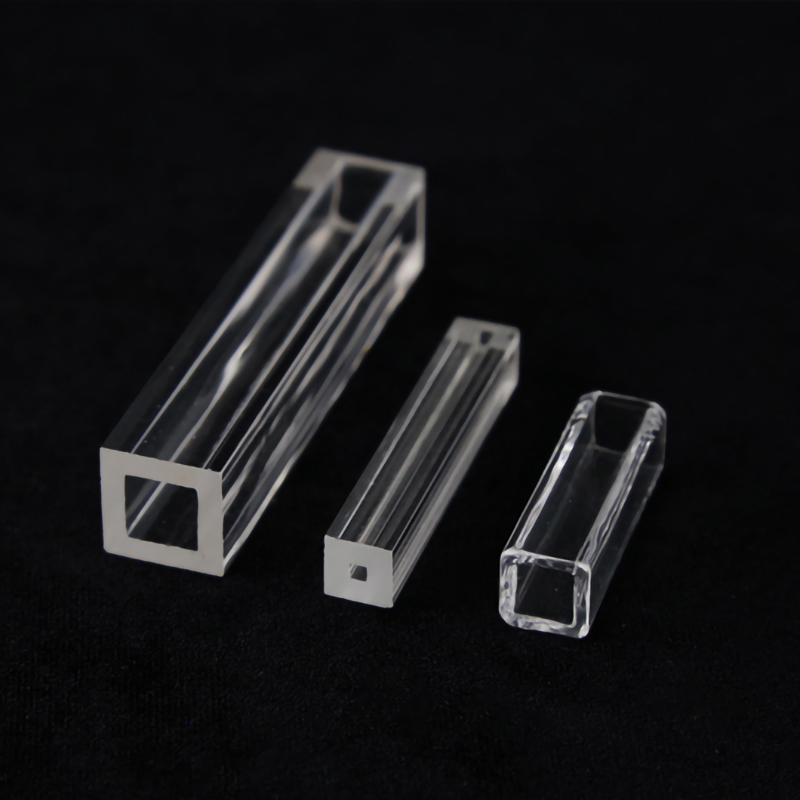
(MQC366) Quartz Capillary Tubes (Square), Outer Dim.: 0.95×0.95mm, Inner Dim.: 0.35×0.35mm, Length: 100mm
Original price was: $38.00.$33.00Current price is: $33.00.15%
(MQC381) Quartz Capillary Tubes (Square), Outer Dim.: 1x1mm, Inner Dim.: 0.3×0.3mm, Length: 50mm
Original price was: $28.00.$24.00Current price is: $24.00.14%
(MQC363) Quartz Capillary Tubes (Square), Outer Dim.: 0.5×0.5mm, Inner Dim.: 0.3×0.3mm, Length: 100mm
Original price was: $38.00.$33.00Current price is: $33.00.14%
Reviews
There are no reviews yet.