
Quartz Cuvette UV Cutoff: JGS1 vs JGS2 vs JGS3 Transmission
This post is also available in:
The UV cutoff of a quartz cuvette is the wavelength at which optical transmission drops below 50% on a 10 mm path — JGS1 at ~185 nm (deep UV), JGS2 at ~220 nm (standard UV-Vis), and JGS3 at ~260 nm (IR-optimized, with reduced UV performance). The cutoff is set mainly by metallic impurities and the melting process, not by OH content: high-purity synthetic JGS1 transmits deepest; JGS2 cuts off near 220 nm because of trace metal impurities and point defects; and JGS3, vacuum-fused from natural quartz, carries oxygen-deficiency defects that absorb in the ~240–260 nm band. OH governs the infrared (absorption bands near 1380 / 2200 / 2730 nm), not the UV.
On this page
MachinedQuartz · Material Reference
Quartz cuvette UV cutoff: JGS1, JGS2, JGS3 transmission compared
A fabricator’s reference for the wavelength below which a quartz cell stops being a cell. Three quartz grades, four alternative materials, the path-length effect, and how to verify cutoff on your own bench. Pairs with the UV-Vis pillar and path length guide.
JGS1: 185 nm
JGS2: 220 nm
JGS3: 260 nm
vs sapphire / CaF₂
Path-length effect
Contents
§1 · Definition
What “UV cutoff” actually means
A cuvette’s UV cutoff wavelength is the wavelength below which the cell’s transmission falls so low that you cannot reliably separate sample absorbance from cell absorbance. The number you see in a datasheet — “JGS1: 185 nm” or “JGS2: 220 nm” — is shorthand for one of the following criteria, depending on whose datasheet you read:
T = 50% at the rated wavelength (most common, e.g. ASTM E275 for quartz windows)
- T = 80% or 90%: stricter criteria used by deep-UV laser optics suppliers; cuts the rated cutoff up by 5–15 nm
- “Useful” cutoff: some cuvette catalogs quote the wavelength where T > 70% on a 10 mm path — a working number for routine UV-Vis
The value depends on three things: the silica grade (which controls intrinsic absorption), the path length you measure through (which scales the absorbance per Beer-Lambert), and any surface contamination or aging. A 10 mm cuvette and a 100 mm cuvette of the same JGS1 quartz have different effective cutoffs (§4).
Key takeaway: “UV cutoff” is a material property in spec sheets and a path-length-dependent number at the bench. Both matter when picking a cell.
§2 · Material Cliff
Cutoff by cuvette material — the cliff at a glance
Before drilling into the three quartz grades, here is the broader landscape of every common cuvette/window material, with the wavelength below which transmission drops below 50% on a standard 10 mm path. Numbers are approximate — vendors vary by ±5–10 nm depending on grade and how strictly they define cutoff.
| Material | UV cutoff (10 mm) | Useful upper limit | UV-Vis fit | Typical use |
|---|---|---|---|---|
| PMMA / acrylic | ~290 nm | 1100 nm | Vis only | Disposable visible-range cells, dye / OD600 work |
| Polystyrene | ~340 nm | 800 nm | Vis only | Disposable visible-range cells |
| Optical glass (BK7) | ~320 nm | 2500 nm | Vis + NIR | Routine colorimetry, A340–A1100 |
| JGS3 quartz | ~260 nm | 3500 nm | UV-B + IR | NIR/IR work, water-band-free transmission |
| JGS2 quartz | ~220 nm | 2500 nm | Standard UV-Vis | Most analytical UV-Vis, pharma QC, biology |
| JGS1 quartz | ~185 nm | 2500 nm | Deep UV | Pharma USP, photochemistry, DNA at A260, deep-UV stray-light tests |
| Sapphire (Al₂O₃) | ~150 nm | 5500 nm | VUV + IR | High-pressure / high-temperature cells, mid-IR windows |
| Calcium fluoride (CaF₂) | ~130 nm | 9000 nm | VUV + far IR | VUV laser spectroscopy, FTIR demountable cells |
| Magnesium fluoride (MgF₂) | ~115 nm | 7000 nm | VUV | Synchrotron / VUV monochromator windows |
The cliff is steep at material boundaries — moving from optical glass to JGS2 quartz buys you 100 nm of extra UV; moving from JGS2 to JGS1 buys you another 35 nm at meaningful cost. Below 185 nm you have to leave quartz entirely, which is why specialty pages on quartz vs sapphire vs CaF₂ windows exist.
§3 · The Three Grades
JGS1 vs JGS2 vs JGS3 — the three grades that matter
Of all the materials in §2, the three JGS grades cover ~95% of analytical cuvette demand. The differences trace back to how the silica is fused, how much OH (water) is left in, and what trace impurities survive. The downstream effect is a different transmission curve and a different price.
JGS1
Deep-UV grade
Cutoff ≈ 185 nm. Made by flame fusion of high-purity SiO₂ powder in an oxyhydrogen flame. Highest OH content (~1000 ppm) — but the OH absorption bands sit at 1380 / 2200 nm, well above the UV region, so they don’t hurt UV-Vis use. Highest transmission below 200 nm of the three grades.
JGS2
Standard UV-Vis grade
Cutoff ≈ 220 nm. Made by electric melting of natural crystalline quartz. Trace metal impurities (Fe, Ti, Al) and point defects from the electric-melting process absorb in the deep UV, which is why it falls off below 220 nm even though the intrinsic SiO₂ absorption edge sits near 150 nm. Any microscopic bubbles add only minor scatter and are not the main cause. The most common, most cost-effective grade.
JGS3
IR-optimized grade
Cutoff ≈ 260 nm. Vacuum-fused — the vacuum step removes OH almost entirely (<5 ppm), eliminating the 1380 and 2200 nm water bands and extending usable transmission out past 3500 nm. The trade-off is a higher UV cutoff because the vacuum process introduces other defects that absorb at 250–260 nm.
Side-by-side specifications
| Property | JGS1 | JGS2 | JGS3 |
|---|---|---|---|
| UV cutoff (T=50%, 10 mm) | ~185 nm | ~220 nm | ~260 nm |
| Transmission @ 185 nm | ≥ 90% | ~5% | < 1% |
| Transmission @ 254 nm | ≥ 90% | ≥ 90% | ~30% |
| OH content | ~1000 ppm | ~200 ppm | < 5 ppm |
| OH band at 1380 nm | Visible (drop ~5%) | Faint | None |
| Upper transmission limit | 2500 nm | 2500 nm | 3500 nm |
| Bubble class | None visible | Microscopic | None visible |
| Relative price | 1.6× | 1.0× | 1.4× |
| Best for | Deep UV, photochemistry, USP | General UV-Vis, biology, dye | NIR/IR, water-free transmission |
Common confusion: JGS1 is not just “premium JGS2.” It costs more and has worse NIR performance because of its higher OH content. Pay for JGS1 only if you actually measure below 220 nm or run deep-UV cells under heavy load. For 220–1100 nm work, JGS2 is the right answer.
Manufacturing-side context, including how Standard 80 (glue-assembled), Sintered 83 (powder-fused), and Molded 83 (one-piece fused) interact with grade choice, lives on our cuvette fabrication method page. The short version: deep-UV applications call for sintered or molded construction in JGS1 — glue joints fluoresce and outgas under 254 nm UV.
§4 · Path-Length Effect
Path length changes the effective cutoff
The single number on a datasheet is for a 10 mm path. Beer-Lambert says absorbance scales linearly with path length, so a 100 mm cell has 10× the absorbance of a 10 mm cell at any wavelength — including the wavelength of the cutoff transition. (Shorter paths push the apparent cutoff toward shorter wavelengths, but only down to the material’s intrinsic SiO₂ absorption edge near 150 nm — path length cannot push transmission past that edge. The numbers below are approximate; for exact limits measure the actual transmission spectrum rather than extrapolating the 10 mm cutoff linearly.) The practical consequence: long-path cuvettes have a worse effective UV cutoff than short-path cuvettes of the same material.
Effective cutoff vs path length, JGS1 quartz
| Path length | Effective T=50% cutoff | Working window for A < 1.0 |
|---|---|---|
| 0.1 mm (demountable) | ~155 nm | To ~150 nm with vacuum-purged spectrometer |
| 1 mm | ~165 nm | To ~160 nm |
| 10 mm | ~185 nm | To ~180 nm |
| 50 mm | ~185 nm | To ~190 nm |
| 100 mm | ~195 nm | To ~200 nm — solvent absorbance dominates |
For the long-path end, solvent absorbance becomes the limiting factor before the cuvette material does. Water absorbs ~0.02 AU/cm at 200 nm — at 100 mm that is 0.2 AU of solvent baseline before the cell or analyte contributes. We cover the budget arithmetic in our path length decision flow.
The opposite trap: demountable 0.1 mm cells extend the cutoff downward but only on a dry-purged or nitrogen-purged spectrophotometer. Atmospheric oxygen only absorbs significantly below ~180 nm; for routine 185–200 nm work dry air is acceptable, while measurements below 180 nm require nitrogen purging — the cell may transmit, but the air in the optical path won’t.
§5 · Picking a Grade
Picking a grade by application wavelength
Most cuvette decisions trace back to one analytical wavelength. Map your wavelength to a grade with the rules below, then verify with a 10 mm pilot scan if your method calls for it.
200–220 nm — peptide bond, USP/EP
JGS1. JGS2 transmission falls off too quickly here. Common applications: peptide bond absorbance for protein content, USP <788> particulate matter, methyl paraben. Pair with sintered or molded construction.
254 nm — DNA, mercury arc, photochemistry
JGS1 or JGS2 — both work. JGS2 is fine for routine A260/A280 nucleic-acid quantitation. Use JGS1 if your sample sees high-intensity 254 nm UV (germicidal lamps, photoreactors) — JGS2 will accumulate solarization defects faster.
280 nm — protein A280
JGS2. Standard grade at the standard wavelength. There is no measurable transmission penalty at 280 nm versus JGS1, and JGS2 is cheaper.
300–600 nm — visible-range UV-Vis
JGS2 or even optical glass. If you never read below 340 nm, BK7 optical glass cuvettes are the cost-optimal choice. JGS2 gives flexibility to reach into the UV later without changing cell stock.
800–2500 nm — NIR with low water bands
JGS3. The vacuum-fused construction kills the 1380 nm and 2200 nm OH bands. Critical for NIR food/agriculture analysis and oil-and-gas hydrocarbon work where samples have their own water bands you don’t want to confuse with the cell’s.
2500–3500 nm — extended NIR/IR
JGS3 only. Both JGS1 and JGS2 fall off past 2500 nm; only JGS3 carries through to the C–H combination band region. Beyond 3500 nm, leave quartz entirely and use sapphire or CaF₂.
§6 · Verification
Verifying cutoff on your own spectrophotometer
Datasheet numbers are nominal. The cutoff your sample actually sees is what your spectrophotometer measures, with your cell, in your optical path. Run this five-minute test for any cuvette you are about to deploy on a critical method:
The five-step cutoff verification
1
Clean the cell. Use the deep-clean protocol on our cuvette cleaning page — a thumbprint at 200 nm reads as 0.2 AU and silently shifts your cutoff by 30 nm.
2
Fill with HPLC-grade water for 200 nm work, or with hexane/cyclohexane for sub-200 nm work. Solvent matters — see §5 of the path-length decision flow.
3
Scan 190–340 nm against air. Take the absorbance reading at every 5 nm. The cutoff is the wavelength where A first exceeds 0.30 (T = 50%) walking from longer wavelength toward shorter. We use T = 50% as a practical cutoff; the threshold is conventional but arbitrary — ASTM E275 work sometimes uses other levels such as T = 10%.
4
Subtract the spectrophotometer’s own contribution. Run the same scan with no cell. The deep-UV intensity drop in your reference scan is your instrument’s limit, not your cell’s.
5
Compare to nominal. Cutoff within 5 nm of datasheet → pass. More than 10 nm off → contamination or aging; clean and re-test, or retire the cell. We document this protocol on every USP/EP cuvette verification we ship.
What the certificate of analysis cannot tell you: any cell can drift after a few hundred hours under deep-UV exposure. Verify cutoff annually if you run methods below 220 nm.
§7 · FAQ
Frequently asked questions
What is the lowest wavelength a quartz cuvette can transmit?
JGS1 (deep-UV grade) transmits down to ~185 nm at a 10 mm path with T = 50%. Below ~165 nm even the cleanest synthetic fused silica fails; for VUV work you must move to sapphire (~150 nm), MgF₂ (~115 nm), or LiF (~105 nm) windows. Our windows guide covers the sub-quartz options.
What’s the difference between JGS1 and “UV grade” or “synthetic” fused silica?
JGS1 is the Chinese national-standard (GB/T) designation for deep-UV-grade fused silica made by flame fusion. “UV grade” or “synthetic” fused silica from US/EU manufacturers (Heraeus Suprasil, Corning 7980, GE 124) refers to the same general class — flame-fused, high OH, ~185 nm cutoff. Performance is equivalent within a few nm; the differences live in how strictly OH content is controlled.
Will a JGS2 cuvette work for DNA quantitation at 260 nm?
Yes. JGS2 transmits ~92% at 260 nm on a 10 mm path — indistinguishable from JGS1 for routine A260 measurement. Only switch to JGS1 if you also need to read 220 nm peptide bonds in the same workflow, or if your DNA sample is exposed to germicidal 254 nm UV during measurement.
Why does my JGS3 cuvette have terrible UV performance?
That is by design, not a defect. JGS3 is vacuum-fused to remove OH for IR work; the same vacuum process introduces oxygen-deficiency defects that absorb in the 200–260 nm region. JGS3 trades UV performance for IR transparency. If you bought JGS3 for UV-Vis use, return it and order JGS2.
Does path length really matter for cutoff?
Yes, by Beer-Lambert. A 100 mm JGS1 cell has a practical cutoff near 195 nm even though the material spec says 185 nm — the ten-fold path adds ten-fold absorbance at the cutoff transition. For trace-UV work needing < 200 nm, use 1–10 mm cells. The full math is in §4 above and on our path length guide.
Can I use a glass cuvette below 340 nm?
No, not reliably. BK7 optical glass shows transmission falling off rapidly between 340 and 320 nm; below 320 nm absorbance exceeds 1 AU on a 10 mm cell. For any UV work, switch to JGS2 (or JGS1 for < 220 nm). Our quartz vs glass comparison covers the full trade-off.
How do I tell JGS1, JGS2, and JGS3 apart visually?
You cannot — all three look identical to the eye. Identification requires either a transmission scan (JGS3 cuts off at 260 nm; JGS2 at 220 nm; JGS1 transmits past 200 nm) or a manufacturer’s certificate. We laser-mark the grade on every MQ cell so you don’t have to guess. If your existing stock is unmarked, run a scan against air at 200 nm.
Does cuvette aging change UV cutoff?
Yes. Heavy deep-UV exposure (germicidal 254 nm at full lamp intensity, hours per day) creates color centers that absorb in the 215 nm region — solarization. After ~500 cumulative hours under intense 254 nm exposure, JGS2 may show 30–50 nm of cutoff shift. JGS1 is more resistant. Annealing at 1000 °C reverses the damage; replacement is usually cheaper.
Can MachinedQuartz fabricate cuvettes in all three grades?
Yes. We stock JGS1, JGS2, and JGS3 raw material in 1–10 mm thicknesses and machine all standard cuvette geometries (semi-micro, sub-micro, flow cells, demountable, cylindrical) in any of the three grades. Each cell ships with a certificate listing measured transmission at 185, 220, 260, 540, and 2200 nm. Lead time 8–14 days for non-stock grade/geometry combinations.
§8 · Recommended Products
Recommended cuvettes by cutoff requirement
Match your analytical wavelength to the right grade. All MQ cells ship with a transmission certificate documenting cutoff and key wavelengths.
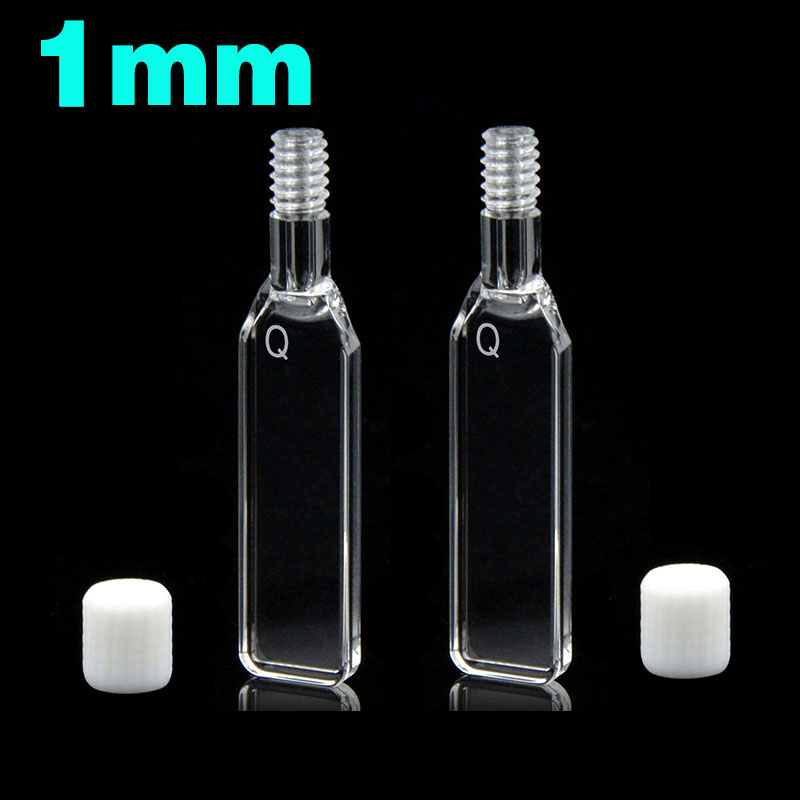 JGS1 · 1 mm
Quartz 1 mm Screw-Cap, Molded 83
Effective cutoff ~165 nm, four-way light. For peptide bond at 200–220 nm and concentrated samples that saturate at 10 mm. Sealed for volatile-solvent UV work.
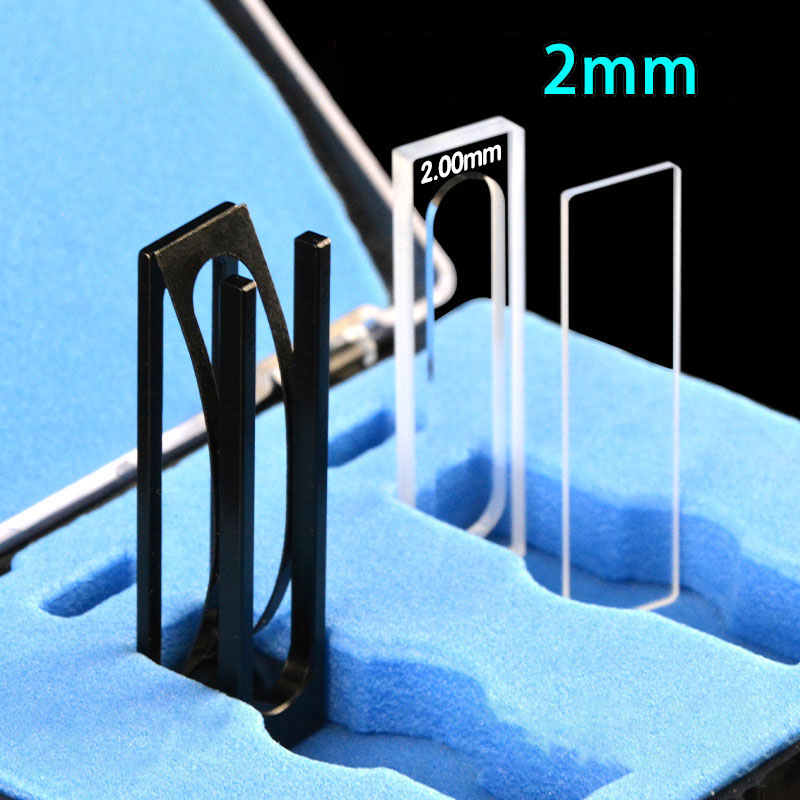 DEMOUNTABLE
Quartz 2 mm Detachable, Molded 83
Effective cutoff ~165 nm with purged spectrometer. Detachable for neat-liquid VUV-adjacent work.
 JGS2 · 10 mm
Quartz 10 mm Ultra-Micro, JGS2
Cutoff ~220 nm. Standard path with sub-micro 50 µL volume — ideal for A260/A280 nucleic acid and protein quantitation.
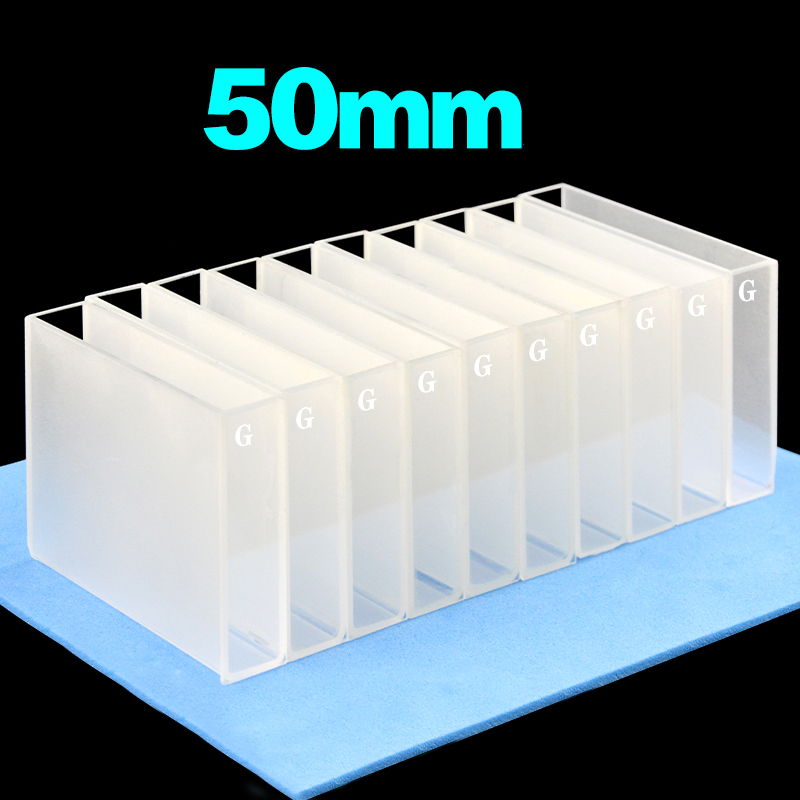 GLASS · 50 mm
Glass 50 mm, Sintered 80
Long-path cell with optical glass cutoff ~320 nm. Trace-color analysis where deep UV is not required (340–1100 nm).
 GLASS · 100 mm
Glass 100 mm, Standard 80
Visible-range trace analysis. For UV work below 340 nm, swap to a JGS1 quartz long-path version (custom build).
CUSTOM
Need a non-standard grade or geometry?
0.1–200 mm path, JGS1 / JGS2 / JGS3, sintered or molded, certified transmission. 8–14 day lead.
Need a cuvette validated to a specific cutoff?
We ship a transmission certificate with every cell. Send us your application wavelength and we will quote the right grade, geometry, and verification points.
Request a quote → Browse size chartWhy You Can Trust This Page
AuthorMachinedQuartz Technical Team
Reviewed byBryan Wright (Founder, 13+ yrs in quartz cuvette manufacturing)
Production baseJGS1 / JGS2 / JGS3 stocked in-house · transmission certified per cell
Last updatedMay 6, 2026 · Next review November 2026
Methodology: cutoff numbers are taken from manufacturer datasheets (Heraeus Suprasil, GE 124, Corning 7980, JGS Group) and cross-checked against MQ’s own transmission scans across our cuvette inventory. Path-length effective cutoffs are computed from Beer-Lambert and validated on a Cary 60 with deuterium source.
References
- ASTM E275-22 — Standard Practice for Describing and Measuring Performance of UV/Vis/NIR Spectrophotometers
- Edmund Optics — UV vs IR Grade Fused Silica
- RP Photonics — Fused Silica properties and grades
- Lake Shore Cryotronics — Fused Silica UV Grade transmission data
- USP <788> — Particulate matter in injections (cuvette UV cutoff requirements)


Recent Comments