
Fused Quartz Labware: When to Upgrade from Borosilicate (17-Family Selection Guide)
Selection guide to MachinedQuartz’s 17 fused quartz labware families and 133 SKUs — when fused quartz beats borosilicate (and when it does not).
Selection guide to MachinedQuartz’s 17 fused quartz labware families and 133 SKUs — when fused quartz beats borosilicate (and when it does not).
A calcium fluoride (CaF₂) optical window is an alkali fluoride single-crystal window with high transmission from 130 nm (vacuum UV) to 9 µm (mid-IR), used in FTIR cells, ATR accessories, mid-IR laser optics, and X-ray spectroscopy where standard quartz becomes opaque above 3.5 µm and sapphire above 5 µm. CaF₂ is mechanically softer than quartz
A sapphire optical window is a single-crystal Al₂O₃ window with exceptional mechanical strength (compressive strength 2,000 MPa vs quartz 1,100 MPa), wide transmission range (170 nm to 5.5 µm), and chemical inertness — the standard choice for high-pressure cells (up to 2,000 bar), laser optics above 100 W/cm², high-temperature flow cells to 1,500 °C, and
The Z-dimension of a cuvette is the distance from the bottom of the cell base to the center of the spectrophotometer’s optical beam — typically 8.5 mm (Beckman DU, Eppendorf, and various clinical/older instruments), 15 mm (the modern standard: Agilent, Shimadzu, Thermo, PerkinElmer Lambda), or 20 mm (Agilent Cary 4000/5000/6000i and some specialty research instruments).
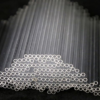
Quartz capillary tubes and rods are precision-drawn fused-silica tubes (hollow) and rods (solid) with outer diameters from 0.5 mm to 50 mm, used in X-ray diffraction, gas chromatography injectors, capillary electrophoresis, microfluidics, fiber-optic preforms, and high-temperature furnace tubes. Selection depends on three parameters: profile (round, square, rectangular, or D-shape), grade (JGS1/JGS2/JGS3 by wavelength), and finish
The UV cutoff of a quartz cuvette is the wavelength at which optical transmission drops below 50% on a 10 mm path — JGS1 at ~185 nm (deep UV), JGS2 at ~220 nm (standard UV-Vis), and JGS3 at ~260 nm (IR-optimized, with reduced UV performance). The cutoff is set mainly by metallic impurities and the melting
Choosing between quartz, sapphire, and CaF₂ optical windows is a decision driven by wavelength range, pressure rating, chemical compatibility, and cost. Quartz (185–3,500 nm) covers UV-Vis-NIR at the lowest cost; sapphire (170 nm–5.5 µm) extends into mid-IR with 3× compressive strength for high-pressure work; CaF₂ (130 nm–9 µm) reaches deepest into the mid-IR but is
A DLS / particle-sizing cuvette is a specialty quartz cell with a flat polished bottom and four optically polished sides, designed for dynamic light scattering instruments (Malvern Zetasizer, Brookhaven NanoBrook, Wyatt DynaPro) that measure 90° or backscatter intensity. Standard DLS cells are 12.5 × 12.5 × 45 mm with 800 µL volume; sub-microliter sizing requires
A thermostatted cuvette is a sealed quartz cell designed to hold sample at a precisely controlled temperature (±0.1 °C) during a UV-Vis or fluorescence measurement, used in DNA melting curves (40–95 °C), enzyme kinetics (4–60 °C), and protein denaturation studies. The cell is mounted in a Peltier-cooled or water-jacketed holder; a screw cap prevents evaporation,
Cuvette and spectrophotometer verification per USP and EP is a quarterly pharmacopeia-mandated qualification of UV-Vis instruments and their cells, used in pharmaceutical QC to confirm wavelength accuracy (±1 nm), absorbance accuracy (±0.005 AU at A = 1), stray light (< 0.01% at 200 nm), and resolution (≤ 2 nm bandwidth). The protocol uses certified reference


Recent Comments