
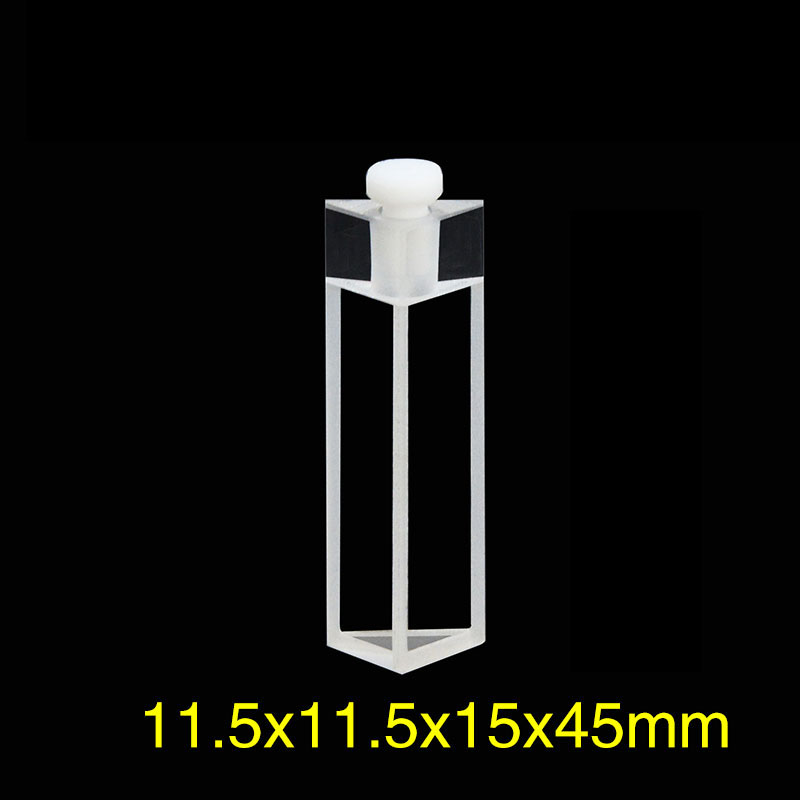
Quartz Stoppered Triangular Cuvette, 1.75ml, Standard 80, Three-Way Light, PTFE Stopper, 1pc/ea, C153SS1
10%
Original price was: $270.00.$243.00Current price is: $243.00.
Quartz triangular cuvette, 1.75 ml, Standard 80 (>80%). Three-Way Light for 90° fluorescence detection. 190–2500 nm. PTFE Stopper. 1 pc/ea. SKU: C153SS1. In Stock.
In Stock
Description
The C153SS1 is a stoppered quartz triangular cuvette with three-way light transmission, designed for fluorescence spectroscopy involving volatile or hazardous samples that require a sealed optical chamber. The PTFE stopper prevents evaporation and contamination, while Standard 80 fabrication (>80% transmittance, 190–2500 nm) ensures consistent UV–Vis–NIR performance across the full 1.75 ml working volume.
Technical Specifications
| Specifications – C153SS1 Triangular Cuvette | |||
|---|---|---|---|
| Material | Quartz (Fused Silica) | SKU | C153SS1 |
| Type | Triangular Cuvette | Internal Volume | 1.75 ml |
| Optical Windows | Three-Way Light (3 polished faces) | Fabrication | Standard 80 |
| Transmittance | >80% | Wavelength | 190–2500 nm |
| Exterior Dimensions | 11.5 × 11.5 × 15 × 45 mm | Interior Dimensions | — |
| Cap / Stopper | PTFE Stopper | Package | 1 pc/ea |
Why Triangular Geometry?
Triangular cuvettes feature three optically polished faces arranged in a prism configuration. This geometry enables simultaneous excitation and 90° emission collection — the standard measurement angle in fluorescence spectroscopy — while the third face can serve as a reference or secondary detection path. Compared to standard rectangular four-window cells, triangular cuvettes minimize back-reflection artifacts and reduce inner-filter effects.
Applications
◆ Fluorescence Spectroscopy (excitation/emission at 90°)
◆ Raman Spectroscopy
◆ Phosphorescence & Luminescence Analysis
◆ Fluorescence Polarization / Anisotropy
◆ Multi-Angle Light Scattering (MALS)
◆ Turbidimetry & Nephelometry
◆ Environmental Water Quality Monitoring
◆ Pharmaceutical QC & Drug Analysis
◆ Raman Spectroscopy
◆ Phosphorescence & Luminescence Analysis
◆ Fluorescence Polarization / Anisotropy
◆ Multi-Angle Light Scattering (MALS)
◆ Turbidimetry & Nephelometry
◆ Environmental Water Quality Monitoring
◆ Pharmaceutical QC & Drug Analysis
Why Standard 80?
Standard 80 cuvettes use precision adhesive bonding to achieve transmittance above 80% at a competitive price point. The bonding process delivers reliable optical performance for routine fluorescence and spectroscopic measurements, making it an economical choice for teaching labs, screening assays, and high-throughput workflows.
Usage Tips
Cleaning: Rinse with spectroscopic-grade solvent immediately after use. For stubborn residue, soak in chromic acid or dilute HNO₃, then rinse thoroughly with deionized water.
Handling: Hold by the frosted or non-optical face only. Fingerprints on polished surfaces cause scattering artifacts in fluorescence measurements.
Orientation: Align the excitation beam perpendicular to one polished face; position the emission detector at 90° through the adjacent polished face for optimal signal-to-noise ratio.
Custom Orders: Need a different volume, path configuration, or specialized coating? We offer custom triangular cuvette fabrication. Contact us with your specifications.
Specifications are nominal values measured under standard conditions. Actual transmittance may vary slightly by wavelength. Images are representative; minor cosmetic variations do not affect optical performance.
Additional information
| Weight | 30 g |
|---|
You must be logged in to post a review.
Related products
15%
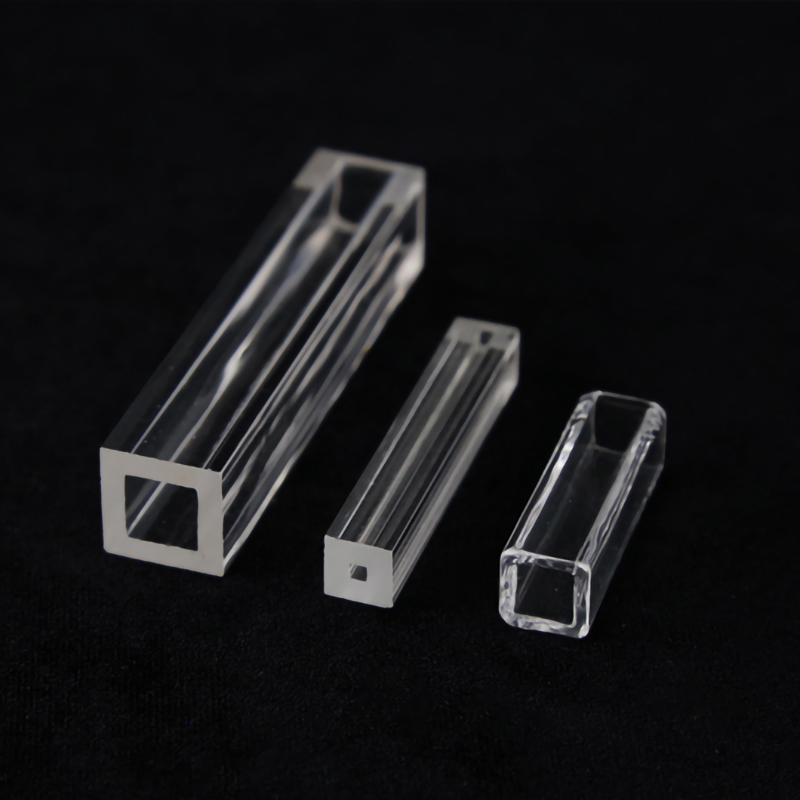
(MQC379) Quartz Capillary Tubes (Square), Outer Dim.: 1x1mm, Inner Dim.: 0.2×0.2mm, Length: 50mm
Original price was: $28.00.$24.00Current price is: $24.00.14%
(MQC375) Quartz Capillary Tubes (Square), Outer Dim.: 1.8×1.8mm, Inner Dim.: 0.25×0.25mm, Length: 100mm
Original price was: $38.00.$33.00Current price is: $33.00.15%
(MQC365) Quartz Capillary Tubes (Square), Outer Dim.: 0.95×0.95mm, Inner Dim.: 0.35×0.35mm, Length: 50mm
Original price was: $28.00.$24.00Current price is: $24.00.15%
Reviews
There are no reviews yet.