
Round-Bottom Quartz Screw Vial: Supporting the Bottle During Sampling
Custom Design Guides · MQQSV001
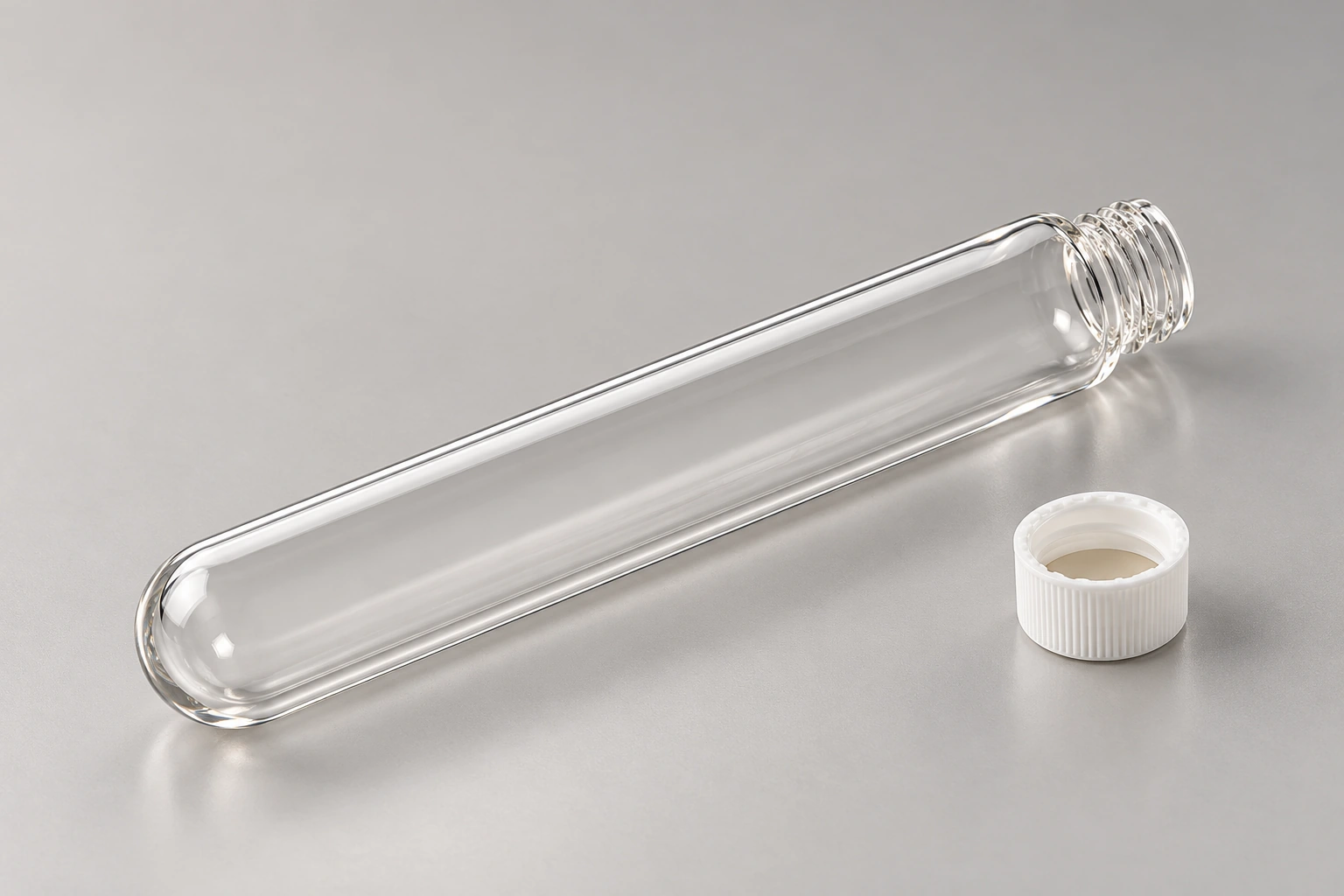
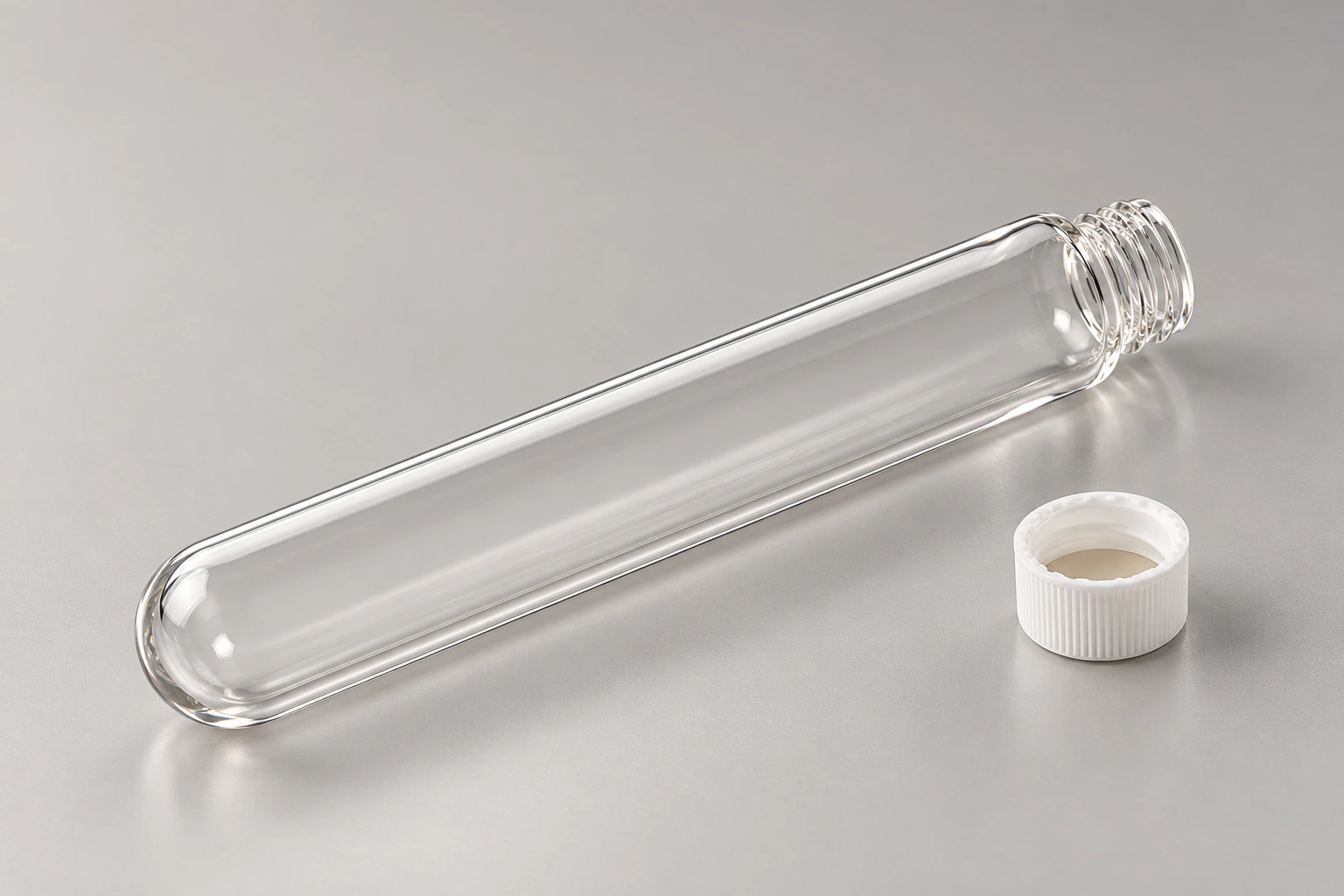
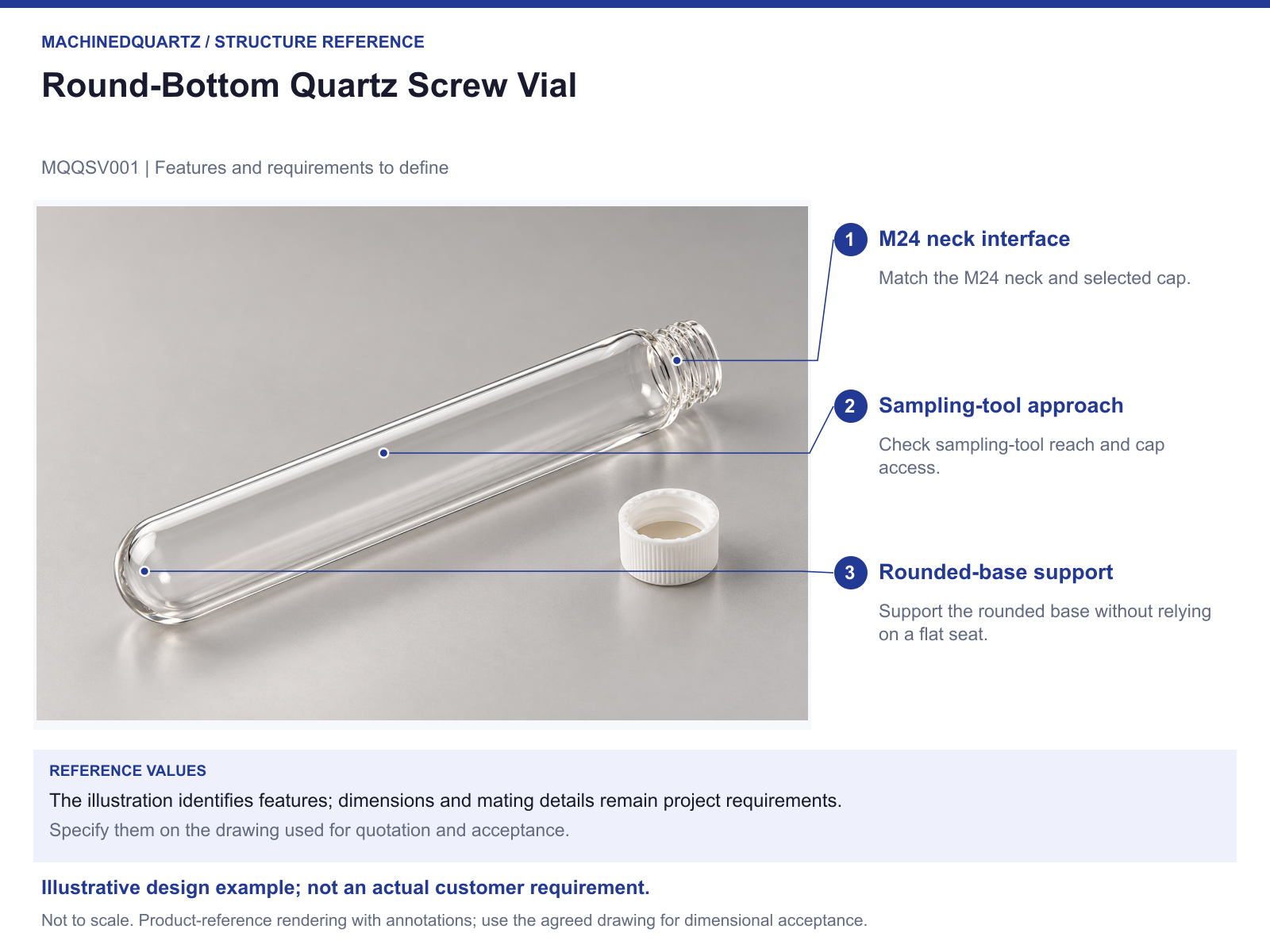
MQQSV001 is a nominal 150 mL quartz sample vial with a rounded base, M24 screw-neck feature and injectable cap. Its support requirement is different from the flat-bottom vials elsewhere in this series.
Consider the whole sampling arrangement: where the bottle sits, how it is restrained while the closure is used and how the sampling tool approaches the cap. A large nominal capacity does not answer those mechanical questions.
In this guide: Configuration · Design comparison · The support is part of the bottle selection · Separate the M24 thread from the sampling interface · Why choose a round-bottom screw vial? · A custom request can retain the body and change access · Enquiry
The configuration discussed here
What changes from the simpler form?
The round-bottom screw vial retains a threaded sampling opening but changes the lower body from a flat seating face to a curved form. A support matched to that base becomes part of the preparation layout.
The support is part of the bottle selection
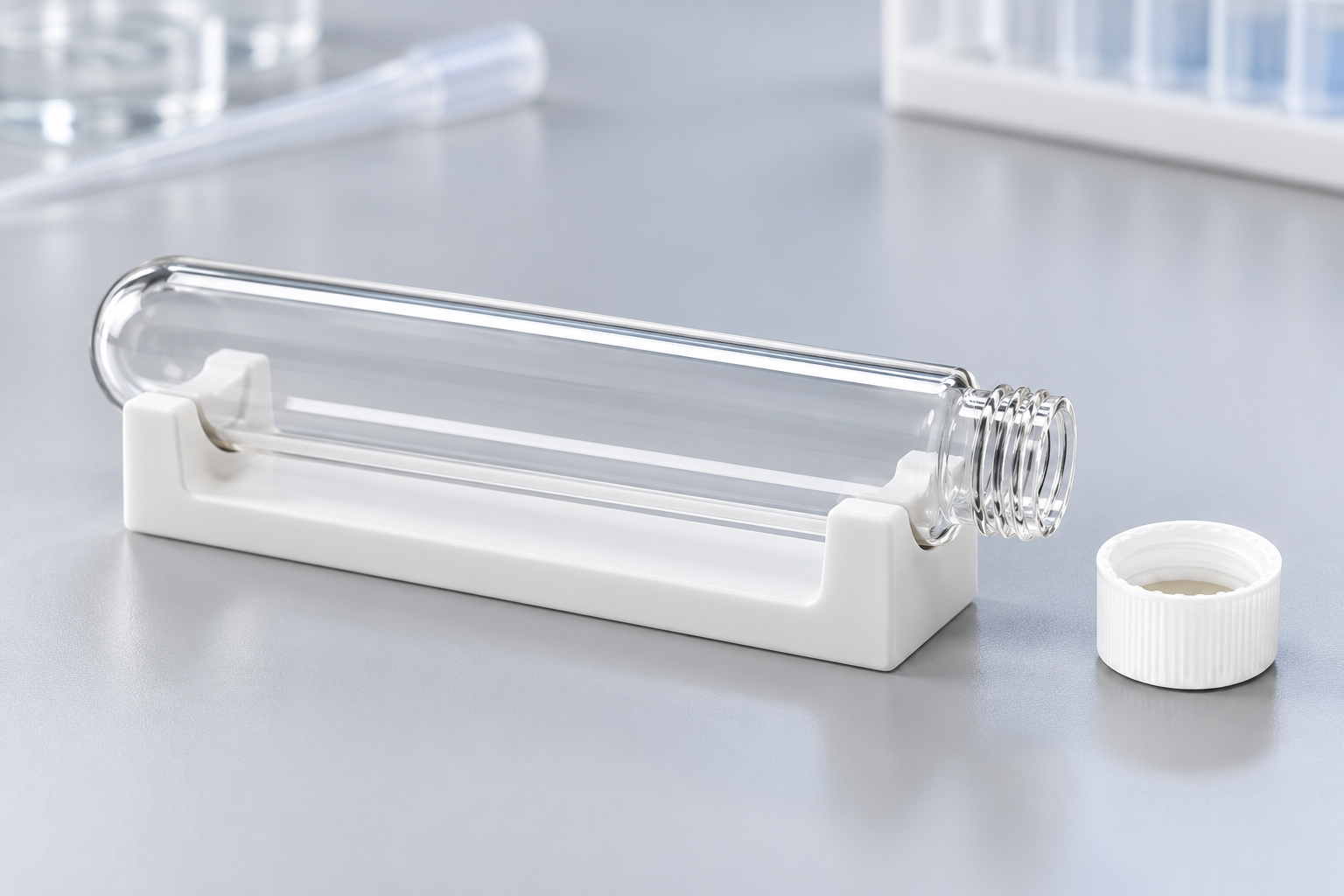
A round-bottom vessel does not have the same bench contact as a flat-bottom vial. Identify the support cradle or holder and the surfaces that meet the body. Include the intended fill and orientation in the drawing.
For example, a sampling tool may be brought to the cap while the bottle remains seated. The support needs to be described for that operation, rather than relying on someone to steady the neck or cap by hand.
Separate the M24 thread from the sampling interface
M24 identifies a nominal neck-thread feature. It does not specify every closing contact, liner or cap detail. If a replacement cap is needed, provide the actual mating part or drawing as well as the thread designation.
The sampling access has its own requirements. State the tool, approach and depth, and identify any required vent or other route. An injectable-cap description does not establish a needle gauge, repeated resealing result or complete sampling method.
Why choose a round-bottom screw vial?
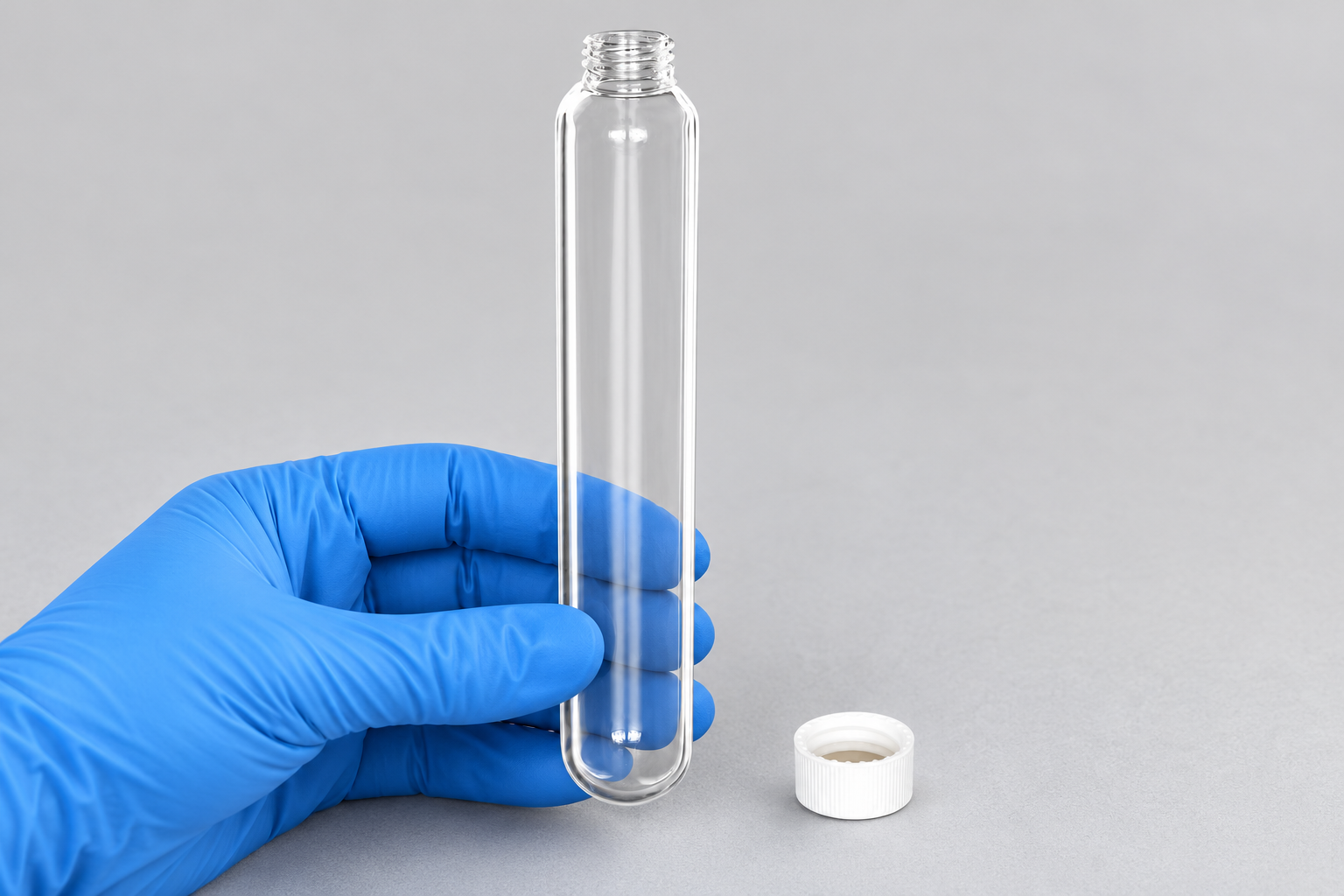
The form is worth discussing when the existing apparatus already supports a rounded vessel or when the body geometry is a specific process requirement. Explain that constraint to MQ; do not assume the rounded base is a performance improvement in every setup.
Compared with an ordinary open round-bottom tube, the screw-neck and cap add a defined closure assembly to review. Compared with a flat-bottom sample bottle, the body requires a different support. These are separate design choices.
A custom request can retain the body and change access
A possible request is to keep the nominal vessel class and support envelope while reviewing the cap interface for an existing sampling tool. Mark the body dimensions to retain and provide the cap, contact and tool geometry.
Agree the operating conditions and any proposed fit or closure checks before quotation. No sterile, anaerobic, pressure or vacuum qualification is established by the vessel and cap appearance.
Structure reference and specification points
Download the structure reference (PDF)
Can the round-bottom vial be placed on the bench like a flat-bottom bottle?
Its rounded base needs a suitable support arrangement. Define the actual cradle, restraint and sampling sequence rather than assuming stable unsupported placement.
Send a drawing or the mating-part details
Send the bottle support and cap-access sketch together. MQ can review the vessel as a sampling assembly rather than only a nominal 150 mL container.
- Working fill, orientation and support drawing
- M24 mating-neck and cap details
- Sampling-tool type, approach and required depth
- Contents, contact conditions and any closure requirement
- Quantity, requested date and agreed verification
Modified designs are reviewed for the project. The drawing, supplied parts, quantity, inspection scope, price and preparation or production time are agreed in the quotation.
Details to settle for the ordered configuration
Cap-contact materials, tool compatibility, leakage, reuse, sterile status and operating limits remain to be confirmed.



Recent Comments