
NIR Quartz Cuvettes for 700–2,500 nm Spectroscopy
This post is also available in:
NIR Quartz Cuvettes
NIR Quartz Cuvettes for 700–2,500 nm Spectroscopy
JGS3-grade quartz cells optimized for the near-infrared window — grain moisture analyzers, pharma raw-material identification, polymer film QC, and biomedical NIR. Where standard JGS1 hits OH absorption, JGS3 stays transparent to 3,500 nm.
700–2,500 nm
NIR Window
JGS3 Grade
OH-Free Quartz
0.5–50 mm
Path Length
2-Way / 4-Way
Light Geometry
An NIR quartz cuvette is a near-infrared spectroscopy cell made from JGS3-grade fused quartz, transparent from approximately 260 nm through 3,500 nm — covering the full NIR window (700–2,500 nm) without the OH-absorption dip at 2,200 nm that limits standard JGS1/JGS2 cells. NIR cuvettes are used in grain moisture analyzers, pharmaceutical raw-material identification (PAT), polymer film thickness measurement, and biomedical tissue spectroscopy, with path lengths typically 1–10 mm to balance signal strength against the strong NIR water bands.
TL;DR — When you need a dedicated NIR cell, not just any quartz cuvette:
NIR overlaps water and OH absorption peaks at 1,440 nm and 1,940 nm — bands that JGS3 quartz handles cleanly while JGS1 and JGS2 distort. If you’re running a Foss, Buchi NIRFlex, MicroNIR, or any process NIR analyzer above 1,200 nm and seeing baseline tilt, the cell material is your first suspect. JGS3 cells are made-to-order with a 4–6 week lead time.
Material Choice
Why JGS3 quartz, not JGS1 or JGS2
The three optical-grade quartz materials look identical to the eye but have very different transmission profiles in the infrared. The key difference is the OH (hydroxyl) content of the melt — and OH absorbs strongly at 2.2 µm (2,200 nm), right inside the NIR window.
| Grade | Transmission Window | OH content (ppm) | Best For |
|---|---|---|---|
| JGS1 | 185 – 2,500 nm | ~1,000 | UV-Vis & deep-UV; OH dip at 2,200 nm makes it poor for NIR > 2,000 nm |
| JGS2 | 220 – 2,500 nm | ~80–150 | Standard UV-Vis; mid-NIR also impaired by OH |
| JGS3 | 260 – 3,500 nm | < 5 | NIR (700–2,500 nm) and short-wave IR (up to 3,500 nm); the NIR cuvette material of choice ✅ |
For a deeper material comparison see our quartz UV cutoff guide.
Decision rule: If your NIR measurement is below ~1,800 nm and away from the 1,440 nm water band, JGS2 is workable. For any NIR work above 1,800 nm, in process analyzers, or where you need clean baseline at 2,200 nm and beyond — specify JGS3.
Why It Matters
The water bands — what makes NIR cuvette selection different
Aqueous samples in the NIR have two dominant water absorption peaks: a moderate one at 1,440 nm (1st overtone of OH stretch) and a much stronger one at 1,940 nm (combination band). These bands fundamentally control your path-length choice in a way they don’t for UV-Vis.
| Wavelength | Water absorbance through 10 mm cell | Path-length implication |
|---|---|---|
| 900 nm (NIR start) | ~0.05 AU | 10 mm fine |
| 1,200 nm | ~0.5 AU | 10 mm OK |
| 1,440 nm (1st OH overtone) | ~3.2 AU | 1 mm needed for transmission |
| 1,650 nm | ~0.7 AU | 5 mm preferred |
| 1,940 nm (water combo band) | > 10 AU | Sub-mm or measure dry sample |
| 2,200 nm | ~6 AU | 0.5–1 mm; JGS3 mandatory |
This is why most commercial NIR analyzers default to 1 mm or shorter path lengths for aqueous samples — half the analytical interest is in regions where water alone saturates a 10 mm cell. For dry samples (powders measured in transmission, polymer films, gas-phase), longer cells (10–50 mm) are routine.
For a complete treatment of path length × concentration trade-offs, see our path-length-by-analyte selection matrix and the Beer-Lambert law guide.
Applications
Six places NIR quartz cells earn their cost premium
Agriculture
1. Grain & feed moisture
Foss Infratec, Bruker MPA, Buchi NIRFlex measuring wheat, corn, soy moisture and protein. JGS3 5 mm cells handle the 1,940 nm water band without saturation.
Pharma PAT
2. Raw material identification
USP <1119> NIR ID for incoming pharma materials. Sealed JGS3 sample vials let QC verify identity through the cap, no aliquoting. Sintered 83 fab for solvent resistance.
Polymer
3. Polymer film thickness & composition
Inline NIR sensors on extrusion lines measure film thickness via the C-H overtone band at 1,730 nm. 1–2 mm process flow cells in JGS3 keep the baseline flat.
Biomedical
4. Tissue oximetry & cerebral NIR
Functional NIR (fNIRS) and tissue spectroscopy at 760, 850, 905 nm benefit from low-stray-light JGS3 reference cells for instrument calibration.
Petroleum
5. Crude oil & fuel composition
Octane number, water content, biodiesel blend ratio — all routine on lab and inline NIR. Sealed long-path (10 mm) JGS3 cells handle dark crude with PTFE caps for solvent compatibility.
Food
6. Fat / sugar / alcohol QC
Dairy fat, juice Brix, beer alcohol — NIR replaces wet-chem methods. Disposable PE cells are common for high-throughput; JGS3 cells used for reference and calibration transfer.
Instrument Fit
Compatibility with common NIR analyzers
NIR instruments use a wider range of cell formats than UV-Vis. Match cell dimensions to your instrument’s sample compartment before ordering:
| Instrument | Wavelength range | Typical cell format |
|---|---|---|
| Foss Infratec Sofia (grain) | 850–1,050 nm | Module-specific quartz disc |
| Buchi NIRFlex N-500 / NIRMaster | 800–2,500 nm | Vials and 10 × 10 mm cells |
| Bruker MPA / Tango / Matrix | 800–2,500 nm | Standard 10 mm + module-specific |
| Thermo Antaris II / Nicolet iS50 NIR | 800–2,500 nm | Standard 10 × 10 mm + transmission accessories |
| JDSU MicroNIR (handheld) | 950–1,650 nm | Direct contact + transmission cell adapters |
| PerkinElmer Spectrum Two N | 1,000–2,500 nm | Standard 12.5 × 12.5 mm |
| Process inline (Yokogawa, Endress) | 1,000–2,500 nm | Custom flow cell, JGS3, 1–5 mm path |
For instrument-specific cell holder dimensions or non-standard form factors, MachinedQuartz will fabricate to drawing in 4–6 weeks (MOQ 1). See our US Manufacturer Guide for the spec-to-quote workflow.
Product Range
Stock NIR-suitable cuvettes
The following stock SKUs ship in JGS1 or JGS2 by default; JGS3 versions of any of them are available with a 4–6 week lead time. Specify JGS3 in your quote request for true NIR work.
| SKU | Path | Body | Light | Best NIR use |
|---|---|---|---|---|
| C012CR | 1 mm | Standard | 2-way | Aqueous near 1,440 nm water band |
| C022CR | 2 mm | Standard | 2-way | Light aqueous, dry powder transmission |
| C052CR | 5 mm | Standard | 2-way | Grain & feed moisture |
| C102CR | 10 mm | Standard | 2-way | Dry samples, polymer films, gas-phase |
| C202CR8 | 20 mm | 20mm body | 2-way | Long-path NIR, dilute samples |
| C014WS3 | 1 mm | Flow, 4mm OD | 4-way | Process NIR with fluorescence option |
| C022WS7 | 2 mm | Flow, 5mm OD | 2-way | Inline polymer / oil monitoring |
| C034WS | 3 mm | Flow, 4mm OD | 4-way | NIR + side-emission scattering |
| Custom drawing | 0.5–50 mm | Any | Any | OEM integration; MOQ 1 in JGS3 |
→ Browse all IR / NIR cuvettes · See the complete cuvettes & cells size chart
NIR-suitable cells in stock
From short-wave NIR to full mid-IR boundary

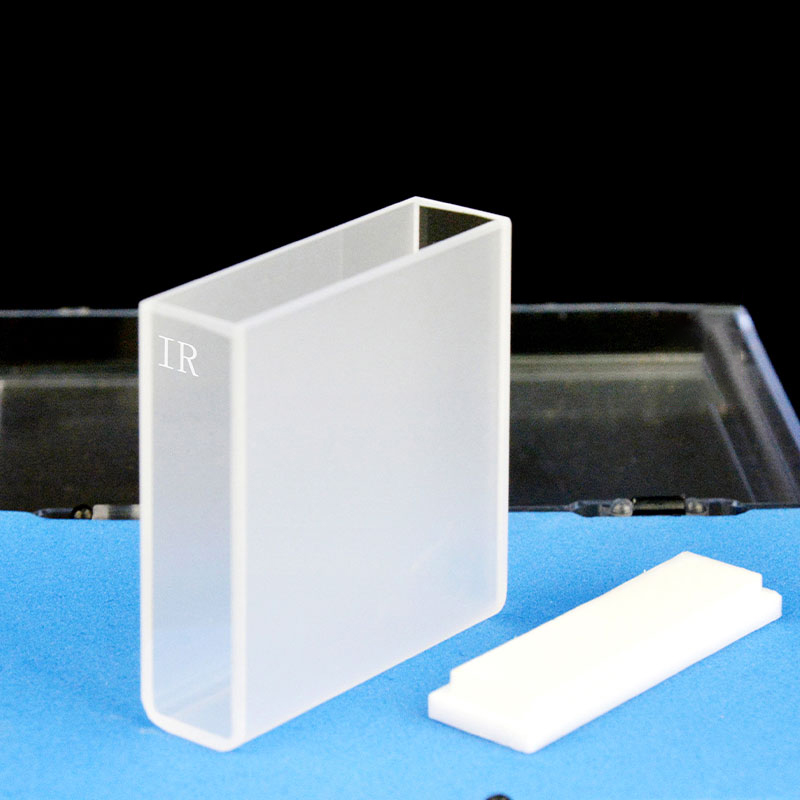
C402CR7
Quartz 40mm Infrared Cuvette
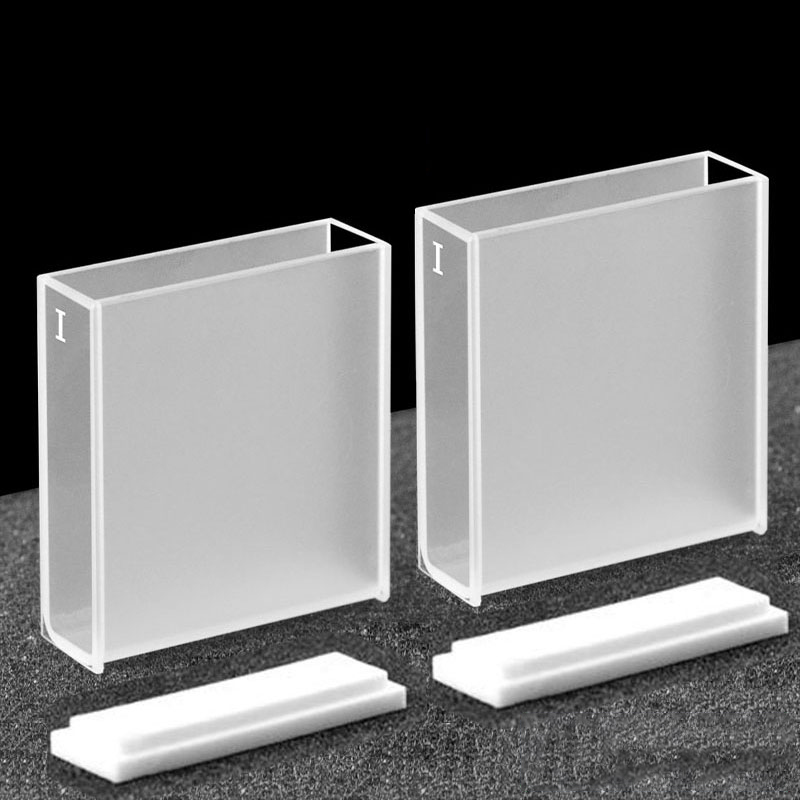
C402CR6
Quartz 40mm Infrared Cuvette
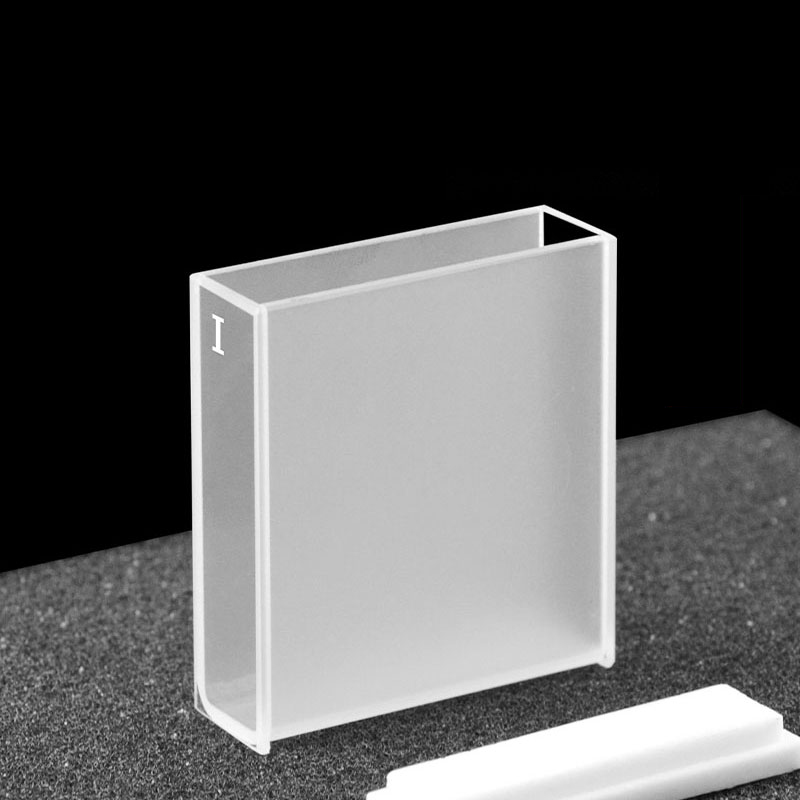
C402CS7
Quartz 40mm Infrared Cuvette
C402CS6
Quartz 40mm Infrared Cuvette
Standard JGS1/JGS2 SKUs ship same day; JGS3 versions of any geometry available custom in 4–6 weeks.
Selection Guide
Pick the right NIR cell — 4-step decision
Step 1 — Identify your NIR wavelength range
Below 1,800 nm: JGS2 acceptable, JGS3 preferred. 1,800–2,500 nm: JGS3 mandatory. Above 2,500 nm (mid-IR / FT-IR): leave quartz entirely — use CaF₂ or sapphire.
Step 2 — Choose path length by water content
Aqueous samples in NIR: 1–2 mm path is the default. Dry powders / films / gas: 10–50 mm. Use the path-by-analyte matrix for specific concentration cases.
Step 3 — Select fabrication for solvent + temperature
Aqueous-only at room temperature: Standard 80 (lowest cost). Mixed organic solvents up to 600 °C: Sintered 80 / Sintered 83. Pharma QC requiring T > 83% transmission and steam autoclave: Molded 83. See fabrication methods.
Step 4 — Confirm holder dimensions
Many NIR analyzers (especially Foss/Buchi/Bruker) use proprietary cell formats — measure your cell-holder before ordering, or send the instrument model and we’ll cross-reference compatibility.
Need JGS3 in a non-standard size?
MachinedQuartz fabricates custom NIR cells from drawing in 4–6 weeks, MOQ 1. Specify JGS3 grade in the quote request.
Request Custom Quote Browse Stock SKUsFAQ
Frequently asked questions
What’s the difference between an NIR cuvette and a UV-Vis cuvette?
The cuvette body itself can be identical — the critical difference is the quartz grade. UV-Vis cuvettes use JGS1 (deep UV) or JGS2 (standard UV-Vis); NIR cuvettes use JGS3, which has < 5 ppm OH content and stays transparent through 3,500 nm. JGS1/JGS2 cells show a strong absorption dip around 2,200 nm that contaminates NIR measurements above 1,800 nm.
Can I use a regular quartz cuvette for NIR if I’m only working below 1,500 nm?
Yes, JGS2 cells are workable in the short-wave NIR (700–1,500 nm) where OH absorption isn’t yet dominant. Above 1,800 nm, JGS3 becomes mandatory. The risk with JGS1/JGS2 even at 1,000–1,500 nm is baseline drift over time as humidity affects the sample chamber, plus you can’t transfer a calibration to longer wavelengths later. For new method development, default to JGS3.
Why do most NIR methods use 1 mm or shorter path lengths?
Water absorbs strongly across the NIR — at 1,940 nm a 10 mm aqueous cell is fully opaque (A > 10 AU). Even at 1,440 nm (the first OH overtone) a 10 mm cell reads ~3.2 AU, well above the linear range. Shortening to 1 mm puts these bands in the 0.3–1.0 AU sweet spot. Dry samples (powders, films, gas) don’t have this constraint and routinely use 10–50 mm cells.
Is JGS3 necessary for handheld NIR analyzers like MicroNIR?
The JDSU MicroNIR covers 950–1,650 nm — within the JGS2-acceptable range. For pure handheld work in this band, JGS2 cells will work. If your workflow includes both handheld scanning and lab calibration transfer to longer-wavelength instruments (Buchi NIRFlex, Bruker MPA), use JGS3 throughout to avoid spectral cross-talk.
Do I need a 4-way light cell for NIR?
For pure transmission NIR (which is most NIR work — Foss, Buchi, Bruker, MicroNIR), 2-way is sufficient. 4-way is needed if your instrument also collects 90° backscatter or fluorescence (some process analyzers, biomedical research setups). Specify 4-way if there’s any chance you’ll add scattering measurements later — the cost premium is small and you avoid re-buying.
How does NIR cleaning differ from UV-Vis cuvette cleaning?
The NIR-specific concern is residual water — even a thin film of water on the inner surface contributes significant absorbance at 1,440 and 1,940 nm. After standard solvent cleaning, finish with anhydrous methanol or ethanol displacement, then dry with N₂. Verify with a baseline scan at 1,940 nm — if you see a peak above 0.05 AU through an empty cell, it’s residual water. See the full cuvette cleaning protocol.
What’s the difference between NIR and short-wave IR (SWIR)?
The terms overlap. NIR is loosely 700–2,500 nm. “SWIR” usually means 1,000–2,500 nm and is the term used in remote-sensing and hyperspectral imaging. Above 2,500 nm is mid-IR (MIR or just “IR”) which needs CaF₂, sapphire, or KBr — quartz becomes opaque around 3,500 nm. For the boundary case 2,500–3,500 nm, JGS3 still works.
What’s the lead time for a custom JGS3 cell?
Stock NIR-suitable cells (JGS1/JGS2) ship same day from our US warehouse (5–8 days to lab). JGS3 versions are made-to-order: 4–6 weeks for path lengths up to 20 mm, 6–8 weeks for 50 mm or larger. MOQ 1 — no minimum order quantity for JGS3 custom work.
Send us your NIR analyzer model
We’ll cross-reference cell-holder dimensions and recommend JGS3 path length based on your wavelength range — typical reply within 24 hours.
Email Sales Read Selection Guide

Recent Comments