
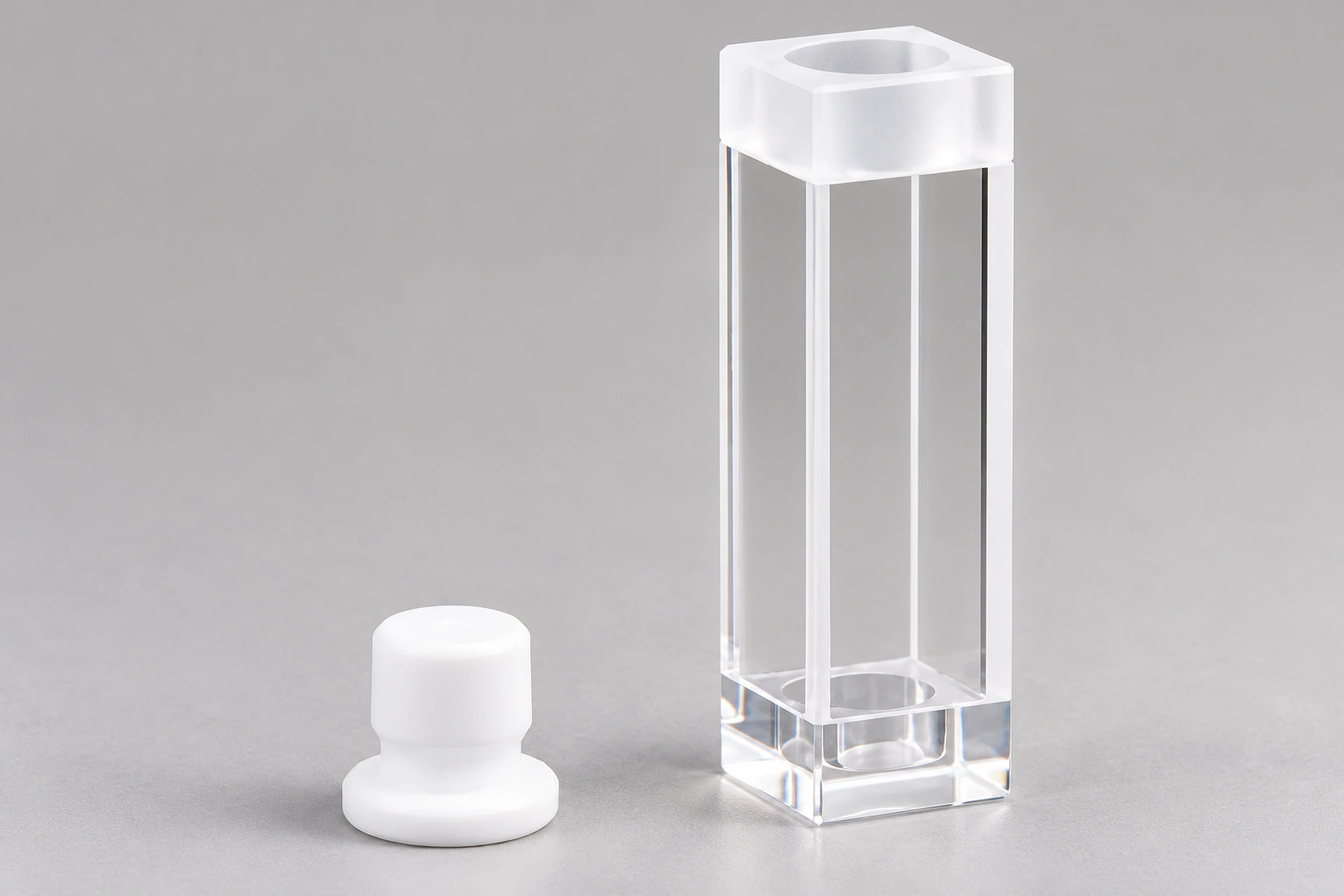
Stoppered Fluorescence Cuvette: Specifying the Opening and Closure Fit
Custom Design Guides · C104SS21
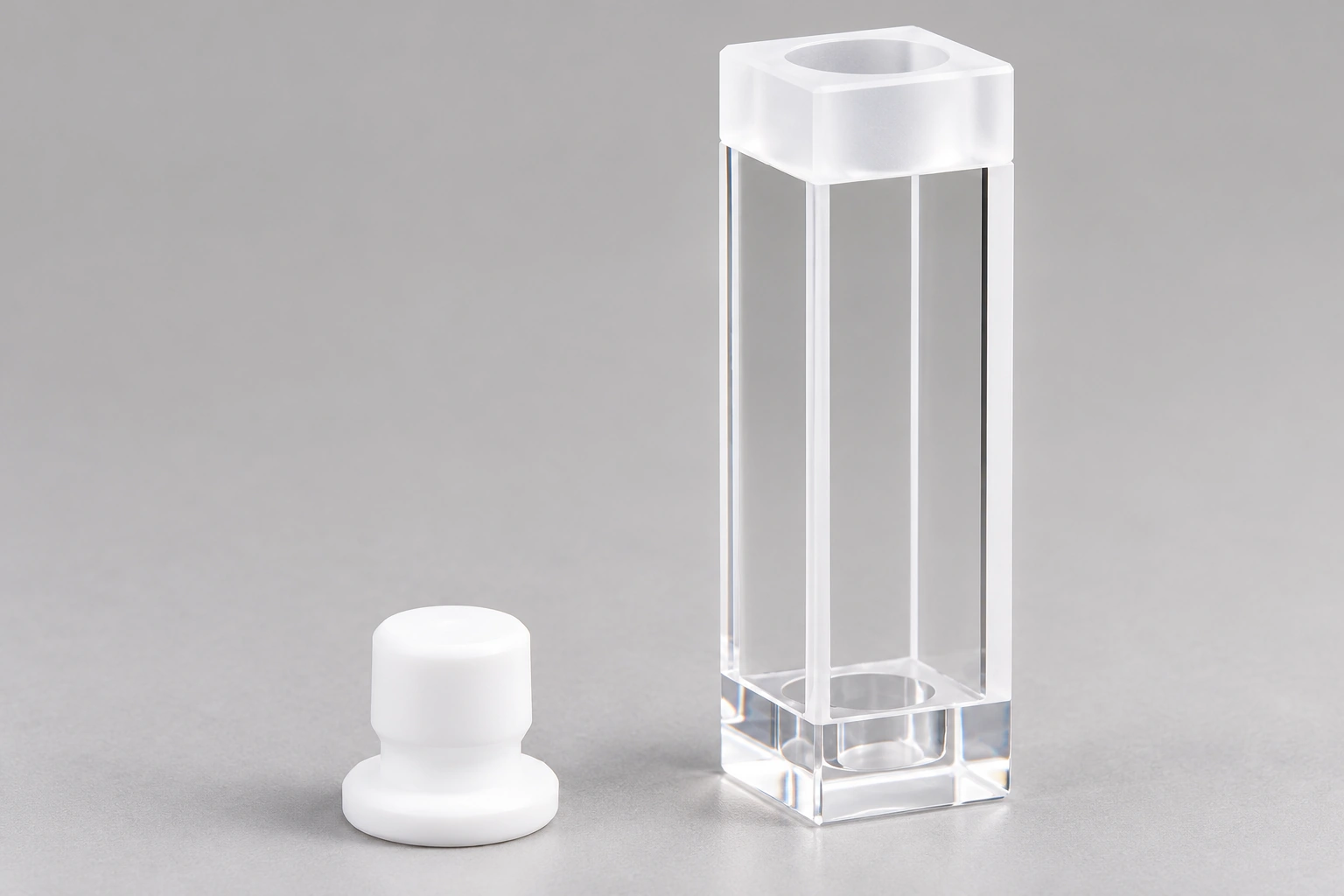
C104SS21 combines a quartz fluorescence-cuvette form with a separate stopper and four side optical-access directions. The current reference is the nominal 10 mm path, 3.5 mL configuration.
The closure needs its own fit description. A stopper shown beside a cell does not establish the contact profile, a leakage result or interchangeability with another stopper of a similar appearance.
In this guide: Configuration · Design comparison · Keep the optical faces clear during opening · Specify the stopper contact instead of a generic seal · Retain the chamber while reviewing the opening · Give the sample and closure conditions together · Enquiry
The configuration discussed here
What changes from the simpler form?
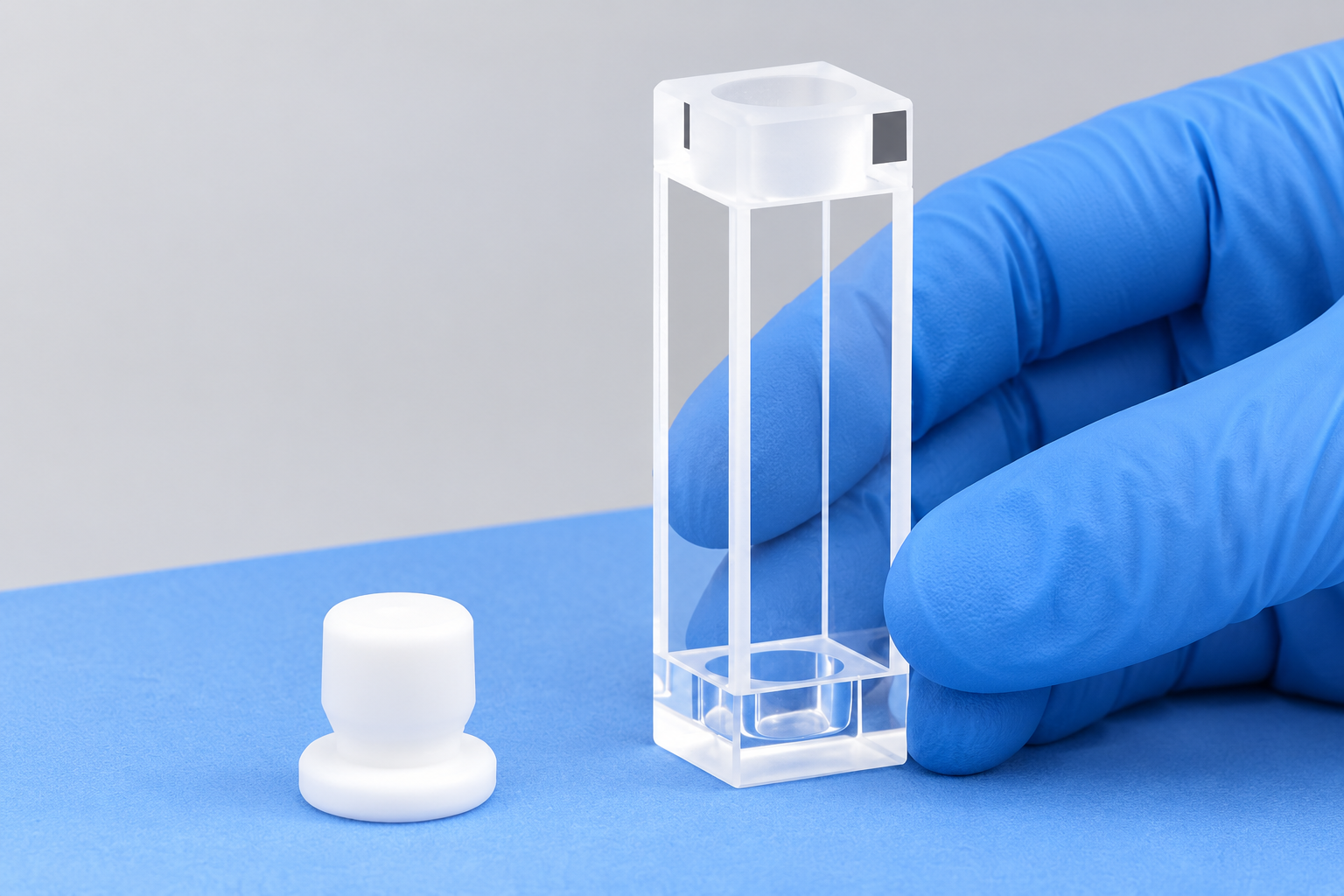
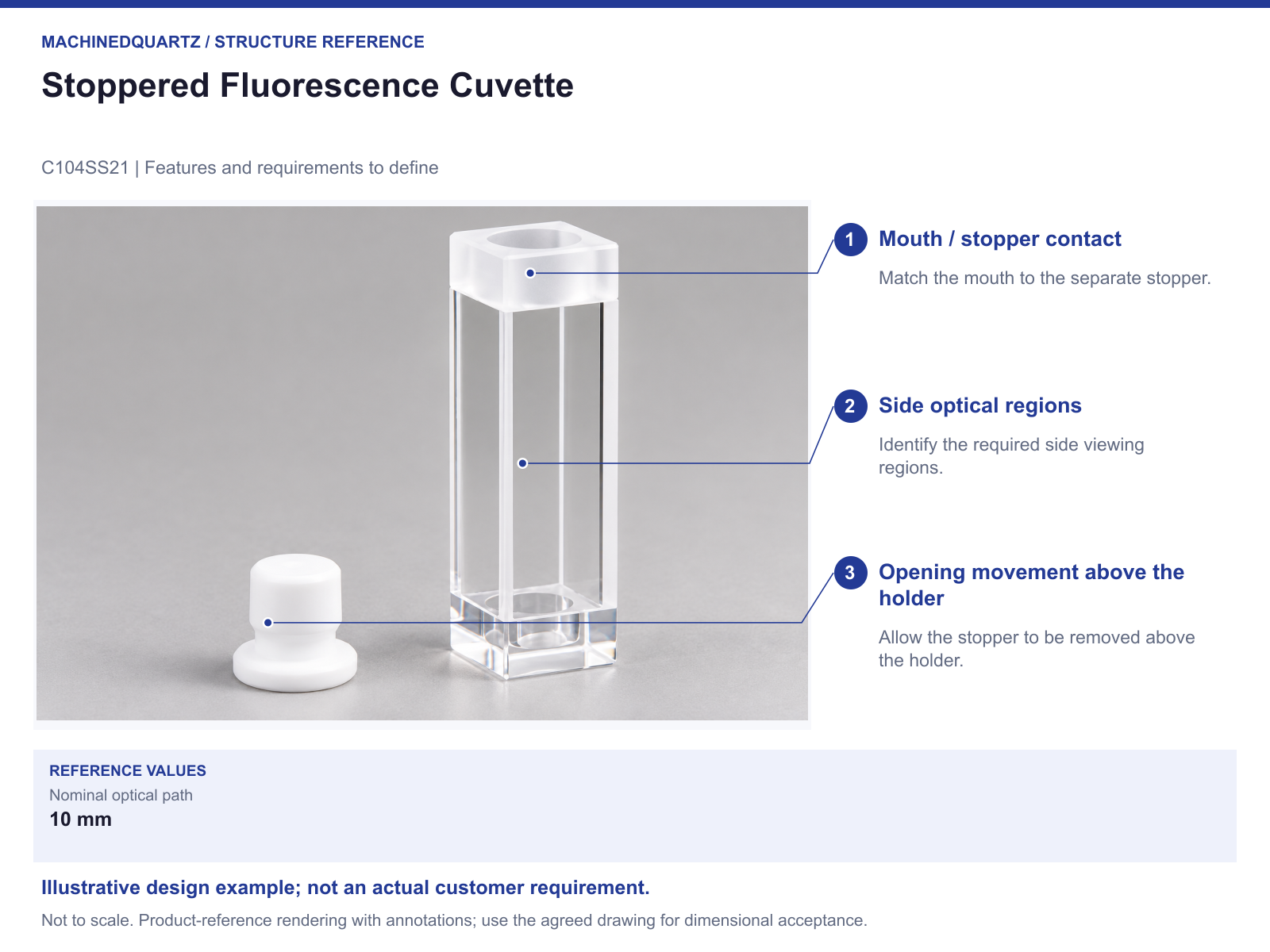
A stopper introduces a mating mouth and an opening movement above the cell. Compared with an open cuvette, the holder review must include that motion and the separate closure requirement.
Keep the optical faces clear during opening
A sample-loading procedure needs room to remove and replace the stopper without obstructing or handling the working window areas unnecessarily. Show the holder, exposed body and available space above the mouth.
For example, an instrument cover may leave enough space for the closed cell but not the lift needed to withdraw the stopper. Mark the complete opening movement rather than checking only the seated height.
Specify the stopper contact instead of a generic seal
Identify where the stopper is intended to meet the mouth and which dimensions must match. If an existing stopper must be retained, provide that part or a mating drawing. Nominal capacity and path length do not define the contact profile.
The product's configuration description includes a groove feature, but the available main view does not fully define its position or function. Do not use an assumed groove geometry in a custom drawing; request the relevant detail first.
Retain the chamber while reviewing the opening
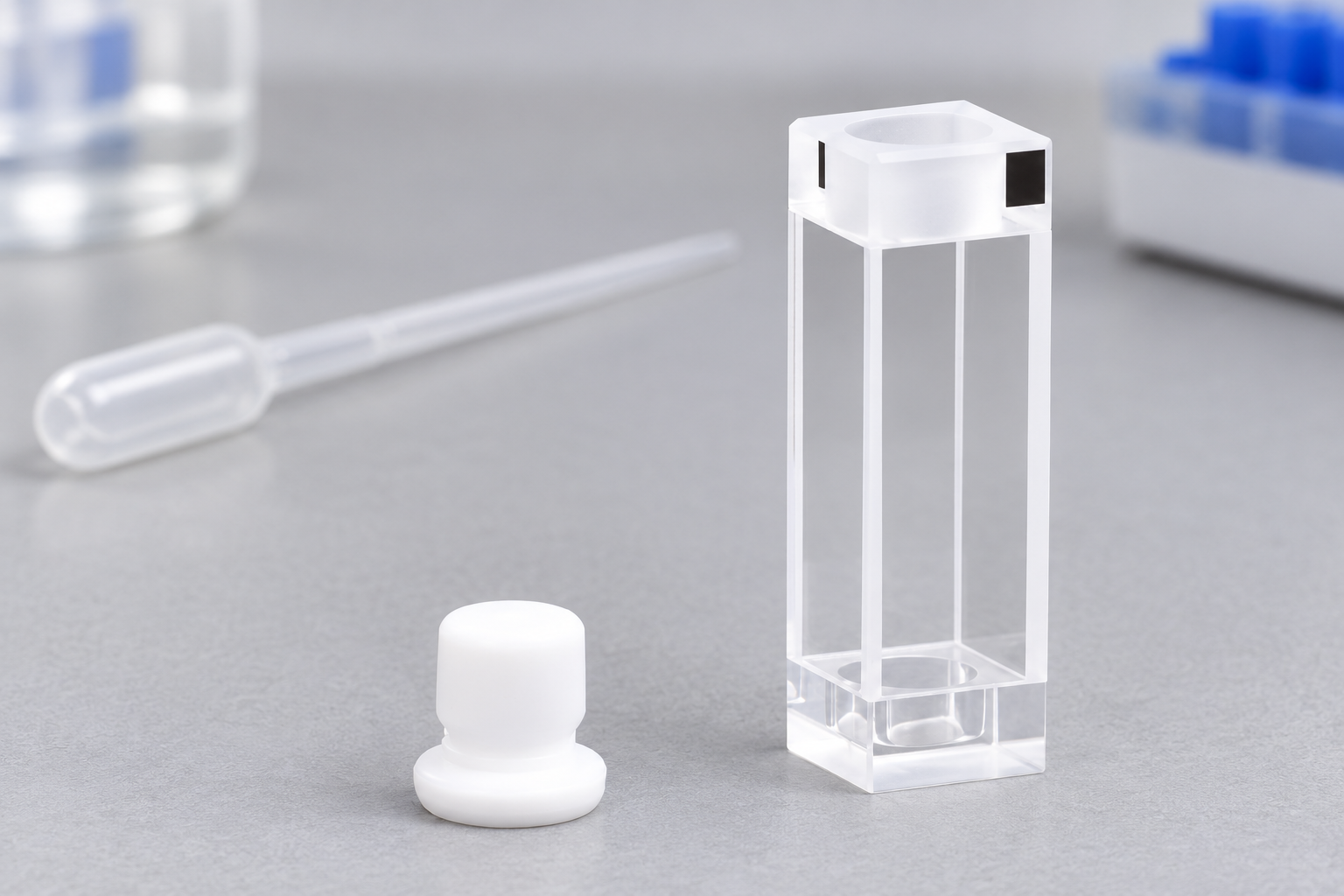
A possible custom brief is to keep the optical path and working window requirements while changing the mouth access for a particular loading tool. Show the tool envelope, stopper movement and the chamber features that must remain fixed.
The proposed opening and closure then need a joint review. A larger mouth or a different stopper does not automatically preserve the same filling, leakage or handling behaviour.
Give the sample and closure conditions together
State the sample, intended fill and any need to restrict exposure or evaporation. If leakage or another closure result matters, define the required conditions and record before quotation.
The nominal 3.5 mL capacity is not a minimum working volume, and four-side access does not establish a particular instrument fit or fluorescence result. Those requirements should be stated for the actual method.
Structure reference and specification points
Download the structure reference (PDF)
Can the stopper be replaced using only the 10 mm path specification?
No. The path describes the sample geometry, not the stopper contact. Provide the mouth and stopper details, or the actual mating part, when replacement or interchangeability is required.
Send a drawing or the mating-part details
Send the mouth detail and opening sequence with the cell enquiry. MQ can discuss the stopper and access without assigning an unverified groove or seal function.
- Nominal path and required clear-window areas
- Mouth and stopper profile or mating reference
- Loading-tool and stopper-removal space
- Working fill, sample and closure requirement
- Critical dimensions, quantity and requested checks
Modified designs are reviewed for the project. The drawing, supplied parts, quantity, inspection scope, price and preparation or production time are agreed in the quotation.
Details to settle for the ordered configuration
Groove details, contact tolerances, working volume, closure performance and instrument compatibility remain to be confirmed.



Recent Comments